
Shipping Company from Saudi Arabia to the Middle East 0506688227 — Overland Guide
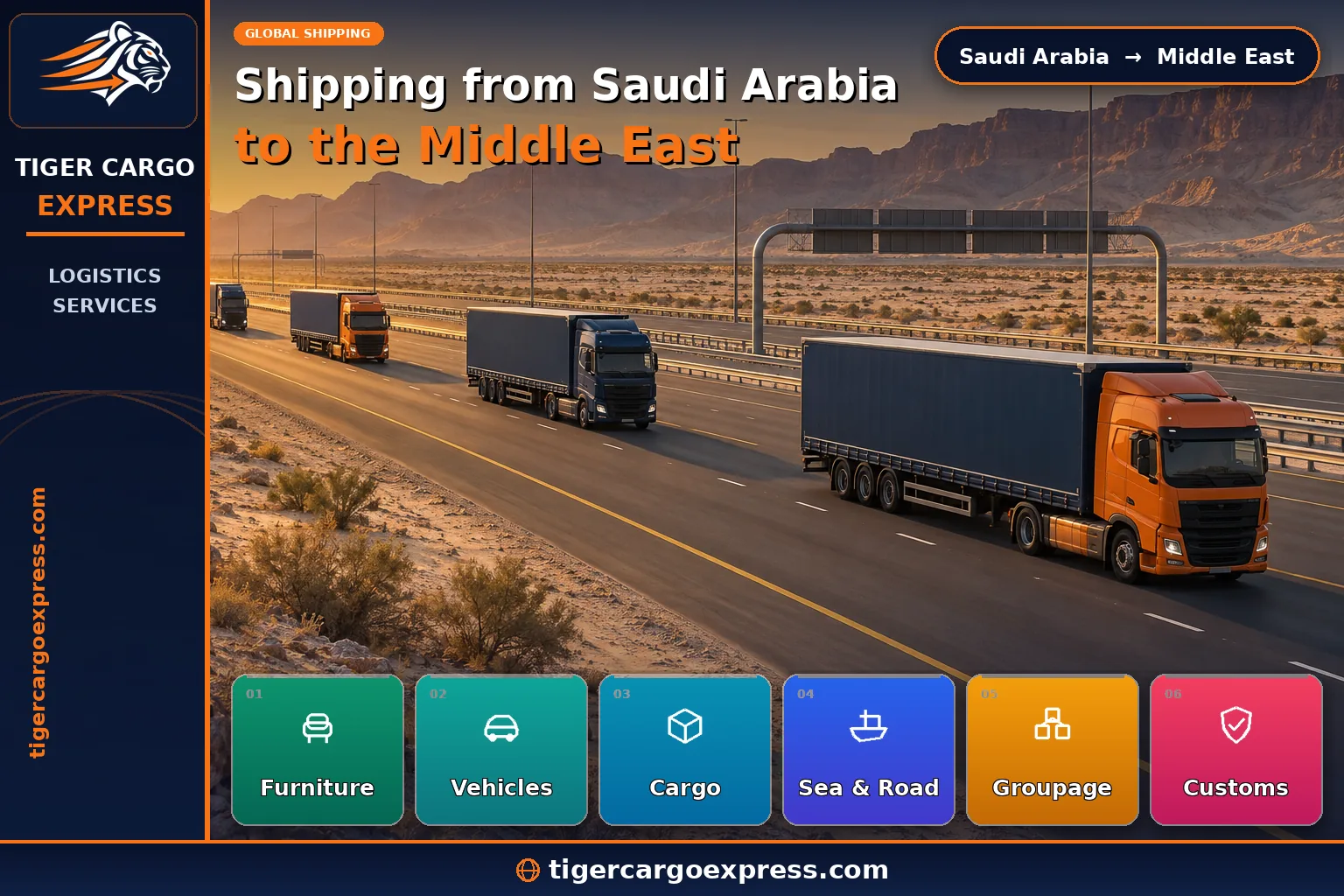
The Middle East overturns all of it: it is the only destination whose journey starts at your front door rather than at a port. Most of its countries are reached overland by a single truck — with no cut-off, no quayside handling, no demurrage and no transhipment. Two items remain: the border crossing and the heat inside the truck.
Guide contents ShowHide
Looking for a shipping company from Saudi Arabia to the Middle East that knows this destination resembles nothing that came before it? Tiger Cargo Express moves furniture, household goods, commercial cargo and vehicles to the Gulf states, the Levant, Iraq, Egypt, Türkiye and the wider region — by road, sea and air — with dismantling, packing, reassembly, clearance at the crossings and cargo insurance. To book: 0506688227
In Europe we asked about the sea, in Asia the ring, in Africa the coast, in South America the ocean, in North America the city, and in Oceania what was clinging to your shipment.
And every one of those questions revolved around a single thing: the ship.
The Middle East overturns all of it:
It is the only destination in our series whose journey starts at your front door — not at a port.
⭐⭐ Most of the region’s countries are reached overland by a single truck — loaded at your door and unloaded at the door of your new home.
No port, no quayside handling, no transhipment, and no waiting for a sailing.
⚠️ And the first question here is not “which sea?” but: which land crossing?
⭐⭐ The land crossings — the classification that actually matters
| Destination | Best mode | Borders | What sets it apart |
|---|---|---|---|
| ⭐⭐ Bahrain | Overland via the causeway | One | The only island nation we reach by road |
| ⭐ Kuwait · Qatar · UAE | Direct overland | One | Direct land borders with the Kingdom |
| ⭐ Oman | Direct overland or via the UAE | One or two | The route follows your city inside the Sultanate |
| ⭐ Jordan | Direct overland | One | The gateway to the Levant — and outside the customs union |
| Iraq | Direct overland | One | ⚠️ We review the current position before booking |
| ⭐ Egypt | A short sea leg or a long road one | Depends on the route | And the Red Sea makes it very close |
| ⭐ Türkiye | Sea, or road across several borders | Three or more by road | The northern edge — and sea is clearer on schedule |
Look back at everything we explained in the six previous guides and you will find most of their complexity came from the port stage:
▸ The cut-off — which does not exist here; the truck moves when we are ready.
▸ Quayside handling — zero here; your goods are not unloaded and reloaded.
▸ Demurrage and free days — which do not arise at all on the road route.
▸ Transhipment and waiting for the next cycle — non-existent here.
▸ The second stage after the port — here the same truck reaches your door.
⭐⭐ Which means the five riskiest items in this whole series disappear at once.
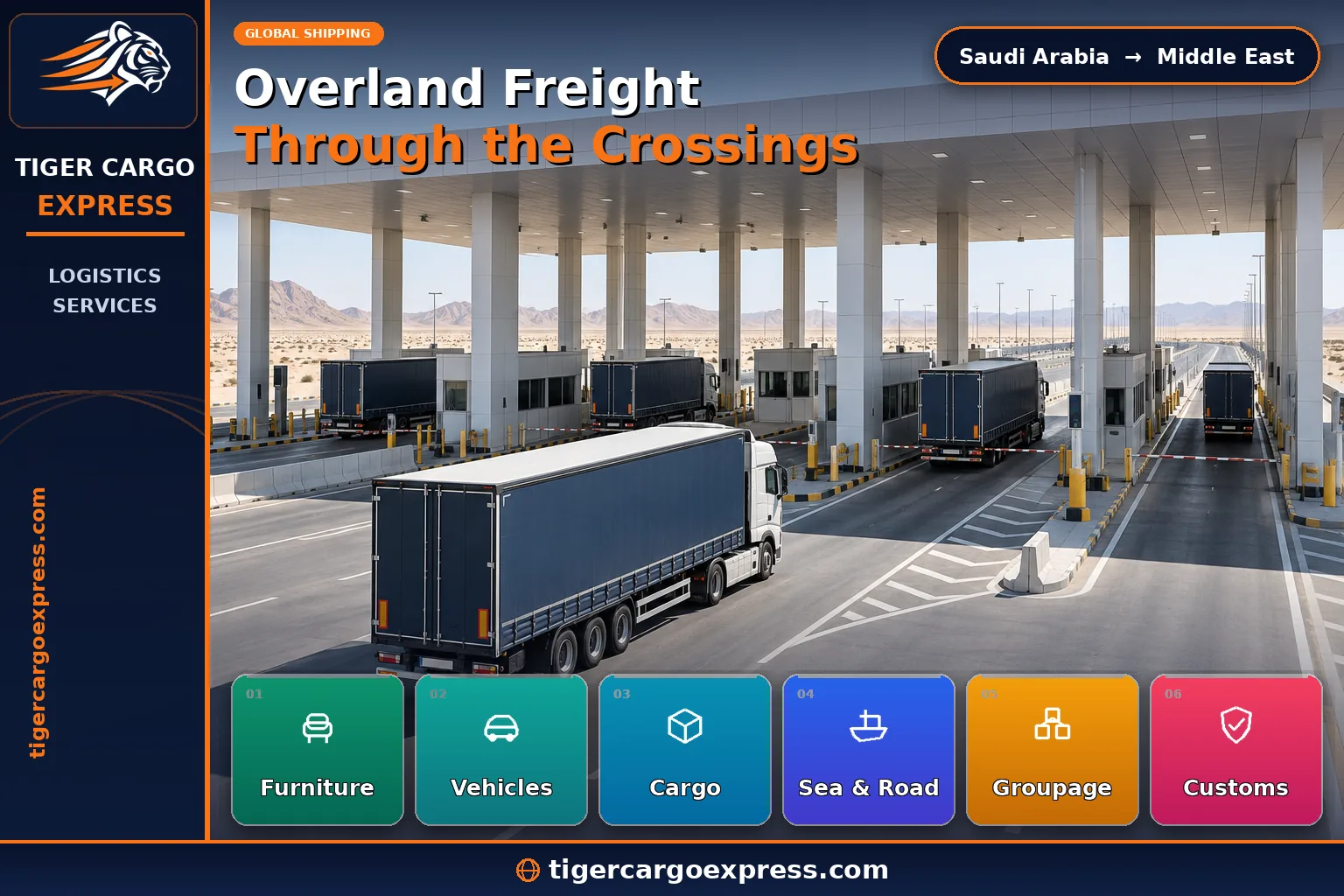
⚠️ But one item remains, and it is the most important here: the border crossing.
It is the only place your shipment may stop — and the readiness of your file decides how long it stops for.
We write into the quote: which crossing, how many borders, and the estimated duration from loading to delivery.
⭐⭐ The Gulf — at last, a real customs framework
We warned in our South America guide and our North America guide against a recurring misunderstanding: that a regional trade bloc does not mean your file is the same across all its countries.
⭐⭐ The GCC states are the one genuine exception outside Europe.
| The framework | Its effect on your file | Assessment |
|---|---|---|
| ⭐⭐ The GCC customs union | A unified tariff and a single point of entry in principle · and eased movement of goods between its states | The closest to the European model |
| ⭐ The six states | Saudi Arabia · UAE · Kuwait · Qatar · Bahrain · Oman | And all of them connected by road |
| ⚠️ What remains national | Residence, vehicle, standards and local documentation requirements | Each state has its own regime |
| ⚠️ Entirely outside the union | Jordan · Iraq · Egypt · Lebanon · Yemen · Türkiye and the rest of the region | An independent national regime for each |
⭐ And this is a large practical difference: shipping within the Gulf is procedurally simpler than shipping to any other region in the entire world — one border, a shared customs framework, and a single truck. ⚠️ But “simpler” does not mean “without conditions” — personal-effects, vehicle and standards requirements remain national, and we review them for your specific country before booking.
The Gulf states — each with its own logic
⭐ The Levant and Iraq
- ▸ ⭐ 🇯🇴 Jordan: a direct land border with the Kingdom, and a short route from Tabuk and the northern region. ⭐ It is the Levant’s logistical gateway, and the port of Aqaba is an available sea alternative. ⚠️ It sits outside the GCC customs union — so its file is independently national.
- ▸ ⭐ 🇮🇶 Iraq: a direct land border, and the road route suits most of its destinations. ⚠️ Internal distances between its north and south are substantial — we ask which city. And we review the current position and requirements before booking.
- ▸ 🇱🇧 Lebanon: reached by sea through the port of Beirut, or overland on a route crossing more than one border — and the choice changes duration and cost together, which we present as a comparison.
- ▸ ⚠️ 🇸🇾 Syria · 🇵🇸 Palestine: destinations subject to particular circumstances and requirements that change over time — we review the current position case by case before booking, and do not accept a shipment we cannot execute.
- ▸ ⭐ And one rule covers this region: all of it lies outside the GCC customs union — each country with its own regime, documents and requirements, and the file is built from scratch for each.
⭐ Egypt, Yemen, Türkiye and Iran
- ▸ ⭐⭐ 🇪🇬 Egypt: the Red Sea makes it among our nearest international destinations anywhere — the sea route from our western ports is very short. ⭐ And it has two gateways: the Red Sea and the Mediterranean — with the choice of port following where you are inside it. The road route is available too but considerably longer.
- ▸ ⭐ 🇾🇪 Yemen: a direct land border and coasts on the Red Sea and the Gulf of Aden. ⚠️ We review the current position and requirements for each destination before booking, and do not promise what we cannot execute.
- ▸ ⭐ 🇹🇷 Türkiye: the region’s northern edge — ⚠️ and the road route crosses three borders or more, so sea is clearer on schedule and less complex in most cases. ⭐ Its ports lie on the Mediterranean, the Black Sea and the Sea of Marmara — and the choice follows your city, with a large difference between Istanbul and Mersin.
- ▸ ⚠️ 🇮🇷 Iran: a destination subject to particular requirements and restrictions that change over time — we review the current position before any commitment.
- ▸ ⭐ A general note: the more borders crossed by road, the more weight the readiness of your file carries — because every crossing is a potential stopping point. Which is why we recommend sea once the borders exceed two.
⭐⭐ When road, when sea and when air?
| Aspect | Road freight | Sea freight | Air freight |
|---|---|---|---|
| ⭐⭐ When it suits you | The Gulf, Jordan and Iraq — and any destination at one or two borders | Egypt, Türkiye and Lebanon — and any destination at three borders or more | Very urgent and high-value |
| ⭐⭐ Handling stages | Two — loaded once and unloaded once | At least six | Four |
| ⭐ Scheduling | Flexible — we move when we are ready | Bound by the cut-off and the sailing cycle | Fastest, least flexible on volume |
| ⚠️ Potential stopping point | The border crossing — and it is the only one | The port, demurrage and procedures | The airport and screening |
| Pricing | Per full truck or part load | Per container or per cubic metre | By volumetric weight |
⭐ Note the red row — the clearest advantage in this whole region: handling stages are two on the road route. ⚠️ Compare with everything we explained in the earlier guides: loading at your door, unloading at the warehouse, loading onto the vessel, unloading at the port, loading onto a truck, unloading at your door — six handling stages, each one a chance of impact. ⭐ Here there are two: load and unload. And that reduces the chance of damage more than any packing measure we could take.
Car shipping in the region
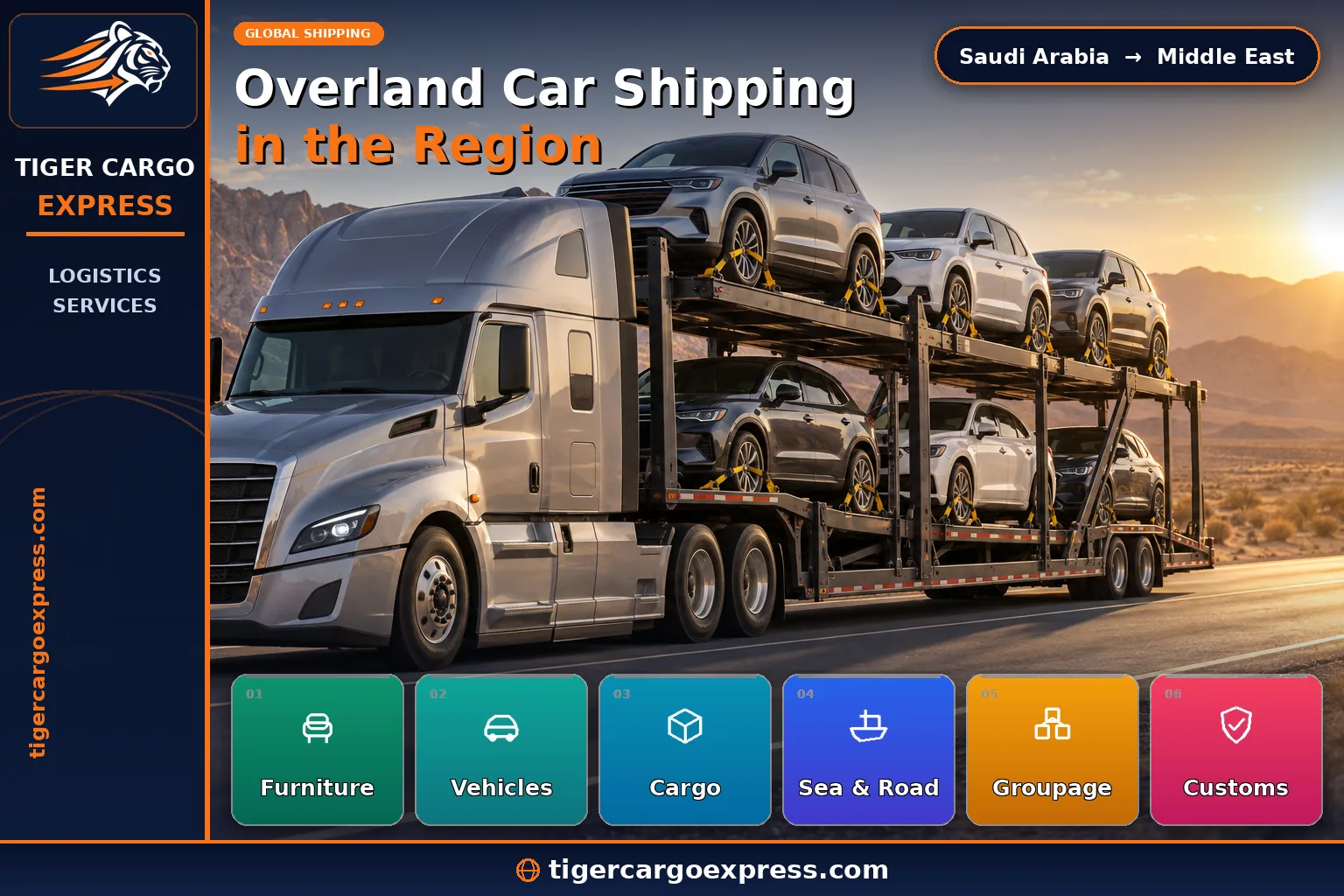
- ▸ ⭐⭐ The best news in the entire series: the steering side is fine across the whole region — driving is on the right in every country without exception, and your car was built for these markets or to similar specifications.
- ▸ ⭐ And road transport on a flatbed suits most destinations — no container, no unloading and no quayside handling, the vehicle is loaded once and unloaded once.
- ▸ ⭐ And within the Gulf specifically: the procedure is among the simplest we handle anywhere — one border and a shared customs framework. ⚠️ But registration and technical inspection requirements remain national in each state.
- ▸ ⚠️ And outside the Gulf: several countries in the region restrict used-vehicle imports with age limits or impose high duties — which we settle before booking rather than after loading.
- ▸ ⭐ And the distinction we repeated in every guide: importing is one thing and registering is another — technical inspection for local registration is entirely separate from clearance.
- ▸ And the standard steps: partially draining fuel and disconnecting the battery · four-point lashing · emptying the vehicle completely · and photographic documentation before departure, handed to you as a file.
Shipping for embassies, consulates and their staff
Shipments for diplomatic and consular missions and their accredited staff do not travel the personal-effects route and are not subject to its conditions. The basis is the standing of the mission or your accreditation to it, the reference framework is the Vienna Convention on Diplomatic Relations of 1961, and treatment is confirmed through the competent official channels. ⭐ The presence of missions and organisations in the region’s capitals is very dense, and we work in both directions.
This is a pleasant exception to what we said in the earlier guides.
On every continent we explained, we said: standing changes the path of the paperwork; it does not shorten a distance, a canal or a corridor.
⭐ Here there is no long distance, no canal and no corridor at all — the only obstacle is the procedure at the crossing.
Which means standing addresses the one remaining obstacle in full.
⚠️ But two things standing does not change:
▸ The road distance itself — the drive to a far destination remains a drive.
▸ And the readiness of the file — a mission needs a precise inventory and correct authorisation like anyone else.
We maintain full confidentiality over information, contents and movement schedules. And we say it plainly: determining what an exemption covers and how far it extends rests with the competent authorities. Our role is purely logistical.
Furniture and household goods moving from Saudi Arabia to the Middle East
The method is the same — but here the starting point is: which crossing, and which city?
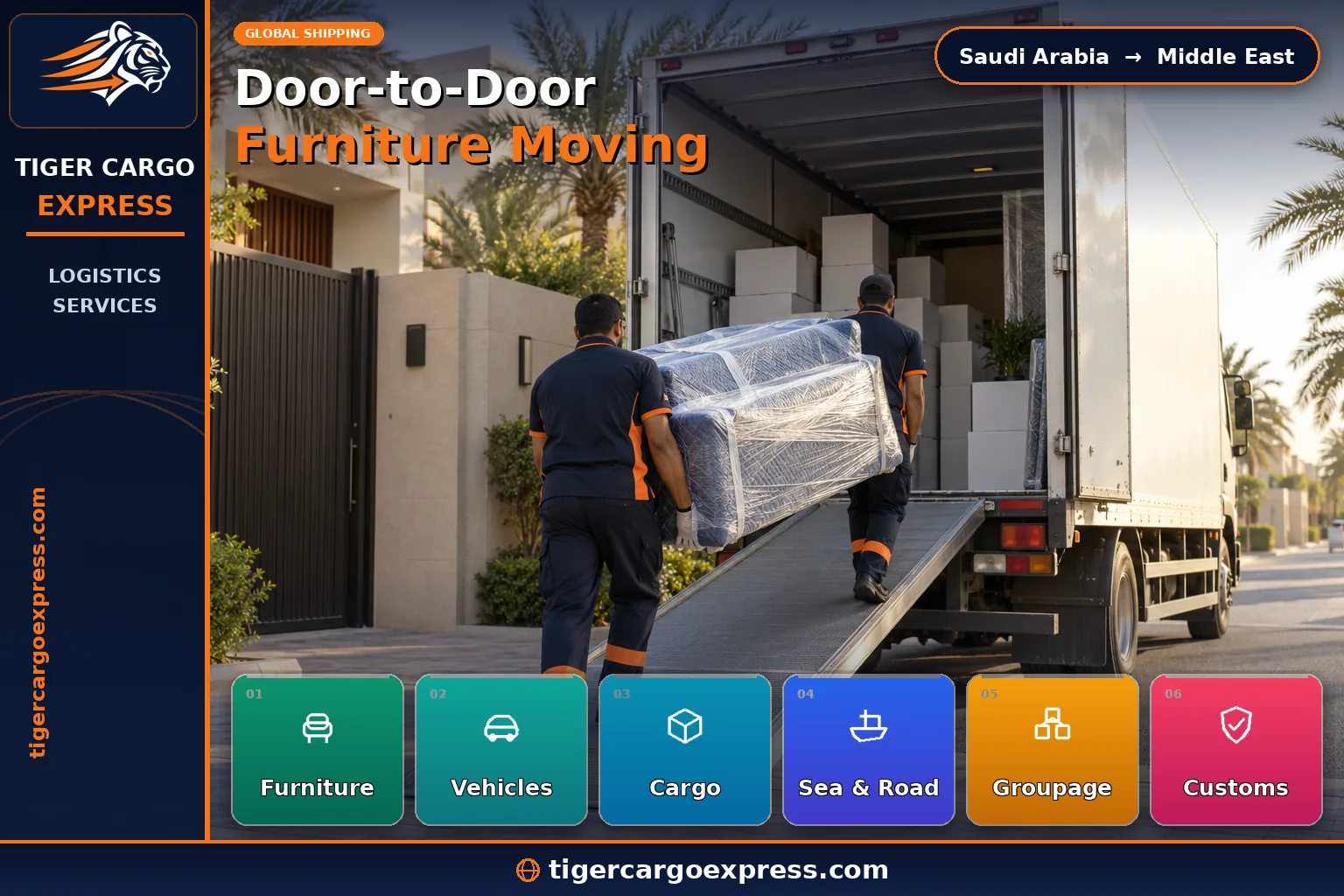
- ▸ ⭐ Naming the country and city: the internal distance is the largest item in the Gulf — and between one emirate and another, or northern and southern Oman, the difference is substantial.
- ▸ ⭐ Establishing the crossing and the border count: every border is a potential stopping point, and one border is not three.
- ▸ ⭐ A detailed itemised inventory tied to carton numbers: which is what settles how long you wait at the crossing — a general description lengthens it.
- ▸ ⭐⭐ Packing for heat and vibration: the journey is overland on desert roads in high temperatures — given a full section below.
- ▸ ⭐ And appliances here are usually shipped: voltage and plug differences between the region’s countries are slight or non-existent — the opposite of every other continent we explained, and a real saving for you.
- ▸ Dismantling, unpacking and reassembly: in your new home, with the inventory checked with you piece by piece.
⭐⭐ Heat — the one challenge here
▸ In Europe a sharp temperature swing · in Asia humidity · in Africa dust and vibration · in South America time · in North America the data · in Oceania biosecurity.
⭐ And here there is one challenge only: the heat inside the truck.
Why is it dangerous despite the short journey?
⚠️ Because the temperature inside a closed truck body standing in the sun exceeds the air temperature by a wide margin — and two hours waiting at a crossing at midday is enough.
What it does specifically:
▸ Candles, discs and adhesive tapes soften and stick — records, tapes and photographs are damaged.
▸ Batteries and electronics are affected by sustained high temperatures.
▸ Leather and upholstered furniture expands, and the glue in joints softens.
▸ And cosmetics and liquids expand and may leak.
⭐ What we do:
Scheduling departure and crossing in cooler hours where possible · thermal insulation for sensitive cartons · separating liquids and electronics into less exposed positions within the truck · and advising you to leave out what cannot take the heat at all.
⚠️ Anyone who thought a short journey removes the need for packing overlooked that heat works by the hour, not by the day.
Cities we cover
Abu Dhabi
Sharjah
Al Ain
Kuwait City
Manama
Doha
Muscat
Salalah
Sohar
Amman
Aqaba
Baghdad
Basra
Erbil
Beirut
Cairo
Alexandria
Istanbul
Mersin
Aden
Sanaa
⭐ Note Salalah and Muscat on this list: hundreds of kilometres apart within the same Sultanate — and the route to each is different. ⚠️ The same is true of Dubai and Al Ain, and of Baghdad, Basra and Erbil. The internal distance is the largest remaining item in this region — and we ask for the city, not the country.
Shipping rates from Saudi Arabia to the Middle East
| Shipment type or line item | Price | Unit and notes |
|---|---|---|
| ⭐⭐ Full truck, door to door | Request a quote — set by survey | The best option — only two handling stages |
| Part load by road | Request a quote — set by survey | Per cubic metre — and it waits for the load to fill |
| Sea container | Request a quote — set by survey | For Egypt, Türkiye and Lebanon and multi-border destinations |
| Air freight | Request a quote — set by survey | By volumetric weight — for the very urgent |
| ⭐⭐ The crossing and the border count | Both written into the quote | The only stopping point on the road route |
| ⭐ The internal distance on arrival | Written into the quote | The largest remaining item — which is why we ask for the city |
| ⭐ Thermal insulation for sensitive items | Set after the survey | For electronics, liquids and sensitive materials |
| ⭐ Vehicle file | Set after your file is reviewed | And the steering side is fine across the whole region |
⭐ Note what is missing from this table: no cut-off, no demurrage, no transhipment, no second stage and no canals — all items that filled the tables of our six previous guides. ⭐ And that is exactly what makes the Middle East the simplest work we do anywhere in the world.
Documents required
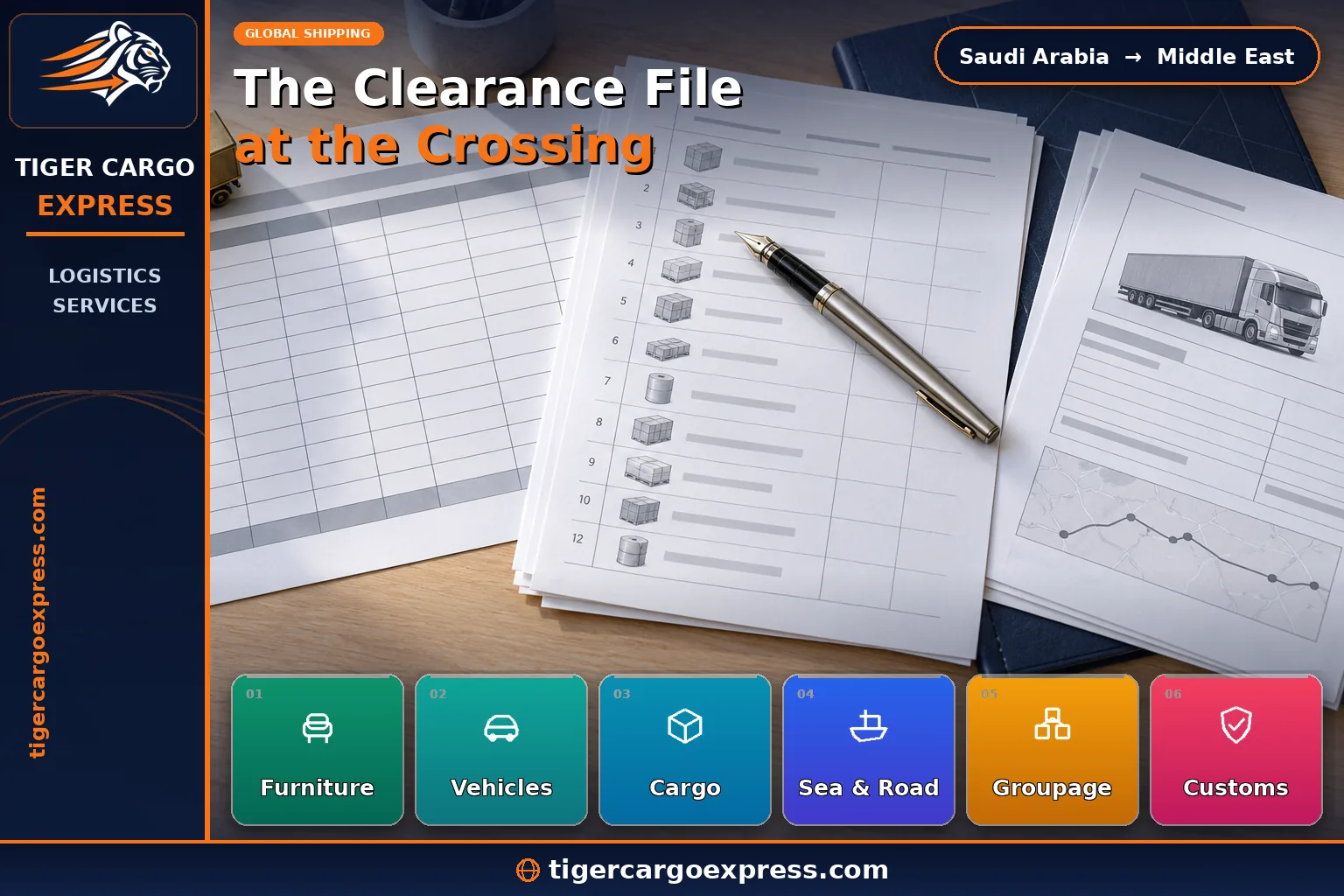
Clearance at the crossings
- ▸ ⭐⭐ The crossing is the only stopping point on the road route — and the readiness of your file decides how long the truck waits, nothing else.
- ▸ ⭐ And an itemised inventory is more useful here than in any region: the check at the crossing is quick if the description is precise — and “household furniture” is a description that lengthens the wait.
- ▸ ⭐ Within the Gulf: the procedure is streamlined by the shared customs framework — and there is only one border.
- ▸ ⚠️ Outside it: every border is an independent procedure with its own documentation — and three borders mean three procedures, not one, which is why we recommend sea then.
- ▸ ⭐ And there is no demurrage on the road route — no port and no free days to count. An item absent from this guide alone out of seven.
- ▸ We track the shipment through the crossing and notify you the moment it clears — not after arrival.
Prohibited items, insurance and delivery
- ▸ Flammable and pressurised materials: aerosols, paints, solvents, fuel and gas — excluded entirely. ⚠️ And they are more dangerous here than elsewhere because of the heat inside the truck.
- ▸ Weapons and ammunition: of every kind, subject to strict permits and regulation.
- ▸ ⭐ Materials subject to religious or regulatory restrictions: and the lists differ appreciably between the region’s countries — we review your list against the specific destination country.
- ▸ Foodstuffs and animal or plant products: subject to sanitary control at the crossing — and we advise against shipping them with household effects.
- ▸ ⭐ And insurance here is simpler than in any region: the policy covers one journey from door to door with no intermediate stages — and the question “where does the policy end?” that occupied every earlier guide does not arise. We confirm it in writing and present the clauses.
- ▸ ⭐ And delivery is usually on the day of arrival — the truck reaches your door directly, then reassembly and the inventory checked with you piece by piece.
Inland delivery on arrival
- ▸ ⭐⭐ The same truck reaches your door — no second stage and no separate inland transport, which does not recur in any other region.
- ▸ ⭐ And delivery is usually on the day of crossing — if the city is near the crossing.
- ▸ ⚠️ Distant inland cities: such as Salalah, Basra, Erbil and Upper Egypt — an extra day or more, which we write into the quote.
- ▸ ⚠️ Residential towers in Gulf cities: restrictions on unloading times and service-lift bookings — and we book the slot in advance, not on delivery day.
- ▸ ⭐ And midday heat counts at delivery too — we prefer unloading in the morning or evening for sensitive items.
- ▸ Then reassembly and the inventory checked with you piece by piece against carton numbers.
How to choose a shipping company — and what we commit to
⭐ We write the crossing and the border count into the quote.
⭐ We recommend road up to two borders, and sea beyond.
⭐ We ask for the city, not the country.
⭐ We insulate, separate and schedule crossings in cooler hours.
⭐ We write it item by item and tie it to carton numbers.
⭐ We notify you the moment it clears, not after arrival.
⭐ Air freight — when is it worth it here?
In every earlier guide, air saved weeks.
⭐ Here road is already fast — so the time gap between road and air is the narrowest in the whole series.
Which means air is worth it only in limited cases:
▸ ⭐ Documents or items that are extremely urgent — measured in hours, not days.
▸ ⭐ A destination crossing three borders or more — where air bypasses every crossing at once.
▸ ⭐ Or heat-sensitive items that cannot take a midday wait at a crossing.
⚠️ And when is it not worth it? In most Gulf cases — the truck arrives very nearly as soon, at far lower cost and with less handling.
⭐ We tell you this plainly even if you choose air — because our role is to advise you, not to sell you the more expensive option.
Our written commitments
How to reduce your shipping cost
- ▸ ⭐⭐ Choose road if your destination is at one or two borders. It is cheaper, faster and lower-handling all at once — a rare case where all three advantages coincide.
- ▸ ⭐ Ship your appliances rather than leaving them. Voltage differences between the region’s countries are slight or non-existent — the opposite of every other continent, and a real saving against buying new.
- ▸ ⭐ Write the inventory item by item from the start. It settles how long you wait at the crossing — and an hour of waiting costs more than an hour of writing.
- ▸ ⭐ Use a full truck if your shipment is medium-sized. A part load waits for the rest of the load to fill — and the price difference may not justify the wait over a short distance.
- ▸ ⭐ Leave out what cannot take the heat. Candles, discs, liquids and cosmetics are ruined by an hour of waiting — and they cost less than cleaning up what leaks.
- ▸ Consolidate into one consignment. Two batches mean two journeys and two crossings.
- ▸ ⭐ Compare the port against the road for Egypt specifically. The Red Sea makes the sea route to it very short — and sometimes cheaper than the long road one.
When do prices rise and transit times stretch?
| Situation | Where it weighs most | What we do |
|---|---|---|
| ⭐⭐ Congestion at the crossings | Seasons, holidays and vacation periods | A written margin plus scheduling crossings off-peak |
| ⭐ An incomplete file or a lumped inventory | At every crossing | An itemised inventory tied to carton numbers in advance |
| ⭐ Peak summer heat | The whole region — and sensitive materials | Thermal insulation and scheduling crossings in cooler hours |
| ⭐ A destination at three borders or more | Türkiye, Lebanon and distant destinations | We recommend sea and present the comparison in writing |
| ⭐ A long internal distance | Oman, Iraq and Egypt | We write it as its own line in the quote |
| ⚠️ Changed requirements or circumstances | Particular destinations | We review the current position before any commitment |
How we work: five steps
Five recurring mistakes — all of them avoidable
- ▸ Choosing sea for a Gulf destination. The most common error — it adds four handling stages, a cut-off and potential demurrage, in exchange for nothing.
- ▸ Writing a lumped inventory. The inventory here is what settles how long you wait at the crossing — and “household furniture” is a description that invites a check lasting hours.
- ▸ Ignoring the heat because the journey is short. Heat inside a truck standing in the sun works by the hour, not by the day — and two hours at a crossing at midday is enough to ruin sensitive goods.
- ▸ Assuming the customs union removes every condition. It unifies the tariff and eases movement — but vehicle, standards and local documentation requirements remain national.
- ▸ Quoting “Oman” or “Iraq” at one rate. Muscat to Salalah is hundreds of kilometres, and Baghdad to Basra much the same — the city decides, not the country.
⭐⭐ The seven regions in one table
⭐ With this guide our world map is complete — and here it all is:
| Region | The first question | The biggest challenge | Handling stages |
|---|---|---|---|
| Europe | Which sea? | A sharp temperature swing | Six |
| Asia | Which ring? | Sustained humidity | Six |
| Africa | Does your country have a coast? | Dust and corridor vibration | Eight if landlocked |
| South America | Which ocean? | Time — the longest voyage | Six |
| North America | Which city, not which port? | Data filed before loading | Eight with the rail leg |
| Oceania | What is clinging to your shipment? | Biosecurity | Six |
| ⭐ The Middle East | Which land crossing? | Heat inside the truck | Two only |
⭐ Note the last column — the whole series summarised in a single number: every region in the world needs six handling stages or more, and the Middle East needs two. ⚠️ And every handling stage is a chance of impact, delay and cost — which is why we say the Middle East is the simplest work we do anywhere, and that choosing sea for a Gulf destination is an unjustifiable error.
The reverse direction — into Saudi Arabia
We work in both directions on the same crossings and routes. The dominant flow: goods, equipment and spare parts from the UAE as a regional re-export hub · agricultural and food products from Jordan, Egypt and Lebanon · and industrial materials from Türkiye — alongside the household effects of movers and returnees everywhere.
⭐ And the same advantage works both ways: one truck, two handling stages, and one border in most cases. ⚠️ We review your list against Saudi import restrictions before loading, and prepare the crossing file to the same standard — because it is the only stopping point in both directions alike.
Frequently asked questions about shipping from Saudi Arabia to the Middle East
In summary
In our six previous guides the question revolved around one thing: the ship — which sea, which ring, which ocean, how many canals. The Middle East overturns all of it: it is the only destination whose journey starts at your front door rather than at a port. Most of its countries are reached overland by a single truck — with no cut-off, no quayside handling, no demurrage, no transhipment and no second stage. ⭐ And in the Gulf specifically there is a real customs framework, closer to the European model than any other bloc we have dealt with. Two items remain: the border crossing — the only stopping point — and the heat inside the truck, the one challenge. What you need here is three things: a company that recommends road or sea by counting borders rather than by habit, a quote naming the crossing and the internal distance, and an itemised inventory that shortens your wait at the crossing. Tiger Cargo Express gives you all three before you ship.
Send us your shipment details — the country and city by name, the approximate volume and your departure city — and we will come back with a detailed quote naming the crossing, the border count and the duration from loading to delivery within 60 minutes. 0506688227
See also our continental guides: Europe · Asia · Africa · South America · North America · Oceania · and our international shipping service page.
Tags:
shipping to the Middle East · moving to UAE · shipping to Kuwait · shipping to Qatar · moving to Bahrain · shipping to Oman · shipping to Jordan · shipping to Iraq · overland freight · border crossings · GCC customs union · door to door · car shipping · air freight · Tiger Cargo Express
Related Shipping Guides
Continue with practical guidance connected to the same route or shipping decision.
Furniture and Car Shipping Company from Saudi Arabia to the Gulf 0506688227
⚠️ "How much does shipping to Kuwait cost?" is a question missing three things. Shipping from Riyadh is not shipping…
Shipping Company from Saudi Arabia to Oceania 0506688227 — The Biosecurity Guide
On every preceding continent the question was: what is inside your shipment? Oceania asks an entirely different one: what is…
Shipping Company from Saudi Arabia to North America 0506688227 — Complete Guide
In Europe we asked about the sea, in Asia the ring, in Africa the coast, in South America the ocean.…
Send your shipment details and get a written quote
We reply within 60 minutes during working hours — with what the price includes and what it does not, stated before you commit.