
Shipping Company from Saudi Arabia to Oceania 0506688227 — The Biosecurity Guide
On every preceding continent the question was: what is inside your shipment? Oceania asks an entirely different one: what is clinging to the outside of it? Australia and New Zealand operate among the strictest biosecurity regimes in the world — their systems do not look for what you declared but for what you did not notice, and the consequence falls on the whole shipment rather than the piece. In return it has an advantage few know: no canal and no mandatory strait on the way.
Guide contents ShowHide
Looking for a shipping company from Saudi Arabia to Oceania that knows the world’s toughest inspection is waiting for your shipment there? Tiger Cargo Express moves furniture, household goods, commercial cargo and vehicles to Australia, New Zealand and the Pacific islands — by sea and air — with dismantling, cleaning, packing, reassembly, clearance at both ends and cargo insurance. To book: 0506688227
In Europe we asked about the sea, in Asia the ring, in Africa the coast, in South America the ocean, and in North America the data.
And in all those continents the question was, at heart, one and the same: what is inside your shipment?
Oceania asks an entirely different one:
What is clinging to the outside of it?
⭐⭐ Australia and New Zealand operate among the strictest biosecurity regimes in the world — and their systems do not look for what you declared, but for what you did not notice.
A grain of soil on the base of a plant pot · a seed in a tent fold · a dry leaf in a camping bag · a dead insect in an evaporative cooler · grass in a mower’s blades.
⚠️ And any one of these may trigger action against your entire shipment — not against that one piece.
Which is why we start here with cleaning before packing — not with volume and not with price.
⭐⭐ Biosecurity — what is actually inspected?
| The item | What the inspector looks for | What we do before packing |
|---|---|---|
| ⭐⭐ Vehicles and garden machinery | Soil in the undercarriage and tyres · plant residue · seeds | Steam-washing the undercarriage with photographic documentation |
| ⭐ Camping and outdoor gear | Soil in tent folds · dry leaves · seeds on the pegs | Full unfolding, cleaning, drying and separate packing |
| ⭐ Garden furniture and parasols | Soil in the feet and joints · insects inside the tubing | Full dismantling and cleaning inside the tubes |
| ⭐ Footwear and sports bags | Soil in the soles — a famous item, and genuinely checked | Cleaning the soles and packing separately |
| ⭐ Plant pots and dried plants | Soil in any form · dried flowers · botanical decorations | We exclude them and tell you in advance |
| ⭐ Wooden and wicker goods | Bark left on · insect traces · untreated timber | Inspection, documentation and certified treatment where needed |
| ⚠️ Vacuum cleaners and evaporative coolers | Dust and insects inside the filters — always overlooked | Emptying and cleaning the filters, or excluding the appliance |
Because the consequence here falls on the whole shipment, not on the piece.
⭐ What happens in practice when soil or plant material is found:
▸ The entire shipment may be held for detailed inspection — not that one carton.
▸ Cleaning or treatment may be required at your expense in the destination country — at several times what it would have cost here.
▸ And storage charges may accrue throughout that period.
▸ And the item may be re-exported or destroyed.
⚠️ Which means an hour of cleaning in your home before shipping may save weeks of waiting and costs that were never in the quote.
⭐ We make cleaning a declared stage in the plan — not a detail we leave to you.
And we say it plainly: biosecurity requirements are set by the competent authorities and are subject to change, and the decision to inspect or release rests with them alone. We review the current position for your destination before booking.
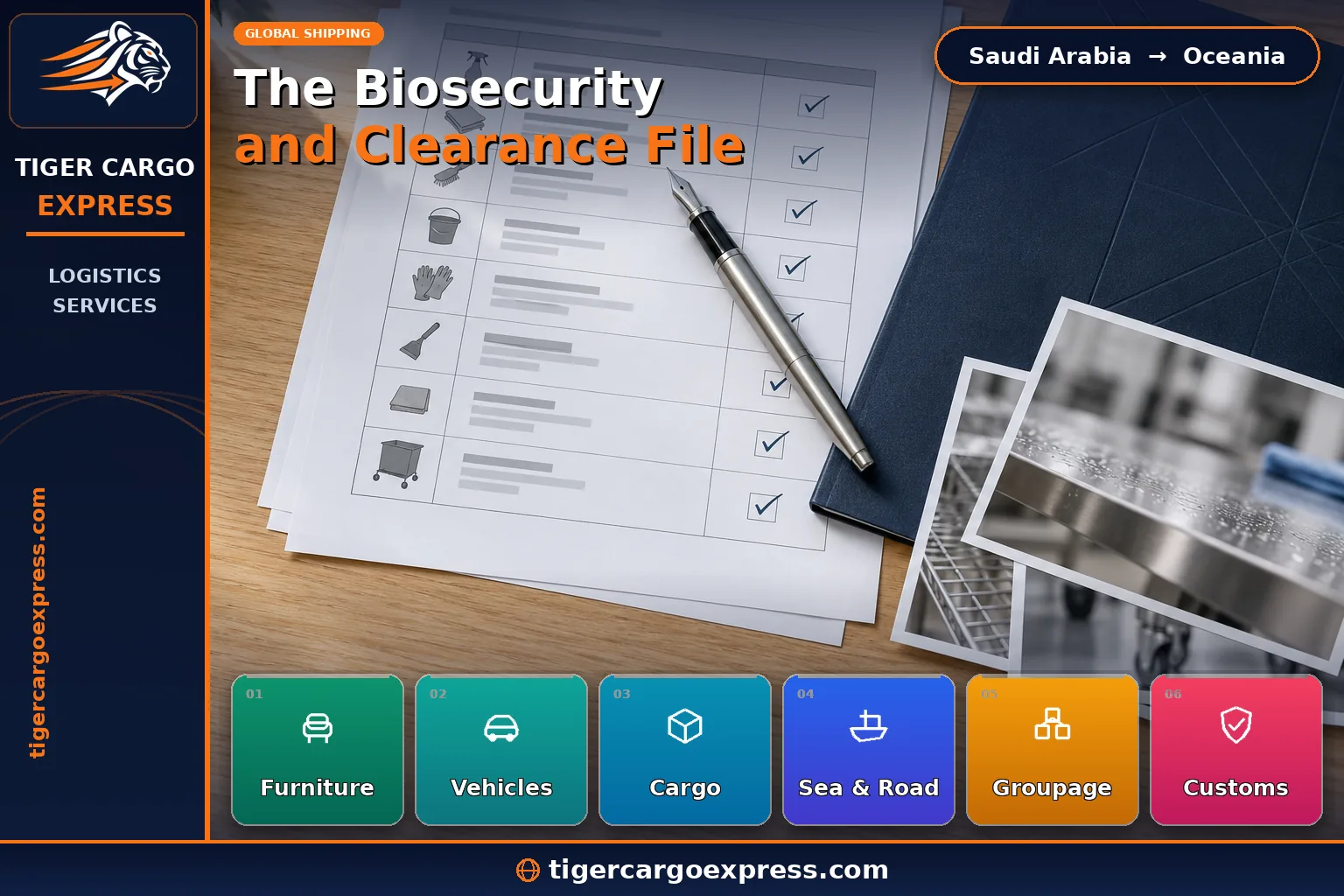
⭐ The cleaning checklist before packing
- ▸ ⭐ Everything that touched the ground is cleaned: furniture feet, chair castors, pot bases, footwear and suitcases — the most commonly overlooked of all.
- ▸ ⭐ Everything with a filter is emptied: vacuum cleaners, air conditioners and tumble dryers — and the dust inside them is usually organic.
- ▸ ⭐ Everything with folds is unfolded: tents, parasols, outdoor rugs and camping chairs — seeds hide in the folds.
- ▸ ⭐ Everything with hollow tubing is dismantled: garden furniture, bicycles and sports equipment — insects enter through the open ends.
- ▸ ⭐ Everything wooden is inspected: for bark left on or insect holes — and handicrafts and wicker attract the most attention.
- ▸ ⚠️ And what we exclude entirely: soil, planted pots, seeds, dried plants, natural decorative stems and foodstuffs of every kind — and we tell you at the survey, not on arrival.
- ▸ ⭐ And photographic documentation of what we cleaned: handed to you as a file — useful to you if evidence is requested.
⭐ The route — an advantage few people know
Many assume Oceania — the furthest away in the mind’s eye — must be the hardest to route.
⭐ In routing terms the truth is the opposite:
The vessel leaves our ports and heads south-east across the Arabian Sea and the Indian Ocean straight to Western Australia.
▸ ⭐ No Suez Canal — unlike Europe and both Americas.
▸ ⭐ No Panama Canal — unlike the American Pacific coast.
▸ ⭐ And no mandatory strait — the Indian Ocean is open to the south, and the route to Western Australia does not pass through Malacca at all.
This is the same advantage we explained in our Asia guide for the south of that continent — and it extends here.
⚠️ But the constraint moves from the route to two other things:
▸ The distance itself — and reaching Australia’s east coast and New Zealand means rounding the continent or its southern edge.
▸ ⭐ And the inspection on arrival — the longest we handle anywhere in the world, and it must be counted into the schedule rather than assumed away.
We write the estimated duration and the expected inspection allowance into the quote — not the sailing time alone.
The two major countries
→ Full article: shipping to Australia
→ Full article: shipping to New Zealand
⭐ The Pacific islands
- ▸ ⭐ 🇫🇯 Fiji: the main transhipment hub for the Pacific islands — many smaller destinations are served from it, so frequency to it is the highest in the region.
- ▸ ⭐ 🇵🇬 Papua New Guinea: the largest island nation by area and population, with ports on the Pacific. ⚠️ And internal distances and mountainous terrain are real factors in delivery.
- ▸ 🇼🇸 Samoa · 🇹🇴 Tonga · 🇻🇺 Vanuatu · 🇸🇧 Solomon Islands: served by transhipment from Fiji, Australia or New Zealand — ⚠️ and missing the cut-off here means waiting two cycles, not one.
- ▸ ⭐ 🇳🇨 New Caledonia · 🇵🇫 French Polynesia: French overseas territories — with a customs position fundamentally different from their neighbours’, reviewed case by case.
- ▸ ⭐⭐ And one rule covers all the islands: biosecurity is strict there too — not in Australia and New Zealand alone. Island ecosystems are fragile, and the controls over them are tight.
- ▸ ⭐ And the packing is designed for marine humidity and salt — over a period that includes a transhipment stage, with metals and electrical contacts suffering first.
⚠️ And we say it plainly: every country and territory on this continent has its own independent national system — and there is no unified customs framework binding them. We review the current position for your specific destination before booking, and we do not accept a shipment we cannot execute.
⭐⭐ Car shipping — cleaning before shipment
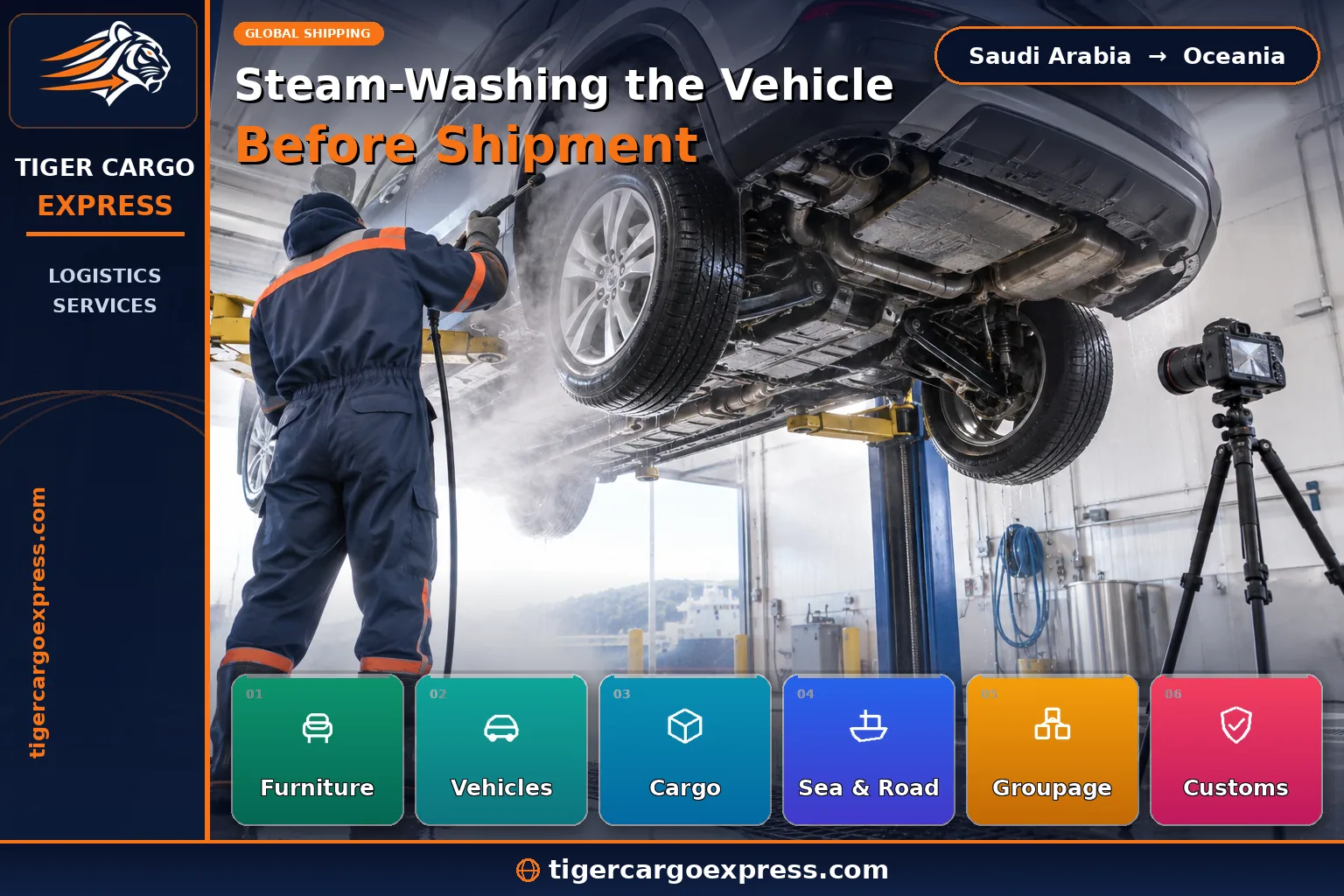
- ▸ ⭐⭐ Cleaning is mandatory, not optional: a vehicle from a desert environment carries soil in the undercarriage, the wheel arches and the engine bay — and that is the first thing inspected.
- ▸ ⭐ And what we clean specifically: the undercarriage by steam · the wheel arches, tyres and their treads · the engine bay · the boot and under the carpets · and the air and cabin filters.
- ▸ ⭐ And photographic documentation after cleaning and before sealing — handed to you as a file.
- ▸ ⚠️ And the steering side: driving is on the left in Australia, New Zealand and most Pacific islands — so your Gulf car becomes a “reversed wheel” across virtually the whole continent.
- ▸ ⚠️ And import approval: bringing vehicles into Australia and New Zealand is subject to defined routes and prior approvals with specific conditions — which we review for your destination before booking, not after shipping.
- ▸ ⭐ And the distinction overlooked here as everywhere: importing is one thing and registering is another — technical conformity for local registration is an entirely separate matter.
- ▸ And the standard steps: draining fuel and disconnecting the battery · emptying the vehicle completely — because personal items inside complicate the biosecurity inspection.
⭐ The reversed seasons — a real scheduling factor
Oceania is in the southern hemisphere — its summer is our winter and its winter our summer.
⭐ What follows in practice:
▸ Peak shipping season there falls in different months from the ones you are used to — and the end of the year is a peak, not a quiet period.
▸ ⭐ And your shipment crosses from Gulf heat into a southern summer or a mild winter — so the temperature swing here is less severe than to Europe, which works in your favour.
▸ ⚠️ But the humidity of the tropics along the way works throughout the crossing — and we pack for it as explained in our Asia guide.
▸ ⭐ And your own arrival timing needs planning: moving for the start of the school year there is not our timing.
We calculate your estimated arrival by season, not by month alone — because the seasonal difference is six months.
Shipping for embassies, consulates and their staff
Shipments for diplomatic and consular missions and their accredited staff do not travel the personal-effects route and are not subject to its conditions — neither residence periods nor vehicle restrictions. The basis is the standing of the mission or your accreditation to it, the reference framework is the Vienna Convention on Diplomatic Relations of 1961, and treatment is confirmed through the competent official channels. We work in both directions.
We have said in every guide that standing changes the path of the paperwork, not the geography.
⚠️ Here it goes further: biosecurity requirements are not a customs procedure but an environmental protection one — and their logic differs from the logic of exemptions.
⭐ Which means in practice:
▸ A mission’s shipment is cleaned before loading like any other.
▸ And a mission’s vehicle is steam-washed from underneath and photographically documented.
▸ And soil and plant material are excluded from a mission’s file as from any client’s.
⚠️ Anyone who promised a mission that standing exempts it from cleaning promised something they do not control.
We put the same cleaning stage and the same margins into a mission’s file as into any client’s — and maintain full confidentiality over information, contents and movement schedules.
And we say it plainly: determining what an exemption covers and how far it extends rests with the competent authorities, and the mission has its own official channels. Our role is purely logistical.
Furniture and household goods moving from Saudi Arabia to Oceania
The method is the same — but here the starting point is cleaning before packing.
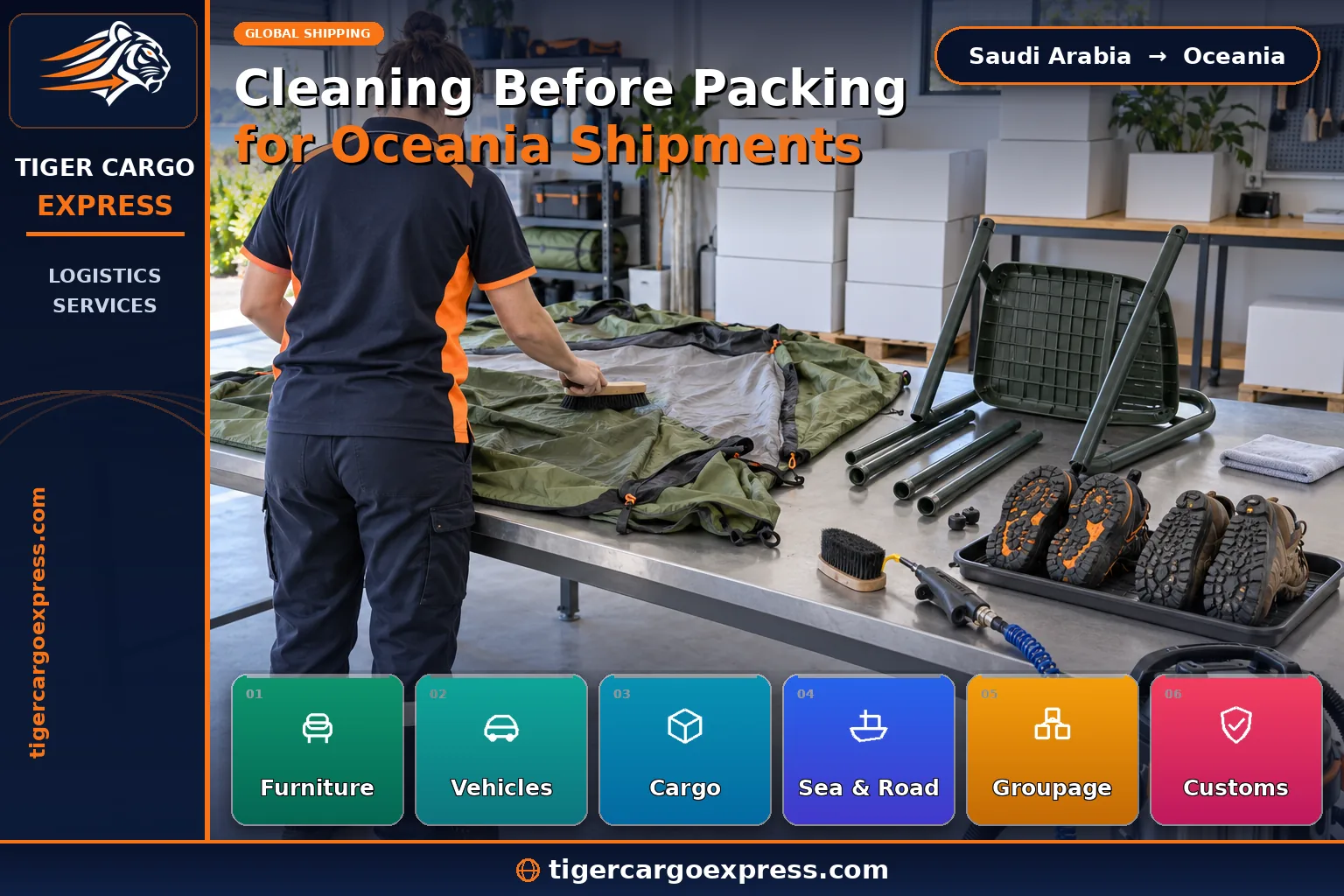
- ▸ ⭐⭐ Sorting what needs cleaning first: the first thing we do at the survey — before the volume and before the price, deciding what is cleaned and what is excluded.
- ▸ ⭐ Naming the country and the state or island: Australia is a continent, New Zealand is two islands, and the islands are served by transhipment.
- ▸ ⭐ A detailed itemised inventory tied to carton numbers: doubly useful here — because a likely inspection targets specific cartons rather than the whole shipment if the numbering is precise.
- ▸ ⭐ Separating likely-inspected items into their own cartons: camping gear, garden furniture, footwear and wooden goods — so those are opened and nothing else.
- ▸ Reviewing appliances before shipping: voltage and plug differences — and emptying the filters if they are shipped.
- ▸ Packing for humidity and duration: interior sealing and absorbents — because the route crosses tropical zones.
- ▸ Dismantling, unpacking and reassembly: in your new home, with the inventory checked with you piece by piece.
⭐ What is not worth shipping at all
⭐ A section we write for this continent specifically — because the cost of a mistake here is measured not in freight but in delaying the whole shipment.
- ▸ ⚠️ Pots, plants and soil in any form: even an empty pot that has been used before — and soil is the most common cause of detention.
- ▸ ⚠️ Foodstuffs, seeds, spices and herbs: even commercially packaged — we exclude them all.
- ▸ ⚠️ Natural decorations: dried flowers, stems, shells, feathers and untanned hides — all of them biological material.
- ▸ ⭐ Appliances that will not run on the grid there: voltage and plug differences are significant — and they take up volume while raising the chance of inspection through their filters.
- ▸ ⭐ Old garden equipment: mowers, tools and hoses — cleaning them to an acceptable standard may cost more than they are worth, and we say so plainly.
- ▸ ⭐ And the rule we give every client: if the item is cheap and hard to clean, leave it — its price there is less than the cost of the risk.
Full container, shared consignment or air?
| Aspect | Full container | Shared (LCL) | Boxes or air |
|---|---|---|---|
| When it suits you | A full home or a commercial batch | One or two rooms plus appliances | Selected items and urgent cargo |
| ⭐⭐ With the biosecurity inspection | Better by a wide margin — your shipment is inspected alone and the result is yours alone | ⚠️ A co-loader’s breach can hold up the whole container — and your shipment with it | Fastest to inspect — less volume |
| ⭐ To the islands | Transhipped as one unit | Broken down then rehandled at the hub | Bypasses transhipment entirely |
| ⭐ Against tropical humidity | One environment whose packing and ventilation we control | Individual packing matters far more | Least exposed |
| Pricing | Fixed rate plus the cleaning stage | Per cubic metre with a minimum | Per box or by volumetric weight |
⭐ Note the red row — the strongest case for a full container in the entire series: on this continent, a co-loader’s goods carrying soil or plant material may hold up the whole container — and your clean shipment waits with it. ⚠️ That is a risk you cannot control, however thoroughly you cleaned your own goods. We explain it plainly before you choose — not after you are detained.
Cities we cover
Melbourne
Brisbane
Perth
Adelaide
Canberra
Darwin
Hobart
Auckland
Wellington
Christchurch
Tauranga
Suva
Lautoka
Port Moresby
Apia
Nuku’alofa
Port Vila
Honiara
Nouméa
⭐ Note Perth and Sydney on this list: a whole continent’s width lies between them — Perth sits directly on the Indian Ocean and is the nearest to us, while Sydney is on the Pacific and needs a passage around the continent or its southern edge. ⚠️ The difference between them in duration and cost is very substantial — and anyone who quoted you “Australia” at one rate did not ask which state.
Shipping rates from Saudi Arabia to Oceania
| Shipment type or line item | Price | Unit and notes |
|---|---|---|
| Boxes and small consignments | Request a quote — set by survey | Per box or by weight |
| Shared consignment (LCL) | Request a quote — set by survey | Per cubic metre — ⚠️ and you carry a co-loader’s risk |
| 20 / 40 ft container | Request a quote — set by survey | Better by a wide margin with the biosecurity inspection |
| Air freight | Request a quote — set by survey | By volumetric weight — and it bypasses transhipment to the islands |
| ⭐⭐ The pre-shipment cleaning stage | Set after the survey | A line with no equivalent on any other continent |
| ⭐ Vehicle steam-washing and documentation | Set after your file is reviewed | Mandatory, not optional |
| ⭐ The port and the state or island | Both written into the quote | A continent’s width lies between Perth and Sydney |
| ⭐ The transhipment stage | Set in the quote, by your destination | For the islands — with a heavier cut-off |
| ⚠️ The expected inspection allowance | A written margin in the quote | We count it into the schedule rather than assume it is zero |
⭐ Note the red row and the last one: “the cleaning stage” and “the expected inspection allowance” are lines we have put in no other continental guide — because they exist only where biosecurity is the first factor. ⚠️ Anyone who did not name them quoted you a journey while ignoring its first stage and its final allowance.
Documents required
Clearance, inspection and demurrage
- ▸ ⭐⭐ Inspection here is a high probability, not an exception: and we plan for it in the schedule rather than assume it away — a fundamental difference from every other continent.
- ▸ ⭐ And precise numbering saves you a great deal: the camping and garden cartons are opened rather than the whole shipment if the inventory is tied to their numbers.
- ▸ ⭐ And we use a closure that reseals without damage: because a carton opened for inspection must close again undamaged.
- ▸ ⚠️ And demurrage starts at discharge, not at the end of the inspection — which is why cleaning in advance is not a luxury but a direct saving.
- ▸ We handle clearance at both ends and report the free days to you in writing.
- ▸ ⭐ And the prohibitions here are wider than on any continent: alongside the usual list — flammables, weapons and protected species products — all the biological material listed above is added.
Insurance and inland delivery
- ▸ ⭐ We confirm in writing that cover extends through to delivery — not merely to the port, and we present clauses rather than headings.
- ▸ ⚠️ And we flag a point specific to this continent: damage arising from an official cleaning or treatment procedure on arrival is not usually treated as transit damage — a further reason for the cleaning to happen here.
- ▸ ⭐ And internal distances in Australia are enormous: delivery to an inland city is a substantial road stage, which we write into the quote.
- ▸ ⭐ And in New Zealand: a South Island destination may mean a ferry after the port — a declared line.
- ▸ ⭐ And in the islands: a transhipment stage then a boat or a truck — planned from the start rather than after arrival.
- ▸ And checking the inventory at delivery: piece by piece against carton numbers.
How to choose a shipping company — and what we commit to
⭐ We make it a declared stage and document it photographically.
⭐ We tell you at the survey, not on arrival.
⭐ We steam-wash and document before sealing.
⭐ We write the port and the state into the quote.
⭐ We build a written margin for it.
⭐ We explain this risk before you choose.
Our written commitments
⭐ Air freight — when is it worth it here?
▸ ⭐⭐ When your destination is a small island. Air bypasses the transhipment stage entirely — and with it the double cut-off that can mean waiting two cycles.
▸ ⭐ When the volume is small and clean. Less volume means a faster inspection — and the inspection here is the longest we handle anywhere.
▸ ⭐ When your arrival is tied to the start of a school year or a work contract. The seasons are reversed, and the calendar there does not follow ours.
⚠️ And when is it not worth it? When the volume is large — pricing by volumetric weight makes bulky furniture expensive without justification.
⭐ We put both options in one table by duration, cost and expected inspection allowance — and we do not recommend one before we know your destination and your volume.
How to reduce your shipping cost
- ▸ ⭐⭐ Clean before you pack — the single biggest saving on this continent. An hour of cleaning in your home may save weeks of detention and treatment costs in the destination country.
- ▸ ⭐ Leave behind what is cheap and hard to clean. Old garden equipment, plant pots and outdoor rugs cost less there than the risk of bringing them.
- ▸ ⭐ Choose a full container if your shipment is large. You insulate yourself from co-loaders whose cleanliness you cannot control.
- ▸ ⭐ Separate likely-inspected items into their own numbered cartons. So one carton is opened rather than ten — saving both time and damage.
- ▸ ⭐ Settle the vehicle import approval before any planning. Shipping a vehicle that cannot be imported over this distance is a double loss.
- ▸ ⭐ Use Perth’s proximity if your destination is in the west. Australia’s western seaboard is appreciably nearer to us — and we compare for you.
- ▸ Consolidate into one consignment. Two batches mean two cleaning stages and two possible inspections.
When do prices rise and transit times stretch?
| Situation | Where it weighs most | What we do |
|---|---|---|
| ⭐⭐ Inspection finding soil or plant material | The harshest factor on this lane by far | We prevent it through cleaning and prior exclusion |
| ⚠️ A co-loader’s breach in a shared container | LCL alone | We explain the risk and compare with a full container |
| ⭐ Southern peak season | The end of the year — a peak there | We book early and give you a specific cut-off |
| ⭐ An east-coast destination | Sydney, Brisbane and New Zealand | We state the transit plainly and compare with the west |
| ⭐ An island destination by transhipment | The Pacific islands | We confirm the cut-off — missing it costs two cycles, not one |
| ⚠️ A vehicle without import approval | Australia and New Zealand | We review the route and the approval before booking |
How we work: five steps
Five recurring mistakes — all of them avoidable
- ▸ Treating cleaning as a detail. The most common and most expensive error — the consequence here falls on the whole shipment, and treatment costs in the destination country are several times what they would be here.
- ▸ Shipping garden and camping gear as it is. Soil in a tent’s folds, a mower’s blades and garden furniture feet are the most common causes of detention.
- ▸ Including biological material thinking it is decoration. Dried flowers, shells, stems and feathers are all biological material — even framed on a wall.
- ▸ Quoting “Australia” at one rate. A whole continent’s width lies between Perth and Sydney — the state decides, not the country.
- ▸ Assuming an Australia file works for New Zealand. Their biosecurity regimes are entirely independent and equally strict or stricter.
⭐⭐ The six continents in one table
⭐ With this guide our continental series is complete — and here it is, summarised in a single table:
| Continent | The first question | The biggest challenge | Canals |
|---|---|---|---|
| Europe | Which sea does your port sit on? | A sharp temperature swing | One |
| Asia | Which ring is your destination in? | High sustained humidity | Zero |
| Africa | Does your country have a coast at all? | Dust and long-road vibration | Zero for the east |
| South America | Which ocean? | Time itself — the longest voyage | One or two |
| North America | Which city — not which port? | Data filed before loading | One or two |
| ⭐ Oceania | What is clinging to the outside of your shipment? | Biosecurity — the strictest on earth | Zero |
⭐ And what unites all six continents is a single conclusion: what stops shipments is not the sea but the preparation. ⚠️ Anyone who quoted you “a continent” without asking you its first question did not quote your journey.
The reverse direction — from Oceania to Saudi Arabia
We work in both directions on the same ports and routes. The dominant flow: agricultural produce, dairy, meat and wool from Australia and New Zealand · minerals and industrial goods from Australia · and agricultural produce from the islands — alongside returnees’ household effects everywhere.
⭐ And the constraints work in reverse differently here: biosecurity is a restriction on what enters Oceania, not on what leaves it — which means the return journey is procedurally simpler than the outbound one, a difference with no equivalent on any other continent. ⚠️ But Saudi import restrictions apply in the reverse direction, and we review your list against them before loading. And we confirm the cut-off at the port before fixing the consolidation date — not the other way round, especially where the shipment comes from an island served by transhipment.
Frequently asked questions about shipping from Saudi Arabia to Oceania
In summary
With this guide our continental series is complete. On every preceding continent the question was, at heart: what is inside your shipment? Oceania asks an entirely different one: what is clinging to the outside of it? Australia and New Zealand operate among the strictest biosecurity regimes in the world — and their systems do not look for what you declared but for what you did not notice, with the consequence falling on the whole shipment rather than the piece. And in return it has a routing advantage many do not know: no canal and no mandatory strait on the way. What you need here is three things: a company that makes cleaning a declared stage rather than a detail left to you, a quote naming the cleaning stage and the expected inspection allowance, and someone who tells you what is not worth shipping before you pay to ship it. Tiger Cargo Express gives you all three before you ship.
Send us your shipment details — the country and the state or island by name, the approximate volume, your departure city, and whether it includes a vehicle or garden or camping equipment — and we will come back with a detailed quote naming the cleaning stage and the inspection allowance within 60 minutes. 0506688227
See also our Australia article · New Zealand article · and our international shipping service page.
Tags:
shipping to Oceania · shipping to Australia · furniture moving New Zealand · biosecurity · quarantine · pre-shipment cleaning · vehicle steam wash · Pacific islands · Fiji · transhipment · reversed seasons · sea freight · air freight · FCL · Tiger Cargo Express
Related Shipping Guides
Continue with practical guidance connected to the same route or shipping decision.
Furniture and Car Shipping Company from Saudi Arabia to the Gulf 0506688227
⚠️ "How much does shipping to Kuwait cost?" is a question missing three things. Shipping from Riyadh is not shipping…
Shipping Company from Saudi Arabia to the Middle East 0506688227 — Overland Guide
The Middle East overturns all of it: it is the only destination whose journey starts at your front door rather…
Shipping Company from Saudi Arabia to North America 0506688227 — Complete Guide
In Europe we asked about the sea, in Asia the ring, in Africa the coast, in South America the ocean.…
Send your shipment details and get a written quote
We reply within 60 minutes during working hours — with what the price includes and what it does not, stated before you commit.