
Shipping Company from Saudi Arabia to North America 0506688227 — Complete Guide
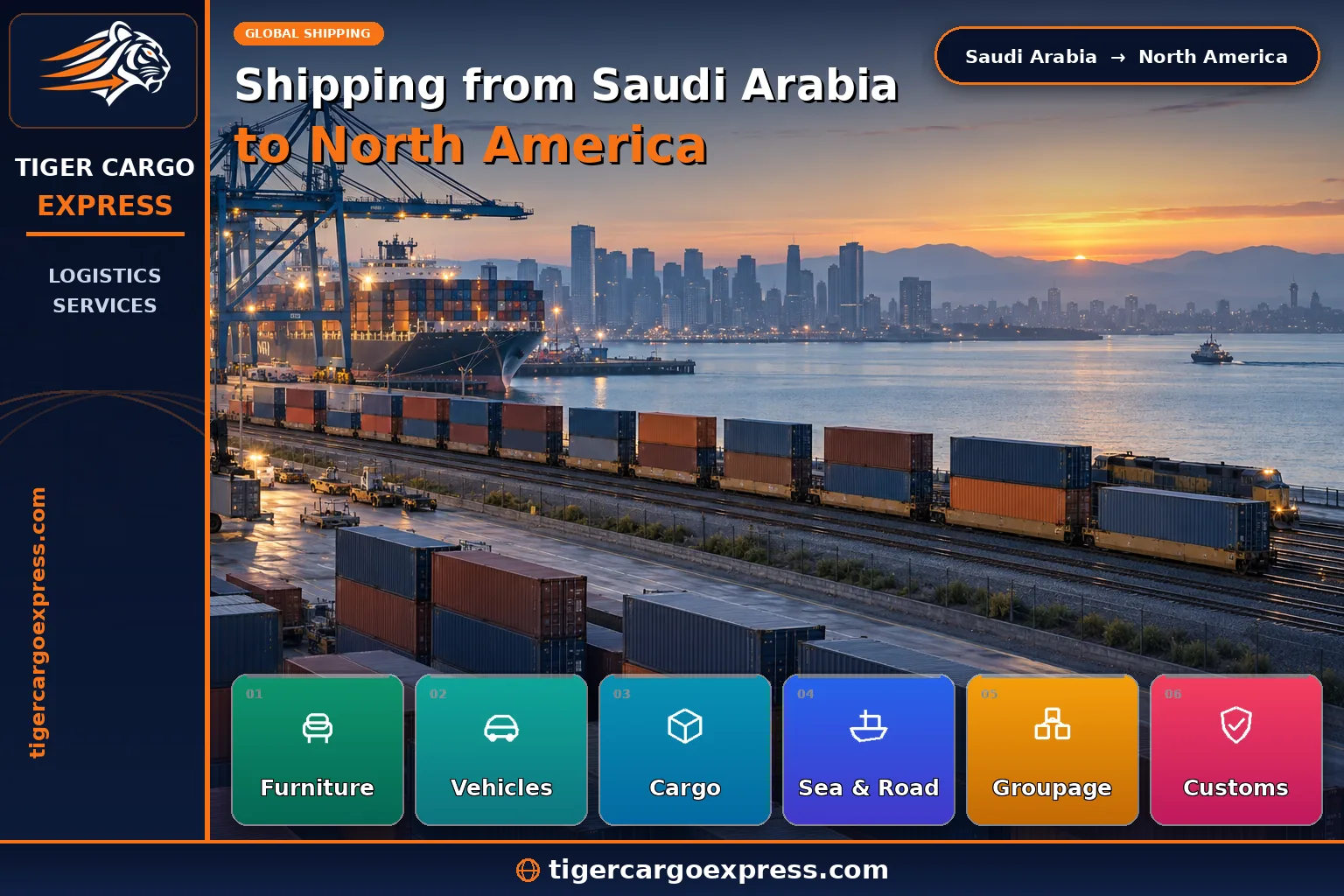
In Europe we asked about the sea, in Asia the ring, in Africa the coast, in South America the ocean. North America does not ask a new question — it inverts three rules: your shipment's data is filed before it is loaded, not before it arrives · your car's age may permit import rather than block it · and the port is not the decision but the inland delivery point, thanks to the land bridge.
Guide contents ShowHide
Looking for a shipping company from Saudi Arabia to North America that knows this continent inverts the rules you learned elsewhere? Tiger Cargo Express moves furniture, household goods, commercial cargo and vehicles to the United States, Canada, Mexico, Central America and the Caribbean — by sea and air — with dismantling, professional packing, reassembly, clearance, advance filing and cargo insurance. To book: 0506688227
In Europe we asked: which sea? In Asia: which ring? In Africa: does your country have a coast? In South America: which ocean?
North America does not ask a new question — it inverts three rules we built with you across the whole series:
Here your shipment’s data is filed before the container is even loaded — to a set deadline.
Here it is the opposite: your car’s age is what may permit it.
Here the port is not the decision — the inland delivery point is, thanks to the land bridge.
We give each inversion a full section — because each one changes your quote at its foundation.
⭐⭐ The first inversion — your data before loading, not before arrival
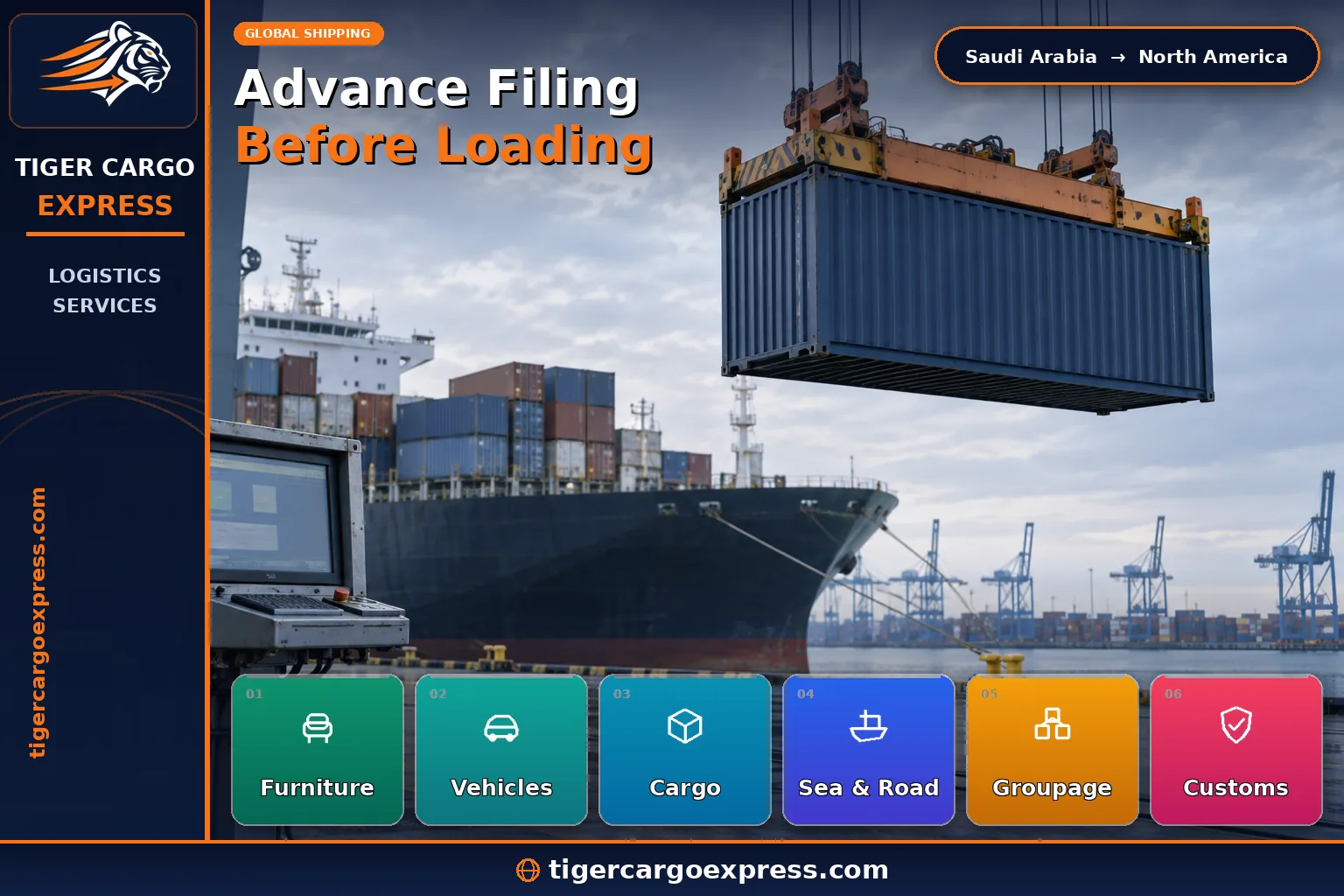
Ocean shipments bound for the United States are subject to a requirement to file advance security data about the consignment — known as the importer security filing programme.
⭐ What sets it apart is its timing.
The filing is submitted before the container is loaded onto the vessel at the origin port — to a set deadline, not on arrival and not even at sailing.
⚠️ Compare with everything we have explained in this series:
▸ In Europe and Asia the file was read on arrival.
▸ In Africa we explained pre-shipment inspection — an inspection of the goods themselves.
▸ ⭐ And here it is not an inspection but data: who the exporter is, who the importer is, who the manufacturer is, where the container was stuffed and who consolidated it.
Which means information you did not think was required — such as who stuffed the container and where — becomes part of your file before sailing.
⚠️ And late filing may expose the shipment to penalties or delays in loading or release.
⭐ Which is why we collect your data in full before we book — not after, because scheduling the filing precedes scheduling the vessel, not the other way round.
- ▸ ⭐ We ask for the data before the volume and the price: the shipper, the consignee with a full address, and the contents item by item.
- ▸ ⭐ And we collect the stuffing data itself: where the container was stuffed and who did it — data not requested on any other continent.
- ▸ ⭐ And we file on time rather than at the last moment — the deadline is counted before loading, and delaying it delays the whole shipment.
- ▸ ⭐ And we match every data point against the bill of lading before issue — a single letter’s difference in a name or address is a correction item, not a detail.
- ▸ And we set out in writing exactly what we need and when — before you pay anything.
Advance filing requirements, their deadlines and their details are set by the competent authorities and are subject to change, differ between the continent’s countries, and some details are decided case by case. This is why we review the current position for your destination before booking. We prepare the file and coordinate the timing — we do not provide legal, tax or immigration advice.
⭐⭐ The second inversion — your car’s age permits import rather than blocking it
We said in our Africa guide and our South America guide that vehicle age limits there are among the strictest in the world — an older car may be blocked.
⭐⭐ In North America the logic is exactly reversed.
| Situation | On most continents | In North America |
|---|---|---|
| ⭐ A recent car | The easiest to import — restrictions target older vehicles | ⚠️ The hardest — it needs to meet local safety and emissions standards |
| ⭐ A car past a certain age | ⚠️ May be blocked by an age ceiling | May be exempted from the conformity requirement — age works in its favour |
| ⭐ The age threshold | A ceiling not to be exceeded | A floor to be reached — and it differs between the US and Canada |
| ⚠️ Temporary import | A side route | A route in its own right with its own conditions and periods — we review it with you |
Because intuition says newer is easier to import.
⭐ The logic here is entirely different: a recent vehicle must have been manufactured to meet local safety and emissions standards in the first place — and a Gulf-market car may not carry those certifications.
And modifying it after import is not a simple procedure, and in some cases may not be possible at all.
⭐ A vehicle past the defined age, on the other hand, may fall outside the conformity requirement — which makes the matter far simpler.
⚠️ And the threshold is not uniform across the continent: it differs between the United States and Canada, each with its own regime and documents.
⭐ We ask for your car’s model year before anything else — because the answer may mean shipping is easy, or needs a special route, or is not practical at all. And we tell you before you book, not after you ship.
⚠️ And we always flag: importing is one thing and registering is another — technical conformity for local registration is entirely separate from customs clearance.
⭐⭐ The third inversion — the land bridge: the port is not the decision
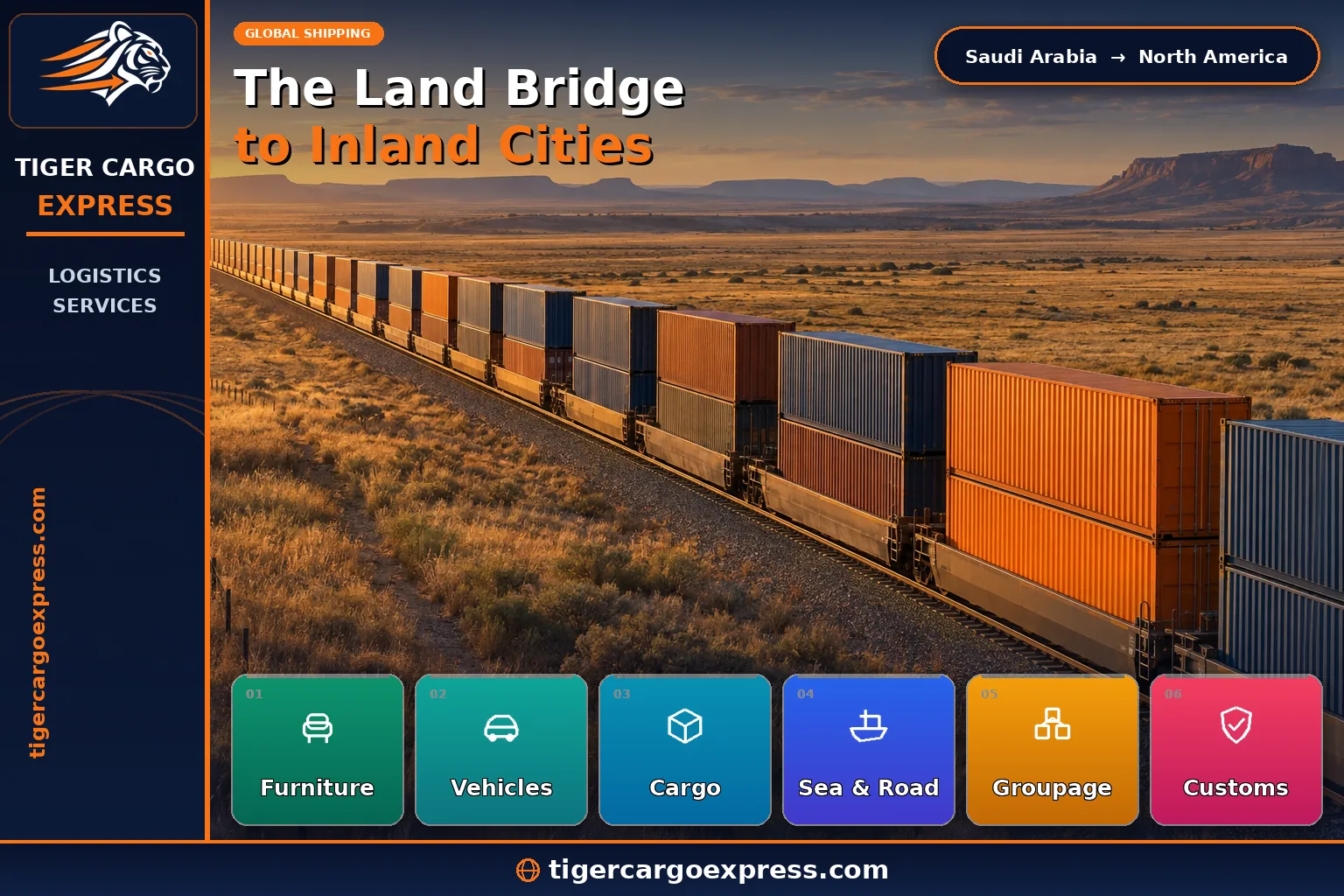
⭐ We explained in every continental guide that the port decides your schedule. ⚠️ In North America the rule breaks — because of the strongest container rail network in the world.
| Your destination | The logical route | Canals | What sets it apart |
|---|---|---|---|
| ⭐ East coast | Suez then the Atlantic to an eastern port | One | The shortest from us and the most frequently served |
| ⚠️ West coast directly | Suez then Panama to a western port | Two | Longer by sea — and a second transit stage |
| ⭐⭐ West coast via the land bridge | An eastern port then transcontinental rail | One | A genuine alternative — and we compare it for you |
| ⭐ An inland city | A port then rail to an inland ramp | Depends on the coast | And clearance may take place inland rather than at the port |
That the choice of ocean here is not final as it is in South America.
⭐ A shipment bound for the west coast may be discharged at an eastern port and cross the continent by rail — saving the Panama Canal transit entirely.
Sometimes that is faster and cheaper, and sometimes it is not — the calculation changes with your destination, your volume and your timing.
⚠️ And it also means “it has reached the port” does not mean nearly arrived on this continent:
▸ Major inland cities are served by inland rail ramps — and your destination may be a ramp rather than a quay.
▸ ⭐ And customs clearance may take place at the inland ramp rather than at the port — which changes where your insurance policy’s responsibility ends.
We write into the quote: which port, whether there is a rail leg, and where clearance takes place — before you pay.
The continent’s countries — each with its own logic
→ Full article: shipping to the United States
→ Full article: shipping to Canada
⚠️ And we say it plainly: some destinations on this continent are subject to restrictions or exceptional arrangements that change over time. We review the current position for your specific destination before booking — and we do not accept a shipment we cannot execute.
⭐ Is there a unified customs framework?
The continent’s three largest countries share a well-known regional trade agreement.
⚠️ But it does not mean your file is the same across the three — and it resembles the European Union in nothing.
⭐ In Europe the transfer-of-residence rule really was one rule, on the same conditions in twenty countries.
Here the agreement concerns trade, tariffs and rules of origin first and foremost — while personal-effects import requirements, vehicle standards and advance filing requirements remain wholly national in each country.
⚠️ Anyone who assumed “the US file will do for Canada” assumed something that does not hold — the vehicle age threshold alone differs between them.
⭐ We build you a file for your country from scratch.
⭐ The three languages — and an overlooked operational item
- ▸ ⭐ English in the United States, most of Canada and several Caribbean islands.
- ▸ ⭐ French is an official language of Canada — and predominant in one of its major provinces, so the document language there is settled in advance.
- ▸ ⭐ Spanish in Mexico, most of Central America and several islands — and the inventory is submitted in it.
- ▸ ⚠️ And why is this operational rather than cultural? Because the inventory, invoices and clearance authorisation are submitted in the destination country’s language — and an inventory in an unacceptable language means translation and storage at your expense.
- ▸ ⭐ And we settle the language before sailing — preparing the inventory in it from the start, not after it is asked for.
Shipping for embassies, consulates and their staff
Shipments for diplomatic and consular missions and their accredited staff do not travel the personal-effects route and are not subject to its conditions — neither residence periods nor vehicle restrictions. The basis is the standing of the mission or your accreditation to it, the reference framework is the Vienna Convention on Diplomatic Relations of 1961, and treatment is confirmed through the competent official channels. ⭐ International organisations have a wide presence on the continent, and some hold headquarters agreements we settle before the bill of lading is issued. We work in both directions.
This conclusion is specific to this continent:
▸ The advance security filing is tied to the moment the container is loaded onto the vessel — a physical moment, not an administrative one.
▸ And a mission’s shipment to an inland city crosses the continent by rail like any other.
▸ And its shipment to the west coast directly transits the Panama Canal.
⭐ Standing changes the path of the paperwork; it does not postpone a cut-off or shorten a railway.
⚠️ Anyone who promised a mission an arrival date without counting the filing deadline and the rail leg promised something they do not control.
We put the same durations and margins into a mission’s file as into any client’s — and maintain full confidentiality over information, contents and movement schedules.
And we say it plainly: determining what an exemption covers and how far it extends rests with the competent authorities, and the mission has its own official channels. Our role is purely logistical.
Furniture and household goods moving from Saudi Arabia to North America
The method is the same — but here the starting point is the data before the cartons.
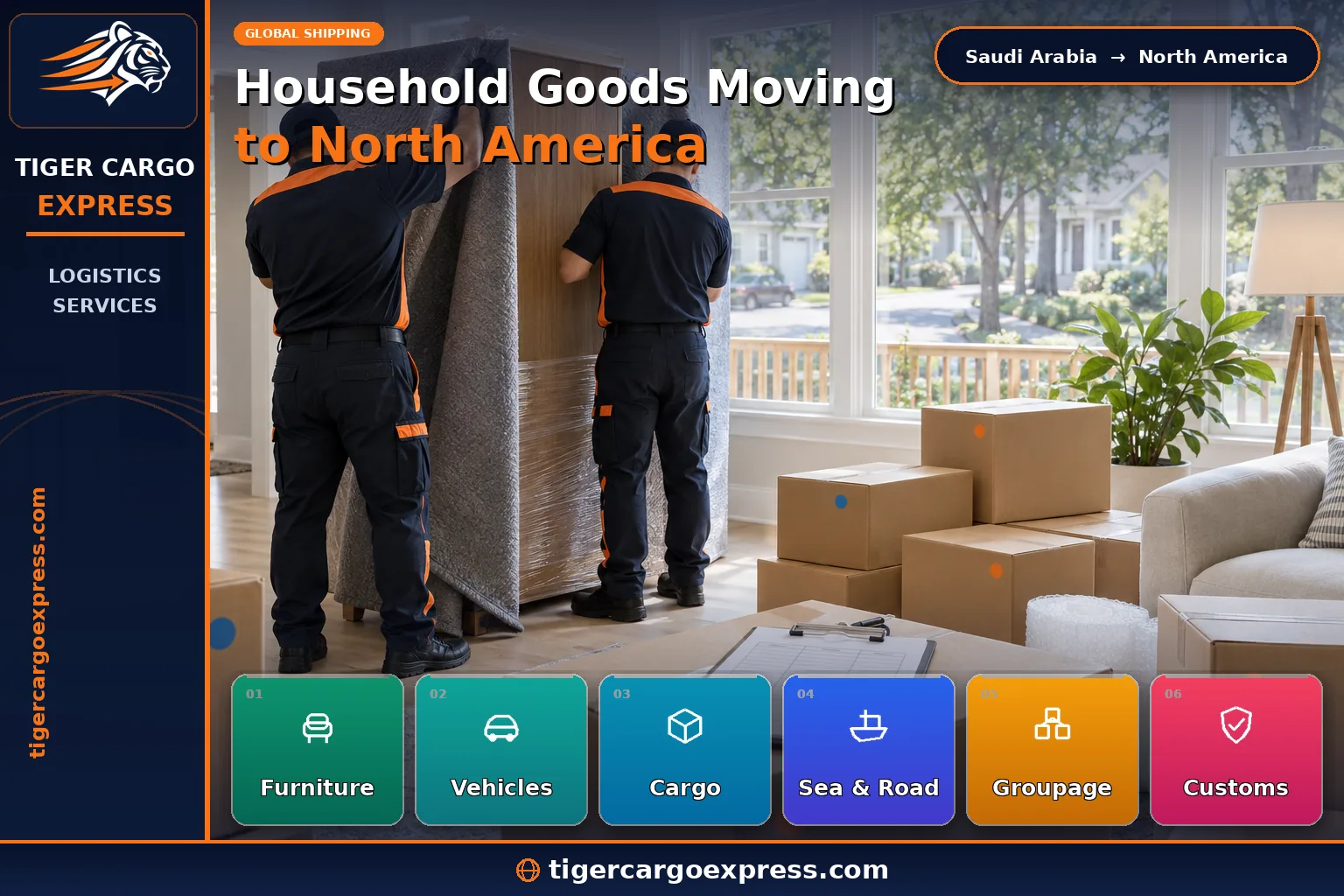
- ▸ ⭐⭐ Collecting the advance filing data first: shipper and consignee with full addresses, contents item by item, and stuffing data — before the volume and before the price.
- ▸ ⭐ Naming the city, not the port: your destination may be an inland rail ramp — and clearance may take place there rather than at the quay.
- ▸ ⭐ Settling the document language: English, French or Spanish — by country and province.
- ▸ ⭐ A detailed itemised inventory tied to carton numbers: which here is part of the filing rather than an accompanying document — a general description will not do.
- ▸ ⭐ Reviewing appliances before shipping: the voltage and plug differences between the Gulf and North America are among the widest in the world — and many appliances are not worth the freight, which we say plainly.
- ▸ Packing for the temperature swing: from Gulf heat to a continental winter in the north — and wood and leather suffer most.
- ▸ Dismantling, unpacking and reassembly: in your new home, with the inventory checked with you piece by piece.
Full container, shared consignment or air?
| Aspect | Full container | Shared (LCL) | Boxes or air |
|---|---|---|---|
| When it suits you | A full home or a commercial batch | One or two rooms plus appliances | Selected items and urgent cargo |
| ⭐⭐ With the advance filing | The clearest — one filing for one shipment, and the container is yours alone | ⚠️ Your data sits inside a shared container — and a co-loader’s late filing can affect loading | Simplest to document |
| ⭐ With the land bridge | Moves by rail as one unit — with no rehandling | Broken down at the port then rehandled | Reaches the inland airport directly |
| ⭐ On the east coast | A comfortable option — frequency is high | Very worthwhile — service is dense | For urgent cargo only |
| Pricing | Fixed rate plus the rail leg | Per cubic metre with a minimum | Per box or by volumetric weight |
⭐ Note the red row — entirely specific to this continent: on every other continent the choice was a scheduling or protection question. ⚠️ Here it is also a data question — a full container means one filing for your shipment alone, while LCL places your data inside a container you share with others. We explain the difference in writing before you choose.
Cities we cover
New Jersey
Houston
Savannah
Miami
Los Angeles
Long Beach
Seattle
Chicago
Dallas
Atlanta
Detroit
Toronto
Montreal
Vancouver
Calgary
Halifax
Mexico City
Veracruz
Manzanillo
Panama City
San José
Santo Domingo
Kingston
⭐ Note Chicago, Dallas, Atlanta and Calgary on this list: four major inland cities no port reaches — all served by inland rail ramps. ⚠️ Your destination there is a ramp, not a quay, and clearance may take place there. We ask for your city by name because it decides the port, the rail leg and the point of clearance together.
Shipping rates from Saudi Arabia to North America
⚠️ There is no “rate for the continent” — the gap between an east-coast port and an inland city is a whole rail leg.
| Shipment type or line item | Price | Unit and notes |
|---|---|---|
| Boxes and small consignments | Request a quote — set by survey | Per box or by weight |
| Shared consignment (LCL) | Request a quote — set by survey | Per cubic metre — your data sits inside a shared container |
| 20 / 40 ft container | Request a quote — set by survey | One filing for one shipment — the clearest to document |
| Air freight | Request a quote — set by survey | By volumetric weight — and it reaches the inland airport directly |
| ⭐⭐ The port and the rail leg | Both written into the quote | A line with no equivalent — the land bridge is a real option |
| ⭐ The point of clearance | Written into the quote | At the port or at the inland ramp |
| ⭐ Preparing the advance filing | Set after your file is reviewed | Submitted before loading, to a set deadline |
| ⚠️ Vehicle file | Set after your file is reviewed | The model year is settled first — the steering side is fine here |
⭐ Note the red and orange rows: “the rail leg” and “the point of clearance” are lines we have put in no other continental guide in this form — because they exist only where inland cities are served by rail ramps. ⚠️ Anyone who did not name them quoted you a journey ending at the quay while your destination lies thousands of kilometres beyond it.
Documents required
Clearance and demurrage
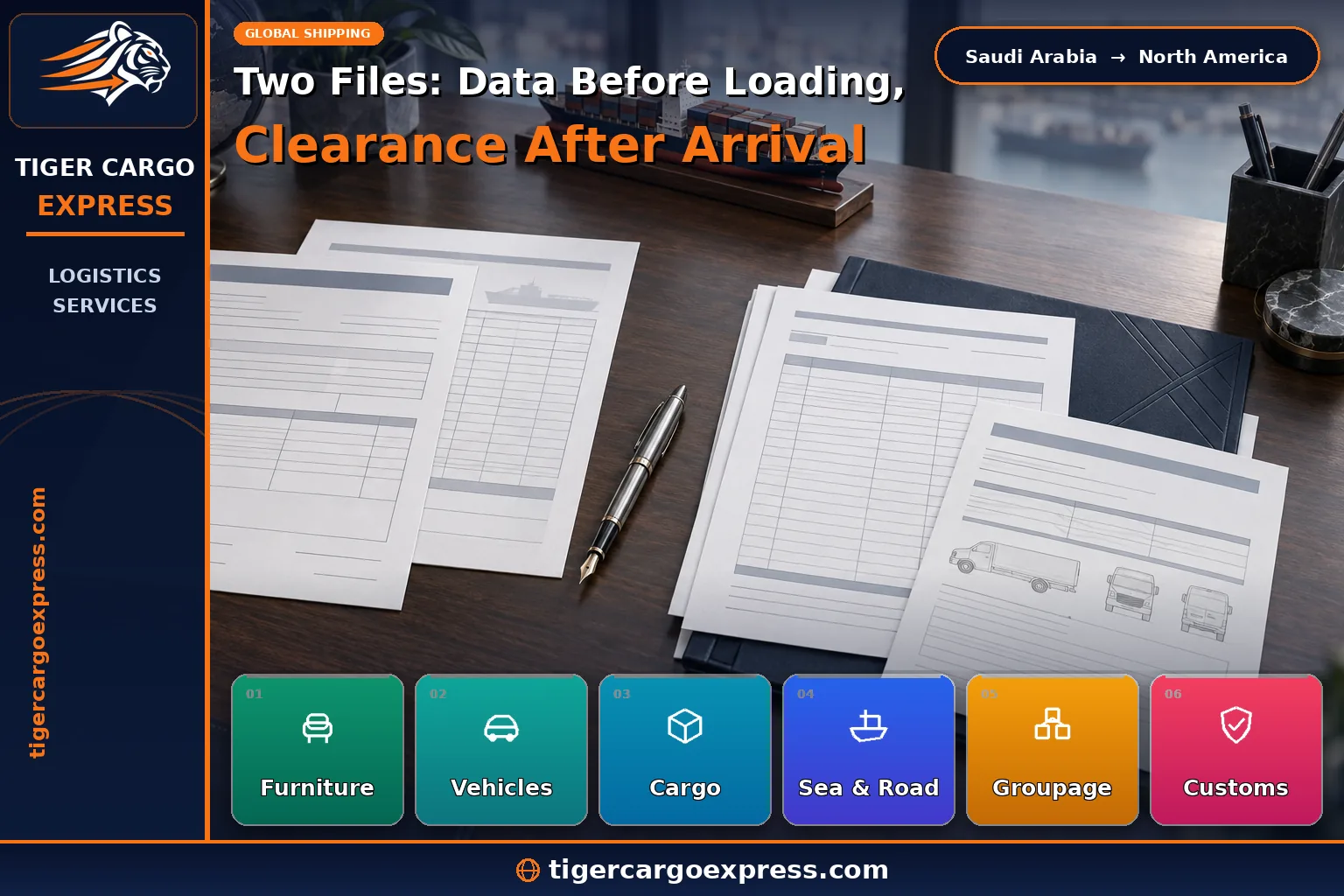
- ▸ ⭐⭐ The file here is two files with two different timings: data before loading, and clearance after arrival — an arrangement with no equivalent on the other continents.
- ▸ ⭐ And the point of clearance may be inland: at the rail ramp rather than at the port — and we write it into the quote.
- ▸ ⚠️ And demurrage is counted at two possible points: at the port and at the inland ramp — and we report the free days at both in writing.
- ▸ ⭐ The inventory tied to carton numbers: so the required carton is opened at inspection, not the whole shipment.
- ▸ ⭐ And the insurance must extend across the rail leg: a port-to-port policy ends before the continental journey begins. We confirm it in writing.
- ▸ Then inland delivery: by truck from the ramp to your door, with reassembly and the inventory check.
Prohibited items and packing
- ▸ Flammable and pressurised materials: aerosols, paints, solvents, fuel and gas — excluded entirely.
- ▸ Weapons and ammunition: of every kind, subject to strict permits and regulation.
- ▸ ⭐ Foodstuffs, animal and plant products, seeds and soil: agricultural control on this continent is among the strictest in the world — even soil on the base of a plant pot may trigger a procedure. We advise against shipping them with household effects.
- ▸ ⭐ Untreated timber: every crate and pallet needs certified treatment and a visible mark — and it is checked closely here.
- ▸ Protected species products: ivory, hides or rare shells — even as a family heirloom.
- ▸ ⭐ And the packing is designed for the temperature swing and a long rail leg: from Gulf heat to a continental winter in the north — then thousands of kilometres by rail. So we seal from the inside and secure to road- and rail-transport standards, not sea standards alone.
Inland delivery after clearance
- ▸ ⭐ Coastal cities: the simplest case — delivery by truck straight from the port.
- ▸ ⭐⭐ Inland cities: a rail ramp then a truck — and your destination is a ramp, not a quay, which we name in the quote.
- ▸ ⚠️ Apartments in major cities: restrictions on unloading times and service-lift bookings — and we book the slot in advance, not on delivery day.
- ▸ ⭐ Suburbs and detached homes: a large truck may not be able to access some residential streets — and we survey the final stretch in advance.
- ▸ ⭐ The continental winter: snow slows roads and railways in the north — and we build a written margin for it.
- ▸ Checking the inventory at delivery: piece by piece against carton numbers — which is what makes the itemised inventory useful to you rather than a burden.
⭐ Insurance — where exactly does your policy end?
At coastal destinations a port-to-port policy ends at the quay — with a short journey between you and your home.
⚠️ Here your policy may end before the continental journey even begins.
A shipment to an inland city covers thousands of kilometres by rail after the port — and a policy ending at the quay covers none of it.
⭐ What we confirm in writing:
▸ That cover extends across the whole rail leg.
▸ ⭐ That it includes the truck delivery from the ramp to your door.
▸ And that it covers any storage period at the inland ramp.
We present the cover options by their clauses rather than their headings — because a policy’s name does not tell you where its responsibility ends.
How to choose a shipping company — and what we commit to
⭐ We collect your data before we book, not after.
⭐ We ask for the year before anything else.
⭐ We write both and the point of clearance into the quote.
⭐ We settle the language before sailing.
⭐ We write it item by item and tie it to carton numbers.
⭐ We confirm it in writing and present clauses, not headings.
⭐ Air freight — when is it worth it here?
▸ ⭐⭐ When your destination is an inland city. Air reaches an airport near you directly — bypassing the port and the entire rail leg, which saves more here than on any other continent.
▸ ⭐ When the volume is small and the documents are ready. A student’s or a contract relocator’s effects do not warrant two stages and two handlings.
▸ ⭐ When the goods are high-value. Air reduces the number of handling stages — and a rail leg is an extra handling by its nature.
⚠️ And when is it not worth it? When the volume is large — pricing by volumetric weight makes bulky furniture expensive without justification.
⭐ We put both options in one table by duration, cost and number of handling stages — and we do not recommend one before we know your city and your volume.
How to reduce your shipping cost
- ▸ ⭐ Prepare the advance filing data in full from day one. One missing data point can delay the whole loading — far more expensive than any saving on the rate.
- ▸ ⭐ Settle your car’s model year before any planning. The answer may mean shipping is easy or not practical at all — and discovering it late is a total loss.
- ▸ ⭐⭐ Compare the land bridge against the direct route if your destination is western. An eastern port plus rail saves the Panama Canal transit entirely — and is sometimes faster and cheaper.
- ▸ ⭐ Review your appliances more strictly than for any other continent. The voltage difference between the Gulf and North America is among the widest in the world — and many appliances occupy volume for nothing.
- ▸ ⭐ Write the inventory item by item from the start. It is part of the filing here — and correcting it after submission is harder than writing it correctly.
- ▸ Choose a full container if your destination is inland. It moves by rail as one unit with no rehandling.
- ▸ Consolidate into one consignment. Two batches mean two advance filings and two rail legs.
When do prices rise and transit times stretch?
| Situation | Where it weighs most | What we do |
|---|---|---|
| ⭐⭐ A gap in the advance filing data | The harshest factor on this lane | We collect the data before booking and match it to the bill of lading |
| ⭐ Congestion at the major ports | Both coasts — and peak season | We compare alternative ports and the land bridge |
| ⭐ Inland rail congestion | Inland cities | A written margin and tracking across the rail leg |
| ⭐ The continental winter | Canada and the northern United States | A schedule margin plus packing for the temperature swing |
| ⭐ Agricultural inspection | The whole continent — control is among the strictest | Certified treatment, a visible mark and a list review |
| ⚠️ Red Sea disruption | The whole continent — the route begins with Suez | We track the position before fixing any date |
How we work: five steps
Five recurring mistakes — all of them avoidable
- ▸ Treating the advance filing as a later step. The most common and most expensive error — its deadline falls before the container is loaded, not on arrival and not even at sailing.
- ▸ Assuming a recent car is easier to import. The rule here is reversed: a recent car needs local standards a Gulf-market vehicle may not carry — and age may work for you rather than against you.
- ▸ Accepting a quote that ends at the port. Your destination may be an inland rail ramp thousands of kilometres away — and clearance may take place there.
- ▸ Assuming the regional agreement means one file. It concerns trade and tariffs — personal-effects requirements and vehicle standards are wholly national, and the vehicle age threshold alone differs between the two countries.
- ▸ Shipping appliances that will not run on the grid there. The voltage difference between the Gulf and North America is among the widest in the world — and what does not fit occupies volume for nothing.
Why Tiger Cargo Express?
Because we know the most important date in this journey falls before the ship moves. Shipments bound for the United States are subject to a requirement for advance security data filed before the container is loaded, to a set deadline — covering information you did not think was required, such as who stuffed the container and where. ⭐ We collect your data in full before we book, not after — because scheduling the filing precedes scheduling the vessel, not the other way round.
And because we ask for your car’s model year before anything else. The rule here is reversed from every other continent: a recent vehicle needs local safety and emissions conformity that a Gulf-market car may not carry, while a vehicle past a defined age may fall outside that requirement entirely. ⭐ And the threshold differs between the United States and Canada. We give you the answer before you book, not after you ship — because it may mean shipping is easy, or that it is not practical at all.
Our written commitments
The reverse direction — from North America to Saudi Arabia
We work in both directions on the same ports and routes. The dominant flow: equipment, machinery, spare parts and industrial goods from the United States and Canada · agricultural and food products from Mexico and Central America — alongside returnees’ household effects everywhere.
⭐ And the same constraints work in reverse: the rail leg precedes the port for shipments starting from inland cities — and we confirm the cut-off at the port before fixing the rail loading date, not the other way round, because missing the train means missing the ship. ⚠️ And we review your list before loading against Saudi import restrictions, preparing the export file to the same standard.
Frequently asked questions about shipping from Saudi Arabia to North America
In summary
In Europe we asked about the sea, in Asia about the ring, in Africa about the coast, and in South America about the ocean. North America does not ask a new question — it inverts three rules: your shipment’s data is filed before it is loaded, not before it arrives · your car’s age may permit import rather than block it · and the port is not the decision but the inland delivery point, thanks to the land bridge. What you need here is three things: a company that collects your data before it books, a quote naming the port, the rail leg and the point of clearance, and a question about your car’s model year before anything else. Tiger Cargo Express gives you all three before you ship.
Send us your shipment details — the country and city by name, the approximate volume, your departure city, and your vehicle’s model year if applicable — and we will come back with a detailed quote naming the port, the rail leg and the point of clearance within 60 minutes. 0506688227
See also our United States article · Canada article · South America guide · and our international shipping service page.
Tags:
shipping to North America · Saudi Arabia to USA · car shipping USA · furniture moving Canada · advance security filing · land bridge · inland rail ramps · vehicle age rule · vehicle conformity · point of clearance · Mexico · Central America · Caribbean · sea freight · air freight · FCL · Tiger Cargo Express
Related Shipping Guides
Continue with practical guidance connected to the same route or shipping decision.
Furniture and Car Shipping Company from Saudi Arabia to the Gulf 0506688227
⚠️ "How much does shipping to Kuwait cost?" is a question missing three things. Shipping from Riyadh is not shipping…
Shipping Company from Saudi Arabia to the Middle East 0506688227 — Overland Guide
The Middle East overturns all of it: it is the only destination whose journey starts at your front door rather…
Shipping Company from Saudi Arabia to Oceania 0506688227 — The Biosecurity Guide
On every preceding continent the question was: what is inside your shipment? Oceania asks an entirely different one: what is…
Send your shipment details and get a written quote
We reply within 60 minutes during working hours — with what the price includes and what it does not, stated before you commit.