
Shipping Company from Saudi Arabia to South America 0506688227 — A Two-Ocean Guide
We said in our Asia guide that the advantage there is no canal on the way, and in our Europe guide that every shipment crosses Suez. South America goes beyond both: it is the only continent your shipment may cross two canals to reach — Suez for the Atlantic, Suez plus Panama for the Pacific. So the first question here is not "which country?" but "which ocean?" It is also the furthest from us of all, so the challenge here is time itself.
Guide contents ShowHide
Looking for a shipping company from Saudi Arabia to South America that knows the first question is “which ocean?” rather than “which country?” Tiger Cargo Express moves furniture, household goods, commercial cargo and vehicles to every country on the continent — by sea and air — with dismantling, professional packing, reassembly, customs clearance at both ends and cargo insurance. To book: 0506688227
We said in our Asia guide that the great advantage there is no canal on the way. And in our Europe guide that every shipment passes through the Suez Canal.
South America goes beyond both:
It is the only continent your shipment may cross two canals to reach.
⭐⭐ Reaching its Atlantic coast means the Suez Canal — and reaching its Pacific coast means Suez and then the Panama Canal.
Which means the first question here is not “which country?” but “which ocean?”
⚠️ And that decision is taken here before sailing — not there after arrival. A vessel routed to the Atlantic does not reach a Pacific port without a whole additional stage.
This continent is also the furthest from us of all — and we build everything around that.
⭐⭐ The furthest continent — and what that actually means
▸ ⭐ The cut-off date carries more weight than on any other continent. The next cycle is not days away — and missing a sailing here means a real wait.
▸ ⭐ The packing is designed for the duration, not the distance. Every factor — humidity, temperature swing, vibration — works on your shipment for longer.
▸ ⭐ The file must be complete before sailing, without exception. A shipment waiting on a document at a port on the other side of the planet waits a long time, and fixing it is very costly.
▸ ⭐ And air freight is worth more here than on any other continent. Because the time gap between air and sea is the widest anywhere — and we always put both side by side.
⚠️ Anyone who quoted you South America on European logic quoted a far shorter journey than the one that will happen.
We give you a written estimated duration by your ocean and destination port — not one figure for the continent.
⭐ The map of the two oceans — the classification that actually matters
| Coast | Countries | What the vessel passes | What governs your schedule |
|---|---|---|---|
| ⭐ Atlantic | Brazil · Argentina · Uruguay · Venezuela · the Guianas | The Suez Canal, then Gibraltar, then the Atlantic | Highest frequency — and the shorter transit |
| ⭐⭐ Pacific | Chile · Peru · Ecuador · Colombia | Suez, then the Panama Canal | A second transit stage + the longest duration |
| ⭐ Both coasts | Colombia — on the Caribbean and the Pacific | Depends on the chosen port | ⚠️ Caribbean without Panama — Pacific with it |
| ⚠️ Landlocked | Bolivia · Paraguay | A neighbouring port then a second stage | One climbs a mountain, the other sails a river |
⭐ Note the third row — a unique case: Colombia alone has ports on the Caribbean Sea and others on the Pacific Ocean. ⚠️ And the difference between them is not an inland distance but the whole Panama Canal — a Caribbean port is reached without transiting it, a Pacific port with it. We ask which city inside Colombia before fixing the port.
⭐⭐ The Panama Canal — the second gateway
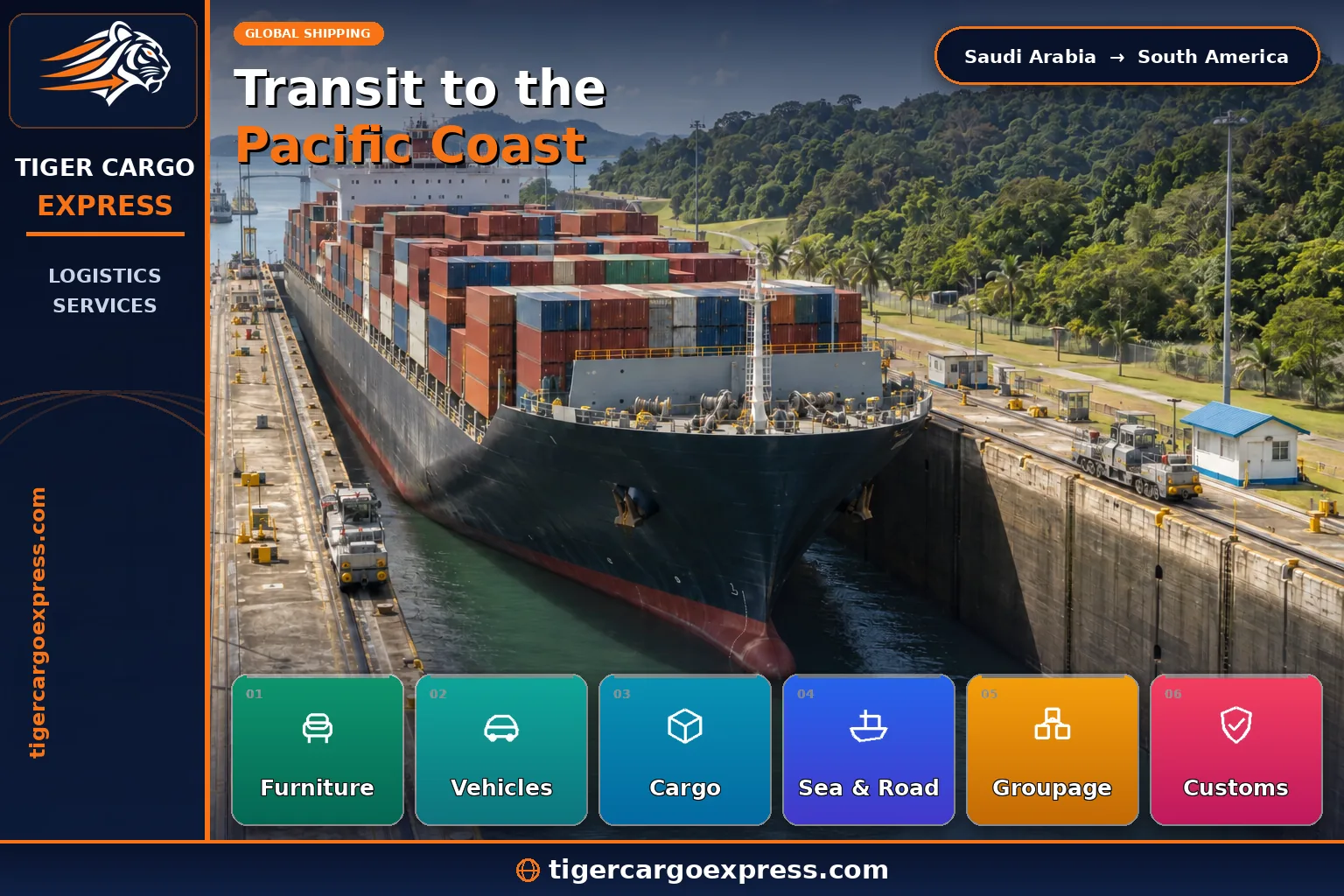
Because it adds three things to your shipment at once:
▸ ⭐ A second transit fee after the Suez fee — a real line in the cost of the voyage.
▸ ⭐ A second regulated transit stage with its own scheduling — it is run on a booking-slot system, not on arrive-and-wait.
▸ ⭐ And additional days on a voyage that is already the longest.
⚠️ And what makes this decisive in your quote:
that two shipments “to South America” can differ widely in cost and duration — not because the volume differs, but because one crosses a canal and the other does not.
⭐ Compare with what we explained on the other continents:
▸ In Asia: no canal at all to the south of the continent — its great advantage.
▸ In Africa: no canal to the eastern seaboard — we share the Red Sea.
▸ In Europe: always one canal.
▸ ⭐ And here: one canal for the Atlantic, two for the Pacific.
We write it plainly into the quote: which ocean, which canals are transited, and how many transit stages — before you pay.
The Atlantic coast — the nearest and most frequently served
This is the continent’s natural gateway from our side — reached through one canal rather than two.
⭐ The Pacific coast — behind the Panama Canal
⭐⭐ The two landlocked countries — one climbs a mountain, the other sails a river
We explained in our Africa guide that landlocked countries are served by overland corridors from neighbouring ports. ⭐ South America has only two landlocked countries — but each is served in a way that looks nothing like the other.
⭐ And the climb is no detail: the road rises thousands of metres over a short distance — which affects both the packing and the securing.
And your file is two files: transit at the port and the border, and final clearance on entry into Bolivia.
⭐⭐ This is the only case in our entire series where the second stage is fluvial rather than overland or maritime.
⚠️ And river navigation is affected by seasonal water levels — a real scheduling factor for which we build a written margin.
⭐ And the comparison between the two neighbours explains the whole continent: both are landlocked, both need a second stage and both a transit file and a clearance file. ⚠️ But a Bolivian shipment crosses two canals then climbs a mountain, while a Paraguayan one crosses a single canal then sails a river. The distance on the map is comparable — and the journey is entirely different. We always write the second stage and its type into the quote.
⭐ The three Guianas — the corner everyone forgets
- ▸ ⭐ 🇬🇾 Guyana: on the Atlantic in the continent’s north-east — and its official language is English, not Spanish or Portuguese. Service frequency is lower than its neighbours’, so the cut-off carries more weight.
- ▸ ⭐ 🇸🇷 Suriname: also on the Atlantic, with Dutch as its official language — the fourth language on this continent. Its port has a river approach, so maximum draught is a point we check in advance.
- ▸ ⚠️ 🇬🇫 French Guiana: not an independent country but a French overseas territory — and its customs position differs fundamentally from its neighbours’, reviewed case by case before booking.
- ▸ ⭐ And one rule covers all three: all lie outside the two customs blocs we explain below — each with its own national system, language and documents.
⭐⭐ Is there a customs framework? Yes — but two
We said in our Asia guide that there is no Asian framework at all. And in our Europe guide that there are three frameworks dominated by one.
⭐ South America sits between them: it has two genuine regional blocs — and countries outside both.
| The bloc | Countries | What it means for your file |
|---|---|---|
| ⭐ Mercosur | Brazil · Argentina · Uruguay · Paraguay | Regional customs coordination — but local requirements remain national |
| ⭐ Andean Community | Colombia · Ecuador · Peru · Bolivia | Another regional coordination — and its rules are not Mercosur’s |
| ⚠️ Outside both | Chile · Venezuela · Guyana · Suriname · French Guiana | An independent national system for each |
The existence of a regional bloc does not mean your file is the same across all its countries — unlike what we explained about the European Union.
⭐ In Europe the transfer-of-residence rule really was one rule, applying to twenty countries on the same conditions.
⚠️ Here the coordination is regional in trade and tariff matters first and foremost — while the requirements for importing personal effects, their periods and their documents remain national in each country separately.
Anyone who assumed “the Brazil file will do for Argentina because they are in the same bloc” assumed something that does not hold.
⭐ We build you a file for your country from scratch — and review the current position there before booking, because requirements are subject to change and some details are decided case by case by the competent authority. We prepare the file and coordinate the timing — we do not provide legal, tax or immigration advice.
⭐ Language — the operational item everyone overlooks
▸ Spanish in most of the continent’s countries.
▸ ⭐ Portuguese in Brazil — the largest country on the continent.
▸ English in Guyana.
▸ Dutch in Suriname.
▸ And French in French Guiana.
⭐ And why is this operational rather than cultural?
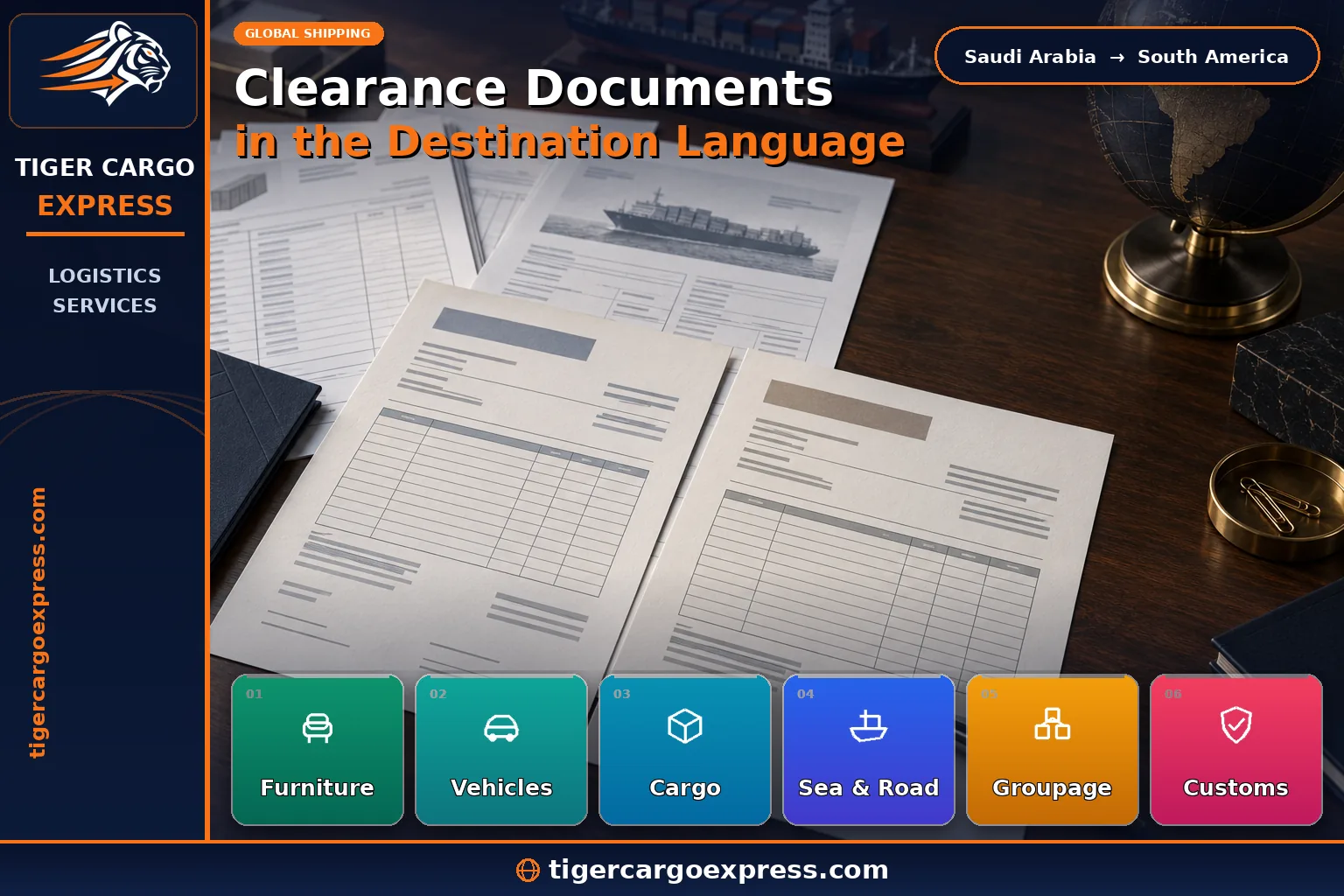
Because the inventory, invoices, clearance authorisation and contents declarations are submitted in the language of the destination country.
⚠️ An inventory written in an unacceptable language means translation and certification after arrival — while you pay storage in the meantime, on a voyage that is already the longest.
⭐ We settle the document language before sailing — and prepare the inventory in it from the start, rather than after it is asked for.
Car shipping to South America
- ▸ ⭐ Good news specific to this continent: driving is on the right (so left-hand drive) in every country without exception — and your Gulf car is fine on that count for any destination you choose.
- ▸ ⚠️ But the other restrictions are among the strictest in the world: several countries restrict used-vehicle imports with strict age limits or prohibit them except in defined cases. We settle that before booking rather than after shipping.
- ▸ ⭐⭐ And an item specific to this continent: a vehicle to a Pacific destination transits the Panama Canal, to Bolivia it transits the canal then climbs the Andes, and to Paraguay it moves by river — each of these stages a declared line in the quote.
- ▸ ⭐ And the distinction overlooked here as everywhere: importing is one thing and registering is another — technical conformity for local registration is entirely separate from customs clearance, and we set it out in writing.
- ▸ ⚠️ And the length of the voyage demands extra care: the vehicle stays lashed inside the container longer than on any other lane we run — so four-point lashing here is a necessity, not a recommendation.
- ▸ And the standard steps: draining fuel and disconnecting the battery · emptying the vehicle completely of personal items · and photographic documentation before sealing, handed to you as a file.
Shipping for embassies, consulates and their staff
Shipments for diplomatic and consular missions and their accredited staff do not travel the personal-effects route and are not subject to its conditions — neither residence periods nor vehicle import restrictions. The basis is the standing of the mission or your accreditation to it, the reference framework is the Vienna Convention on Diplomatic Relations of 1961, and treatment is confirmed through the competent official channels. We work in both directions.
This conclusion recurred in all our continental guides:
▸ A mission’s vessel to Santiago or Lima transits Suez then Panama — like any other shipment.
▸ And a mission’s shipment to La Paz climbs the Andes after the two canals.
▸ And its shipment to Asunción sails a river.
⭐ Standing changes the path of the paperwork; it does not shorten a canal or reduce a distance.
⚠️ Anyone who promised a mission an arrival date on the Pacific coast without counting both transit stages and the real duration promised something they do not control.
We put the same durations and margins into a mission’s file as into any client’s — and maintain full confidentiality over information, contents and movement schedules.
And we say it plainly: determining what an exemption covers and how far it extends rests with the competent authorities, and the mission has its own official channels. Our role is purely logistical.
Furniture and household goods moving from Saudi Arabia to South America
The method is the same — but here the starting point is: which ocean?
- ▸ ⭐ Establishing the ocean first: Atlantic or Pacific? — because the answer decides the number of canals, the duration and the cost before anything else.
- ▸ ⭐ Then the city, not the country: in Chile, Brazil and Argentina the internal distances exceed the length of whole countries.
- ▸ ⭐ Settling the document language: Spanish, Portuguese or another — and we prepare the inventory in it from the start, not after it is asked for.
- ▸ ⭐⭐ Packing designed for the longest duration: every factor works on your shipment for longer here — given a full section below.
- ▸ A detailed item-by-item inventory tied to carton numbers: so the right carton is opened at inspection, not the whole shipment.
- ▸ Reviewing appliances before shipping: voltage differences on this continent are wide and vary even between neighbouring countries — and we tell you what is not worth the freight.
- ▸ Dismantling, unpacking and reassembly: in your new home, with the inventory checked with you piece by piece.
⭐⭐ The long duration — and what it actually does to your shipment
▸ In Europe the challenge is a sharp temperature swing from Gulf heat to a continental winter.
▸ Across half of Asia, high sustained humidity.
▸ In Africa, dry heat, dust and road vibration.
▸ ⭐ And in South America the challenge is time itself.
The voyage here is the longest we run — and it passes through successive climate zones, all within a single journey.
⚠️ What that means in practice:
▸ The shipment crosses from Gulf heat to the Mediterranean to the Atlantic to the tropics and then to the temperate south — with temperature and humidity changing several times along the way.
▸ And repeated cycles of expansion and contraction are harsher on wood and joints than a single sharp swing.
▸ And condensation inside the container becomes a real possibility over a period of this length.
⭐ What we do:
Interior sealing before the outer packing · moisture-absorbing materials in sensitive cartons · considered ventilation inside the container · and securing that assumes a long period rather than a short trip.
⚠️ Anyone who packed for South America to short-lane standards packed for a different journey.
Full container, shared consignment or air?
| Aspect | Full container | Shared (LCL) | Boxes or air |
|---|---|---|---|
| When it suits you | A full home or a commercial batch | One or two rooms plus appliances | Selected items and urgent cargo |
| ⭐⭐ With the long duration | Clearly the best — one environment whose packing and ventilation we control | ⚠️ Shares the container for a long period — individual packing is decisive | Least exposed by a wide margin |
| ⭐ On the Atlantic coast | A comfortable option — frequency is higher | Worthwhile — and the wait is reasonable | For urgent and high-value goods |
| ⚠️ On the Pacific coast | One cut-off we commit to — and the clearest on schedule | ⚠️ Waiting for the consolidator can mean a whole cycle | Bypasses both canals at once |
| ⭐ To the two landlocked countries | Moves as one unit through the second stage | May wait for regrouping at the port | Bypasses the mountain or the river entirely |
⭐ Note the red row — the clearest recommendation in this article: on the longest lane we run, a full container gives you one environment whose packing and ventilation we control throughout the voyage. ⚠️ A shared consignment means your goods share a container with other cargo for a long period — so individual packing becomes decisive rather than optional. We put the comparison to you by duration, protection and price together.
Cities we cover
Rio de Janeiro
Santos
Brasília
Buenos Aires
Córdoba
Montevideo
Asunción
Santiago
Valparaíso
Lima
La Paz
Santa Cruz
Quito
Guayaquil
Bogotá
Cartagena
Caracas
Georgetown
Paramaribo
⭐ Note La Paz, Quito and Bogotá on this list: three capitals at considerable mountain altitudes — where delivery is a genuine climb after the port, not ordinary inland transport. And Asunción alone is reached by river. We ask for your city by name because roughly a third of them need a second stage of a special kind.
Shipping rates from Saudi Arabia to South America
⚠️ There is no “rate for the continent” — the difference between its Atlantic and Pacific coasts is an entire canal.
| Shipment type or line item | Price | Unit and notes |
|---|---|---|
| Boxes and small consignments | Request a quote — set by survey | Per box or by weight |
| Shared consignment (LCL) | Request a quote — set by survey | Per cubic metre — individual packing is decisive over this duration |
| 20 / 40 ft container | Request a quote — set by survey | Best protection on the longest lane we run |
| Air freight | Request a quote — set by survey | By volumetric weight — and its time advantage here is the widest anywhere |
| ⭐⭐ The ocean and the number of canals | Both written into the quote | A line with no equivalent on any other continent |
| ⭐ The second stage | Set in the quote, by your destination | A mountain climb, a river passage or inland transport |
| ⭐ Document language and translation | Written into the quote | Spanish, Portuguese or another |
| ⭐ Long-duration packing | Set after the survey | Interior sealing, absorbents and considered ventilation |
| ⚠️ Vehicle file | Set after your file is reviewed | The age limit is settled first — the steering side is fine here |
⭐ Note the red row: “number of canals” is a line we have put in no other continental guide — because Europe is always one canal, Asia has none, and East Africa has none. ⚠️ Here the number changes with your ocean — and changes the cost and duration with it. We declare it openly because it is the single biggest thing separating one quote from another.
Documents required
Clearance and demurrage
- ▸ ⭐⭐ The file is prepared before sailing — and this rule is stricter here than on any other continent. A shipment waiting on a document on the other side of the planet waits a long time, and rescheduling is not in your hands.
- ▸ ⭐ The inventory in the destination country’s language: not the departure country’s — and translation after arrival means storage at your expense.
- ▸ ⭐ And for the two landlocked countries: two files, not one — a transit file at the neighbouring port and the border, and a final clearance file on entry. We handle both.
- ▸ The inventory tied to carton numbers: so the required carton is opened at inspection, not the whole shipment — saving both time and damage.
- ▸ Tracking the free days: counted from the discharge date rather than the sailing date — and reported to you in writing.
- ▸ Then the second stage: inland transport, a mountain climb or a river passage, depending on your destination.
Prohibited items and insurance
- ▸ Flammable and pressurised materials: aerosols, paints, solvents, fuel and gas — excluded entirely from any shipment.
- ▸ Weapons and ammunition: of every kind, subject to strict permits and regulation.
- ▸ ⭐ Foodstuffs, animal and plant products and seeds: agricultural control on this continent is among the strictest in the world — in protection of its vast agriculture. We advise against shipping them with household effects.
- ▸ ⭐ Untreated timber: this item is checked here more closely than usual — every crate and pallet needs certified treatment and a visible mark.
- ▸ Protected species products: the continent is home to enormous biodiversity and enforcement is tight — even for a family heirloom.
- ▸ ⭐⭐ And insurance over a period this long is not a luxury: a port-to-port policy ends before your home — and before the mountain or the river if your destination is landlocked. We confirm in writing that cover extends through to delivery, and present clauses, not headings.
How to choose a shipping company to South America — and what we commit to
⭐ We write the ocean and the canal count into the quote.
⭐ We settle the language before sailing.
⭐ We write it and its type into the quote.
⭐ We seal from the inside, add absorbents and ventilate carefully.
⭐ We settle them before booking, not after shipping.
⭐ We confirm it in writing and present clauses, not headings.
How to reduce your shipping cost
- ▸ ⭐ Compare the two coasts where your destination allows it. In Colombia, for instance, a Caribbean port is reached without transiting the Panama Canal — and the difference in duration and cost is substantial.
- ▸ ⭐ Meet the cut-off strictly. This is the longest voyage we run, and the next cycle is not days away — missing it costs far more than any saving on the rate.
- ▸ ⭐ Prepare the documents in the destination language from the start. Translation and certification after arrival mean storage at your expense — an item avoidable at no cost.
- ▸ ⭐ Do not economise on packing on this lane specifically. What survives a short voyage may not survive one crossing successive climate zones.
- ▸ ⭐ Compare air against sea more seriously than on any other continent. Because the time gap between them is the widest anywhere here — and for selected items air may be the correct decision rather than a luxury.
- ▸ Settle the vehicle age limit before shipping. Shipping a vehicle that cannot be imported over this distance is a double loss.
- ▸ Consolidate into one consignment. Two batches on this lane mean two full voyages, not two halves.
When do prices rise and transit times stretch?
| Situation | Where it weighs most | What we do |
|---|---|---|
| ⭐⭐ Missing the cut-off | The whole continent — worst on the Pacific coast | We give you the cut-off, not the sailing date |
| ⭐ Panama Canal congestion | The Pacific coast alone | A written margin, and we track it before fixing the date |
| ⭐ River water levels | Paraguay — and the river corridor | A written seasonal margin, not a spoken one |
| ⭐ Documents in an unacceptable language | The whole continent | We prepare the inventory in the destination language before sailing |
| ⭐ Agricultural inspection of timber | The whole continent — control is among the strictest | Certified treatment and a visible mark on every crate |
| ⚠️ Red Sea disruption | The whole continent — the route begins with Suez | We track the position before fixing any date |
How we work: five steps
Five recurring mistakes — all of them avoidable
- ▸ Accepting a quote that names neither the ocean nor the canal count. The most common error — the difference between the coasts is the whole Panama Canal with its fee, its transit stage and its days.
- ▸ Preparing the documents in the departure country’s language. The continent has four official languages, and the inventory is submitted in the destination’s — and translation after arrival means storage at your expense.
- ▸ Assuming a regional bloc means one file. Coordination here is primarily commercial, and personal-effects requirements remain national — unlike the European Union.
- ▸ Packing to short-lane standards. The voyage here is the longest and passes through successive climate zones — and repeated expansion and contraction cycles are harsher than a single sharp swing.
- ▸ Quoting “Chile” or “Brazil” at one rate. Internal distances in these two countries exceed the length of whole continents — the city decides, not the country.
Why Tiger Cargo Express?
Because we start with the right question. South America is the only continent your shipment may cross two canals to reach — Suez for the Atlantic, and Suez plus Panama for the Pacific. And the difference between the coasts is not an inland distance but a whole canal with its fee, its transit stage and its days. ⭐ We write the ocean and the canal count into the quote before you pay — because it is the single biggest thing separating one quote from another.
And because we pack for the duration, not the distance. This is the longest voyage we run, and it passes through successive climate zones all within a single journey — and repeated cycles of expansion and contraction are harsher on wood and joints than a single sharp swing. ⭐ We seal from the inside, place absorbents in sensitive cartons, ventilate the container carefully, and secure on the assumption of a long period rather than a short trip — and we write that as a line in the quote rather than as a spoken promise.
Frequently asked questions about shipping from Saudi Arabia to South America
In summary
We said in our Europe guide that the question is “which sea?”, in our Asia guide “which ring?”, and in our Africa guide “does your country have a coast?”. Here the question is: which ocean? This is the only continent your shipment may cross two canals to reach — and the difference between its coasts is not a distance but an entire canal. It is also the furthest from us of all, so the challenge here is time itself: a heavier cut-off, a file that tolerates no gap, and packing designed for the duration. It has two landlocked countries, one climbing a mountain and the other sailing a river, and four official languages in which your documents are submitted. What you need here is three things: a company that asks which ocean before it quotes, a quote naming the canal count, the second stage and the document language, and packing designed for the duration. Tiger Cargo Express gives you all three before you ship.
Send us your shipment details — the country and city by name, the approximate volume and your departure city — and we will come back with a detailed quote naming the ocean, the canal count and the second stage within 60 minutes. 0506688227
See also our Europe guide · Asia guide · Africa guide · and our international shipping service page.
Tags:
shipping to South America · Saudi Arabia to South America · car shipping Brazil · furniture moving Argentina · Panama Canal · Atlantic coast · Pacific coast · Mercosur · Andean Community · Bolivia · Paraguay · river corridor · document language · sea freight · air freight · FCL · shipping guide · Tiger Cargo Express
Related Shipping Guides
Continue with practical guidance connected to the same route or shipping decision.
Furniture and Car Shipping Company from Saudi Arabia to the Gulf 0506688227
⚠️ "How much does shipping to Kuwait cost?" is a question missing three things. Shipping from Riyadh is not shipping…
Shipping Company from Saudi Arabia to the Middle East 0506688227 — Overland Guide
The Middle East overturns all of it: it is the only destination whose journey starts at your front door rather…
Shipping Company from Saudi Arabia to Oceania 0506688227 — The Biosecurity Guide
On every preceding continent the question was: what is inside your shipment? Oceania asks an entirely different one: what is…
Send your shipment details and get a written quote
We reply within 60 minutes during working hours — with what the price includes and what it does not, stated before you commit.