
Shipping Company from Saudi Arabia to Africa 0506688227 — Corridors and Ports Guide
In Africa: does your country have a coast at all — and if not, whose port do you borrow? The continent has sixteen landlocked countries, more than any other — and shipping to it is measured not in ports but in corridors. Add a second reversal: your shipment may be inspected before it leaves, not after it arrives. And in return it has an advantage no other continent has: the Red Sea we share.
Guide contents ShowHide
Looking for a shipping company from Saudi Arabia to Africa that knows the continent is not measured by its ports? Tiger Cargo Express moves furniture, household goods, commercial cargo and vehicles to more than thirty African countries — by sea, road and air — with dismantling, professional packing, reassembly, customs clearance, corridor handling and cargo insurance. To book: 0506688227
We wrote our Europe guide and said the question there is: which sea does your port sit on? And we wrote our Asia guide and said the question there is: which ring is your destination in?
In Africa the question is entirely different:
Does your country have a coast at all — and if not, whose port do you borrow?
⭐⭐ Africa has sixteen landlocked countries — more than any continent on earth.
Which means shipping to Africa is not measured in ports but in “corridors” — fixed overland routes linking one specific port to the group of countries behind it.
⚠️ And to that is added a second reversal with no equivalent on any other continent we ship to:
Your shipment may be inspected before it leaves Saudi Arabia — not after it arrives.
We give each of these ideas a full section — they are what separates a realistic quote from one that surprises you later.
⭐ The nearest neighbour — and the sea we share
Africa is the only continent with which we share a single sea.
⭐ The ports of the Horn of Africa and Sudan sit directly on the opposite bank of the Red Sea — and the route from our western ports is among the shortest international sea lanes we run anywhere.
Which means three things:
▸ ⭐ No canal and no strait on the way to the north-eastern seaboard — unlike Europe, which always needs Suez.
▸ ⭐ And a very short sea transit, which makes shared consignments worthwhile even for small shipments.
▸ ⭐ And high service frequency on this lane specifically.
⚠️ But the advantage stops at the water’s edge.
“It has reached the port” in Africa can mean you are still a thousand kilometres from your destination — and that is what the next two sections explain.
⭐ The southern and western seaboards are another story entirely: reaching West Africa requires rounding the continent or passing through the Mediterranean, and the transit is far longer than anyone expects who only read the word “Africa”.
⭐⭐ The borrowed-port map — sixteen countries with no coast
We noted in our Europe guide that six European countries are landlocked, and called it a surprise. ⭐ In Africa the number is sixteen — including the most populous landlocked country in the world.
| Landlocked country | Borrowed port | Corridor |
|---|---|---|
| ⭐ Ethiopia | Djibouti | The Djibouti Corridor — the busiest on the continent |
| ⭐ Uganda · Rwanda · Burundi · South Sudan | Mombasa (Kenya) | The Northern Corridor |
| ⭐ Zambia · Malawi · Rwanda · Burundi · DR Congo | Dar es Salaam (Tanzania) | The Central Corridor |
| Zimbabwe · Botswana · Lesotho · Eswatini | Southern African and Mozambican ports | The southern corridors |
| Mali · Burkina Faso · Niger | Gulf of Guinea and West African ports | The western corridors |
| ⚠️ Chad · Central African Republic | Central African Atlantic ports | The longest overland run on the continent |
That your journey is always two stages: sea then road — and the second may exceed the first in both cost and duration.
⭐ Which means four things enter your quote:
▸ The transit port: which is not a port in your country — the goods enter one country and leave it.
▸ The transit procedure: with documentation independent of the final clearance file, handled by us.
▸ The length of the road stage: which can run to hundreds or thousands of kilometres.
▸ The number of international borders crossed: and some destinations cross two, not one.
⚠️ Anyone comparing two quotes to a landlocked country without knowing each one’s port and corridor length compared nothing at all.
We write all four into the quote — before you pay anything.
⭐ The four major corridors — the classification that actually matters
| Corridor | From the port | To | What sets it apart |
|---|---|---|---|
| ⭐ Djibouti Corridor | Djibouti | Ethiopia | Shortest by sea from Saudi Arabia · one border · busiest |
| ⭐ Northern Corridor | Mombasa | Uganda · Rwanda · Burundi · South Sudan | ⚠️ Some destinations cross two borders, not one |
| ⭐ Central Corridor | Dar es Salaam | Zambia · Malawi · DR Congo · Rwanda | A genuine alternative to the Northern Corridor |
| Southern corridors | Southern African and Mozambican ports | Zimbabwe · Botswana · Zambia | Good infrastructure — and the longest sea transit |
| Western corridors | Gulf of Guinea ports | Mali · Burkina Faso · Niger | ⚠️ Very long overland distances |
⭐ Note the second and third rows: Rwanda and Burundi are served by two different corridors — the Northern via Mombasa or the Central via Dar es Salaam. ⚠️ And choosing between them changes the duration, the number of borders crossed and the cost together. We present it as a written comparison rather than a decision we make for you.
⭐⭐ Pre-shipment inspection — the reversal that defines Africa
Several African countries operate conformity verification programmes applied before shipment — known generally as “conformity verification” or “pre-shipment inspection” programmes.
⭐ The idea is simple and strict:
the goods undergo inspection and conformity assessment in the country of origin or export, and a certificate of conformity is issued, before they are loaded onto the vessel.
⚠️ What makes this a reversal?
That everything we have explained in this series rested on one rule: “prepare your file before sailing, because fixing it after arrival is expensive.”
Here there is no fixing it at all.
⚠️ A shipment that left without a certificate of conformity — where one is required — cannot have its position corrected on arrival, because the required inspection had to take place here, not there.
⭐ This applies mainly to commercial cargo and regulated products, not usually to used personal effects — but the difference between the two is read from your file, and a mixed file may read as commercial.
And what do we do about it?
- ▸ ⭐ We ask about the nature of the goods before the volume: personal or commercial? — because the answer decides whether you need a pre-shipment inspection route at all.
- ▸ ⭐ And we split a mixed file: your personal effects in one file, any commercial goods in another — not in one.
- ▸ ⭐ And we review the requirements for your specific destination before booking — the programmes differ from one country to another and are updated from time to time.
- ▸ ⭐ And we schedule the inspection before booking rather than after: because scheduling the inspection precedes scheduling the vessel, not the other way round.
- ▸ And we tell you plainly if your shipment does not need it — we do not add a line that does not apply to you.
Requirements across Africa differ fundamentally from one country to another and are updated from time to time, and some details are decided case by case by the competent authority. This is why we review the current position for your specific country before booking — and we do not accept a shipment we cannot execute. We prepare the file and coordinate the timing — we do not provide legal, tax or immigration advice.
East Africa and the Horn — our busiest destinations
These are the continent’s nearest destinations to us and its busiest — and each has its own detailed article.
→ Full article: shipping to Djibouti
→ Full article: shipping to Ethiopia
→ Full article: shipping to Kenya
→ Full article: shipping to Tanzania
→ Full article: shipping to Somalia
⭐ North Africa and the Mediterranean coast
- ▸ ⭐ 🇪🇬 Egypt: the only country in the world sitting on both the Red Sea and the Mediterranean — which gives it two gateways rather than one, and the choice of port follows where you are inside it. ⭐ Service frequency is among the highest on the continent given its proximity.
- ▸ ⭐ 🇸🇩 Sudan: directly on the Red Sea — and among the shortest distances we ship. ⚠️ We review the current position before booking, and do not accept a shipment we cannot execute.
- ▸ ⭐ 🇲🇦 Morocco: on both the Mediterranean and the Atlantic — and its ports near the Gibraltar entrance make it one of the busiest handling hubs on the continent. The route to it runs via Suez then the Mediterranean.
- ▸ 🇩🇿 Algeria · 🇹🇳 Tunisia · 🇱🇾 Libya: on the Mediterranean, reached via the Suez Canal — so they are nearer to us through the Mediterranean than by rounding the continent, and service frequency is good.
- ▸ ⚠️ And a general note on this region: customs requirements here are purely national, each country with its own system — and no unified regional framework applies, unlike the one we explained for Europe.
⭐ West Africa and the Gulf of Guinea
- ▸ ⭐ 🇳🇬 Nigeria: the largest market on the continent, with ports on the Gulf of Guinea. ⚠️ And among the most prominent countries operating a pre-shipment conformity verification programme on regulated goods — so the inspection happens here, not there.
- ▸ 🇬🇭 Ghana · 🇨🇮 Côte d’Ivoire · 🇸🇳 Senegal · 🇹🇬 Togo · 🇧🇯 Benin: Gulf of Guinea and Atlantic ports — heading the corridors that serve the landlocked countries behind them.
- ▸ ⚠️ 🇲🇱 Mali · 🇧🇫 Burkina Faso · 🇳🇪 Niger: three landlocked countries — with overland distances among the longest on the continent, where the road stage may exceed the sea leg in cost.
- ▸ ⭐ And an important routing note: reaching West Africa from Saudi Arabia requires rounding the continent or passing through the Mediterranean then the Atlantic — so the transit is far longer than to the eastern seaboard, and we state it plainly.
⭐ Central and Southern Africa
- ▸ ⭐ 🇨🇲 Cameroon · 🇬🇦 Gabon · 🇨🇬 Congo: Atlantic ports on the continent’s centre — heading the corridors for Chad and the Central African Republic behind them.
- ▸ ⚠️ 🇹🇩 Chad · 🇨🇫 Central African Republic: landlocked in the heart of the continent — and their road stage is among the longest we handle anywhere in the world, with its length written into the quote.
- ▸ ⭐ 🇨🇩 DR Congo: it has a narrow sea outlet, but most of its major cities are far from it — so in practice it is served through the Central Corridor from Dar es Salaam or the southern corridors.
- ▸ ⭐ 🇿🇦 South Africa: the strongest logistics infrastructure on the continent, with ports on both the Indian and Atlantic Oceans. ⚠️ But it is the furthest from us by sea — the longest African transit. ⭐ And driving there is on the left, so your Gulf car is a “reversed wheel”.
- ▸ 🇲🇿 Mozambique · 🇦🇴 Angola · 🇳🇦 Namibia: southern ports on both oceans — heading corridors for Zimbabwe, Zambia and Botswana.
- ▸ ⚠️ 🇿🇼 Zimbabwe · 🇧🇼 Botswana · 🇿🇲 Zambia · 🇲🇼 Malawi · 🇱🇸 Lesotho · 🇸🇿 Eswatini: six landlocked countries in the south — each with one or two corridors, which we present as a comparison.
⭐ The Indian Ocean islands
- ▸ ⭐ 🇲🇬 Madagascar: a very large island — ⚠️ and “it has reached the island” does not mean “it has reached near you”, because its internal distances are substantial.
- ▸ ⭐ 🇲🇺 Mauritius · 🇸🇨 Seychelles: two islands with orderly ports and clear procedures — usually served by transhipment, so the cut-off carries more weight.
- ▸ ⭐ 🇰🇲 Comoros: a small archipelago — and a destination off the main island means a second sea stage, which we write into the quote.
- ▸ ⭐ And one rule covers all the islands: the packing is designed for marine humidity and salt together — metals and electrical contacts suffer first, as we explained in our Asia guide.
⚠️ And we say it plainly: some African destinations are subject to restrictions or exceptional arrangements that change over time. We review the current position for your specific destination before booking — and we do not accept a shipment we cannot execute.
⭐⭐ No single rule — and here is what does recur
We said in our Asia guide that the continent is twenty systems standing alone. Africa is the same in lacking a unified rule — but it differs in having recurring operational patterns.
| The pattern | Where it appears | What we do |
|---|---|---|
| ⭐⭐ The road stage | 16 landlocked countries + inland cities | We write the corridor, its length and the border count into the quote |
| ⭐⭐ Pre-shipment inspection | Several countries — on regulated goods | We schedule it before booking, not after |
| ⭐ The transit procedure | Every corridor crosses a border | Two files, not one — and we handle both |
| ⭐ The detailed inventory | The whole continent | Item-by-item description tied to carton numbers |
| ⚠️ And what does not recur | Relief conditions, periods and currencies | We build a file for your country from scratch |
⭐ Note the difference from Europe: there the common factor was one customs rule applying to twenty countries. ⚠️ Here the common factor is operational rather than legal — a road stage, a transit and an inventory. The conditions themselves are national in every country, and we review yours specifically.
Car shipping to Africa
- ▸ ⭐ The continent is split between two driving systems, like Asia: driving on the left (so right-hand drive) in Kenya, Tanzania, Uganda, South Africa, Zimbabwe, Zambia, Mozambique, Botswana, Malawi, Namibia, Mauritius and Seychelles — where your Gulf car becomes a “reversed wheel”.
- ▸ ⭐ And driving on the right (so left-hand drive) in: Egypt, Sudan, Ethiopia, Djibouti, Somalia, Nigeria, Ghana, Morocco, Algeria, Tunisia, Libya and Senegal and most of West and Central Africa — where your car is fine.
- ▸ ⚠️ And several African countries restrict used-vehicle imports with strict age limits — in some cases stricter than on any other continent. We settle that before booking rather than after shipping.
- ▸ ⭐⭐ And a line with no equivalent on other continents: a vehicle bound for a landlocked country is discharged at the neighbouring port then moved overland along the corridor — which means transport on a flatbed or driving under a transit permit, a declared line in the quote.
- ▸ ⭐ And the distinction overlooked across the whole continent: importing is one thing and registering is another — technical conformity for local registration is entirely separate from customs clearance.
- ▸ And the standard steps: draining fuel and disconnecting the battery · four-point lashing with straps and chocks · emptying the vehicle completely · and photographic documentation before sealing, handed to you as a file.
Shipping for embassies, consulates and organisations
Shipments for diplomatic and consular missions and their accredited staff do not travel the personal-effects route and are not subject to its conditions. The basis is the standing of the mission or your accreditation to it, the reference framework is the Vienna Convention on Diplomatic Relations of 1961, and treatment is confirmed through the competent official channels. ⭐ International organisations have a wide presence across Africa, and in some capitals they hold headquarters agreements we settle before the bill of lading is issued. We work in both directions.
This conclusion recurred in every one of our African articles:
▸ A mission’s shipment to Addis Ababa is discharged in Djibouti and crosses a border by road — like any other.
▸ And its shipment to Kampala or Kigali covers the Northern Corridor in full.
▸ And its shipment to an island needs a second sea stage.
⭐ Standing changes the path of the paperwork; it does not shorten a corridor or give a country a port.
⚠️ Anyone who promised a mission an arrival date into a landlocked country without counting the road stage and the border crossing promised half a journey.
We put both stages and the same margins into a mission’s file as into any client’s — and maintain full confidentiality over information, contents and movement schedules.
And we say it plainly: determining what an exemption covers and how far it extends rests with the competent authorities, and the mission has its own official channels. Our role is purely logistical.
Furniture and household goods moving from Saudi Arabia to Africa
The method is the same — but here the starting point is: does your country have a coast?
- ▸ ⭐ Naming the country and city: then establishing whether it has a coast — because the answer decides the transit port, the corridor and the border count.
- ▸ ⭐ Establishing the nature of the shipment: personal, commercial or mixed — because that decides whether you need a pre-shipment inspection route.
- ▸ ⭐ A detailed item-by-item inventory: tied to carton numbers — so the right carton is opened at inspection, not the whole shipment.
- ▸ ⭐⭐ Packing that survives the road stage: the biggest difference from Europe and Asia — given a full section below.
- ▸ Reviewing appliances before shipping: voltage, plugs and supply stability — and we tell you what is not worth the freight.
- ▸ Dismantling, unpacking and reassembly: in your new home, with the inventory checked with you piece by piece against carton numbers.
⭐⭐ Dust, heat and road — the challenge that defines Africa
▸ In Europe the challenge is a sharp temperature swing from Gulf heat to a continental winter.
▸ Across half of Asia the challenge is high, sustained humidity throughout the voyage.
▸ ⭐ In Africa the challenge is compound: dry heat, dust, and the vibration of a long road.
Why? Because your journey does not end at the quay.
⚠️ A shipment to a landlocked country covers hundreds or thousands of kilometres on roads of varying quality — after sitting in a container on a ship.
⭐ What that does specifically:
▸ Continuous vibration loosens screws and joints — assembled furniture suffers first.
▸ Fine dust works its way into appliances and contacts through any opening.
▸ Dry heat cracks wood and leather — the exact opposite of what Asian humidity does.
▸ And repeated handling at crossing points raises the chance of impact damage.
⭐ What we do:
Full dismantling of everything that can be dismantled — a dismantled piece does not vibrate · dust-proof sealing on appliances and sensitive cartons · internal padding that absorbs vibration rather than merely filling space · and securing inside the container to road-transport standards, not sea standards alone.
⚠️ Anyone who packed for Africa to sea-voyage standards only packed for half the journey.
Full container, shared consignment or air?
| Aspect | Full container | Shared (LCL) | Boxes or air |
|---|---|---|---|
| When it suits you | A full home or a commercial batch | One or two rooms plus appliances | Selected items and urgent cargo |
| ⭐ On the Red Sea | A comfortable option — service is dense | Very worthwhile — the sea transit is short anyway | For urgent cargo only |
| ⭐⭐ To a landlocked country | Clearly the best — it crosses the corridor as one unit under a single transit | ⚠️ Regrouping at the port plus extra handling on the road | Bypasses the corridor entirely to the capital’s airport |
| ⭐ Against dust and vibration | The best — one sealed environment whose securing we control | Individual packing matters far more | Least exposed |
| Pricing | Fixed rate + corridor + transit | Per cubic metre with a minimum | Per box or by volumetric weight |
⭐ Note the red row — the clearest practical recommendation in this article: if your destination is landlocked, a full container is better by a wide margin — because it crosses the corridor as one unit under a single transit procedure, while LCL needs regrouping at the port and then extra handling on the road. That is a difference in duration and safety together, not in price alone.
Major African cities we cover
Addis Ababa
Mombasa
Nairobi
Dar es Salaam
Zanzibar
Mogadishu
Berbera
Kampala
Kigali
Juba
Khartoum
Port Sudan
Cairo
Alexandria
Casablanca
Algiers
Tunis
Lagos
Accra
Abidjan
Dakar
Johannesburg
Durban
Lusaka
Antananarivo
⭐ Note Addis Ababa, Kampala, Kigali, Juba and Lusaka on this list: five capitals no port reaches — all served by an overland corridor from another country’s port. We ask for your city by name because the answer decides the corridor before it decides the price.
Shipping rates from Saudi Arabia to Africa
⚠️ There is no “rate for Africa” — the gap between Djibouti and Chad is wider than between any two European countries.
| Shipment type or line item | Price | Unit and notes |
|---|---|---|
| Boxes and small consignments | Request a quote — set by survey | Per box or by weight |
| Shared consignment (LCL) | Request a quote — set by survey | Per cubic metre — especially worthwhile on the Red Sea |
| 20 / 40 ft container | Request a quote — set by survey | Clearly the best to landlocked countries |
| Air freight | Request a quote — set by survey | By volumetric weight — and it bypasses the corridor entirely |
| ⭐⭐ The corridor, its length and border count | Written into the quote | The largest line for a landlocked destination |
| ⭐ Pre-shipment inspection | Set after your file is reviewed | On regulated goods in certain countries |
| ⭐ The transit procedure | Set in the quote, by your destination | Two files, not one — and we handle both |
| ⭐ Road-grade packing | Set after the survey | Dust-proof and vibration-absorbing |
| ⚠️ Vehicle file | Set after your file is reviewed | Steering side and age limit settled first |
⭐ Note the red row: in Europe and Asia the sea voyage was usually the largest line. ⚠️ For a landlocked African destination the overland corridor may be the largest line — and the sea leg the smallest. Anyone who did not name the corridor in their quote did not price its biggest item.
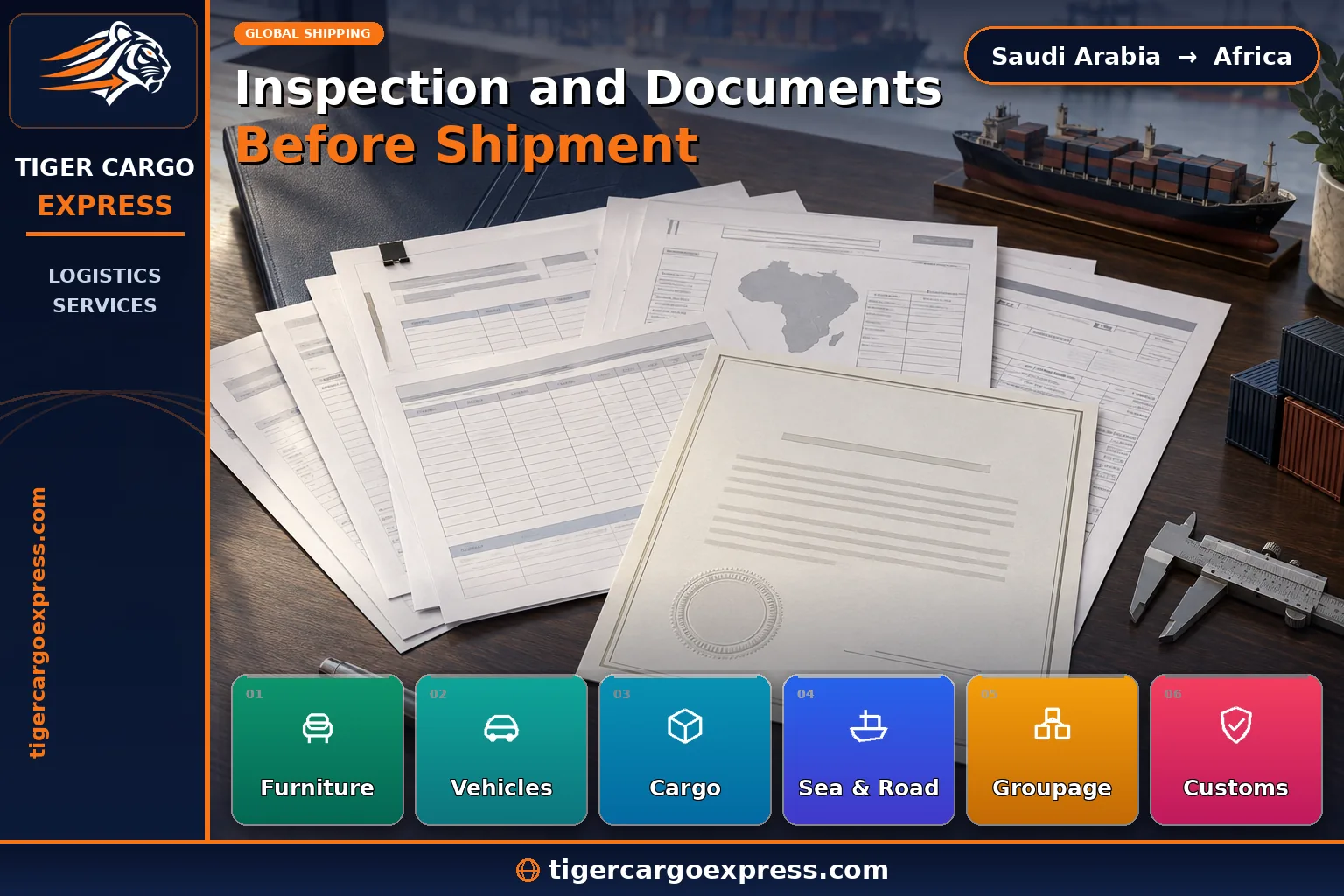
Documents required
Clearance, transit and demurrage
- ▸ ⭐ For coastal destinations: one clearance at the port of arrival, then inland delivery.
- ▸ ⭐⭐ For landlocked destinations: two files, not one — a transit file at the neighbouring port and the borders, and a final clearance file on entry into your country. We handle both.
- ▸ ⭐ And the file is prepared before sailing: because a shipment stopped at an international border in the middle of a corridor is harder to rescue than one stopped in a port.
- ▸ ⭐ The inventory tied to carton numbers: and your shipment may be inspected more than once — at the port and at the border — so tied numbering saves opening the whole shipment each time.
- ▸ ⚠️ And demurrage is more dangerous here than on any other continent: because the free days are counted at a port you are not in, and you may be in another country entirely. We report them to you in writing from the discharge date.
- ▸ Then the road stage along the corridor: with its declared schedule and written margin.
Prohibited items and insurance
- ▸ Flammable and pressurised materials: aerosols, paints, solvents, fuel and gas — excluded entirely from any shipment.
- ▸ Weapons and ammunition: of every kind, subject to strict permits and regulation.
- ▸ ⭐ Protected species products: ivory, horn or rare hides — and enforcement on this is among the strictest in the world across Africa, even for a family heirloom.
- ▸ ⭐ Foodstuffs and animal or plant products: subject to sanitary control on entry and at every border along the corridor — and we advise against shipping them with household effects.
- ▸ Untreated timber: every crate and pallet needs certified treatment and a visible mark — and it is checked at transit too.
- ▸ ⭐⭐ And insurance matters more here than on any other continent: a port-to-port policy ends in a country that is not yours, and before a corridor running hundreds of kilometres. We confirm in writing that cover extends along the corridor through to delivery — and present clauses, not headings.
How to choose a shipping company to Africa — and what we commit to
⭐ We write the corridor, its length and the border count.
⭐ We review your destination’s requirements before booking.
⭐ We handle both files.
⭐ We dismantle what can be dismantled, block dust and absorb vibration.
⭐ We settle both before booking.
⭐ We confirm it in writing and present clauses, not headings.
How to reduce your shipping cost to Africa
- ▸ ⭐ Compare the two corridors if your destination has two. Rwanda, Burundi and Zambia are served by two different corridors — and the gap between them in duration and cost is substantial.
- ▸ ⭐ Choose a full container if your destination is landlocked. It crosses the corridor as one unit under a single transit — LCL adds regrouping and extra handling on the road.
- ▸ ⭐ Separate commercial from personal from the start. A mixed file may be read as commercial in its entirety — pulling in requirements you did not need.
- ▸ ⭐ Do not economise on road-grade packing. A piece whose joints shake loose after a thousand kilometres costs more than an hour of dismantling in your home.
- ▸ ⭐ Use the short Red Sea lane if your destination is on it. The short sea transit makes shared consignments worthwhile even for small shipments.
- ▸ Settle the steering side and age limit before shipping the vehicle. Shipping a vehicle that cannot be brought in is a total loss.
- ▸ Consolidate into one consignment. Two batches to a landlocked country mean two transit procedures and two corridor runs.
When do prices rise and transit times stretch?
| Situation | Where it weighs most | What we do |
|---|---|---|
| ⭐⭐ Corridor and border congestion | The sixteen landlocked countries | A written margin plus daily tracking of the shipment |
| ⭐ Cargo that left without a certificate of conformity | Countries that require one | We prevent it happening at all — there is no remedy |
| ⭐ The rainy season | East and Central African corridors | A written schedule margin, not a spoken one |
| ⚠️ Demurrage at a distant port | Every landlocked destination | A complete file before sailing, not before arrival |
| ⭐ A destination on the western seaboard | West and Central Africa | We state the transit plainly — it is longer than assumed |
| ⚠️ Red Sea disruption | The north-eastern seaboard | We track the position before fixing any date |
How we work: five steps
Five recurring mistakes — all of them avoidable
- ▸ Accepting a quote that does not name the corridor. The most common and most expensive error — for a landlocked destination the overland corridor may be the largest line, and the sea leg the smallest.
- ▸ Ignoring pre-shipment inspection. Cargo that left without a certificate of conformity — where one is required — cannot have its position corrected on arrival, because the inspection had to take place here.
- ▸ Mixing commercial and personal in one file. The whole file may then be read as commercial — pulling in requirements you did not need.
- ▸ Packing for a sea voyage only. Vibration and dust work after the port for hundreds of kilometres — and assembled furniture suffers first.
- ▸ Shipping the vehicle before settling the steering side and age limit. The continent is split between two driving systems, and age limits in some countries are among the strictest anywhere — the error is a loss, not a delay.
Frequently asked questions about shipping from Saudi Arabia to Africa
In summary
We said in our Europe guide that the question there is “which sea?”, and in our Asia guide that it is “which ring?”. In Africa the question is: does your country have a coast at all — and if not, whose port do you borrow? The continent has sixteen landlocked countries, and shipping to it is not measured in ports but in corridors. Add two reversals: your shipment may be inspected before it leaves rather than after it arrives, and your packing must survive the road, not the quay alone. And in return it has an advantage no other continent has: the Red Sea we share. What you need here is three things: a company that asks whether your country has a coast before it quotes, a quote that names the corridor, its length and the border count, and packing designed for the road. Tiger Cargo Express gives you all three before you ship.
Send us your shipment details — the country and city by name, the approximate volume, your departure city, and whether it is personal or commercial — and we will come back with a detailed quote naming the corridor and its length within 60 minutes. 0506688227
See also our Europe guide · Asia guide · and our international shipping service page.
Tags:
shipping to Africa · Saudi Arabia to Africa · car shipping Africa · furniture moving Africa · overland corridors · landlocked countries · Djibouti Corridor · Northern Corridor · Central Corridor · Mombasa · Dar es Salaam · pre-shipment inspection · certificate of conformity · Red Sea · transit procedure · sea freight Africa · air freight Africa · FCL Africa · Africa shipping guide · Tiger Cargo Express
Related Shipping Guides
Continue with practical guidance connected to the same route or shipping decision.
Furniture and Car Shipping Company from Saudi Arabia to the Gulf 0506688227
⚠️ "How much does shipping to Kuwait cost?" is a question missing three things. Shipping from Riyadh is not shipping…
Shipping Company from Saudi Arabia to the Middle East 0506688227 — Overland Guide
The Middle East overturns all of it: it is the only destination whose journey starts at your front door rather…
Shipping Company from Saudi Arabia to Oceania 0506688227 — The Biosecurity Guide
On every preceding continent the question was: what is inside your shipment? Oceania asks an entirely different one: what is…
Send your shipment details and get a written quote
We reply within 60 minutes during working hours — with what the price includes and what it does not, stated before you commit.