
Car and Equipment Shipping Company from Saudi Arabia to Ethiopia 0506688227 Your Container Clears 900 km From the Sea
Car and equipment shipping from Saudi Arabia to Ethiopia — a destination with no coastline. Your container clears at a dry port nine hundred kilometres from the nearest wave, and the road leg is half the journey, not its last mile. Add the ban on importing internal-combustion vehicles — your petrol car does not enter at all.
Guide contents ShowHide
Looking for a car and equipment shipping company from Saudi Arabia to Ethiopia that knows your container will be cleared nine hundred kilometres from the nearest sea? Tiger Cargo Express ships equipment, furniture, goods and vehicles to Addis Ababa and the rest of Ethiopia, by sea and road corridor, with dismantling, packing and reassembly, clearance at both ends, and cargo insurance. To book: 0506688227
In our previous article we wrote about Djibouti, and said its port serves its neighbour more than it serves itself.
This article is about that neighbour.
Ethiopia is a destination with no coastline at all — and that overturns everything we built across fifty-eight articles:
Your container is cleared at a dry port — nine hundred kilometres from the nearest wave.
At every earlier destination the “port of arrival” was an address on a coast, and the quay was where the sea ended and the land began.
Here the quay is in one country and the clearance in another — with a mountain road between them, climbing from the Red Sea to the highlands.
And your petrol car? It does not enter at all.
What do we ship from Saudi Arabia to Ethiopia?
Traffic on this lane is commercial, industrial and professional: importers and manufacturers, people relocating on contracts in the industrial, agricultural and diplomatic sectors, families and returnees.
A destination with no coast — and one corridor
Ethiopia lost its coastline in 1993, when Eritrea became an independent state. It has been landlocked ever since — and more than 95% of its imports and exports move through a single corridor running roughly 900 kilometres from the Red Sea to the highlands.
Three things that change your file from the outset:▸ ⭐ Your shipment crosses a land border. It arrives at a port in one country, then crosses into another. This is the first file in our series that deals with two sovereignties rather than one.
▸ ⭐ The road leg is not a “last mile” — it is half the journey. In the USA, inland transport was a line in the quote. Here it is the quote.
▸ ⚠️ And the cost of trade in landlocked countries is roughly twice that of coastal ones — which is not marketing hyperbole but a structural fact we tell you before you price anything.
So we do not ask you “which port?” — we ask “which corridor, and which dry port?”
⭐ And in return, real good news: because this corridor is the artery of two economies rather than one, its infrastructure is mature and seriously managed. Port activity accounts for around 76% of Djibouti’s GDP, and Ethiopian transit generates roughly a quarter of its income. Both sides need the corridor to work — and that serves you.
⭐ The dry ports — your container’s real address
And here is the idea we have not written in fifty-eight articles.
Ethiopia built a network of inland dry ports to offset the effects of being landlocked. There are eight operational ones:Modjo — among the largest and busiest · Qality · Semera · Mekelle · Dire Dawa · Gelan · Kombolcha · Hawassa · Woreta.
⭐ A dry port is not a warehouse — it is a full customs facility treated as a port: the container arrives there under transit, is cleared there, and is released from there.
Which means your “port of arrival” is not on the Red Sea — it is inland in Ethiopia, close to your city.
And this is the best thing about this lane: instead of clearing your shipment on a distant coast and then hauling it cleared for nine hundred kilometres, it travels under transit and clears near your door.
⭐ And why does that change our first question to you?
Because choosing the dry port determines how many kilometres your shipment travels cleared at your own cost — and how many it travels under transit within the carriage contract.
Someone living in Hawassa whose shipment clears at Modjo pays for an extra road journey. Someone whose shipment clears at the dry port nearest them removes it.
⚠️ And this is decided at booking, not on arrival — because the transit destination is fixed in the documents from the start. So we ask about your city before we ask about your volume.
⚠️ Car shipping — the destination that does not accept petrol
We place this section early rather than at the end of the article, because it settles your decision before you read a line about prices.
Ethiopia has taken a step with no parallel anywhere in our series:▸ In January 2024 — a ban on importing fully built fuel-powered vehicles.
▸ In May 2025 — the ban was extended to assembly kits, semi-knocked-down and completely knocked-down.
▸ Electric and hybrid vehicles are exempt, and are given incentives: a VAT exemption and relief from consumption tax and surtax.
⚠️ Which means, without softening: your Gulf-market petrol or diesel car does not enter.
Note how different that is from everything we have written:
▸ 🇯🇵 Japan asked: “where will you park it?”
▸ 🇭🇰 Hong Kong asked: “what does the parking cost?”
▸ 🇺🇸 The USA asked: “does it meet the standards?”
▸ 🇸🇬 Singapore asked: “can you own it at all?”
▸ 🇪🇹 Ethiopia asks nothing — it says no.
This is the shortest car section in our series, because the answer does not admit elaboration.
⭐ The only open route is electric or hybrid. If that is your case, we review the model, year and specification with you before booking, and prepare its file separately from the furniture file.
What we set out is the framework in force as we work with it in practice — and we state regulatory policy as a fact we comply with, not as an opinion about it. Some details are decided case by case by the competent authority, requirements are subject to update, and this file in particular has seen successive changes.So we review the current position with you before booking, and we do not build on what we read a year ago. We prepare the file and coordinate the timing — we do not give legal, tax or immigration advice.
Shipping for embassies, consulates and their staff
Addis Ababa has one of Africa’s densest diplomatic and international presences.
Shipments for diplomatic and consular missions and their staff do not run through the personal-effects route and are not bound by its conditions. The basis here is the mission’s status or your accreditation to it, the reference framework is the Vienna Convention on Diplomatic Relations of 1961, and treatment is approved through the competent official channels.
This is the clearest difference here — and it is operational rather than fiscal.Diplomatic status is read on the customs side, and that is clear and provided for.
⚠️ But it does not shorten the corridor.
Mission cargo crosses the same distance, the same border and the same mountain road — nine hundred kilometres from coast to highland. Geography exempts nobody.
Which means that the hardest part of this file — the corridor — remains for a mission exactly as it remains for anyone else.
So we plan mission cargo with the same care in packing, scheduling and dry-port selection — because what protects cargo here is engineering, not privilege.
- ▸ We settle the status first and build the file on it — not the other way round.
- ▸ ⭐ And we plan for the corridor in every case — packing, scheduling and dry-port choice, without exception.
- ▸ We begin with the competent department, not the individual — official correspondence is the foundation of the whole file.
- ▸ We match the consignee’s name and status between the correspondence and the bill of lading letter for letter before issue.
- ▸ We document the inventory to a higher standard and hand it over certified by both parties.
- ▸ We treat everything in strict confidence — information, contents and movement dates.
And we say plainly: determining what the exemption covers and its extent rests with the competent authorities, and the mission has its own official channels. Our role is purely logistical. We work both directions.
Equipment moving company from Saudi Arabia to Ethiopia
And the packing here is designed for two journeys, not one.
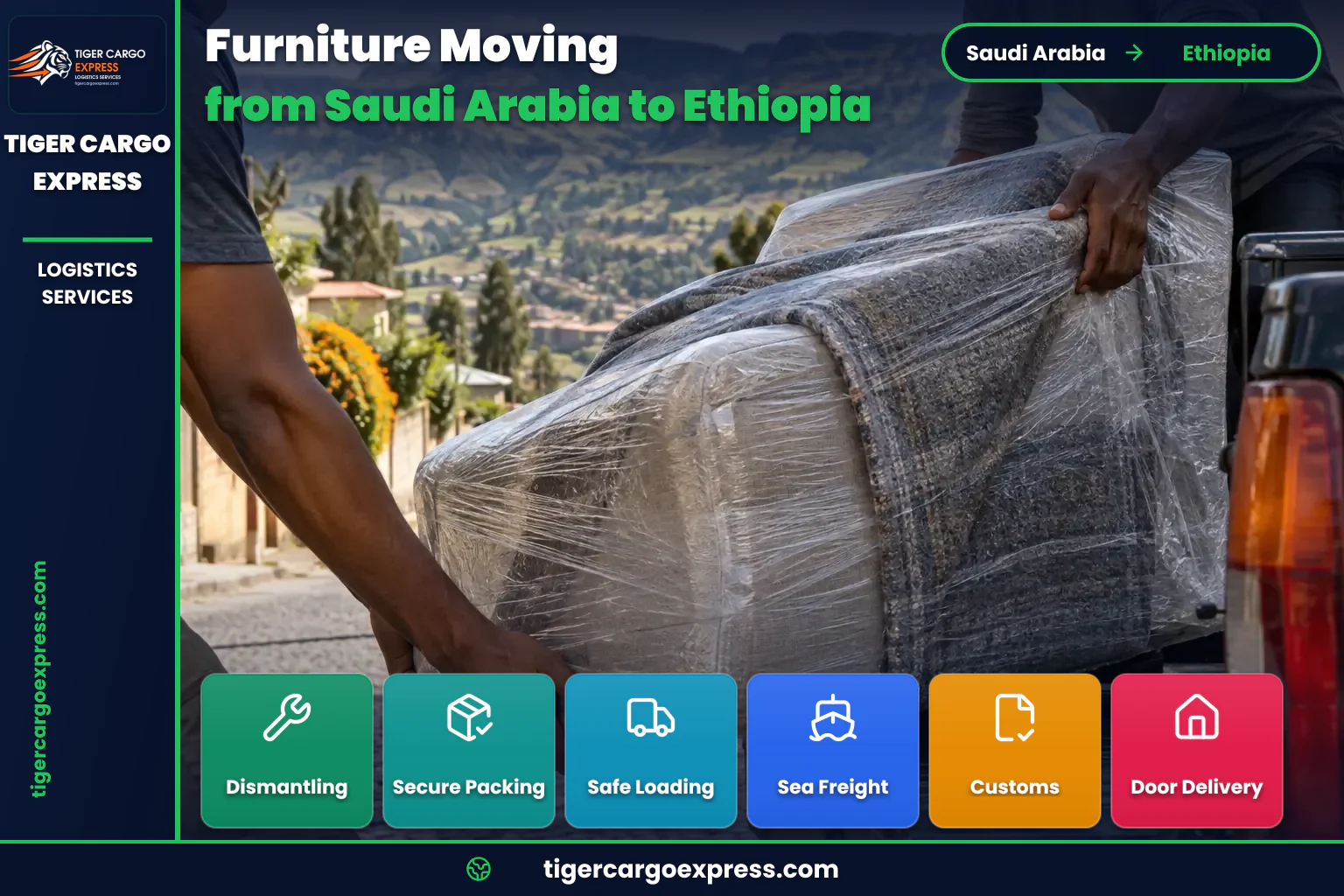
- ▸ ⭐ Packing for two journeys: a sea crossing and then a long mountain road — and sustained road vibration is harder on furniture than a calm sea. We pack on that basis.
- ▸ ⭐ Choosing the dry port by your city: before booking — because it is fixed in the transit documents from the start.
- ▸ ⭐ Heavy internal bracing: a load that shifts inside a container on a mountain road damages itself — and empty space is your enemy here, not weight.
- ▸ Reviewing appliances against the highland climate: the plateau is temperate, even cool, not hot — the exact opposite of Djibouti.
- ▸ Treated and marked timber: every crate and pallet, with approved treatment and visible marking.
- ▸ Survey and volume estimate: in cubic metres — even for a few boxes.
- ▸ Dismantling, unpacking and reassembly: in your new home, with an inventory check alongside you, piece by piece.
The corridor: from quay to highland
| Stage | What happens | Its weight |
|---|---|---|
| 1 — The sea crossing | Jeddah to a Red Sea port | The shortest and easiest — days, not weeks |
| 2 — Handling and transit conversion | Opening the transit file and fixing the dry-port destination | ⭐ Where a late file is paid for |
| ⭐ 3 — The road leg | Roughly 900 km climbing to the highlands and a border crossing | The longest stage and the hardest on cargo |
| ⭐ 4 — The dry port | The actual clearance, inland | Where the shipment truly becomes yours |
| 5 — Final delivery | From the dry port to your door | Short if we chose the dry port well |
Note stages three and four. The longest stage does not end in delivery but in clearance — your shipment covers nine hundred kilometres before it has been cleared at all. And that is precisely what makes the transit regime a benefit rather than a burden: without it, the goods would have to be cleared on the coast and then hauled cleared, with everything that implies.
Corridor alternatives
Alongside the main corridor, other regional ports are used as logistical options depending on where in Ethiopia the destination sits and what the cargo is — and we mention them as operational options, nothing more.
⭐ And our position is plain: we do not sell you an alternative corridor merely because it is an alternative. The main corridor is the shortest and most mature in most cases, and an alternative is assessed when your destination inside Ethiopia genuinely makes it logical — not when it is simply an extra name to decorate a quote.
Shipping methods
Note the difference from everything before. At every other destination, air bought you time. Here it buys you an entirely different route — and removes nine hundred kilometres of vibration from pieces that cannot take it. Which is why we sometimes propose it for part of your shipment rather than all of it.
Full container, shared load or boxes?
| Aspect | Full container | Shared load | Boxes or air |
|---|---|---|---|
| When it suits you | A whole home or equipment | A room or two plus appliances | Sensitive and valuable pieces |
| ⭐ On the road corridor | Best by far — your load alone, braced by us | ⚠️ You share the container with someone else’s bracing | The safest — it avoids the corridor entirely |
| ⭐ Dry-port flexibility | You pick the one nearest your city | Usually follows the consolidator’s destination | Not applicable — the airport directly |
| Pricing | A fixed container rate plus the corridor | Per cubic metre with a minimum | Per box or by volumetric weight |
Note the two middle rows — considerations that exist at no coastal destination. A full container here is not a luxury but protection: your load alone, braced by us, and its inland destination chosen freely. In a shared load, your goods travel nine hundred kilometres beside bracing we did not put there.
Ethiopian cities we cover
Door delivery — and every city is read through the dry port nearest it.
Adama
Dire Dawa
Hawassa
Mekelle
Bahir Dar
Jimma
Gondar
Dessie
Harar
Kombolcha
Semera
Bishoftu
Shashamane
Nekemte
Arba Minch
Shipping prices from Saudi Arabia to Ethiopia
The final quote is built on the survey and the dry port — with the corridor line stated in it, not hidden.
| Shipment type or line | Price | Unit and notes |
|---|---|---|
| Boxes and small shipments | Request a quote — set by survey | Per box or by weight |
| Shared load (LCL) | Request a quote — set by survey | Per cubic metre with a minimum |
| 20ft / 40ft container | Request a quote — set by survey | And we recommend it on this lane to protect the load |
| Air freight | Request a quote — set by survey | By volumetric weight — and it removes the road corridor entirely |
| ⭐ The road corridor and border crossing | Set in the quote, by your destination | The largest line in the quote — and we state it rather than dissolve it |
| ⭐ Dry-port handling | Set in the quote, by your destination | A line with no parallel — because clearance happens inland |
| Import duties and taxes | Set after your file is reviewed | By classification and status — at the prevailing rates |
| ⚠️ The vehicle file | Set after your file is reviewed | Electric and hybrid only — petrol is outside the route |
Note the first red line. The corridor is the largest item in your quote — and that is a structural fact, not a pricing choice. We state it openly rather than dissolve it into a lump sum, because whoever dissolves it looks cheaper and then surprises you. You deserve to see where your money goes.
Documents required
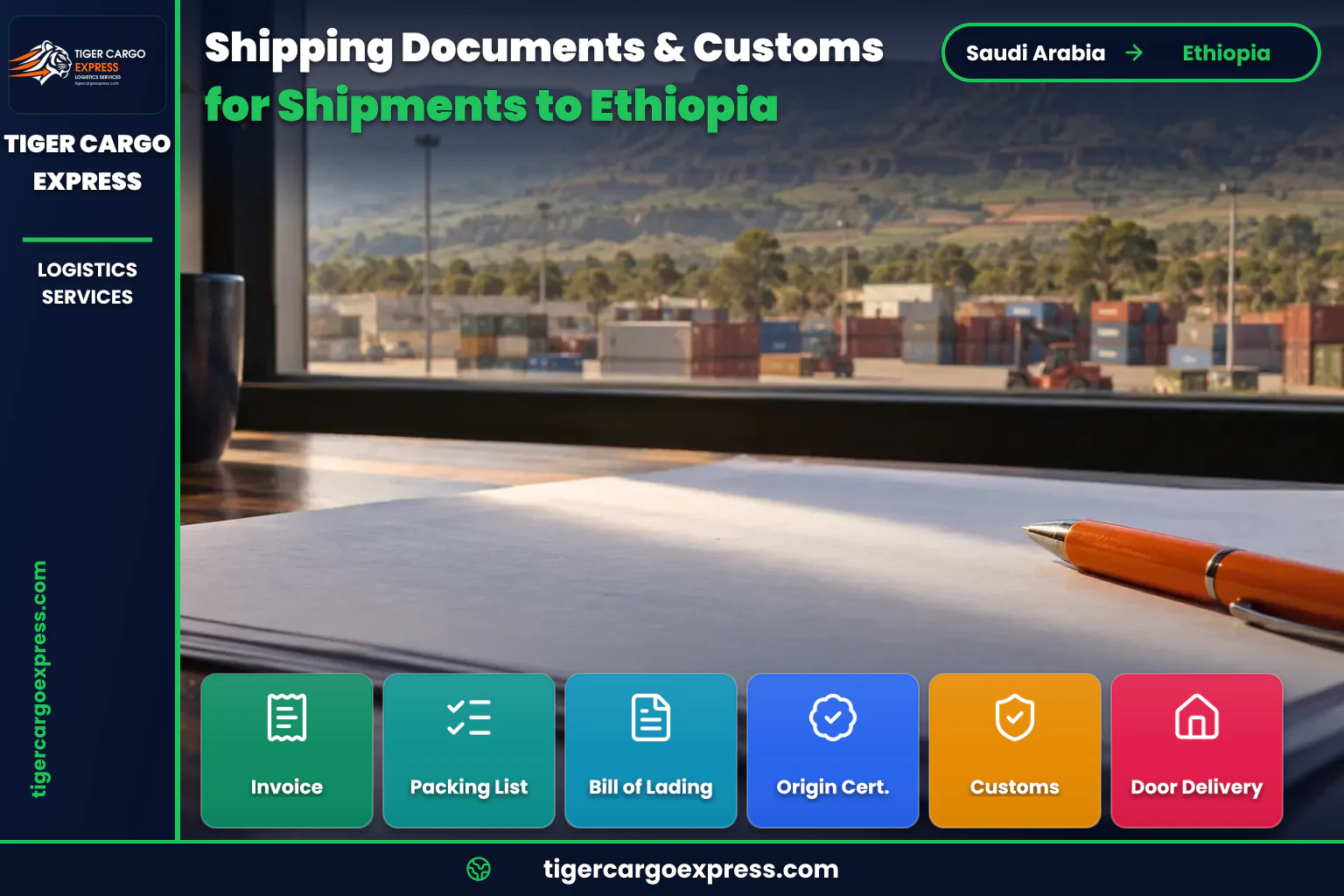
First: which city inside Ethiopia? — because it determines the dry port, and the dry port is fixed in the transit documents from the start and is not easily changed afterwards.Second: is there a vehicle in your shipment? — and if the answer is yes, our next question is: electric or not? There is no third question after it.
Note that the first is geographic and the second regulatory — and both are settled before price.
Anyone who asks you about cubic metres first is pricing you a sea crossing — and the sea is the shortest stage of this journey.
Clearance and standing charges
We handle clearance at both ends. The actual clearance takes place at the dry port, not on the coast — as explained in its own section.
A shipment here can stand in two possible places, not one:▸ Standing at the transit port — if the conversion into the transit regime is late.
▸ And standing at the dry port — if the final clearance file is late.
⚠️ And each has its own separate charges.
Which means a single incomplete file can cost you twice — once on the coast and once inland.
That is why the file here is built to serve two stops, and why we insist on closing it before sailing.
So we say: delay on this lane does not multiply by days but by stops.
Prohibited and restricted items
- ▸ Flammables and pressurised goods: aerosols, paints, solvents, fuel and gas — and the risk doubles on a long mountain road.
- ▸ ⚠️ Fuel-powered vehicles: banned from import — fully built or as assembly kits, as explained in their section.
- ▸ Weapons and ammunition: of every kind — under strict permits and never listed among household furniture.
- ▸ Food and agricultural products: under health and phytosanitary control — and we advise against shipping them among personal effects.
- ▸ Medicines and medical supplies: requiring prior approvals — personal use by prescription.
- ▸ Radio and transmitting equipment: requiring approval from the competent authority — an item often overlooked.
- ▸ Untreated timber: every crate or pallet needs approved treatment and visible marking.
- ▸ Products of protected species: ivory, hides or rare shells — even as a family heirloom.
In the Djibouti article we said: ship your air conditioner — the destination is among the hottest climates on earth and your Gulf-market unit was built for it.⚠️ Here we say the exact opposite.
Addis Ababa and most Ethiopian cities sit on a high plateau — with a temperate, even cool, climate year round, cold at night.
Which means your Gulf air conditioner — the heaviest item in your home — may not be needed at all.
⭐ And this is a large financial decision: you would pay to ship it by sea and then nine hundred kilometres by road — the most expensive haul per cubic metre in our entire series.
We say it plainly: two neighbouring countries, two opposite pieces of advice — because altitude changes everything.
Packing and insurance
The challenge on this lane is not the sea but the road — a complete reversal of everything we have written.
Inland delivery after clearance
- ▸ ⭐ The short distance is the reward: if we chose the dry port well, the final delivery is a short run rather than a continental one.
- ▸ ⭐ Steep streets in the capital: Addis Ababa is a mountain city — some districts have narrow access and slopes, and we plan the last stretch in advance.
- ▸ Residential buildings with limited lifts: we arrange the delivery slot with management in advance where needed.
- ▸ The rainy season: slows inland roads for parts of the year — and we allow a written margin for it.
- ▸ Orderly unloading and an inventory check with you: piece by piece — more important here than anywhere, after a two-stage journey.
The reverse direction — Ethiopia to Saudi Arabia
We work both directions on the same corridor. The dominant traffic out of Ethiopia is coffee and agricultural products, textiles and leather, minerals and food products, alongside the effects of returnees and mission staff.
⚠️ And the same logic applies in reverse: the shipment starts at an inland dry port, crosses the road corridor, then loads by sea. The road leg remains half the journey in both directions — and bracing remains more important than packing. We review your list before loading against Saudi import restrictions.
How to choose a shipping company to Ethiopia
Our written guarantees
How to lower the cost of your shipment
- ▸ ⭐ Ship less — the saving here is doubled. Every cubic metre is paid for by sea and then over nine hundred kilometres of road. Volume costs more here than at any coastal destination.
- ▸ ⭐ Leave the air conditioners. The plateau is temperate, even cool — and they are the heaviest item over the heaviest corridor for no benefit.
- ▸ ⭐ Choose the dry port nearest your city. Every extra kilometre after clearance is paid twice: in haulage and in handling.
- ▸ Split the sensitive pieces onto air. A small part flown may spare you a large loss by road.
- ▸ Close your file before sailing. Delay here multiplies by stops, not by days.
- ▸ Allow full dismantling. It cuts volume and makes bracing inside the container easier — two benefits, not one.
- ▸ Do not buy an alternative corridor without a reason. The main corridor is the shortest and most mature in most cases.
When do rates rise and transits lengthen?
| Period or situation | What happens |
|---|---|
| ⭐ Peak national import season | The heaviest pressure on this lane — one corridor carries an entire country’s trade, and the pressure falls on trucks, not ships. |
| ⭐ The rainy season | Slows mountain and inland roads for parts of the year — and we allow a written margin. |
| Holidays at either end | Administrative pauses — and their effect doubles here because the file serves two stops. We schedule around them. |
| ⭐ Red Sea disruption | Its effect here is direct — the entire first stage sits inside the Red Sea, and we monitor it before fixing any date. |
| Truck availability | A factor specific to this lane — the vessel may arrive on schedule and your shipment waits for a truck, not a ship. |
How we work: five steps
Five recurring mistakes — all avoidable
- ▸ Treating the file as a coastal file. The mistake most specific here — clearance happens at an inland dry port, and the file serves two sovereignties, not one.
- ▸ Packing for the sea rather than the road. The danger here is nine hundred kilometres of vibration — and bracing matters more than packing.
- ▸ Shipping a petrol vehicle. It does not enter — fully built or as assembly kits; electric and hybrid are the only route.
- ▸ Shipping air conditioners. The heaviest item over the heaviest corridor — to a temperate plateau that usually does not need them.
- ▸ Insurance covering the sea alone. Half your journey is on the road — and an incomplete policy is discovered only after the damage.
Why Tiger Cargo Express?
Because we price the whole journey, not the sea part of it. Ethiopia is a destination with no coast, and the sea is the shortest stage of your journey — anyone who prices you a sea crossing and dissolves the corridor into a lump sum looks cheaper and then surprises you. We state the corridor line openly because you deserve to see where your money goes.
We choose the dry port nearest your city before booking, because it is fixed in the transit documents and not easily changed. We brace rather than merely pack, because the danger on this lane is road vibration, not sea swell. And we advise you to leave your air conditioner behind even though it is the heaviest item on our invoice — because the plateau does not need it, and you should not pay to haul what you will never switch on.
Frequently asked questions about shipping from Saudi Arabia to Ethiopia
In summary
Ethiopia is a destination with no coast — and your container is cleared at a dry port nine hundred kilometres from the nearest wave. More than 95% of its trade moves through a single corridor, eight operational dry ports are the real arrival addresses, and the road leg is half the journey rather than its last mile. Add the ban on importing internal-combustion vehicles — your petrol car does not enter at all. What you need here is three things: a dry port chosen by your city before booking, heavy bracing rather than packing alone, and a quote that states the corridor line instead of dissolving it. Tiger Cargo Express gives you all three before you ship.
Send your shipment details — approximate volume, origin city, your city inside Ethiopia, and whether your shipment includes a vehicle and of what type — and we reply with a detailed quote with stated lines within 60 minutes. 0506688227
Where does Ethiopia sit on our map?
Shipping to Ethiopia is one lane within a wider region — and the full Africa guide explains the rules governing it and its neighbours together: the route, the customs framework, and the challenge that lane is priced around.
Related Shipping Guides
Continue with practical guidance connected to the same route or shipping decision.
Furniture and Car Shipping Company from Saudi Arabia to the Gulf 0506688227
⚠️ "How much does shipping to Kuwait cost?" is a question missing three things. Shipping from Riyadh is not shipping…
Shipping Company from Saudi Arabia to the Middle East 0506688227 — Overland Guide
The Middle East overturns all of it: it is the only destination whose journey starts at your front door rather…
Shipping Company from Saudi Arabia to Oceania 0506688227 — The Biosecurity Guide
On every preceding continent the question was: what is inside your shipment? Oceania asks an entirely different one: what is…
Send your shipment details and get a written quote
We reply within 60 minutes during working hours — with what the price includes and what it does not, stated before you commit.