
Shipping Company from Saudi Arabia to Somalia 0506688227 — Your Container Never Leaves the Quay
Across sixty destinations the container left sealed for your door. In Somalia it is stripped inside the port, and your goods leave piece by piece — in Mogadishu by the owner's own arrangement, in Berbera onto conventional trucks inside the terminal. That changes package weight, carton strength and numbering entirely. Add a declared weight ceiling that varies by port — the 40ft carries less than the 20ft — a fortnightly cycle that makes the cut-off matter more than the sailing date, and a bill of lading issued as a single original.
Guide contents ShowHide
Looking for a shipping company from Saudi Arabia to Somalia that knows what happens to your container after the vessel berths? Tiger Cargo Express moves commercial cargo, household supplies, furniture and vehicles to Mogadishu, Berbera, Bosaso and Kismayo on a regular service — with packing designed specifically for this lane, plus clearance and full coordination. To book: 0506688227
We covered four destinations before this one in this group. In every one of them the big question was when your container is released: the document deadline, the ninety-day window, the continuity condition, the demurrage clock.
Here the question is entirely different.
Your container never leaves the quay.
Across sixty destinations we have written about, the container was released and moved sealed to your door, then opened in front of you.
Here it is stripped inside the port — and your goods leave piece by piece, not by the container.
That changes everything about how your goods are packed, what your shipment weighs and how your cartons are numbered — and anyone who ships here the way they ship elsewhere receives their goods damaged or short.
What we ship from Saudi Arabia to Somalia
Traffic on this lane is largely commercial, and partly family: importers and suppliers, people relocating, and families sending supplies to relatives.
⭐⭐ Your container never leaves the quay
Containers here are stripped inside the port — they do not leave sealed for your destination.
Stop and consider what that actually means.
In every destination we have covered before this one, the sequence was: vessel → quay → release → truck → your door → opening.
⭐ Here the sequence is: vessel → quay → opening → piece-by-piece stripping → transport → your destination.
Which means every carton in your shipment will be carried by a human hand — at least once, and usually more.
⚠️ This is not a flaw in the port or in anyone — it is the established way of working, which we respect and plan around.
But anyone who ships here with packing designed for a sealed journey is shipping goods into a reality nobody prepared them for.
⭐ In Mogadishu
All containers are stripped inside the port, and the goods are then moved by the owner’s own arrangement. Which means the final stretch is not part of the container’s movement — it is an independent arrangement that begins inside the terminal. And we arrange it for you rather than leaving you to discover it on arrival.
⭐ And in Berbera
Containers are stripped and the goods loaded onto conventional trucks inside the terminal. So the exit is by flatbed or conventional closed truck — not by container on a trailer. ⚠️ Which means the size and shape of each package decide whether it can be loaded at all — and what would have been crane-loaded inside a container may need to be split here.
Four things change in your shipment — all of them before it loads in Jeddah or Dammam, not after it arrives:
▸ The weight of each package: what will be carried by hand must be carriable by hand — a heavy carton gets dropped or dragged.
▸ Carton strength: no single-wall cardboard — double-wall, or treated timber where it is warranted.
▸ Numbering and tallying: every package numbered and documented — because a piece-by-piece exit means a piece-by-piece tally.
▸ Content distribution: heavy never on top of fragile, and never all the high value in one package.
This is not an “optional extra” we are selling — it is the minimum for anyone who understands how goods are delivered here.
Operational requirements on this lane differ from port to port — weight limits, the exit format, and the availability of any given service all follow the arrival port rather than the country.
So we say it plainly: we confirm requirements with the arrival port before booking.
⚠️ We do not hand you a general figure “for Somalia” and then apologise at the quay — we ask which port first, then answer.
We treat ports as logistical destinations, and work inside the limits of our work: packing, loading, shipping and coordination. Anything beyond that we refer to those qualified for it, and do not opine on.
⭐ Weight limits — and two figures, not one
This is the second thing that sets this lane apart. Weight here is a declared, specific constraint — not left to judgement as it is in many destinations. And it differs from port to port.
| Port | Weight limit | What it means for you |
|---|---|---|
| ⭐ Mogadishu | 35 tonnes gross | The limit is on the gross — container and contents together |
| ⭐ Berbera — 20ft | 28 tonnes | Governed by vessel capacity at 30 tonnes |
| ⭐ Berbera — 40ft | 26 tonnes | The 40ft takes less than the 20ft — the container itself weighs more |
| Bosaso and Kismayo | Confirmed before booking | We ask the port rather than assume |
A 40ft container carries less weight than a 20ft.
That looks inverted at first glance — and it is entirely logical: the limit is governed by vessel capacity at thirty tonnes, and the weight of the empty container itself is deducted from that limit. A 40ft is heavier empty than a 20ft, so less remains for its contents.
⭐ What follows from that in practice:
If your cargo is heavy — steel, ceramics, building materials — a 40ft is not “double” a 20ft.
▸ 20ft: less space, more weight.
▸ 40ft: more space, less weight.
⚠️ Anyone who books a 40ft assuming it carries double the weight discovers at loading that part of the cargo has to come out.
So we ask what your cargo weighs, not only what it measures — before we recommend a size.
Car shipping to Somalia
We ship vehicles on this lane in two formats: inside a container, or on a flat rack, depending on the vehicle and the arrival port.
- ▸ ⭐ We settle the format before booking: container or flat rack — the choice follows the arrival port, not your preference.
- ▸ ⭐ Weight enters the calculation here too: a vehicle inside a container counts against the same weight ceiling — it is not treated separately.
- ▸ Draining fuel and disconnecting the battery: a standard step with no exceptions — it is a vessel safety requirement.
- ▸ Four-point lashing inside the container: with straps and chocks — not an improvised timber wedge.
- ▸ Photographic documentation before sealing: exterior, interior and odometer reading — handed to you as a file.
- ▸ ⭐ Emptying the vehicle completely: no personal items inside — it is an independent line on the declaration, not a suitcase.
- ▸ Documents in the owner’s name: title, invoice and bill of lading — matched letter for letter.
⭐ Prohibited items — and what Sharia forbids
The import of anything forbidden by Islamic Sharia is prohibited.
That covers: alcoholic beverages · forbidden foodstuffs · counterfeit products · narcotics of every kind · weapons and ammunition · indecent publications and materials · toxic and hazardous waste.
⭐ Note the difference between this list and those of other destinations:
In most of what we have covered, the lists were technical: flammable materials, agricultural produce, untreated timber.
Here the basis is declared through a single reference, and everything else follows from it.
⚠️ Which works in your favour practically: the rule is understood without ambiguity by any shipper from Saudi Arabia, and the list needs no interpretation.
We review your list on that basis before loading — not after it arrives.
- ▸ Flammable and pressurised materials: aerosols, paints, solvents, fuel and gas — excluded entirely from any shipment.
- ▸ ⭐ Counterfeit products: an expressly stated item here — and we review your commercial branding before loading, because this concerns importers in particular.
- ▸ Untreated timber: every crate and pallet needs certified treatment and a visible mark.
- ▸ ⭐ Toxic and hazardous waste: an explicit item — and it covers what might be sent in good faith as “used equipment” while actually being waste.
- ▸ Whatever Saudi Arabia restricts on export: which we review from our side before loading — because a restriction can come from the departure side, not the arrival side.
Shipping for missions and international organisations
Organisational presence on this lane is substantial — and it follows an independent route.
Shipments for diplomatic and consular missions, international organisations and their staff do not travel the commercial cargo route and are not subject to its conditions. The basis here is the standing of the mission or organisation, or your accreditation to it; the reference framework for missions is the Vienna Convention on Diplomatic Relations of 1961, and for organisations their headquarters agreement and standing. Treatment is confirmed through the competent official channels.
The heaviest thing in this article is not a customs procedure — it is an operational reality.
The container is stripped inside the port whether the consignee is an importer or an international organisation.
⭐ So standing changes the path of the paperwork — it does not change the handling.
Which means an organisation’s shipment of sensitive equipment needs the same packing standard as a trader’s — in fact more, because the equipment is worth more and its replacements are further away.
⚠️ Anyone who planned on the basis that “the diplomatic documents are enough” prepared the paperwork and forgot the carton.
We prepare both.
- ▸ We establish standing first and build the file on it — not the other way round.
- ▸ ⭐ And we pack to the manual-handling standard in every case — the quay does not distinguish between one shipment and another.
- ▸ We start with the competent department, not the individual — formal correspondence is the foundation of the file.
- ▸ We match the consignee name and standing across the correspondence and the bill of lading before issuing.
- ▸ We document the inventory to a higher standard and deliver it certified by both parties.
- ▸ We maintain full confidentiality over information, contents and movement schedules.
And we say it plainly: determining what the treatment covers and how far it extends rests with the competent authorities, and the mission or organisation has its own official channels. Our role is purely logistical. We work in both directions.
Household goods moving from Saudi Arabia to Somalia
The work here starts with the carton — not the container.
- ▸ ⭐ Splitting the shipment into carriable packages: because every package will be carried by a human hand — and a heavy one gets dragged or dropped.
- ▸ ⭐ Double-wall cartons: no single-wall cardboard on this lane — and treated timber for what warrants it.
- ▸ ⭐ Numbering and a piece-by-piece tally: because a piece-by-piece exit means a piece-by-piece receipt — and the list is your only protection.
- ▸ ⭐ Distributing value across packages: never all the valuables in one carton — and never heavy on top of fragile.
- ▸ ⭐ Calculating weight before size: the weight ceiling may stop you filling the container — and volume alone misleads.
- ▸ Full dismantling where possible: it reduces volume, protects edges and eases manual carrying all at once.
- ▸ Photographic documentation before sealing: a number and a photo for every package — handed to you as a file before sailing.
Ports of entry and shipping methods
⭐ A fortnightly service — and what that means for your schedule
The service to Berbera runs on a fortnightly cycle via a feeder from Salalah.
⭐ This is a figure to build around — not one to ignore.
On the major lanes, sailings were weekly or more frequent, and being a day late cost you days.
⚠️ Here being one day late for the cut-off can cost you two full weeks.
That means three practical things:
▸ The cut-off date matters more than the sailing date — and we give you the first, not the second.
▸ The document file is prepared early — because one missing page means a whole cycle.
▸ And packing starts well before the cut-off — not on the day of it.
We give you a calendar with a specific cut-off date — not an open promise that “a vessel is coming soon.”
Full container, shared consignment or boxes?
| Aspect | Full container | Shared (LCL) | Boxes |
|---|---|---|---|
| When it suits you | A commercial consignment or a full home | A small batch or two rooms | Selected supplies for a family |
| ⭐ With stripping inside the port | Your goods alone in the strip — the tally is cleaner | ⚠️ Your goods are stripped alongside others’ — numbering is decisive | Easiest to tally — a limited numbered count |
| ⭐ With the weight ceiling | The constraint falls on you directly — we calculate it before booking | It falls on the consolidator — and may delay the cut-off | Not a practical concern for you |
| Pricing | Fixed rate plus stripping and transport | Per cubic metre or by weight — whichever is higher | Per box |
Look at the second row. In a shared consignment your goods are stripped inside the port alongside other shippers’ goods at the same time — and clear numbering is what separates your shipment from theirs. Anyone who ships LCL in unnumbered cartons has nothing to prove anything with.
Somali cities we cover
Berbera
Hargeisa
Bosaso
Kismayo
Galkayo
Garowe
Baidoa
Burao
Merca
Jowhar
Beledweyne
Shipping rates from Saudi Arabia to Somalia
The final quote is built on your port and the weight of your cargo — with every line item declared.
| Shipment type or line item | Price | Unit and notes |
|---|---|---|
| Boxes and small consignments | Request a quote — set by survey | Per box — in hand-carriable sizes |
| Shared consignment (LCL) | Request a quote — set by survey | Per cubic metre or by weight — whichever is higher |
| 20 ft container | Request a quote — set by survey | Less space, more weight — best for heavy cargo |
| 40 ft container | Request a quote — set by survey | More space, less weight — best for bulky cargo |
| ⭐ Manual-handling packing | Set in the quote, by your destination | A line item with no equivalent elsewhere — because goods exit piece by piece |
| ⭐ In-port stripping and transport | Set in the quote, by your destination | An independent line — because it is not part of the container’s movement |
| Vehicle shipping | Set after your file is reviewed | In a container or on a flat rack — depending on the port |
| ⚠️ Refrigerated shipping | Set after your file is reviewed | Not currently available at Berbera — we confirm availability before booking |
Note the green and orange rows. These are two line items we have not included in any destination before this one — because in those destinations they do not exist at all: the container left sealed, and the packing served a single journey. We declare them openly because they are real work, and because whoever does not price them for you today will bill you for them tomorrow.
Documents required
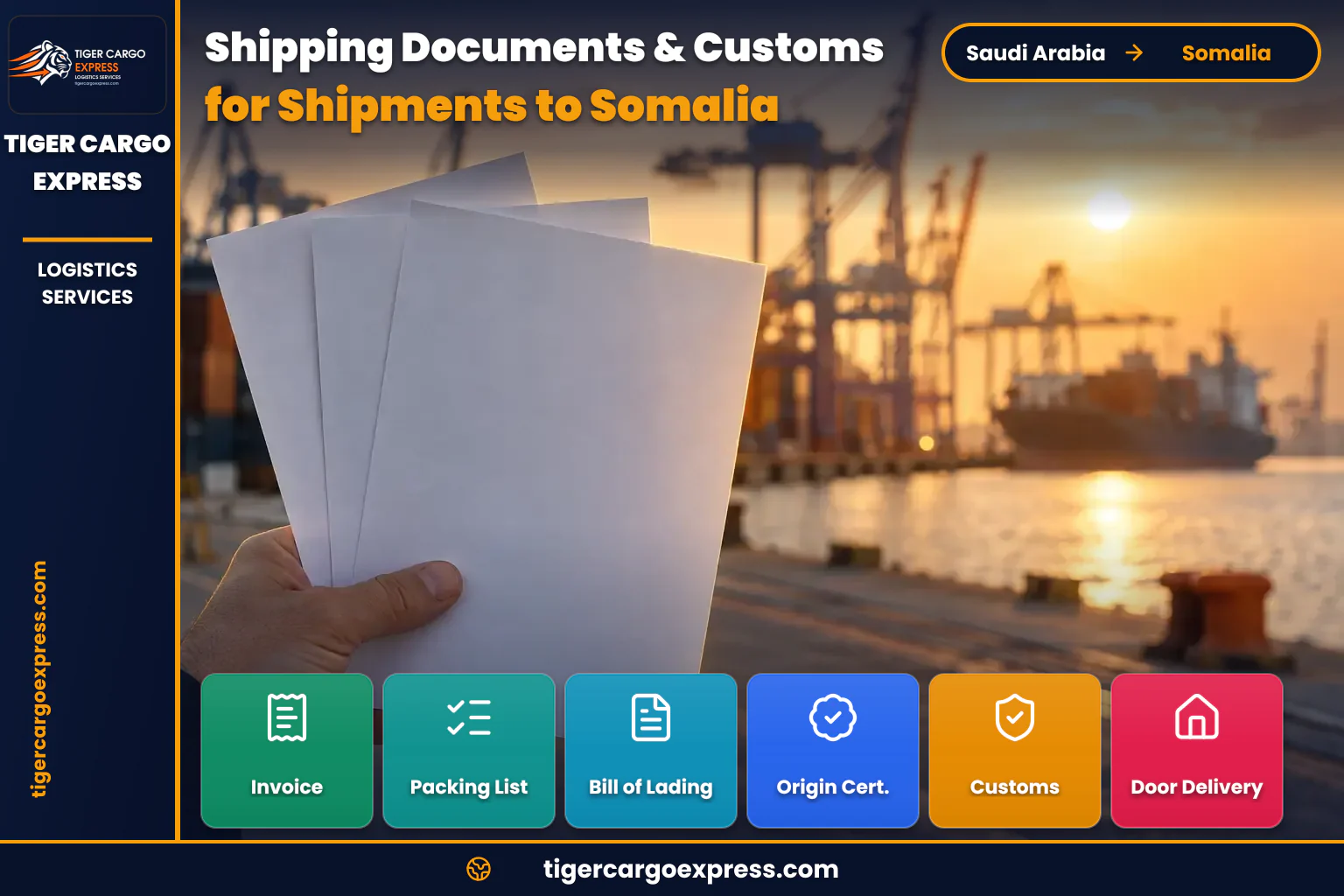
On most lanes the bill of lading is issued in three originals, and losing one stops nothing because two remain.
⭐ Here the original is one.
⚠️ Which means losing it in the post or at an intermediary means a complicated procedure to issue a replacement — with your cargo standing still throughout.
This is not deliberate complication — it is what makes the document itself carry more weight.
⭐ So we work to two rules on this lane:
▸ We do not hand the original to an unspecified party — only by documented handover to a named person.
▸ And we discuss express release with you where it is available and appropriate — rather than posting a document that has no substitute.
Anyone treating your bill of lading here the way they treat it on a European lane is risking a document with no backup copy.
Clearance and coordination on arrival
- ▸ ⭐ We confirm requirements with the arrival port before booking: weight, exit format and service availability — and assume nothing.
- ▸ ⭐ We plan for in-port stripping as a declared stage: not a surprise discovered at the quay.
- ▸ We prepare documents before the cut-off: because one missing page on a fortnightly lane means a whole cycle.
- ▸ We verify consignee details: name, contact and address — because a piece-by-piece receipt needs a present, identified person.
- ▸ We give the consignee the package list in advance: so they tally during receipt rather than after it — this is the most important page they hold.
- ▸ We follow through to final delivery: documenting what was delivered and when — we do not stop at the quay.
Packing, insurance — and refrigerated cargo
This is the section that separates a shipment arriving intact from one arriving short on this lane in particular.
Refrigerated shipping is not currently available at Berbera.
⭐ And we say this in the article rather than telling you after you book.
Anyone planning to ship cargo needing refrigeration to that port needs to know it now, not at the cut-off date.
⚠️ Alternatives are assessed case by case: a different port, a different shipping format, or rescheduling — each with its own cost and duration, which we present in writing.
We confirm the availability of any special service with the arrival port before booking — not after.
Anyone who promised you a service without asking the port promised you something they do not have.
On insurance: we confirm in writing that the policy covers the in-port stripping stage and the manual handling — not the sea voyage alone. ⚠️ A port-to-port policy stops at the quay, and most of what happens on this lane happens after the quay. We present the cover options by their clauses, not by their headings.
Inland delivery after the port
- ▸ ⭐ Transport starts inside the terminal: not at the port gate — and this is the first stage we arrange after the strip.
- ▸ ⭐ A conventional truck is the exit vehicle at Berbera: and we book one sized to your packages, not to a generic standard.
- ▸ Hargeisa from Berbera: a substantial road run — quoted as a declared line item.
- ▸ Interior cities: Galkayo, Garowe, Baidoa and Beledweyne — and we fix duration and cost before booking, not after.
- ▸ ⭐ Piece-by-piece receipt against a list: we give the consignee the package list before arrival so they tally during receipt.
- ▸ The rainy season: it slows interior roads — and we build a written margin into the schedule.
The reverse direction — Somalia to Saudi Arabia
We work both directions on the same ports and cycle. The dominant flow out of Somalia is livestock and livestock products, hides, frankincense and gums, and marine products, alongside relocating families’ effects.
⭐ And the same rule applies in reverse: loading here is also done piece by piece inside the terminal — and packing at origin needs the same standard. We review your list before loading against Saudi import restrictions and the health requirements for animal products in particular, since they are the most prominent movement in this direction.
How to choose a shipping company from Saudi Arabia to Somalia
What we commit to in writing
How to reduce your shipping cost
- ▸ ⭐ Know what your cargo weighs before choosing a size. Booking a 40ft for heavy cargo may force you to take part of it out at loading — and adjusting at the quay costs more than planning at the desk.
- ▸ ⭐ Meet the cut-off. One day costs you two weeks on a fortnightly lane — and two weeks of storage and delay outweigh any saving on the rate.
- ▸ ⭐ Do not economise on packing on this lane in particular. A damaged package is a total loss, while packing is a fraction of its value — and manual handling is unforgiving to single-wall cartons.
- ▸ ⭐ Standardise your package sizes where you can. Uniform packages stow better and load faster — and faster loading is a cost line.
- ▸ Consolidate into a single consignment. Two batches on two cycles means a full month and double the coordination cost.
- ▸ Review your list against the Sharia-based rule early. One prohibited item stops the whole shipment, not just its own line.
- ▸ Allow full dismantling. It reduces volume and eases manual carrying at once — two cost lines, not one.
When do prices rise and transit times stretch?
| Period or situation | What happens |
|---|---|
| ⭐ Missing the cut-off | The harshest factor on this lane — the cycle is fortnightly, so one day means two weeks plus storage in between. |
| ⭐ Exceeding the weight ceiling | A factor specific to this lane — it means redistributing the load or an extra booking, and both cost time and money. |
| Ramadan and the Hajj season | Export traffic from Saudi ports rises and booking pressure increases — so we book early. |
| ⭐ Red Sea and Gulf of Aden disruption | Its effect here is direct — the route passes through both, and we track the position before fixing any date. |
| The rainy season | It slows interior roads after the port — and we build a written margin into the schedule. |
How we work: five steps
Five recurring mistakes — all of them avoidable
- ▸ Packing for a sealed journey. The most expensive mistake here — the container is stripped inside the port and every package is carried by hand, and single-wall cartons do not survive it.
- ▸ Booking a 40ft for heavy cargo. The 40ft carries less weight than the 20ft — and discovering that at loading means taking part of the cargo out.
- ▸ Tracking the sailing date instead of the cut-off. And one day on a fortnightly lane costs two full weeks.
- ▸ Shipping unnumbered packages. Receipt here is piece by piece — and without a numbered list there is nothing to tally against.
- ▸ Posting the original bill of lading by ordinary mail. The original here is a single copy — and losing it stops your cargo with no ready substitute.
Why Tiger Cargo Express?
Because we plan for what happens after the quay — not up to it. The difference on this lane is not the rate and not the vessel, but the fact that your container is stripped inside the port and your goods leave piece by piece. Anyone who packed you for a sealed journey packed you for a reality that is not the reality. We build the entire shipment — from carton size to numbering to the weight of each package — on that single fact.
And because we confirm requirements with the arrival port before booking — and never hand you a general figure “for Somalia” then apologise at the quay. We tell you plainly what is not available, like refrigeration at Berbera, in the article rather than after you have paid. And we give you the cut-off date rather than the sailing date, because it is the date that decides whether your cargo travels this week or in two weeks’ time.
Where does Somalia stand among the East African destinations?
This completes the ninth group — and here is where Somalia sits among its five destinations.
| Aspect | 🇩🇯 Djibouti | 🇪🇹 Ethiopia | 🇰🇪 Kenya | 🇹🇿 Tanzania | 🇸🇴 Somalia |
|---|---|---|---|---|---|
| ⭐ Where the risk sits | In the deadline | In the road | In your standing | In your dates | ⭐ In your carton |
| ⭐ The container | Leaves sealed | Transits to a dry port | Leaves sealed | Leaves sealed | ⭐ Does not leave — it is stripped |
| ⭐ The weight ceiling | Standard | Standard | Standard | Standard | ⭐ Declared, and varies by port |
| What you must prepare most | Early documents | Securing and lashing | Your standing file | Your passport stamps | ⭐ Packing and numbering |
Look at the first row across the whole group. In four destinations the risk lived in a document, a date or a standing — that is, in the office. Here it lives in the carton itself — that is, in the warehouse. ⭐ Which is why this is the only article in the group where our actual work changes, not just our file: we pack to a different standard, calculate a different weight, and number in a way we use nowhere else.
Frequently asked questions about shipping from Saudi Arabia to Somalia
In summary
Somalia is the only article in this group where our work changes, not our file. The difference here is not a document, a date or a standing — it is the fact that your container is stripped inside the port and your goods leave piece by piece. Add to that a declared weight ceiling that differs between Mogadishu and Berbera, a fortnightly service cycle that makes the cut-off matter more than the sailing date, and a bill of lading issued as a single original. What you need here is three things: packing designed for manual handling, numbering that protects your tally, and a company that asks the arrival port before it promises you anything. Tiger Cargo Express gives you all three before you ship.
Send us your shipment details — your arrival port, the approximate weight of your cargo and not only its volume, your departure city and your final destination — and we will come back with a detailed, itemised quote and a specific cut-off date within 60 minutes. 0506688227
Where does Somalia sit on our map?
Shipping to Somalia is one lane within a wider region — and the full Africa guide explains the rules governing it and its neighbours together: the route, the customs framework, and the challenge that lane is priced around.
Related Shipping Guides
Continue with practical guidance connected to the same route or shipping decision.
Furniture and Car Shipping Company from Saudi Arabia to the Gulf 0506688227
⚠️ "How much does shipping to Kuwait cost?" is a question missing three things. Shipping from Riyadh is not shipping…
Shipping Company from Saudi Arabia to the Middle East 0506688227 — Overland Guide
The Middle East overturns all of it: it is the only destination whose journey starts at your front door rather…
Shipping Company from Saudi Arabia to Oceania 0506688227 — The Biosecurity Guide
On every preceding continent the question was: what is inside your shipment? Oceania asks an entirely different one: what is…
Send your shipment details and get a written quote
We reply within 60 minutes during working hours — with what the price includes and what it does not, stated before you commit.