
Car and Household Furniture Shipping Company from Saudi Arabia to Kenya 0506688227 Ninety Days and Your Door Opens Twice
Shipping cars and furniture from Saudi Arabia to Kenya—this is the most extensive exemption in our series: four conditions waived simultaneously. Yet, it is governed by a two-way timeframe: ninety days to bring the vehicle in, and a potential thirty-day window requiring its removal. There is also the issue of the steering wheel being on the "wrong" side—but there is a legal workaround that no one tells you about.
Guide contents ShowHide
Looking for a car and household furniture shipping company from Saudi Arabia to Kenya that knows your time window opens in two directions rather than one? Tiger Cargo Express ships furniture, effects, goods and vehicles to Nairobi, Mombasa and the rest of Kenya, by sea and air, with dismantling, packing and reassembly, clearance at both ends, and cargo insurance. To book: 0506688227
The route runs south down the Red Sea and then across the Indian Ocean to Mombasa — the largest port on Africa’s east coast, serving the regional interior as well as Kenya.
Kenya gives you the widest relief we have written about in fifty-nine destinations: four taxes and charges falling away at once.
But it frames that generosity with a narrow time window — one with a face we have not seen before:
Ninety days to bring your goods in… and ninety days that may require you to take them out.
Across fifty-nine destinations the obligation ran in one direction: bring your shipment in on time, and that was that.
Here the same provision works both ways — the first reverse obligation in our entire series.
And to that is added an obstacle that has nothing to do with price or paperwork:
Your Saudi car has its steering wheel on the wrong side — and there is a legal way out that nobody tells you about.
What do we ship from Saudi Arabia to Kenya?
Traffic on this lane is return, relocation and business: Kenyans coming home from the Gulf, people moving on work permits, importers, families, and mission and organisation staff.
The widest relief in our series — four in one

Kenya works within the East African Community customs framework — the Customs Management Act of 2004, Fifth Schedule, Part B. A returning resident there is a Kenyan citizen changing residence from a place outside Kenya to a place within it.
A returning resident is exempt from:▸ Import duty
▸ Excise duty
▸ Value added tax
▸ And the import declaration fee
⭐ This is the widest relief wording we have read across fifty-nine destinations.
Compare: in Singapore the whole discussion turned on a single tax and when it falls away. In Djibouti, on a consumption tax. Here four heads fall together under one provision.
Which means the gap between a complete file and an incomplete one is financially larger here than at any destination before it.
⚠️ So we say it plainly: your file here is worth real money — not a formality.
What we set out is the framework in force as we work with it in practice, and some details are decided case by case by the competent authority — and the Commissioner has a discretion expressly provided for in more than one place. Requirements are subject to update. So we review the current position with you before booking. We prepare the file and coordinate the timing — we do not give legal, tax or residency advice.
The ninety-day window
The goods must be shipped and imported within ninety days of the date of your arrival.
The Commissioner may allow a further period not exceeding three hundred and sixty days from arrival.Note the structure of the rule — it is familiar and strange at once:
▸ The default is narrow: ninety days only.
▸ The exception is very wide: up to a full year.
⚠️ But the difference is fundamental: the first is a right, the second a discretion.
The ninety days are yours by the text of the law. The three hundred and sixty are granted by the Commissioner if he sees fit — on acceptable grounds and a timely application.
Anyone who builds a plan on the extension as though it were guaranteed has built on someone else’s decision.
So we plan your shipment on the ninety, and apply for an extension with documented grounds if needed — not as the primary plan.
⭐⭐ The reverse door — the first obligation of its kind in our series
This provision has no equivalent in fifty-nine articles.
A person who obtained the exemption as a returning resident, and then changes residence to a place outside Kenya within ninety days of arriving, must export their personal and household effects within thirty days — extendable to sixty.Pause on how strange that is:
At every earlier destination the obligation ran one way. Bring your shipment in by the deadline, the file closes, and your relationship with customs ends.
⭐ Here the same provision works in both directions: it sets you a deadline to come in, and a deadline to go out if your plan reverses.
The logic is entirely understandable: the relief was granted because you are moving your life to Kenya. If you do not actually move it, the reason falls away — and your relieved effects fall with it.
⚠️ And this concerns a real group of people, not a hypothetical one: someone who came home to settle and then received an overseas job offer two months later, or whose family circumstances changed. They did not breach anything — their life changed.
And we tell them before they ship, not when they call to say they are leaving.
| Aspect | The first door — coming in | ⭐ The second door — going out |
|---|---|---|
| When does it start? | From the date of your arrival | From the date you change residence abroad |
| The period | 90 days — extendable to 360 | 30 days — extendable to 60 |
| ⭐ What is asked of you? | To bring your effects in | To take them out |
| The shorter deadline | Relatively wide | ⚠️ Thirty days only — the narrowest in the whole article |
Note the last row. The deadline that obliges you to take goods out is three times narrower than the one that lets you bring them in. The law is generous in welcome and quick in settlement. We make sure you know that from day one — because someone who knows about two doors plans for both.
⭐⭐ The steering wheel — and the legal way out nobody tells you about

We start with the hard fact before the solution:
Kenya drives on the left, and its vehicles are right-hand drive.⚠️ Your Saudi or Gulf car is left-hand drive.
Which means, without softening: your car does not enter — and that has nothing to do with its age, its condition or its price.
Note how the question has shifted across our series:
▸ 🇯🇵 Japan: “where will you park it?”
▸ 🇺🇸 The USA: “does it meet the standards?”
▸ 🇸🇬 Singapore: “can you own it at all?”
▸ 🇪🇹 Ethiopia: “no.”
▸ 🇰🇪 And Kenya: “its steering wheel is on the wrong side.”
This is the first obstacle in our entire series caused by the car’s engineering rather than by regulation or tax.
Anyone who was resident in a country whose vehicles are left-hand drive — and Saudi Arabia is one — is permitted to import a right-hand-drive replacement vehicle in place of the one they had.The three conditions:
▸ ⭐ Proof that you owned and used the original vehicle in your country of expatriation for one year.
▸ ⭐ Proof that you disposed of it before returning — by a sale agreement, transfer of ownership or receipt.
▸ ⭐ That the replacement’s value does not exceed the value of the one disposed of, and that it is of broadly the same category in engine size, make and year.
Which means something worth saying clearly:
⭐ You do not lose the vehicle exemption because your steering wheel is on the wrong side — you transfer it to another vehicle.
⚠️ But execution demands discipline: selling your car before you return is a condition, not a later step, and the papers are gathered at the time of sale, not months afterwards.
So we ask you about your car before you sell it — not after.
⚠️ And we say it plainly: importing a left-hand-drive vehicle is a serious offence exposing the vehicle to confiscation. We will not ship you something that cannot enter — however much you insist.
A different route: those entering on a work permit
Not every client on this lane is a returning citizen. Many relocate on work permits — and their route differs in the details that matter.
| Aspect | Returning resident | Work permit holder |
|---|---|---|
| Status | A citizen changing residence into Kenya | Relocating on a work permit |
| ⭐ When the clock starts | From your arrival date — 90 days | From the permit’s issue date — 3 months |
| Possession requirement | Used effects for your own use | Owned and used for at least a year |
| ⚠️ Disposal restriction | The reverse door if you leave early | Not sold or lent throughout your stay |
Note the second row — the most common error among permit holders. Your clock does not start from your arrival but from the issue of your permit. ⚠️ Anyone who arrived on a visitor visa, waited two months for the permit and then shipped, counted from the wrong day.
And note the last row too: a permit holder sits under a disposal restriction lasting the whole of their stay — like the one we explained in Djibouti. So the two statuses give one relief under two entirely different obligations.
Shipping for embassies, consulates and their staff
Nairobi is one of the largest centres of international work in Africa — with UN bodies and regional headquarters.
Shipments for diplomatic and consular missions and their staff do not run through the personal-effects route and are not bound by its conditions — neither the ninety-day window nor the status requirement. The basis here is the mission’s status or your accreditation to it, the reference framework is the Vienna Convention on Diplomatic Relations of 1961, and treatment is approved through the competent official channels.
This is the clearest difference here — and it is engineering, not customs.The customs side is read through diplomatic status, and the heaviest obligation in this article — the reverse door — does not exist in a mission’s file.
⚠️ But the steering-wheel rule is a road-traffic rule, not a customs one.
It protects road safety, not the treasury — and the road does not distinguish between one driver and another.
So we do not promise any client — whatever their status — that a left-hand-drive vehicle will run on a Kenyan road.
And we say it plainly: customs relief is one thing, and a vehicle’s fitness for the road is another — two independent routes, neither read across to the other.
- ▸ We settle the status first and build the file on it — not the other way round.
- ▸ ⭐ And we review a vehicle’s road fitness in every case — it is a route independent of the relief.
- ▸ We begin with the competent department, not the individual — official correspondence is the foundation of the whole file.
- ▸ We match the consignee’s name and status between the correspondence and the bill of lading letter for letter before issue.
- ▸ We document the inventory to a higher standard and hand it over certified by both parties.
- ▸ We treat everything in strict confidence — information, contents and movement dates.
And we say plainly: determining what the exemption covers and its extent rests with the competent authorities, and the mission has its own official channels. Our role is purely logistical. We work both directions.
Furniture moving company from Saudi Arabia to Kenya
The work here begins before you pack — and sometimes before you sell your car.
- ▸ ⭐ Settling your status first: returning resident or work permit holder — because the clock starts on a different date in each case.
- ▸ ⭐ Asking about your car before you sell it: because proof of disposal is a condition for the replacement — and the papers are gathered at the time of sale, not months later.
- ▸ ⭐ Explaining the reverse door before shipping: because someone who knows about two doors plans for both — and we do not want you discovering it when your plan changes.
- ▸ ⭐ Obtaining your tax identification number and inspection certificate: both precede shipping rather than follow it.
- ▸ A detailed numbered English inventory: the relief here covers four heads — so your file’s value is financial, not formal.
- ▸ Survey and volume estimate: in cubic metres — even for a few boxes.
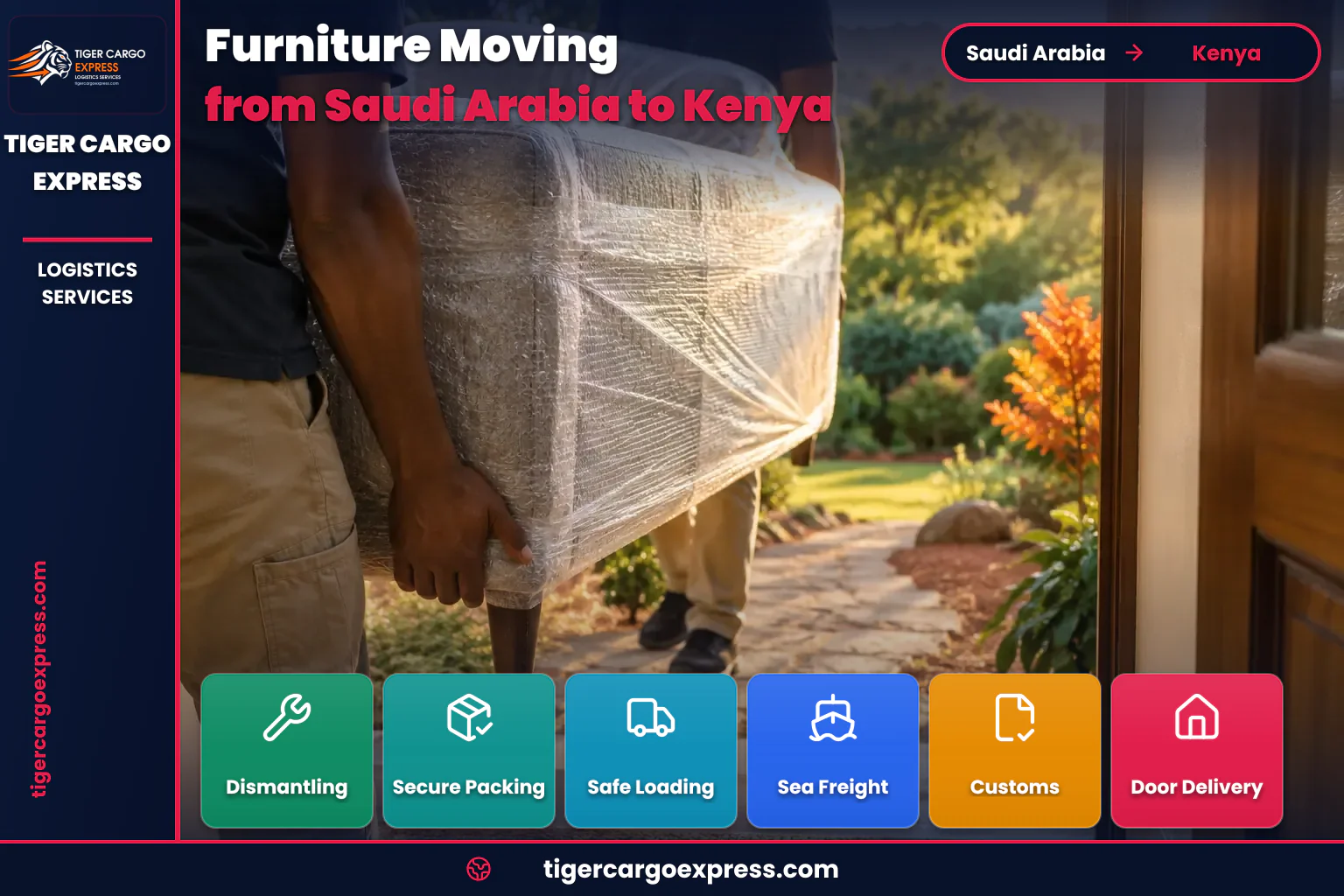
- ▸ Dismantling, unpacking and reassembly: in your new home, with an inventory check alongside you, piece by piece.
The Port of Mombasa and shipping methods
Most of our clients are heading for Nairobi — which is not on the coast but inland, on high ground.Which means your shipment covers a substantial road journey from Mombasa to Nairobi after clearance.
⚠️ That is a real line in the quote, not a detail — and we state it rather than dissolve it.
⭐ And an important climate consideration is added: the coast is hot and humid, while Nairobi is on high ground with a temperate climate. So your shipment moves from one climate to another within a single day — and that matters for packing, as we explain.
Full container, shared load or boxes?
| Aspect | Full container | Shared load | Boxes or air |
|---|---|---|---|
| When it suits you | A whole home and a vehicle | A room or two plus appliances | Curated essentials or a first batch |
| ⭐ Against the ninety-day window | The most controllable — one date, and it is yours | ⚠️ Your date follows the load filling up — risky in a narrow window | The fastest — it enters the window without anxiety |
| With a vehicle | Possible in one container with special arrangement | No — a separate file | Not applicable |
| Pricing | A fixed rate plus inland transport | Per cubic metre with a minimum | Per box or by volumetric weight |
Note the second row — a consideration that only surfaces when the window is narrow. A shared load is cheaper, but its sailing date follows the load filling up, not your wishes. Anyone with a ninety-day window may find the saving expensive. We work it through with you honestly rather than sell you the cheapest and then apologise.
Kenyan cities we cover
Mombasa
Kisumu
Nakuru
Eldoret
Thika
Machakos
Nyeri
Malindi
Kilifi
Kericho
Nanyuki
Kitale
Garissa
Narok
Lamu
Shipping prices from Saudi Arabia to Kenya
The final quote is built on the survey and your city — with inland transport stated in it.
| Shipment type or line | Price | Unit and notes |
|---|---|---|
| Boxes and small shipments | Request a quote — set by survey | Per box or by weight |
| Shared load (LCL) | Request a quote — set by survey | Per cubic metre — and its date follows the load filling up |
| 20ft / 40ft container | Request a quote — set by survey | The most controllable for anyone with a narrow window |
| Air freight | Request a quote — set by survey | By volumetric weight — and it reaches Nairobi directly |
| ⭐ Inland transport, Mombasa to Nairobi | Set in the quote, by your destination | A real line, not a detail — Nairobi is not on the coast |
| ⭐ Preparing the exemption file | Set in the quote, by your destination | An investment line — the relief here covers four heads |
| ⚠️ Duties and taxes if relief is not granted | Set after your file is reviewed | Four heads together — which is what makes the file worth money |
| ⭐ The replacement vehicle file | Set after your file is reviewed | Right-hand drive, with the disposal and value conditions — and an inspection certificate |
Note the green and red lines together. What you spend on preparing the file here is set against four heads that either fall away or stay. This is the highest return on file preparation we have written about in our whole series.
Documents required
First: are you a returning resident or a work permit holder? — because the clock starts on a different date in each case: from your own arrival, or from the issue of your permit.Second: have you sold your car yet? — a question you will never hear from a shipping company. Yet proof of disposal is a condition for the replacement vehicle, and the papers are gathered at the time of sale, not months later.
Note that neither has anything to do with your shipment’s volume.
Anyone who asks about cubic metres first may price you a shipment — and then you discover you have lost an entire vehicle exemption.
Clearance and standing charges
We handle clearance at both ends. A container has a limited free period at Mombasa starting from discharge rather than from your notification, after which a daily charge applies for it remaining and another for late return to the shipping line.
Your shipment faces two meters running together:▸ The port standing meter — familiar at every destination.
▸ ⭐ And the ninety-day window meter — which is personal to you.
⚠️ The first costs you money daily. The second may cost you the entire relief.
Which means a shipment sitting at Mombasa is not merely bleeding demurrage — it is consuming your window.
⭐ And that is what makes an incomplete file more expensive here than at any destination before it: you pay daily, and you move closer to losing four heads at once.
Which is why we close your file before sailing — not after berthing.
Prohibited and restricted items
- ▸ Flammables and pressurised goods: aerosols, paints, solvents, fuel and gas — excluded entirely.
- ▸ ⚠️ Left-hand-drive vehicles: barred from Kenyan roads — and attempting to import one is a serious offence exposing the vehicle to confiscation.
- ▸ ⭐ Vehicles over eight years old: outside the age limit — and not accepted whatever their condition.
- ▸ Weapons and ammunition: of every kind — under strict permits and regulations.
- ▸ ⭐ Food and agricultural products: under health and phytosanitary control — and we advise against shipping them among personal effects.
- ▸ Single-use plastic bags: Kenya is among the world’s strictest on this — and we exclude them from our packing materials altogether.
- ▸ Untreated timber: every crate or pallet needs approved treatment and visible marking.
- ▸ Products of protected species: ivory, hides or rare shells — Kenya is highly sensitive on this, even for a family heirloom.
Kenya is a middle case between Djibouti and Ethiopia — and this bears directly on your appliances:▸ 🌡️ The coast — Mombasa and Malindi: hot and humid year round. Your Gulf air conditioner is genuinely useful here.
▸ 🏔️ The highlands — Nairobi, Nakuru and Eldoret: temperate, even cool at night. An air conditioner there is of little use.
⭐ So the question here is not “Kenya” but “which Kenya”.
Anyone who measured by the capital while heading for the coast — or the reverse — has shipped what they do not need or left behind what they do.
So we review your appliance list against your specific city, not against the country.
Packing and insurance
The challenge on this lane is a double climate transition: high coastal humidity on berthing, then a climb to a temperate plateau the same day.
Inland delivery after clearance
- ▸ ⭐ The run from Mombasa to Nairobi: a real line in the quote — and we state it rather than dissolve it into a lump sum.
- ▸ Detached houses with gardens and gated estates: the norm in Nairobi’s suburbs — among the easiest deliveries we handle.
- ▸ ⭐ Estate access permissions: many neighbourhoods require access to be arranged with estate management in advance — and we arrange it before delivery day.
- ▸ Nairobi traffic: we avoid peak hours in scheduling delivery — the city is among the most congested capitals on the continent.
- ▸ The two rainy seasons: they slow inland roads at two points in the year — and we allow a written margin for them.
The reverse direction — Kenya to Saudi Arabia
We work both directions on the same port and route. The dominant traffic out of Kenya is tea, coffee, flowers and agricultural products, textiles and minerals, alongside the effects of returnees and mission staff.
⭐ And we flag an important difference: the reverse door we explained is not an ordinary export — it is an obligation tied to a relief that was granted. Anyone taking their effects out under it needs a file linking the export to the earlier exemption, not an ordinary shipment. And we prepare it on that basis.
How to choose a shipping company to Kenya
Our written guarantees
How to lower the cost of your shipment
- ▸ ⭐ Invest in the file rather than in negotiating the rate. Four heads fall away or stay on the strength of one file — the highest return we have written about.
- ▸ ⭐ Do not sell your car before you speak to us. Proof of disposal on its conditions is what transfers the vehicle exemption to a right-hand-drive replacement.
- ▸ ⭐ Enter the window safely. A shared load is cheaper and its date follows someone else — and ninety days is not a window that tolerates waiting for a load to fill.
- ▸ ⭐ Review your appliances against your city. An air conditioner to Nairobi is usually pointless; an air conditioner to Mombasa is essential.
- ▸ Complete the inspection certificate before loading. Deferring it holds a shipment and consumes your window at the same time.
- ▸ Check whether your family members qualify independently. A spouse and children over eighteen may qualify in their own right — which widens what enters relieved.
- ▸ Allow full dismantling. It cuts volume — and volume is the sea-freight pricing unit.
When do rates rise and transits lengthen?
| Period or situation | What happens |
|---|---|
| ⭐ Peak regional transit | A factor specific to Mombasa — the port serves the Northern Corridor into the regional interior, and its peak may not follow your season. |
| ⭐ The two rainy seasons | Kenya has two, not one — and they slow inland roads. We allow a written margin for them. |
| The expatriate return season | Pressure on personal-effects shipments — and we book early. |
| ⭐ Red Sea disruption | Its effect here is direct — the first stage sits inside the Red Sea, and we monitor it before fixing any date. |
| ⭐ Your window running short | A factor personal to you rather than to the market — a narrow window forces the fastest option, not the cheapest. We plan early to avoid that. |
How we work: five steps
Five recurring mistakes — all avoidable
- ▸ Selling the car before taking advice. The costliest mistake here — proof of disposal on its conditions is what transfers the exemption to a right-hand-drive replacement, and it cannot be fixed after the sale.
- ▸ Counting the window from the wrong day. A returning resident’s clock runs from arrival; a permit holder’s from the permit’s issue.
- ▸ Assuming the extension is guaranteed. The ninety is a right; the three hundred and sixty a discretion — and building on the second is building on someone else’s decision.
- ▸ Ignoring the reverse door. Leaving within ninety days obliges you to export your effects within thirty — and it is discovered only late.
- ▸ Treating Kenya as a single climate. The coast is hot and humid and the highlands temperate — an air conditioner is useful in one and pointless in the other.
Why Tiger Cargo Express?
Because we ask about your car before you sell it. Kenya bars left-hand drive from its roads, but it opens a legal route out that nobody tells you about: a right-hand-drive replacement, conditional on proof of disposal of the original and its value. And the papers are gathered at the time of sale, not months later — anyone who sold before asking lost an entire vehicle exemption.
We explain the reverse door before you ship — that your window works in both directions, and that the deadline to go out is three times narrower than the one to come in. We settle your status before we ask about your shipment’s volume, because your clock starts on a different date in each case. And we review your appliances against your city rather than your country — so we will tell you to leave your air conditioner behind if you are heading for Nairobi, even though it shrinks our invoice.
Frequently asked questions about shipping from Saudi Arabia to Kenya
In summary
Kenya gives you the widest relief in our series — four heads falling together under one provision — and frames it with a time window that works in two directions: ninety days to bring your goods in, and thirty days that may oblige you to take them out if your plan changes. Add the steering-wheel obstacle: your Gulf car does not enter Kenyan roads — but there is a provided-for legal route out: a right-hand-drive replacement, conditional on proof of disposal of the original and its value. What you need here is three things: a status settled before price, a question about your car before you sell it, and a file worth four heads rather than a formality. Tiger Cargo Express gives you all three before you ship.
Send your shipment details — approximate volume, origin city, your city in Kenya, whether you are a returning resident or a work permit holder, and whether you have sold your car yet — and we reply with a detailed quote with stated lines within 60 minutes. 0506688227
Where does Kenya sit on our map?
Shipping to Kenya is one lane within a wider region — and the full Africa guide explains the rules governing it and its neighbours together: the route, the customs framework, and the challenge that lane is priced around.
Related Shipping Guides
Continue with practical guidance connected to the same route or shipping decision.

Furniture and Car Shipping Company from Saudi Arabia to the Gulf 0506688227
⚠️ "How much does shipping to Kuwait cost?" is a question missing three things. Shipping from Riyadh is not shipping…
Shipping Company from Saudi Arabia to the Middle East 0506688227 — Overland Guide
The Middle East overturns all of it: it is the only destination whose journey starts at your front door rather…

Shipping Company from Saudi Arabia to Oceania 0506688227 — The Biosecurity Guide
On every preceding continent the question was: what is inside your shipment? Oceania asks an entirely different one: what is…
Send your shipment details and get a written quote
We reply within 60 minutes during working hours — with what the price includes and what it does not, stated before you commit.