
Car and Container Shipping Company from Saudi Arabia to the USA 0506688227 Your File Is Filed Before the Ship Sails

Car and container shipping from Saudi Arabia to the USA — where your file is filed before the ship sails from Jeddah. The security filing goes 24 hours before loading, the relief form is not valid until you arrive, and a fifteen-day clock runs without customs notifying you. Three deadlines money cannot fix.
Guide contents ShowHide
Looking for a car and container shipping company from Saudi Arabia to the USA that knows your file must be complete before the ship moves, not after it berths? Tiger Cargo Express ships containers, furniture, goods and vehicles to New York, Houston, Los Angeles and the rest of the United States, by sea and air, with dismantling, packing and reassembly, customs clearance at both ends, and cargo insurance. To book: 0506688227
The route runs west through the Suez Canal and the Atlantic to the East Coast, or east around Asia to the West Coast — and your destination chooses the direction.
What sets the United States apart from every destination before it in our series is an inversion of time itself:
Your file is filed before the ship sails from Jeddah — not when it arrives.
At fifty-one earlier destinations the question was the same: “what do you do on arrival?” — a declaration to be stamped, a card to be issued, an inspection to attend.
In the United States the question is different: “what must already be complete before the ship moves?”
There is a security filing sent to US customs at least twenty-four hours before your container is loaded onto the vessel at the port of departure — that is, while we are still in Jeddah.
And once the ship has sailed, nothing fixes a filing that was never sent.
What do we ship from Saudi Arabia to the USA?
Traffic on this lane is professional, academic and family: scholarship students, people relocating on work contracts, settled families, and those returning.
The security filing — the paper that precedes the ship

US customs require a security filing on containerised ocean shipments, known as “ten plus two”: ten data elements provided by the importer and two by the carrier. It is transmitted at least twenty-four hours before the goods are loaded onto the mother vessel at the port of departure.
“At the port of departure” — that is, in Jeddah or Dammam.
The filing is not made on arrival in New York, nor when the ship berths, nor even while it is mid-ocean.
It is made while we are still loading your container onto the Saudi quay.
Which means one decisive thing: your shipment’s data must be complete and correct before loading — not after.
So we ask for your documents before we book you space on a vessel, not after booking. And that surprises anyone used to sending their paperwork “later”.
On this lane there is no “later”.
⭐ And why twenty-four hours specifically?
Because the purpose is security rather than revenue. The receiving authority wants to know what is about to be loaded onto a vessel bound for it before it is actually loaded — so it can stop it at the quay if need be, rather than chase it across an ocean.
▸ A penalty on the importer for a late, incomplete or inaccurate filing.
▸ The container may be held or subjected to heightened examination on arrival.
▸ And the shipping line may refuse to load it at all — some lines will not load without a confirmed filing.
The third is the most dangerous in practice: not that you are fined, but that your shipment never sails — so it waits for the next vessel while you pay storage in Jeddah.
⚠️ And one thing we state plainly: the filing requires a customs bond, which is a line we declare in our quote rather than hide.
So we make the filing a visible line in the quote — and we show you the transmission confirmation. Anyone who will not show it to you has not sent it.
The relief form — and it is not valid until you arrive

The Declaration for Free Entry of Unaccompanied Articles is the form that relieves your personal effects of duty. And here is a second timing detail no less important than the first:
One of its fields is “date of your arrival in the US” — and the official guidance is explicit: plan your arrival to coincide with the arrival of your consignment.
Which means a shipment that arrives before you is not an early shipment but a stalled one.
And that inverts your arithmetic: at other destinations we hurried the shipment so it would be waiting for you. Here we slow it so it arrives after you.
Combine this with the next item — the fifteen-day window — and you will see that timing here is a narrow window with two edges:
▸ It must not arrive before you — or the form is not valid.
▸ And it must not sit after it arrives — or the general order warehouse follows.
So we build the schedule around your travel date, not the next available vessel.
⭐ The one-year rule — and a detail in it that relieves many
Articles such as furniture, dishes, linens, libraries and artwork must have been used for one year by you or your family in a household of which you were a resident member, and must not be intended for sale.
The year of use does not need to be continuous, nor does it need to be the year immediately before the date of importation.
Compare that with Malaysia, which counts each item’s age separately at six months, and with Japan, which measures by a “reasonable limit” judgement.
The standard here is wider and kinder: a piece you used for a year five years ago and then stored still qualifies.
⚠️ But note the second condition: a long-term visa — a visitor’s visa is not enough to bring in a household duty-free.
So we review your visa before we review your list — because the wrong visa collapses the whole file however sound the list is.
What we set out is the framework in force as we work with it in practice, and some details are decided case by case by the competent authority. Requirements are subject to update. So we review the current position with you before booking. We prepare the file and coordinate the timing — we do not give legal, tax or immigration advice.
⚠️ Fifteen days — and the clock starts without anyone telling you
This is the most dangerous passage in the article, and we give it its own section because it genuinely costs people their shipments.
▸ US customs will not notify you that your goods have arrived — the official text says so plainly.
▸ The carrier is the one who notifies you, and that is where the responsibility sits.
▸ After fifteen days without clearance, the shipment is moved to a general order warehouse.
▸ And it may be sold at auction after six months.
Combine this with the previous section: the form is not valid before you arrive.
Picture someone whose shipment sailed a month before them, and whose own travel then slipped by two weeks. Their goods have landed, the clock is running, the form is not valid, and no notice reaches them from anyone.
This is not hypothetical — it is the most common disaster on this lane.
So we monitor your shipment’s arrival ourselves and tell you, and we build the schedule around your travel.
| The moment | Where does it fall? | What happens if it is missed? |
|---|---|---|
| ⭐ The security filing | 24 hours before loading — in Jeddah | Penalty · hold · or refusal to load at all |
| ⭐ Your own arrival | Before the shipment arrives | The form is not valid — and the goods wait |
| ⚠️ Clearance | Within 15 days of arrival | Moved to the general order warehouse — auction after six months |
Note that all three are deadlines money cannot fix. No discount and no urgency brings back a filing never sent, validates a form before its time, or lifts a shipment out of a general order warehouse without cost and procedure. That is the reason this whole article exists.
Shipping for embassies, consulates and their staff
And here there is a procedural difference stated explicitly in the official text, not inferred by us.
Shipments for diplomatic and consular missions and their staff do not run through the personal-effects route and are not bound by its conditions. The basis here is the mission’s status or your accreditation to it, the reference framework is the Vienna Convention on Diplomatic Relations of 1961, and treatment is approved through the competent official channels.
The official text provides that brokers are not permitted to clear on the relief form for holders of the first-category diplomatic visa.
Which means — and this matters a great deal — that the route is not merely “easier” but different in its mechanism: it is not run through an ordinary clearing broker, but through the accredited official channel.
At every earlier destination we said mission cargo was exempt from conditions. Here we say more: it is outside the channel itself.
So the file differs from the outset: no individual relief form, no requirement that your arrival coincide, and no fifteen-day clock read by the same logic.
And the first question here is: “what is the consignee’s status, and who addresses us officially?” — not “when do you arrive?”.
- ▸ We settle the status first and build the file on it — not the other way round.
- ▸ ⭐ We do not put mission cargo on the broker route — the text forbids it for certain categories.
- ▸ We begin with the competent department, not the individual — official correspondence is the foundation of the whole file.
- ▸ We match the consignee’s name and status between the correspondence and the bill of lading letter for letter before issue.
- ▸ We document the inventory to a higher standard and hand it over certified by both parties.
- ▸ We treat everything in strict confidence — information, contents and movement dates.
And we say plainly: determining what the exemption covers and its extent rests with the competent authorities in the receiving state, and the mission has its own official channels. Our role is purely logistical. We work both directions: foreign missions in the Kingdom, and Saudi missions in Washington and the consulates.
Car shipping from Saudi Arabia to the USA
This section is settled before booking, not after — because the question here is not cost but eligibility.
In Japan the question was “where will you park it?”. In Hong Kong, “what will the parking cost you?”.
In the United States the question is: “does your vehicle meet US specifications at all?”
An imported vehicle needs an Environmental Protection Agency form and a Department of Transportation form, and must conform to US safety and emissions standards.
⚠️ And many Gulf-market vehicles are not built to US specification — they were made for a different market to different standards.
And what does not conform cannot be permanently imported except in defined cases, among them a vehicle old enough to fall outside the requirement.
▸ Add a cleanliness requirement: the vehicle is washed free of any foreign soil before shipping — an agricultural condition, not a customs one.
So we ask for the chassis number, model and year before we discuss price at all.
The practical result: in most cases we advise against shipping — the American car market is among the largest, most varied and most competitive in the world, and selling here and buying there is cheaper by a clear margin. And we say so even though we lose the whole line.
If you have a special case that genuinely justifies it — a classic or a vehicle of collector value — we review its file separately from the furniture file, because mixing the two delays both on a route built on timing in the first place.
Furniture moving company from Saudi Arabia to the USA
And here the inventory is an official document, not an internal note.

- ▸ ⭐ A detailed numbered English inventory: not “household effects” — the official text says that is not enough, and the inventory is treated as the packing list.
- ▸ ⭐ Closing the file before booking: passport, visa, address and travel date — because the security filing precedes loading.
- ▸ ⭐ Setting the sailing to your travel date: so the shipment arrives after you, not before.
- ▸ Reviewing the electrical supply: the US grid runs at a different voltage from the Gulf — and we tell you what will not work before you ship it.
- ▸ Treated and marked timber: for every crate and pallet — approved treatment with visible marking.
- ▸ Survey and volume estimate: in cubic metres — even for a few boxes, because we serve small shipments and not only containers.
- ▸ Dismantling, unpacking and reassembly: in your new home, with an inventory check alongside you, piece by piece.
Ports of entry
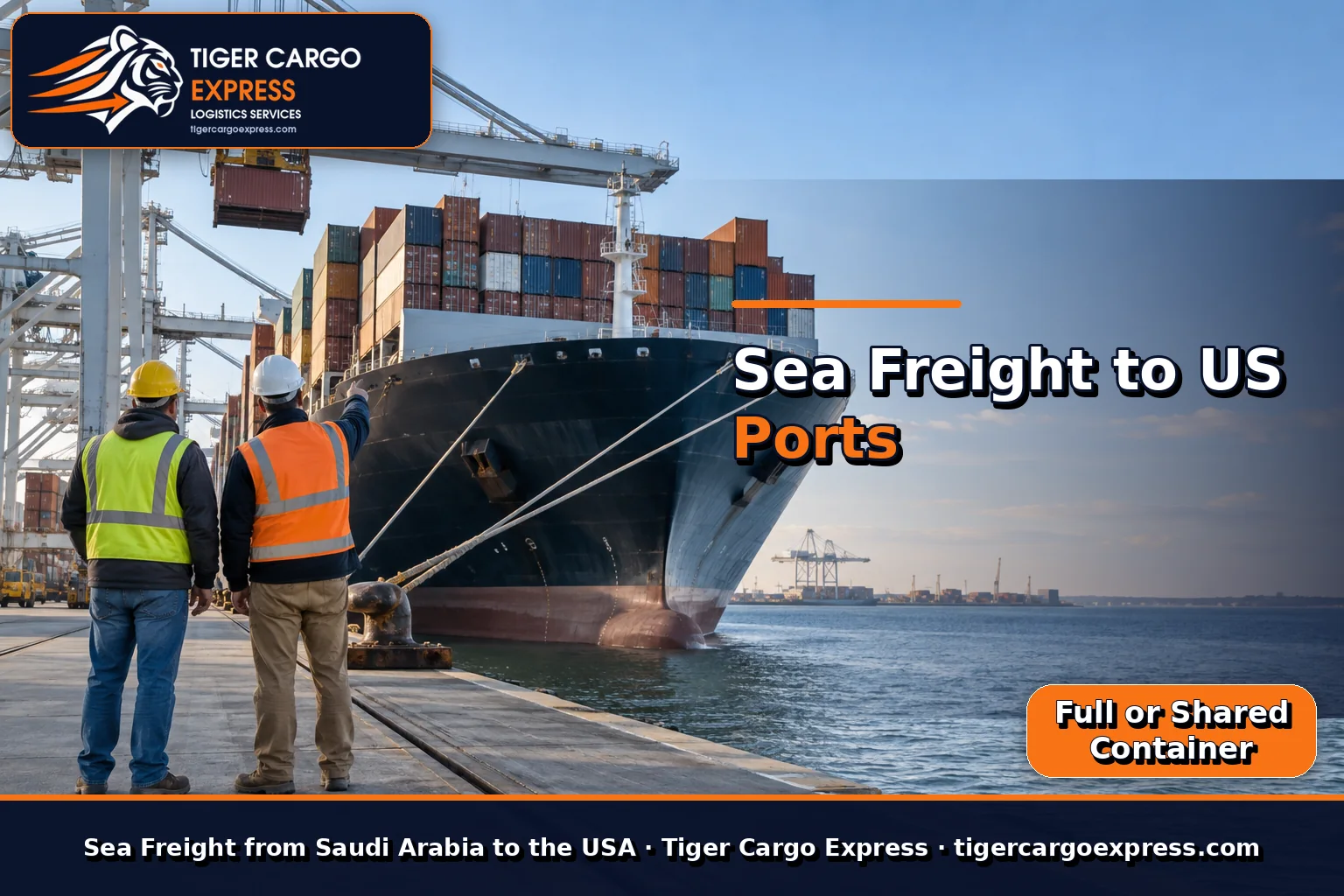
The United States is the only destination in our series where the choice of port changes the direction of the voyage itself: the East Coast westward via Suez and the Atlantic, the West Coast eastward around Asia and the Pacific.
| Port | Coast | Best suited to |
|---|---|---|
| ⭐ New York and New Jersey | East | The largest in the north-east — for New York, New Jersey, Connecticut and Pennsylvania |
| Savannah | East | For the south-east — Georgia, the Carolinas and Atlanta |
| Norfolk and Charleston | East | For Virginia, the Carolinas and the mid-Atlantic region |
| ⭐ Houston | Gulf of Mexico | For the large Gulf community in Texas — and for Dallas, Austin and Oklahoma |
| Miami | East | For Florida, Orlando and Tampa |
| ⭐ Los Angeles and Long Beach | West | The largest on the Pacific — for California, Arizona and Nevada |
| Seattle and Oakland | West | For the Pacific north-west and San Francisco |
| ⭐ In-bond movement | From any port | Moves clearance to a port nearer your city — and we arrange it where needed |
Note the last row. The default is that clearance takes place at the first port of arrival — but someone living in Chicago whose shipment lands in New York can move it in bond and clear it closer to home. And that is a decision taken before booking, not after arrival.
Shipping methods — sea and air
Full container, shared load or boxes?
| Aspect | Full container | Shared load | Boxes or air |
|---|---|---|---|
| When it suits you | A whole home | A room or two plus appliances | Curated essentials — best for students |
| ⭐ The security filing | In your own name — the responsibility and the bond sit with you | Handled by the consolidator — but someone else’s delay can delay you | The simplest procedurally |
| ⭐ The fifteen-day window | Costliest when missed | Moderate — and deconsolidation adds days | Least affected |
| Pricing | A fixed container rate | Per cubic metre with a minimum | Per box or by volumetric weight |
Note the second row — a consideration particular to the USA. In a full container the security filing is in your name and the bond is yours; in a shared load the consolidator handles it. The first is clearer in responsibility, the second lighter in procedure — and the difference deserves to be explained to you before you choose.
US cities we cover
Door delivery from coast to coast.
Los Angeles
Chicago
Houston
Dallas
Washington DC
Boston
San Francisco
Seattle
Atlanta
Detroit and Dearborn
Miami
Phoenix
Denver
Minneapolis
Orlando
Shipping prices from Saudi Arabia to the USA
The final quote is built on the survey and the arrival coast — with the pre-sailing lines stated in it.
| Shipment type or line | Price | Unit and notes |
|---|---|---|
| Boxes and small shipments | Request a quote — set by survey | Per box or by weight — best for students |
| Shared load (LCL) | Request a quote — set by survey | Per cubic metre with a minimum |
| 20ft / 40ft container | Request a quote — set by survey | And the coast changes price and transit together |
| Air freight | Request a quote — set by survey | By volumetric weight |
| ⭐ Security filing and customs bond | Set in the quote, by your destination | A line with no parallel — paid before sailing, not after arrival |
| ⭐ In-bond movement to another port | Set after your file is reviewed | For anyone living far from the first port of arrival |
| Interstate inland transport | Set in the quote, by your destination | Distances here are continental — and the port choice changes them radically |
| ⚠️ The vehicle file | Set after your file is reviewed | Preceded by an eligibility check — not by a price calculation |
Note the first distinctive line. This is the first quote in our series containing an item paid before the shipment moves — and anyone who hides it gives you a lower price and a higher invoice, or worse: saves you a line and then leaves your shipment standing on the quay.
Documents required
First: what is your own travel date? — not when you want the shipment to arrive. We set the sailing so it lands after you, because the form is not valid before your arrival.
Second: what type of visa do you hold, and for how long? — because a visitor’s visa collapses the relief entirely however sound your list is.
Note that both are asked before booking — not after.
Most companies ask about volume first and the visa last. We reverse the order — because the wrong answer to the second question cancels the booking altogether.
Clearance and standing charges
We handle clearance at both ends. A container has a limited free period at the arrival port starting from discharge rather than from your notification, after which a daily charge applies for it remaining and another for late return to the shipping line.
And here the fifteen-day clock we explained is added — a different clock from the standing charges, running in parallel with them. The first leads to the general order warehouse, the second to a daily invoice. And both run without anyone telling you.
First: a late or incomplete security filing. Settled before loading in Jeddah.
Second: you arriving after your shipment. Settled by setting the sailing to your travel date.
Third: an inventory written in general terms. “Household effects” is not enough by the text, and it is settled with detailed numbering before packing.
Note that all three fall on our desk before the ship moves — not on the American quay.
Which is why we say the most important week in your file is the week before loading, not the week after berthing.
Prohibited and restricted items
- ▸ Flammables and pressurised goods: aerosols, paints, solvents, fuel and gas — excluded entirely.
- ▸ Weapons and ammunition: of every kind — under strict federal control and separate permits.
- ▸ ⭐ Alcoholic beverages: they do not fall within duty-free personal effects and need separate treatment — we exclude them.
- ▸ ⭐ Food and agricultural products: under the control of the Food and Drug Administration and the Department of Agriculture — meat, plants, seeds and soil are the most restricted.
- ▸ Untreated timber: every crate or pallet needs approved treatment and visible marking.
- ▸ Counterfeit goods: seizure and penalties — and enforcement is very active in US ports.
- ▸ Products of protected species: ivory, hides or rare shells — even as an old family heirloom.
- ▸ New goods in quantity: they leave the personal-effects route and are treated commercially.
The US electrical grid runs at a voltage and frequency different from the Gulf.
A fridge, a washing machine, an oven or an air conditioner is not prohibited — but it may not work, or may run less efficiently and die sooner, or need a costly and heavy transformer.
This is a practical constraint, not a customs one — and you will not find it in any official list, because it is not customs’ business.
So we review your appliance list before packing and tell you plainly what will not work there.
A piece that clears customs and then stands idle in your kitchen is a total loss — you paid to ship it, then you pay to remove it.
Packing and insurance
The challenge on this lane is the length of the voyage and the spread of climates: from Jeddah’s humidity to a Chicago winter or Arizona’s dryness, across an entire ocean.
Inland delivery after clearance
- ▸ ⭐ Continental distances: from the arrival port to your city can be thousands of kilometres — which alone makes the port choice a large financial decision.
- ▸ Suburban houses: wide entrances and driveways — the easiest delivery among all our destinations.
- ▸ ⭐ Apartments in the major cities: New York, Boston and San Francisco — a service lift booking and a parking permit are essential, and we arrange both in advance.
- ▸ Large trucks: some neighbourhoods bar them — so the load transfers to a smaller vehicle for the last stretch.
- ▸ Winter in the north: snow can postpone delivery in the north-east and midwest — and we allow a written margin for it.
The reverse direction — the USA to Saudi Arabia
We work both directions on the same ports and routes. The dominant traffic out of the USA is vehicles, industrial and medical equipment, spare parts, electronics, sporting equipment and office furniture, alongside the effects of those returning from study and work.
And we flag an important difference: certain equipment and technologies fall under US export controls, a matter settled before booking rather than after. We also review your list against Saudi import restrictions.
How to choose a shipping company to the USA
Our written guarantees
How to lower the cost of your shipment
- ▸ ⭐ Close your file before booking. The largest saving here is not in price but in time — a complete file prevents a penalty and standing time at once.
- ▸ ⭐ Choose the port by your city. Distances here are continental — and the right port can save more than any discount.
- ▸ Do not sail before you have booked your flight. A shipment that outruns you is paid for daily to no purpose.
- ▸ Leave the large appliances. The voltage difference makes many of them useless — and buying there is usually cheaper.
- ▸ Consider a shared load for medium volumes. The consolidator handles the security filing — which simplifies your file.
- ▸ Number your inventory precisely. It saves clearance time — and every day saved is a day not paid for.
- ▸ Allow full dismantling. It cuts volume — and volume is the sea-freight pricing unit.
When do rates rise and transits lengthen?
| Period or situation | What happens |
|---|---|
| ⭐ Peak season — late summer and autumn | Freight peaks ahead of the US commercial seasons — vessel space tightens and rates rise clearly. |
| ⭐ The scholarship season — late summer | With the start of the academic year — heavy pressure on small shipments specifically. We book early. |
| Year-end holidays | An administrative and operational pause in late December — we schedule around it, not into it. |
| ⭐ Hurricane season — the Gulf and East Coast | Can halt handling at Houston and Miami for days — and we allow a written margin for it. |
| ⭐ Disruption on sea lanes | And its effect here is large, unlike Asia — because the East Coast route passes through the Suez Canal. |
How we work: five steps
Five recurring mistakes — all avoidable
- ▸ Sending the documents after booking. The mistake most specific to the USA — the security filing precedes loading, and there is no “later” on this lane.
- ▸ Shipping long before you travel. The form is not valid before your arrival — and a shipment that outruns you is a stalled shipment.
- ▸ Waiting for a notice from customs. It will not come — the text says so plainly, and the fifteen-day clock runs meanwhile.
- ▸ An inventory reading “household effects”. Not enough by the text — the complete inventory is treated as an official packing list.
- ▸ Shipping large appliances without checking the voltage. They clear customs and then stand idle in the kitchen — a double loss.
Why Tiger Cargo Express?
Because we work on the right timeline. The United States is the one destination where your file is settled before the ship moves — and anyone who treats it like the others discovers the difference once it is too late.
So we ask about your visa and travel date before we ask about your volume, and we send your security filing before loading and show you the confirmation — because a promise with no evidence is not a promise. We notify you ourselves when your shipment lands, because customs will not and the clock does not forgive. And we set the sailing to your own travel date even if it delays the booking by a week — because faster is not better here.
Frequently asked questions about shipping from Saudi Arabia to the USA
In summary
The United States is the destination where your file is settled before the ship sails: a security filing transmitted twenty-four hours before loading in Jeddah, a relief form that is not valid until you arrive, and a fifteen-day clock that runs without customs notifying you. The one-year rule here is kinder than you might expect — neither continuous nor immediately prior — but the wrong visa collapses the whole file. What you need here is three things: a file closed before booking, a sailing set to your travel date, and someone to notify you of arrival, because nobody else will. Tiger Cargo Express gives you all three before you ship.
Send your shipment details — approximate volume, origin city, your city in the USA, the type and duration of your visa, and your confirmed travel date — and we reply with a detailed quote with stated lines within 60 minutes. 0506688227
Where does the USA sit on our map?
Shipping to the USA is one lane within a wider region — and the North America guide explains the rules governing it and its neighbours together: the route, the customs framework, and the challenge that lane is priced around.
the North America guide · Our international shipping service
Related Shipping Guides
Continue with practical guidance connected to the same route or shipping decision.
Furniture and Car Shipping Company from Saudi Arabia to the Gulf 0506688227
⚠️ "How much does shipping to Kuwait cost?" is a question missing three things. Shipping from Riyadh is not shipping…
Shipping Company from Saudi Arabia to the Middle East 0506688227 — Overland Guide
The Middle East overturns all of it: it is the only destination whose journey starts at your front door rather…
Shipping Company from Saudi Arabia to Oceania 0506688227 — The Biosecurity Guide
On every preceding continent the question was: what is inside your shipment? Oceania asks an entirely different one: what is…
Send your shipment details and get a written quote
We reply within 60 minutes during working hours — with what the price includes and what it does not, stated before you commit.