
Car and Personal Effects Shipping Company from Saudi Arabia to Australia 0506688227 They Inspect Your Shoes, Not Your Invoice
Car and personal effects shipping from Saudi Arabia to Australia — where they inspect your shoes, not your invoice. The inspection here is biological, not financial, every shipment is subject to some form of it, and biosecurity's decision comes before customs'. The prohibited list is a list of conditions, not of items: the shoe is not prohibited — the dirty shoe is.
Guide contents ShowHide
Looking for a car and personal effects shipping company from Saudi Arabia to Australia that knows an inspector will look at the sole of your shoe before anyone looks at your invoice? Tiger Cargo Express ships personal effects, furniture, goods and vehicles to Sydney, Melbourne, Perth and the rest of Australia, by sea and air, with dismantling, packing and reassembly, clearance at both ends, and cargo insurance. To book: 0506688227
The route runs east across the Indian Ocean — one of our longest lanes and, at the same time, one of our least congested.
What sets Australia apart from every destination before it in our series is a change in who decides your shipment’s fate:
They inspect your shoes, not your invoice.
At fifty-three destinations the inspection — when it happened — was financial: how old is this piece? What is it worth? Is it for sale?
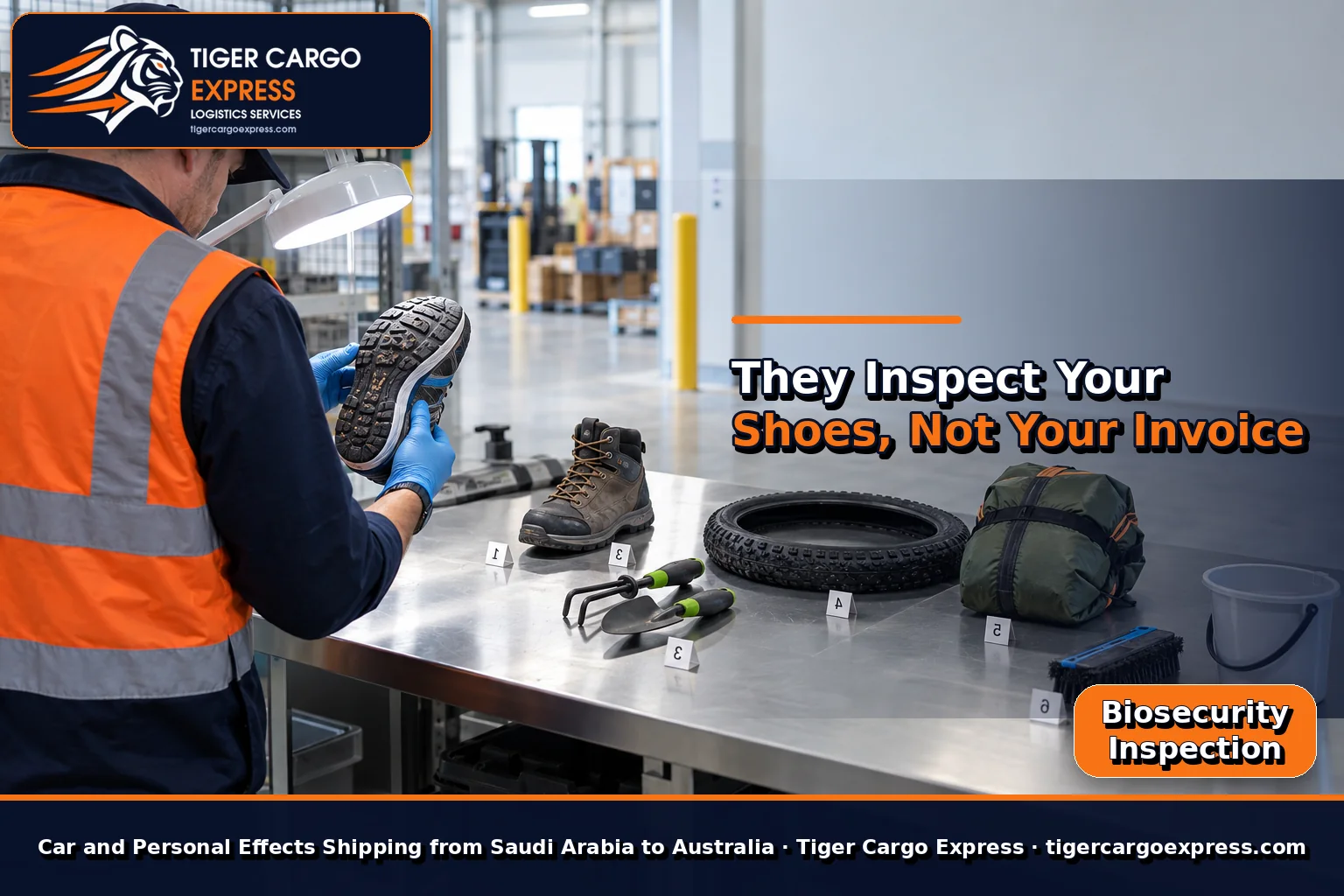
In Australia the inspection is biological: is there soil on this sole? Is there a seed in this tent? Is there an insect between the treads of your bicycle tyre?
Which means the prohibited list here is not a list of items but a list of conditions:
The shoe is not prohibited — the dirty shoe is.
What do we ship from Saudi Arabia to Australia?
Traffic on this lane is migration, study and skilled work: people on skilled visas, students, contract relocations, and those returning.
Two authorities, not one — and biosecurity comes before customs
Your shipment in Australia passes through two authorities entirely different in logic and purpose:
A flawless customs file counts for nothing if your shipment does not clear biosecurity.
And all personal-effects shipments are subject to some form of biosecurity inspection — the documents you provide determine how much is inspected, not whether it is inspected.
This differs fundamentally from Korea. There the inspection was total but fiscal: looking for commercial goods disguised as effects. Here the inspection is looking for a living organism.
Which in practice means something that inverts our order of priorities:
▸ In Korea your largest saving was a precise inventory.
▸ Here your largest saving is a brush.
And the next section explains how that turns into real money on your invoice.
What we set out is the framework in force as we work with it in practice, and some details are decided case by case by the competent authority. Requirements are subject to update. So we review the current position with you before booking. We prepare the file and coordinate the timing — we do not give legal, tax or immigration advice.
The statement and the risk items
An unaccompanied personal effects statement is submitted for every shipment. It is available in several languages, but it is completed in English. On it you declare the risk items your shipment contains.
Failing to declare a risk item on the statement may lead to prosecution under Australian legislation.
Note the wording: “failing to declare” — not “bringing in something prohibited”.
The problem is not that you own a tent. It is that you did not mention it.
And that inverts many people’s instinct: someone who assumes that mentioning their garden tools will cause trouble creates the trouble by hiding them.
The rule we work to is simple: we declare everything, and we clean everything. Declaring protects you; cleanliness speeds you up.
⭐ The official recommendation nobody follows
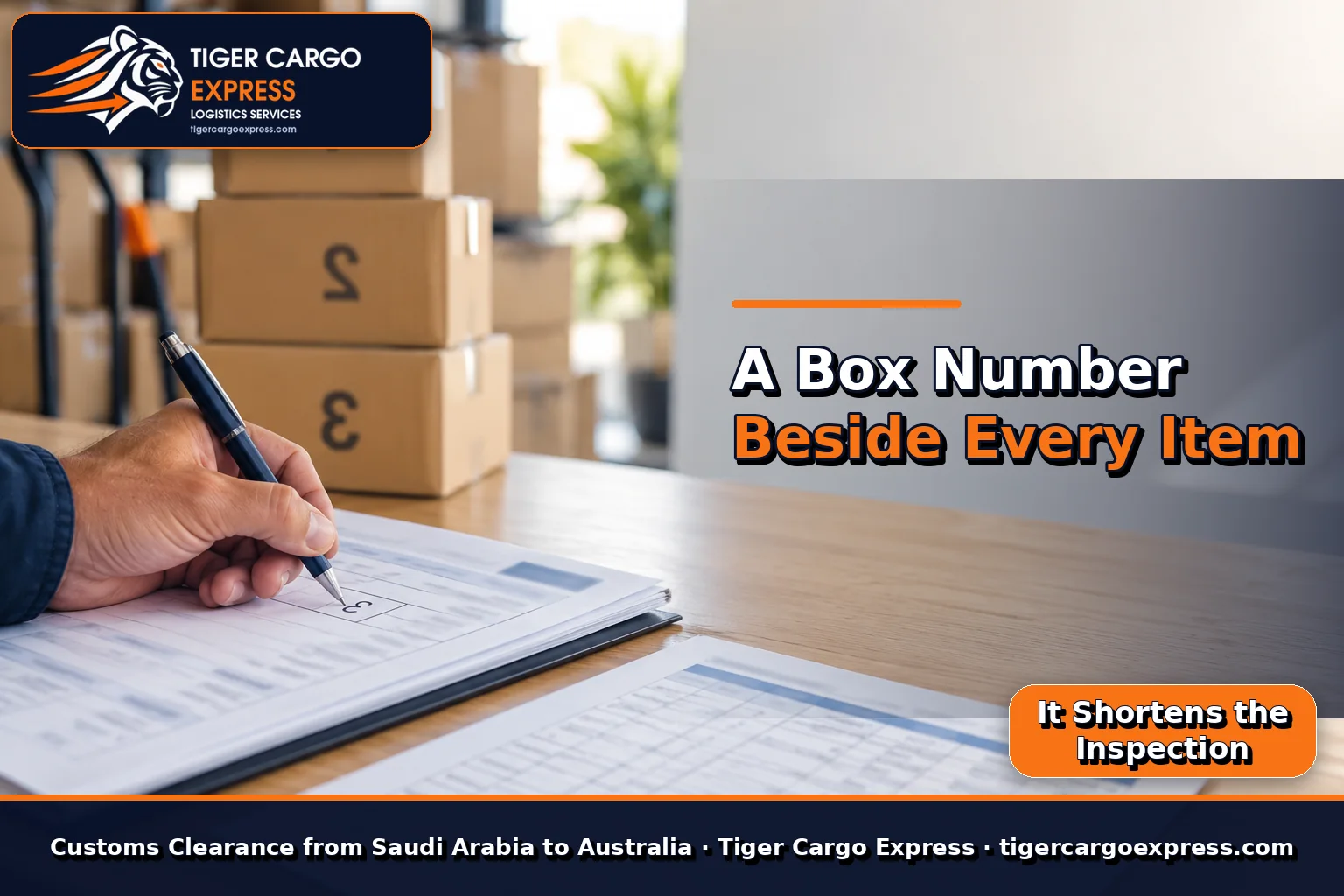
The official guidance says to record the number of the box containing each risk item you declared — so it can be found easily at inspection.
And it states the reason explicitly: because this reduces inspection time and cost.
Consider what that means:
▸ An inspector who knows the shoes are in box 14 opens box 14.
▸ An inspector who does not know searches your entire shipment.
The difference between the two is hours of labour charged to you.
⭐ This is the strongest promise we can make in the whole eighth group: because it is verifiable, sourced from the authority itself, and saves real money.
And yet — you will find many statements completed with that field left blank, because filling it costs time during packing.
We fill it every time, because the time we spend here is money you save there.
And what are the risk items?
- ▸ Timber and wooden products: wooden furniture, antiques, carvings, baskets and woven goods.
- ▸ ⭐ Footwear of every kind: sports, work and formal — and the sole is where the inspection happens.
- ▸ ⭐ Bicycles: tyres and frame — and mud between the treads is what is caught most.
- ▸ Garden furniture and gardening tools: outdoor chairs, spades, shears and hoses.
- ▸ ⭐ Vacuum cleaners: an explicit risk item — because by definition they contain soil, hair and debris. They are emptied and cleaned completely.
- ▸ Camping and sporting equipment: tents, sleeping bags, trekking poles and fishing gear.
- ▸ Plant and animal products: hides, feathers, shells, seeds and dried botanical decorations.
- ▸ Food: fresh food is excluded, and commercially packaged food is declared and inspected strictly — and best not shipped at all.
You will not find “footwear is prohibited” or “bicycles are banned”.
Everything on that list is permitted — on one condition: that it is clean.
Clean of soil, of plant material, of animal material, and of insects.
Which is why we said at the top of this article: the prohibited list here is a list of conditions, not a list of items.
And the difference between permitted and prohibited at this destination… is a brush.
⭐ A useful detail: valid offshore treatment certificates are accepted and reduce inspection — what was treated and documented before shipping is not dealt with from scratch.
⚠️ Asbestos — the ban that surprises everyone
We give this its own section because it is what surprises arrivals from outside Australia most, and because it does not cross anyone’s mind while they are packing a house.
Australia bans the import of goods containing asbestos outright, and the responsibility sits with the importer — that is, with you.
And here is the surprise: it is not only about building sheets.
Asbestos may be present in items nobody associates with it:
▸ Old spare parts — brake pads and engine gaskets.
▸ Old machinery and equipment and the thermal insulation in them.
▸ Very old household appliances with their original insulation.
▸ Building and finishing materials left over from an old renovation.
⚠️ And the question is not your intent: someone who ships an old piece inherited from their father is not excused by not knowing.
So we exclude old items of unknown composition from our shipments — and we ask you about them outright rather than packing them and staying silent.
Our rule: what we do not know the make-up of does not travel to Australia.
Shipping for embassies, consulates and their staff
And its angle here is finer than it looks.
Shipments for diplomatic and consular missions and their staff do not run through the customs personal-effects route and are not bound by its conditions — neither the twelve-month requirement nor the individual effects statement. The basis here is the mission’s status or your accreditation to it, and the reference framework is the Vienna Convention on Diplomatic Relations of 1961.
At every earlier destination, diplomatic relief meant bypassing the whole route.
Here we separate two things — because the two authorities are different:
▸ The customs side is read through diplomatic status, and that is clear.
▸ ⭐ But biosecurity works by an entirely different logic: it does not protect a treasury; it protects an island continent’s agriculture and environment.
Which means soil on a diplomat’s shoe is still soil.
So we do not promise any client — whatever their status — that their shipment will not be cleaned or reviewed biologically.
And we say so plainly: we prepare mission cargo for biosecurity with the same care as any client’s, because this is not a privilege to be claimed but the protection of an entire country.
- ▸ We settle the status first and build the file on it — not the other way round.
- ▸ ⭐ And we prepare for biosecurity in every case — cleaning, declaring and numbering, without exception.
- ▸ We begin with the competent department, not the individual — official correspondence is the foundation of the whole file.
- ▸ We match the consignee’s name and status between the correspondence and the bill of lading letter for letter before issue.
- ▸ We document the inventory to a higher standard and hand it over certified by both parties.
- ▸ We treat everything in strict confidence — information, contents and movement dates.
And we say plainly: determining what the exemption covers and its extent rests with the competent authorities in the receiving state, and the mission has its own official channels. Our role is purely logistical. We work both directions: foreign missions in the Kingdom, and Saudi missions in Canberra and the consulates.
Car shipping from Saudi Arabia to Australia
A vehicle here is a separate file on two routes: a customs route and a biological one — and the second is stricter than you imagine.
A vehicle entering Australia is inspected biologically outside, inside and underneath.
An ordinary wash is not enough. What is required is that it be entirely free of soil, plant material and insects — in:
▸ The underbody, around the wheels and inside the arches.
▸ Inside the engine bay and the air intakes.
▸ The boot and beneath the interior carpets.
⚠️ And a vehicle arriving insufficiently clean may be required to undergo treatment or specialist washing at its owner’s expense — waiting in the meantime.
Add to that specification and safety requirements, left-hand traffic, and a wide, well-regulated domestic market.
The result is that we advise most clients against shipping — and we say so even though we lose the whole line.
If you have a special case that genuinely justifies it, we review the model, year and specification with you before booking, prepare its file separately from the effects file, and include specialist pre-shipment washing as a stated line in the quote — because it is far cheaper than washing on arrival.
Personal effects moving company from Saudi Arabia to Australia
And cleaning here is part of the packing, not an added service.
- ▸ ⭐ Cleaning risk items before packing: footwear, bicycles, garden tools and equipment — with a stiff brush, washing where needed, and full drying.
- ▸ ⭐ Emptying and cleaning vacuum cleaners: an explicit risk item — and not packed until completely emptied.
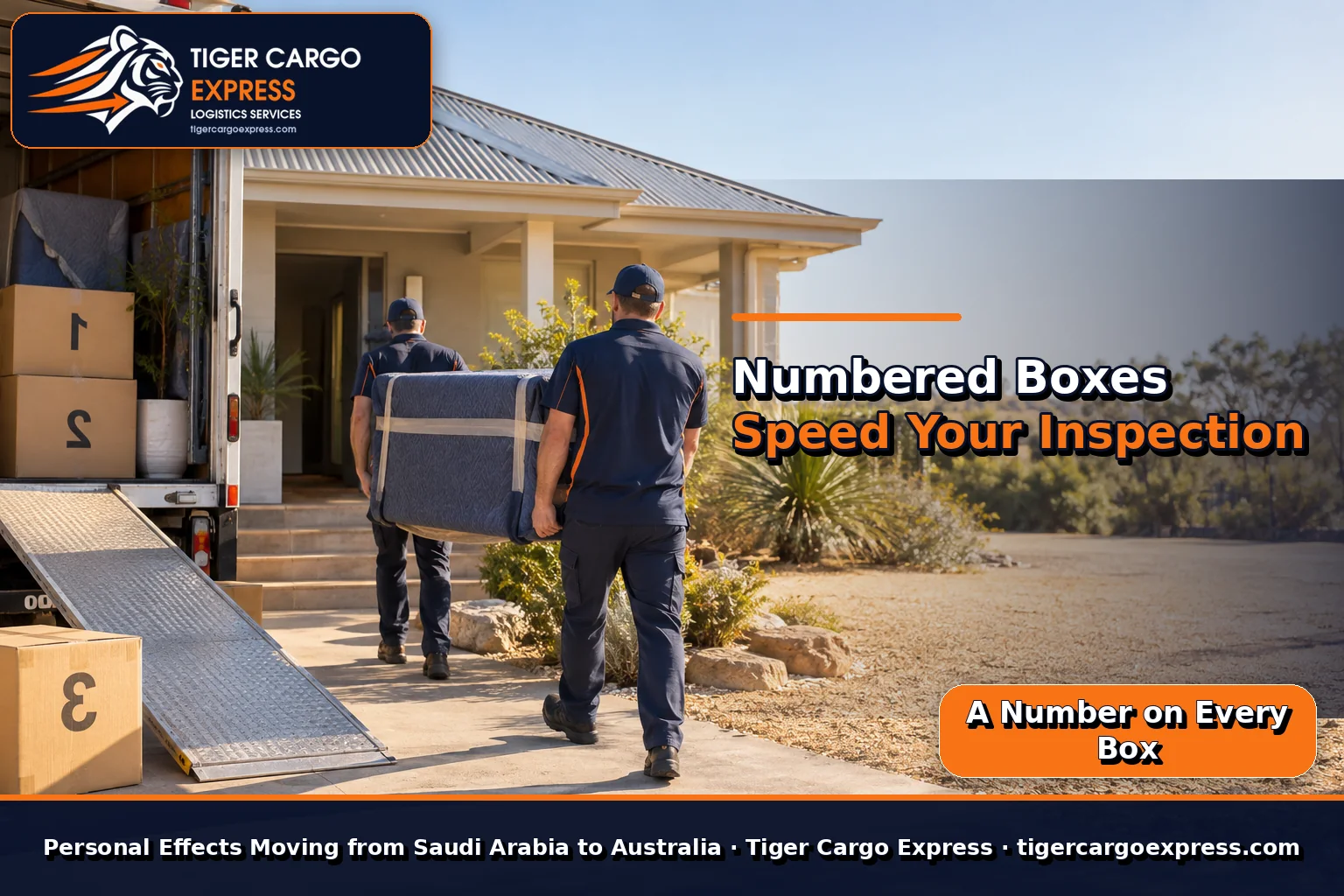
- ▸ ⭐ Numbering boxes with large, clear numbers: then writing the box number beside each risk item on the statement — this line alone shortens your inspection.
- ▸ ⭐ Isolating risk items in dedicated boxes: rather than scattering them through the shipment — so two boxes are opened instead of ten.
- ▸ Excluding what is not worth it: dried plants, organic decorations and food — and we tell you before you pack them, not after.
- ▸ Survey and volume estimate: in cubic metres — even for a few boxes, because we serve small shipments and not only containers.
- ▸ Dismantling, unpacking and reassembly: in your new home, with an inventory check alongside you, piece by piece.
Ports of entry
| Port | State | Best suited to |
|---|---|---|
| ⭐ Fremantle (Perth) | Western Australia | The nearest Australian port to us — vessels from the Indian Ocean reach it first |
| ⭐ Sydney | New South Wales | The largest — for Sydney, Canberra, Newcastle and Wollongong |
| Melbourne | Victoria | For Melbourne, Geelong and the south-eastern states |
| Brisbane | Queensland | For Brisbane, the Gold Coast and the north-east |
| Adelaide | South Australia | For Adelaide and its surrounds |
| ⭐ A note on distances | — | Perth to Sydney is the width of a continent — and the wrong port costs more here than at any other destination |
Note the last row. Australia is a continent the size of Europe with its population around the rim — and the distance from Perth to Sydney is close to that from London to Moscow. So we do not ask you about “Australia” but about your specific city before we book.
Shipping methods — sea and air
Full container, shared load or boxes?
| Aspect | Full container | Shared load | Boxes or air |
|---|---|---|---|
| When it suits you | A whole home | A room or two plus appliances | Curated essentials |
| ⭐ Biosecurity inspection time | Scales with the number of risk items — not with the shipment’s size | Someone else may delay you in the same load | The fastest if free of risk items |
| ⭐ Effect of good numbering | By far the greatest — the alternative is searching a whole container | Large as well | Limited — the pieces are few anyway |
| Pricing | A fixed container rate | Per cubic metre with a minimum | Per box or by volumetric weight |
Note the second row — a consideration particular to Australia. In Korea, inspection time scaled with the number of your pieces. Here it scales with the number of risk items among them. A full container of books and clothes may pass faster than two boxes holding a tent and a bicycle. The equation here is qualitative, not quantitative.
Australian cities we cover
Door delivery from Perth to Brisbane.
Melbourne
Brisbane
Perth
Adelaide
Canberra
Gold Coast
Newcastle
Wollongong
Hobart
Darwin
Cairns
Geelong
Townsville
Sunshine Coast
Toowoomba
Shipping prices from Saudi Arabia to Australia
The final quote is built on the survey and your delivery city — with the biosecurity lines stated in it.
| Shipment type or line | Price | Unit and notes |
|---|---|---|
| Boxes and small shipments | Request a quote — set by survey | Per box or by weight |
| Shared load (LCL) | Request a quote — set by survey | Per cubic metre with a minimum |
| 20ft / 40ft container | Request a quote — set by survey | And the port radically changes the inland leg |
| Air freight | Request a quote — set by survey | By volumetric weight — and subject to the same inspection |
| ⭐ Cleaning risk items before packing | Set in the quote, by your destination | An investment line, not a cost — it reduces inspection and its cost on arrival |
| ⭐ Biosecurity entry and inspection booking | Set in the quote, by your destination | A line with no parallel — issuing the entry and booking the inspection slot |
| ⚠️ Treatment on arrival if required | Set after your file is reviewed | And this is what we aim to avoid by cleaning in advance |
| Interstate inland transport | Set in the quote, by your destination | Perth to Sydney is the width of a continent |
Note the green and orange lines together — they are two faces of one decision. What you pay for cleaning in advance you save on treatment on arrival. The first is your choice; the second is someone else’s.
Documents required
First: do you have footwear, bicycles, camping equipment, garden tools or a vacuum cleaner? — a question nobody else asks on a first call, because it sounds odd. But it determines your inspection’s length and cost more than your shipment’s entire volume does.
Second: which Australian city exactly? — not the state, and not “Australia”. Perth to Sydney is the width of a continent, and the wrong port costs more here than at any other destination in our series.
Note that the first question is about contents, not volume.
Anyone who asks only “how many cubic metres?” is pricing you a voyage — not an inspection.
Clearance and standing charges
We handle clearance at both ends. A container has a limited free period at the arrival port starting from discharge rather than from your notification, after which a daily charge applies for it remaining and another for late return to the shipping line.
And here something is added that is added nowhere else: issuing the biosecurity entry and booking the inspection slot — a stage with its own fee and its own duration, which we count into the schedule from the outset.
At other destinations delay was linear: a missing paper costs a day or two.
Here it can be circular:
▸ A shipment arrives containing an unclean risk item.
▸ Washing or treatment is required.
▸ New slots are booked for the treatment and then for re-inspection.
▸ And the container stands throughout, with daily charges running.
And that entire cycle could have been cancelled by a brush before packing.
Which is why we say the cheapest ten minutes you will spend on this whole shipment are the ten spent cleaning the soles of your shoes.
Prohibited and restricted items
- ▸ Flammables and pressurised goods: aerosols, paints, solvents, fuel and gas — excluded entirely.
- ▸ Weapons, ammunition and replicas: of every kind — under strict permits and regulations that differ between states.
- ▸ ⚠️ Goods containing asbestos: banned outright, with the responsibility on the importer — as we explained in its section.
- ▸ ⭐ Fresh food: fruit, vegetables, meat and dairy — excluded, with immediate fines for failing to declare.
- ▸ Seeds, plants and soil: including soil stuck to items — which is the heart of the whole inspection.
- ▸ Products of protected species: ivory, hides or rare shells — even as a family heirloom.
- ▸ Untreated timber: every crate or pallet needs approved treatment and visible marking.
- ▸ New goods in quantity: they leave the personal-effects route and are treated commercially.
The Australian electrical grid runs at a voltage close to the Gulf’s — good news compared with the USA and Canada.
⚠️ But note the plug shape and the frequency: Australian plugs have two angled pins, so you will need plug adaptors rather than voltage transformers — far cheaper and lighter.
⭐ And more important than any of this is a biological line, not an electrical one: the vacuum cleaner.
Ordinary appliance though it is, it is an explicit risk item, because by definition it holds soil, hair and organic debris from your old home.
We empty and clean it completely before packing, and declare it on the statement with its box number.
Packing and insurance
The packing challenge here is unique: we pack on the assumption that the boxes will be opened and searched for a living organism.
Inland delivery after inspection
- ▸ ⭐ Continental distances: Australia is the size of Europe with its population around the rim — and interstate transport is a journey in its own right.
- ▸ Detached houses with wide entrances: the norm in the suburbs — among the easiest deliveries we handle.
- ▸ Apartments in Sydney and Melbourne: a service lift booking is essential and its slots are limited — we arrange it with building management in advance.
- ▸ ⭐ Cyclone season in the north: Queensland and the Northern Territory — can halt handling and roads for days, and we allow a written margin.
- ▸ Bushfires and floods: can close inland roads seasonally — and we monitor the routes before fixing a delivery date.
The reverse direction — Australia to Saudi Arabia
We work both directions on the same ports and routes. The dominant traffic out of Australia is mining and industrial equipment, agricultural and food products, medical equipment, spare parts and vehicles, alongside the effects of those returning from study and work.
And we flag a difference that relieves many: the strict biosecurity logic governs entry into Australia, not exit from it. The reverse direction is read by Saudi import rules, and we review your list against those before loading.
How to choose a shipping company to Australia
Our written guarantees
How to lower the cost of your shipment
- ▸ ⭐ Clean before you pack. The largest saving on this lane is a brush — not a discount and not a negotiation.
- ▸ ⭐ Ask for the box numbers to be written on the statement. An official recommendation stating explicitly that it reduces time and cost — and yet often left blank.
- ▸ ⭐ Reduce risk items, not volume. Inspection is measured by type, not by cubic metre — and leaving an old bicycle behind may save more than leaving a wardrobe.
- ▸ Do not ship food at all. What you gain on it is not worth the risk of delaying the whole shipment.
- ▸ Keep your offshore treatment certificates. They are accepted and reduce inspection — what was treated and documented is not redone from scratch.
- ▸ Choose the port by your city. Perth to Sydney is the width of a continent — the difference here is larger than anywhere else.
- ▸ Allow full dismantling. It cuts volume and makes wooden pieces easier to inspect — two benefits, not one.
When do rates rise and transits lengthen?
| Period or situation | What happens |
|---|---|
| ⭐ Peak arrivals — late in the year | Biosecurity inspection slots spread further apart — a factor unique to this destination, where the wait is for the appointment rather than the clearance. |
| ⭐ Study season — early in the year | The Australian academic year starts in February — with pressure on small shipments beforehand. We book early. |
| Year-end holidays and the Australian summer | A broad operational pause in late December and January — their summer, not their winter. We schedule around it. |
| ⭐ Cyclone season in the north | Queensland and the Northern Territory — can halt handling and roads for days, and we allow a written margin. |
| Disruption on sea lanes | Moves rates generally — though its effect is smaller here because we cross the Indian Ocean directly without the Suez Canal. |
How we work: five steps
Five recurring mistakes — all avoidable
- ▸ Hiding a risk item in the belief that mentioning it causes trouble. The mistake most specific to Australia — the problem is failing to declare, not owning the item, and failing to declare may lead to prosecution.
- ▸ Leaving the box-number field blank. An official recommendation to leave money on the table — because the inspector then searches your whole shipment.
- ▸ Packing a shoe or a bicycle without cleaning it. And the treatment cycle on arrival costs many times what a brush does.
- ▸ Shipping old items of unknown composition. The asbestos ban is total and the responsibility sits with the importer — and nobody is excused by not knowing.
- ▸ Saying “Australia” instead of naming the city. Perth to Sydney is the width of a continent — and the wrong port costs more here than anywhere else.
Why Tiger Cargo Express?
Because we work by the logic of the authority that actually decides. Most companies prepare your file for customs — and customs is not what stops your shipment here. We prepare it for biosecurity: cleaning, declaring, numbering and isolating.
And we apply a written official recommendation that many leave aside: putting a box number beside every risk item, because the authority itself says this reduces inspection time and cost. We ask you on the first call a question that sounds odd — “do you have shoes, bicycles and camping gear?” — because it determines your invoice more than your shipment’s volume does. And we exclude what we cannot identify the composition of, to protect you, even though it shrinks your shipment and our invoice with it.
Frequently asked questions about shipping from Saudi Arabia to Australia
In summary
Australia is the destination where they inspect your shoes, not your invoice: two authorities rather than one, biosecurity’s decision coming before customs’, and every shipment subject to some form of inspection. The prohibited list here is a list of conditions, not of items — the shoe is not prohibited, the dirty shoe is. Add the total asbestos ban with its responsibility on the importer. What you need here is three things: cleaning before packing, every risk item declared, and a box number beside each one — an official recommendation the authority itself says reduces time and cost. Tiger Cargo Express gives you all three before you ship.
Send your shipment details — approximate volume, origin city, your specific Australian city, and whether you have footwear, bicycles, camping equipment, garden tools or a vacuum cleaner — and we reply with a detailed quote with stated lines within 60 minutes. 0506688227
Where does Australia sit on our map?
Shipping to Australia is one lane within a wider region — and the Oceania guide explains the rules governing it and its neighbours together: the route, the customs framework, and the challenge that lane is priced around.
Related Shipping Guides
Continue with practical guidance connected to the same route or shipping decision.
Furniture and Car Shipping Company from Saudi Arabia to the Gulf 0506688227
⚠️ "How much does shipping to Kuwait cost?" is a question missing three things. Shipping from Riyadh is not shipping…
Shipping Company from Saudi Arabia to the Middle East 0506688227 — Overland Guide
The Middle East overturns all of it: it is the only destination whose journey starts at your front door rather…
Shipping Company from Saudi Arabia to Oceania 0506688227 — The Biosecurity Guide
On every preceding continent the question was: what is inside your shipment? Oceania asks an entirely different one: what is…
Send your shipment details and get a written quote
We reply within 60 minutes during working hours — with what the price includes and what it does not, stated before you commit.