Furniture Relocation Company in Riyadh 0506688227 Four Pieces, Four Different Methods
Guide summary
Furniture relocation in Riyadh with a specialist carpenter, dismantling that precedes lifting and assembly tested before handover — most damage in furniture moving comes not from carelessness but from one uniform treatment. A rug is folded as a blanket is folded, a mirror is laid flat, a wardrobe is carried assembled — and each is an engineering error rather than a worker's lapse. Rugs are rolled because folding leaves permanent lines, mirrors stand because laid flat they break under their own weight, and timber lies flat because standing it bows. And one question reveals who has a carpenter: when do you not dismantle?
Guide contentsShowHide
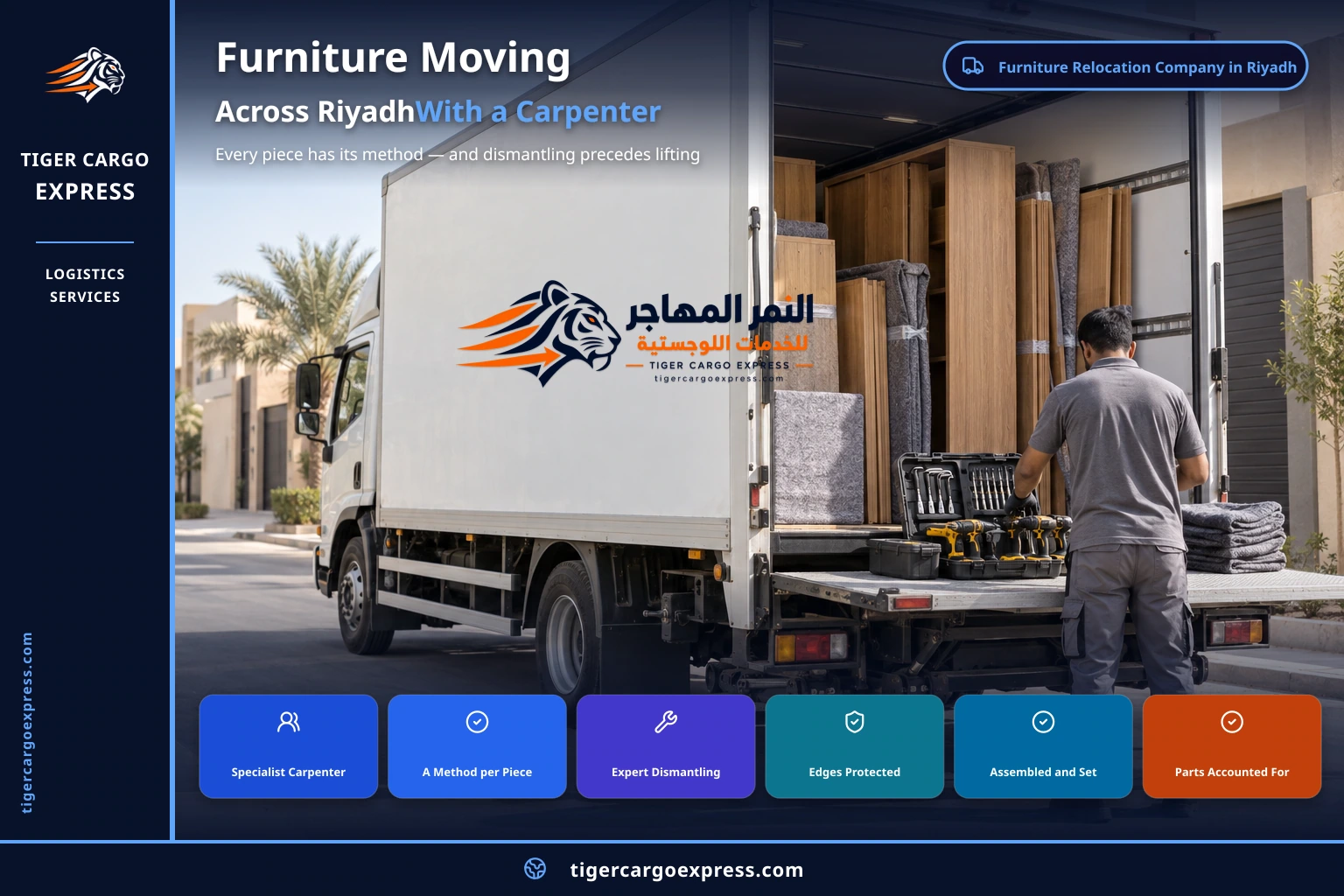
Looking for a furniture relocation company in Riyadh that treats every piece by its own method? Tiger Cargo Express moves your furniture with a specialist carpenter, dismantling that precedes lifting, and assembly tested before handover. To book: 0506688227
Most damage in furniture moving comes not from carelessness but from one uniform treatment. A rug is folded as a blanket is folded, a mirror is laid flat as a board is laid flat, and a wardrobe is carried assembled as a chair is carried.
And each of these three is an engineering error — not a lapse by a tired worker. This article is about the pieces themselves: how they come apart, how they are wrapped, and how they go back.
4materials, four methods
1carpenter with every crew
0pieces carried assembled without cause
20+years in the field
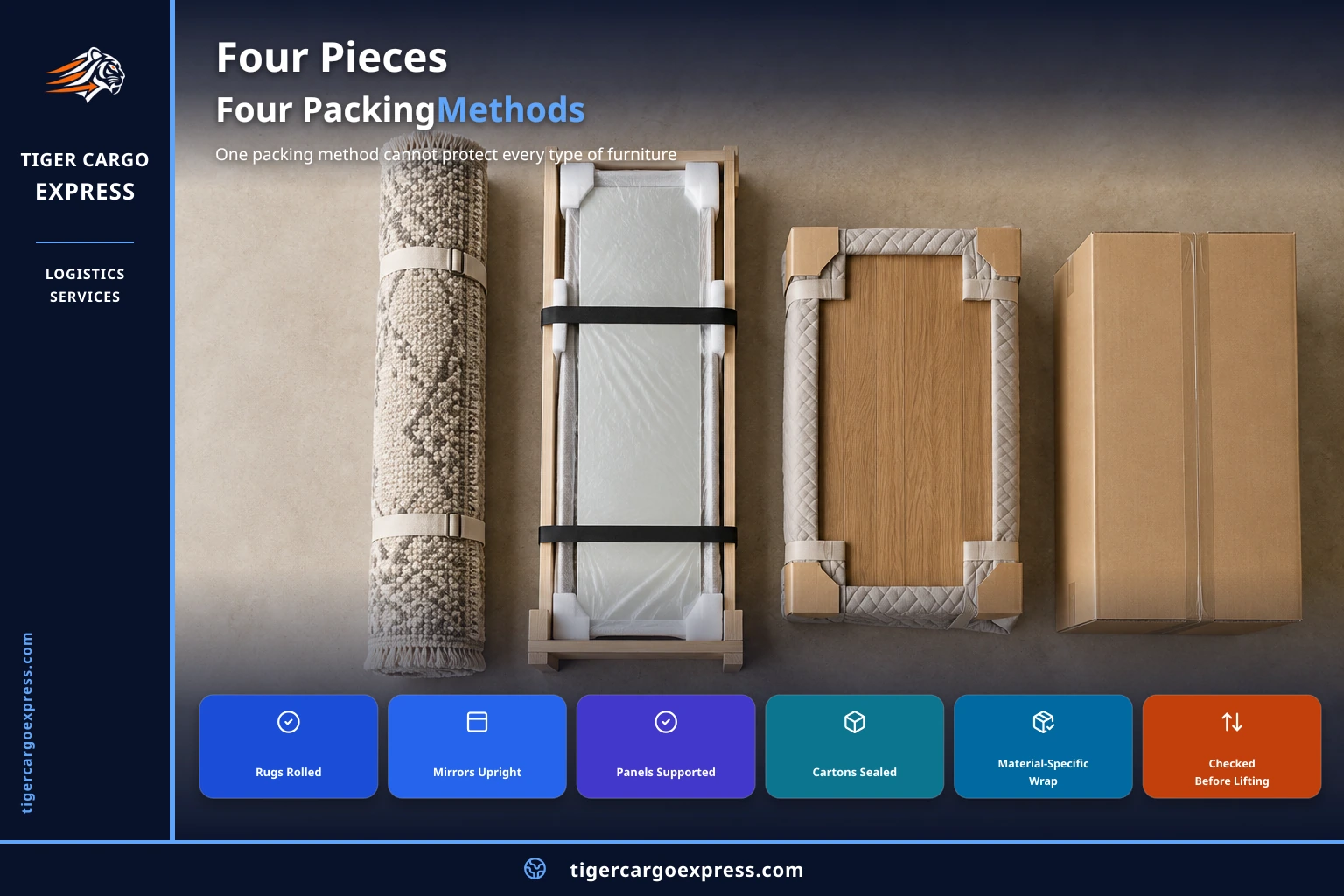
Four pieces — four entirely different methods
And one uniform treatment is the root of the damage.
And one treatment for everything is the root of the damage.
The piece
The correct position
And why
Rugs
Rolled around a tube
Folding leaves permanent lines in the weave
Mirrors and glass
Standing upright in a rack
Laid flat, it breaks under its own weight
Timber panels
Laid flat on a rigid support
Standing, they bow over time
Sofas and mattresses
Covered and raised off the base
The fabric catches and tears when dragged
Marble and granite
Upright with separators
Laid flat, it cracks from the middle
Paintings and frames
Upright with foam between
Pressure breaks the glass and the frame together
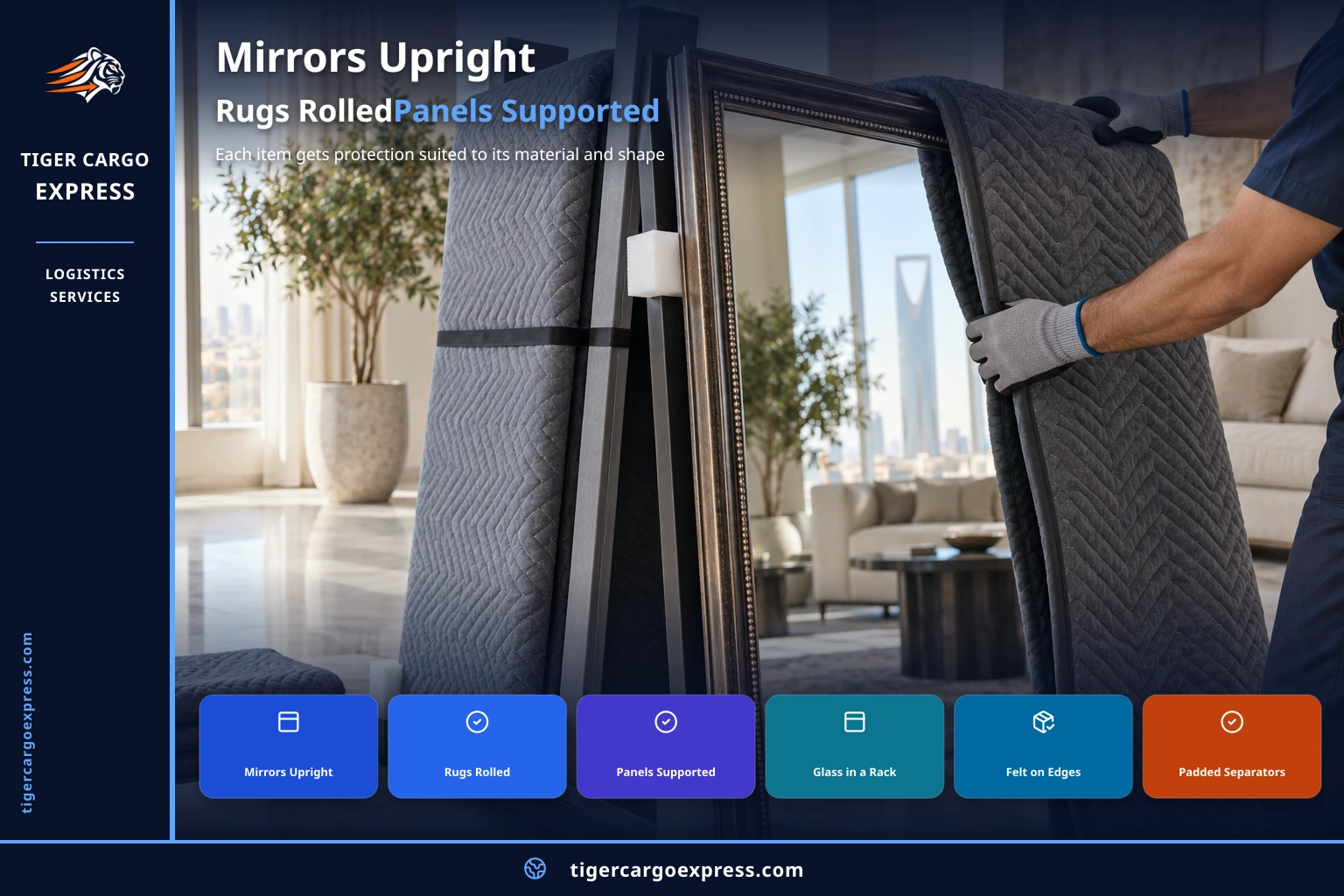
And notice the contradiction between the second and third rowsMirrors stand and timber lies flat — and the reverse destroys both. A mirror laid flat carries its whole weight on one point if it is jolted, and breaks from the middle. A standing timber panel leans with the vibration and bows gradually — and the bow shows not on moving day but when the door will not close afterwards. Anyone treating both the same way loses one of them inevitably.
And rugs are the most commonly mishandled
Because folding looks practical. A folded rug takes less space and is easier to carry — and it arrives with lines that never disappear.
Folding
Rolling
Permanent lines in the weave
A flat surface as it was
Dust trapped in the creases
No creases at all
The pile crushed at the fold
The pile evenly distributed
It never lies flat again
It is laid down and lies flat at once
Less space in the lorry
More space — and that is its price
And we absorb the extra space rather than passing it on to youRolling takes more room in the lorry than folding. Anyone folding rugs gains space they sell to another client. We roll them and absorb the difference — because a rug with permanent lines cannot be repaired, and the space difference is counted once while the rug lasts years.
And dismantling is not taking apart but preparing for assembly
And here the difference between a carpenter and a labourer shows.
So you hunt for no fitting on assembly day.
Anyone dismantling without order leaves double the work at the new home. And sometimes missing parts — because a small screw is not lost on dismantling day but on assembly day.
What most do
What we do
The difference at assembly
Screws in a shared box
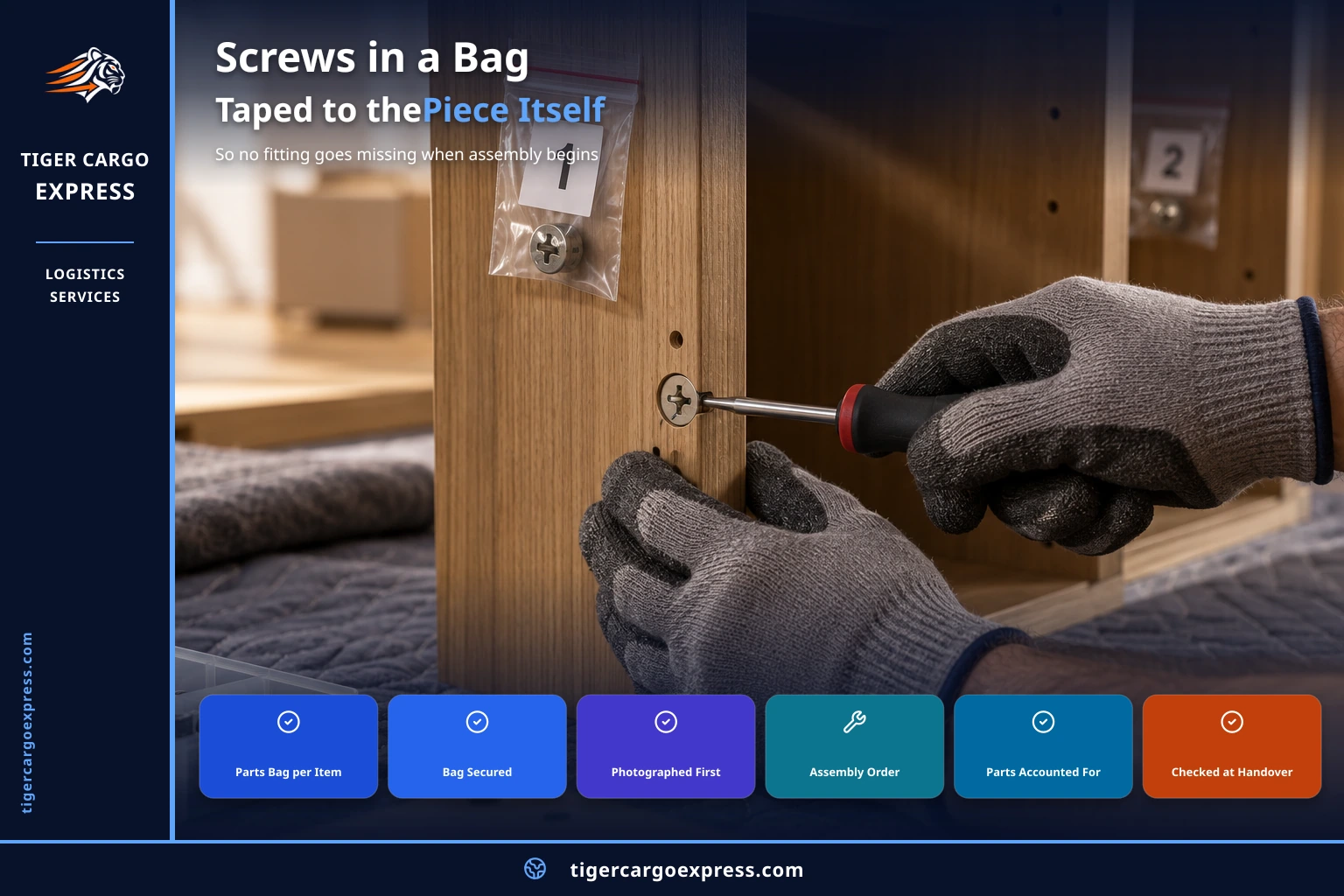
A bag per piece taped to it
No searching and no mixing
Dismantling without documentation
A photograph of the piece before dismantling
Whoever assembles knows how it was
Panels piled up
Ordered by assembly sequence
Assembly begins immediately
Hinges in one bag
They stay with their own door
A swapped door never sits true
Dismantling everything as a precaution
Only what is necessary
Every dismantling is a chance of looseness
One crew dismantles, another assembles
The same crew
Whoever took it apart knows how it returns
And the hinges line deserves explainingWardrobe doors look identical and are not. Each door settled on its own hinges for years, and its runners formed around its position. When the hinges are mixed and a door is fitted elsewhere, its closing never sits true — it rubs on one side or leaves a gap on the other. We number the doors, keep their hinges with them, and fit them in their original order.
The pieces we move
BedroomsOf every kind — and dismantling always precedes lifting for wardrobes and beds.
Majlis sets and sofasMeasuring the doorway first and deciding on dismantling before lifting.
Classical furnitureThe most delicate — carvings and edges that tolerate no friction.
Children’s furnitureLight but with weaker joints — and usually dismantled.
KitchensNumbered doors with their hinges kept with them.
Valuable piecesWith photographic documentation before dismantling and after assembly.
Every piece has its own wrapping
And each has an engineering reason rather than a habit.
The wrapping material is not one thing because the risk is not one thing. What protects timber from scratching does not protect glass from pressure, and what protects fabric from tearing does not protect paintwork.
The material
Its risk
Its wrapping
Painted timber
Scratching from the edges
Full felt + reinforced corners
Veneered timber
The veneer separates with friction
Doubled felt at the edges
Glass and mirrors
Breaking under pressure
Foam, then an upright rack
Fabric and leather
Tearing and dragging
A full cover pulled taut rather than wound
Painted metal
Scratching and denting
Felt and separators between pieces
Marble and stone
Cracking from the middle
Upright with separators and foam
And veneered timber is often mishandledBecause it looks like solid timber and is not. The veneer layer is thin and glued, and friction at the edge lifts it so a strip separates and never returns. Solid timber can be sanded; veneer cannot be repaired — so we double the felt at the edges specifically, because the edge is what rubs.
When do we dismantle and when do we not?
Every dismantling is a chance of looseness — a joint taken apart once never returns to quite its original tightness. So we do not dismantle as a precaution but by calculation.
The situation
Dismantle?
Why
The piece passes the doorway assembled
No
Needless dismantling weakens the joints
The doorway is narrower than the piece
Yes
What will not pass assembled passes in parts
A wardrobe over two metres
Usually yes
The length makes carrying it hazardous
A bed with a storage base
Yes
The weight and the size together
A sectional sofa
We separate the sections rather than dismantling it
And that is not dismantling
A table with fixed legs
By its length
Legs are the weakest point in carrying
And we measure the doorway before decidingWe do not dismantle because dismantling is easier for us, and we do not carry assembled because carrying is faster. We measure the door’s width and height and the stairwell’s turn, then decide. Measuring takes minutes, and the wrong decision means either a loose joint or a scratched door — and neither was necessary.
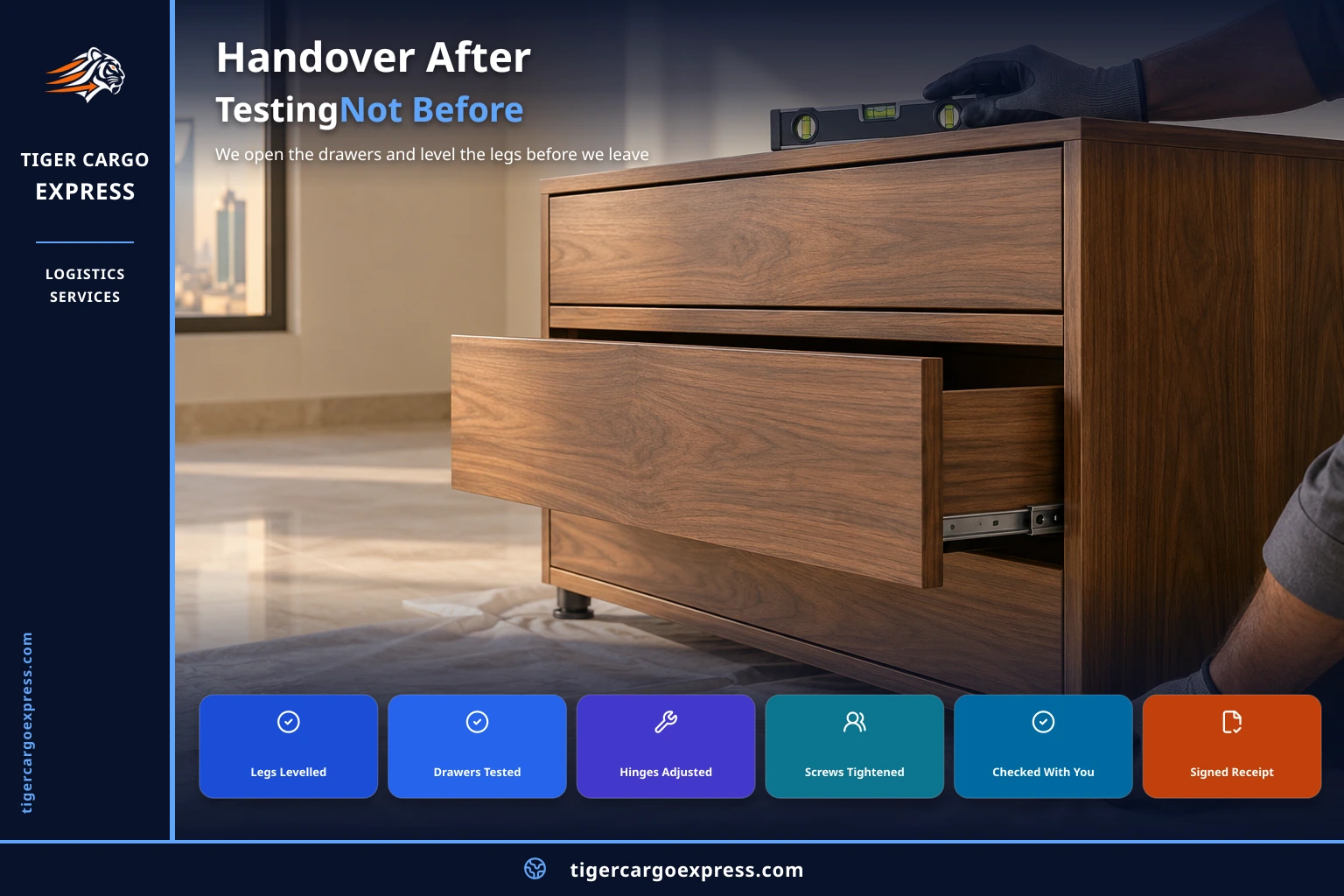
Handover after testing, not before
We open the drawers and level the legs before we leave.
Assembly does not end with placing the piece but with testing it. A wardrobe assembled whose doors will not close has not been assembled.
1We level the legs to the floorThe new floor is not the old one, and the piece rocks if it is not levelled.
2We open and close every drawerTo confirm it runs as it did rather than more heavily.
3We adjust the door hingesSo they close square with no rubbing and no gap.
4We retighten the screws after settlingThe piece settles after assembly and needs a second tightening.
5We check with you piece by pieceBefore we leave rather than after.
6We remove everything we usedCardboard, wrapping and tape — it leaves with us rather than staying with you.
And the fourth step is what everyone omitsAn assembled piece settles over hours onto its new weight. Screws tightened while it is being assembled need a second tightening once it has settled — otherwise a creak begins within days. We tighten them before we leave, and for large pieces we advise tightening again after a week and show you how.
Furniture relocation prices in Riyadh
We move by the household and by the piece alike — because not everyone relocating moves a whole home.
What you move
Approximate price
Includes
A complete bedroom
SAR 550 – 900
Dismantling, wrapping and assembly
A majlis set or sofa
SAR 400 – 750
By the number of sections
A single wardrobe
SAR 280 – 550
Dismantling and assembly
A dining table with its chairs
SAR 350 – 650
Leg removal and wrapping
A complete kitchen
SAR 900 – 1,800
Numbered doors and their hinges
A complete two-bedroom flat
SAR 1,400 – 2,200
All of the above
And three lines raise the price with no discount to offset themA floor with no lift, a narrow doorway, and exceptional pieces — marble and fitted cabinets among them. We mention them at the survey and write them into the quote, because discovering them on the morning leaves you facing a revised price in the middle of your day.
Classical furniture and valuable pieces
Not heavier but more delicate — their carvings and edges tolerate what modern furniture does not.
Photographic record before dismantlingEvery piece photographed from each side — and compared after assembly.
Doubled felt on the carvingsBecause carving stands proud and is the first thing to rub.
Less dismantling rather than moreWe avoid taking apart what can be carried — an old joint is weaker.
Timber crates for small itemsFor ornaments and pieces separated from their place.
Carried by hand rather than trolleyA trolley jolts; a hand controls.
Handover compared against the photographsYou open the file and compare yourself before we leave.
And the rule is reversed hereWith modern furniture we dismantle to protect; with classical we avoid dismantling to protect. An old piece’s joints have settled over decades, and taking it apart means reshaping it. So we calculate: does it pass assembled? — and if it does, we do not dismantle it even though carrying is harder for us.
Riyadh districts we serve
The northAl Narjis · Al Yasmin · Al Malqa · Hittin · Al Arid · Al Qirawan · Al Sahafah
The centreAl Olaya · Al Sulaymaniyah · Al Malaz · Al Mursalat · Al Wurud · Salah Al Din · Al Muruj
The eastAl Rawdah · Al Naseem · Al Rimal · Al Yarmouk · Qurtubah · Ghirnatah · Al Andalus
The westAl Uraija · Dhahrat Laban · Al Suwaidi · Badr · Diriab · Shubra
The southAl Shifa · Al Mansourah · Al Dar Al Baida · Namar · Ukaz · Tuwaiq
Outside RiyadhAl Kharj · Diriyah · Huraymila · Al Muzahimiyah · Thadiq — by prior arrangement
What will not return as it was — and we say so before we begin
Cabinets fixed to the wall — removing them marks both the wall and the piece
Cheap compressed-board furniture — its joints will not take a second dismantling
Furniture already dismantled more than once — each dismantling weakens the housing
Pieces repaired with adhesive rather than fixings — they separate at the first vibration
Marble already cracked, however fine the crack
Anything with woodworm or rot — we point it out and do not carry it
And we say it at the survey rather than on moving dayA piece that will not return as it was is something you should know before you pay. And we may recommend you do not move it at all, if replacing it costs less than moving and repairing it. We say so even though it reduces our invoice — because a client surprised by a piece that came apart will hear no explanation after the fact.
How is a bedroom dismantled?
An order known only to someone who has done it a hundred times.
1We empty and photograph before any screwdriverA picture of every face, and drawers fully emptied into numbered boxes.
2The top rail firstNot the panels — anyone starting with the panels breaks the rail.
3Doors numbered with their hingesEach door with its number and its hinges in a bag taped to it.
4Shelves before the sidesA shelf braces the side, and removing the side first drops the shelf.
5The mirror separated and wrapped uprightBefore the back of the dressing table is touched.
6Panels ordered by assembly sequenceNot piled — assembly begins from the last thing dismantled.
7The bed: the base before the sidesOtherwise the sides fold in on each other.
And the second step is the real differenceThe top rail in a wardrobe braces the sides and carries the doors. Anyone starting by removing the side panels leaves the rail hanging unsupported — so it bends or snaps at the first movement. This is not something read but something learned by error — and we learned it, and would rather you did not learn it on your wardrobe.
Sofas: we separate the sections rather than dismantling them
And this is an important distinction that many confuse.
The case
What we do
Why
A sofa with separable sections
We separate the sections
Its design allows it — and it does not count as dismantling
A sofa with fixed legs
We remove the legs only
The legs are the weakest point in carrying
A one-piece sofa
Never dismantled
Its frame is glued and nailed — dismantling means destroying it
A sofa with a folding backrest
We fold and secure it
We do not dismantle it
A large corner unit
We separate and measure the doorway
And if it will not pass we look for another route
And the third row is where the error happensA one-piece sofa is not dismantled — and anyone attempting it destroys it. Its timber frame is glued, nailed and covered in fabric, and opening it means cutting the fabric and breaking the fixings. And if it will not pass the doorway the answer is not dismantling but another route — a balcony or a wide window by prior arrangement, and we tell you so at the survey.
Questions clients ask
Should I photograph my furniture myself before the move?We encourage it. Photograph whatever you like with your phone — the pictures are yours rather than ours. We photograph too, but your own record puts you at ease and makes any later discussion clearer for both of us.
What if a piece was already damaged before the move?We photograph it and point it out to you before we touch it. An old scratch or a loose joint is documented at the survey rather than discovered at handover — and that protects both sides rather than one.
Do you assemble furniture I bought new?Yes — assembling new furniture is a separate service with us. Flat-pack furniture needs a precise order of steps, and anyone skipping one discovers it at the last panel.
How long does dismantling and assembling a bedroom take?Dismantling around one to two hours, and assembly roughly twice that. Assembly is always slower because it needs adjusting, levelling and testing — and anyone assembling at dismantling speed has adjusted nothing.
What if a screw is missing?We replace it from our own stock at once. We carry screws, hinges and runners in common sizes, because older pieces may already have lost parts before we arrive. And we do not leave a piece incomplete and move on.
Do you move between floors within the same house?Yes — a common case when room layouts change. And we treat it as a full move: dismantling, wrapping, carrying and assembly — because stairs inside the house are no different from stairs outside it.
How do you know they really have a carpenter?
Five questions only a carpenter answers.
1How do you dismantle a wardrobe with a top rail?A carpenter knows the rail comes off before the panels rather than after.
2Where do you put each piece’s screws?‘In a box’ is a labourer’s answer; ‘a bag taped to the piece’ is a carpenter’s.
3Do you mix the door hinges?Whoever says no and explains why knows that a swapped door never sits true.
4When do you not dismantle a piece?A carpenter knows every dismantling is a chance of looseness — a labourer dismantles everything.
5Do you retighten the screws after assembly?The piece settles and needs a second tightening — and that occurs only to someone who has seen it.
And the fourth question is the most revealingBecause the instinctive answer is ‘we dismantle everything to protect it’. A carpenter knows the opposite is sometimes true: an old piece that passes assembled is not dismantled, because its joints settled over years and taking it apart means reshaping it. Anyone answering ‘we always dismantle everything’ has told you, without meaning to, that they have labourers rather than a carpenter.
What we guarantee and what we do not
A method per materialRugs rolled, mirrors standing, timber flat — not one recipe.
Screws taped to their own pieceNot a shared box searched through on assembly day.
A carpenter with the crewDeciding when to dismantle and when not — by calculation rather than precaution.
Handover after testingWe open the drawers, level the legs and adjust the hinges in front of you.
And what we do not promise: we will not say every piece returns exactly as it was. Fitted cabinets, furniture dismantled repeatedly and pieces repaired with adhesive have limits we set out at the survey. And we will not dismantle a piece because dismantling is easier for us, nor carry it assembled because carrying is faster — we measure and decide.
Five mistakes that damage furniture
Folding a rug rather than rolling itFolding leaves permanent lines that never flatten out, and traps dust in the creases. Rolling takes more space and preserves the rug.
Laying mirrors flatA mirror laid flat carries its weight on one point if jolted and breaks from the middle. Standing in a rack is what protects it.
Standing timber panels uprightThe exact opposite — a standing panel leans with the vibration and bows, and it shows only when the door will not close afterwards.
Mixing pieces’ screws in one boxA screw is not lost on dismantling day but on assembly day. A bag taped to the piece itself settles the matter.
Dismantling everything as a precautionEvery dismantling is a chance of looseness. What passes the doorway assembled is not dismantled — old pieces above all.
Why Tiger Cargo Express?
A carpenter with every crewDeciding by calculation rather than precaution — and knowing when not to dismantle.
A method per materialFour pieces, four methods — and one uniform treatment is the root of the damage.
Screws and hinges with their own pieceBecause a swapped door never closes true however it is adjusted.
We roll rugs and absorb the spaceRather than passing the difference to you — a permanent line cannot be repaired.
We check with you before we leaveDrawers opened, legs levelled and hinges adjusted.
Verify that we are properly registeredRegistration 5800108005 and a documented national address — sent whenever you ask.
Ask about the carpenter before you ask about the priceSend photographs of your furniture, your district and your floor — the estimate and a dismantling decision per piece reach you.Call 0506688227Message on WhatsApp
Frequently asked questions about furniture relocation in Riyadh
Why are rugs rolled rather than folded?Because folding leaves permanent lines in the weave that never flatten out, traps dust in the creases, and crushes the pile at the fold. Rolling takes more space in the lorry — and we absorb the difference, because a rug with lines cannot be repaired.
And why do mirrors stand while timber lies flat?Because the risk differs in each. A mirror laid flat carries its whole weight on one point if jolted and breaks from the middle, while a standing timber panel leans with the vibration and bows — and the bow shows only when the door will not close afterwards.
Where do you put the dismantling screws?In a bag taped to the piece itself — not a shared box. A screw is not lost on dismantling day but on assembly day, and we photograph the piece before dismantling so whoever assembles knows how it was.
Do you mix the door hinges?No — every hinge stays with its own door. Wardrobe doors look identical and are not: each settled on its hinges for years and its runners formed around its position. A swapped door never sits true — it rubs on one side or gaps on the other.
When do you not dismantle a piece?When it passes the doorway assembled. Every dismantling is a chance of looseness, and a joint taken apart never returns to quite its original tightness. We measure the door’s width and the stairwell’s turn, then decide — we do not dismantle because it is easier for us.
How do you handle classical furniture?By a reversed rule: we avoid dismantling rather than favour it. An old piece’s joints settled over decades and taking it apart means reshaping it. We double the felt on the carvings, carry it by hand rather than by trolley, and document it with photographs before and after.
What does moving a bedroom alone cost?Between SAR 550 and 900, including dismantling, wrapping and assembly. And three lines raise it: a floor with no lift, a narrow doorway, and exceptional pieces — mentioned at the survey and written into the quote.
And a kitchen?Between SAR 900 and 1,800. And what matters most in it is numbering the doors and keeping their hinges with them — a kitchen’s doors are the most commonly mixed, and the result is doors that never close square in the new kitchen.
Do you retighten the screws after assembly?Yes — a piece settles over hours onto its new weight. Screws tightened during assembly need a second turn once it has settled, otherwise the creaking begins within days. We tighten them before we leave, and for large pieces we advise tightening again after a week and show you how.
How do I know you have a carpenter?Ask: when do you not dismantle a piece? The instinctive answer is ‘we dismantle everything to protect it’ — and a carpenter knows the opposite is sometimes true. Anyone answering ‘we always dismantle everything’ has told you, without meaning to, that they have labourers rather than a carpenter.
Do you move a single piece?Yes — a wardrobe, a majlis set or a table, at its own price. Not everyone relocating moves a whole home, and many who buy or are given a piece need it moved properly.
Which pieces will not return as they were?Cabinets fixed to the wall, cheap compressed board, anything dismantled repeatedly, and pieces repaired with adhesive.And we say so at the survey rather than on moving day — and may recommend you do not move them if replacing costs less than moving and repairing.
Do you cover the floors while working?Yes — we lay runners on the paths and protect the entrances and wall corners before we begin. The new home is scratched during the move-in more often than the furniture is, and repairing a floor costs more.
Do you remove the waste?Yes — every carton, wrap and strip of tape leaves with us. Anyone leaving you a mountain of cardboard in your new home has not finished their work, and this sits within the service rather than as an extra line.
In summary
Most damage in furniture moving comes not from carelessness but from one uniform treatment. A rug is folded as a blanket is folded, a mirror is laid flat, a wardrobe is carried assembled — and each is an engineering error rather than a worker’s lapse.
Four pieces, four methods: rugs are rolled because folding leaves permanent lines, mirrors stand because laid flat they break under their own weight, and timber lies flat because standing it bows — and the last two rules contradict each other deliberately.
And dismantling is not taking apart but preparing for assembly: screws in a bag taped to the piece, hinges kept with their own door, and a decision not to dismantle what passes assembled — because every dismantling is a chance of looseness.
And one question reveals who has a carpenter: when do you not dismantle a piece? — because anyone answering “we always dismantle everything” has answered you without meaning to.
Send photographs of your furniture, your district and your floor — the estimate and a dismantling decision per piece reach you. 0506688227
Your furniture is in safe handsA method per material · A carpenter deciding by calculation · Screws on their own piece · Handover after testingCall 0506688227Message on WhatsApp
Related services in Riyadh
Furniture Relocation in Riyadh is part of our Riyadh coverage — the same crews, the same packing standard and the same written inventory across every district and every outbound route.