Furniture Storage Company in Riyadh 0506688227 Dust and Temperature Swing, Not Humidity
Guide summary
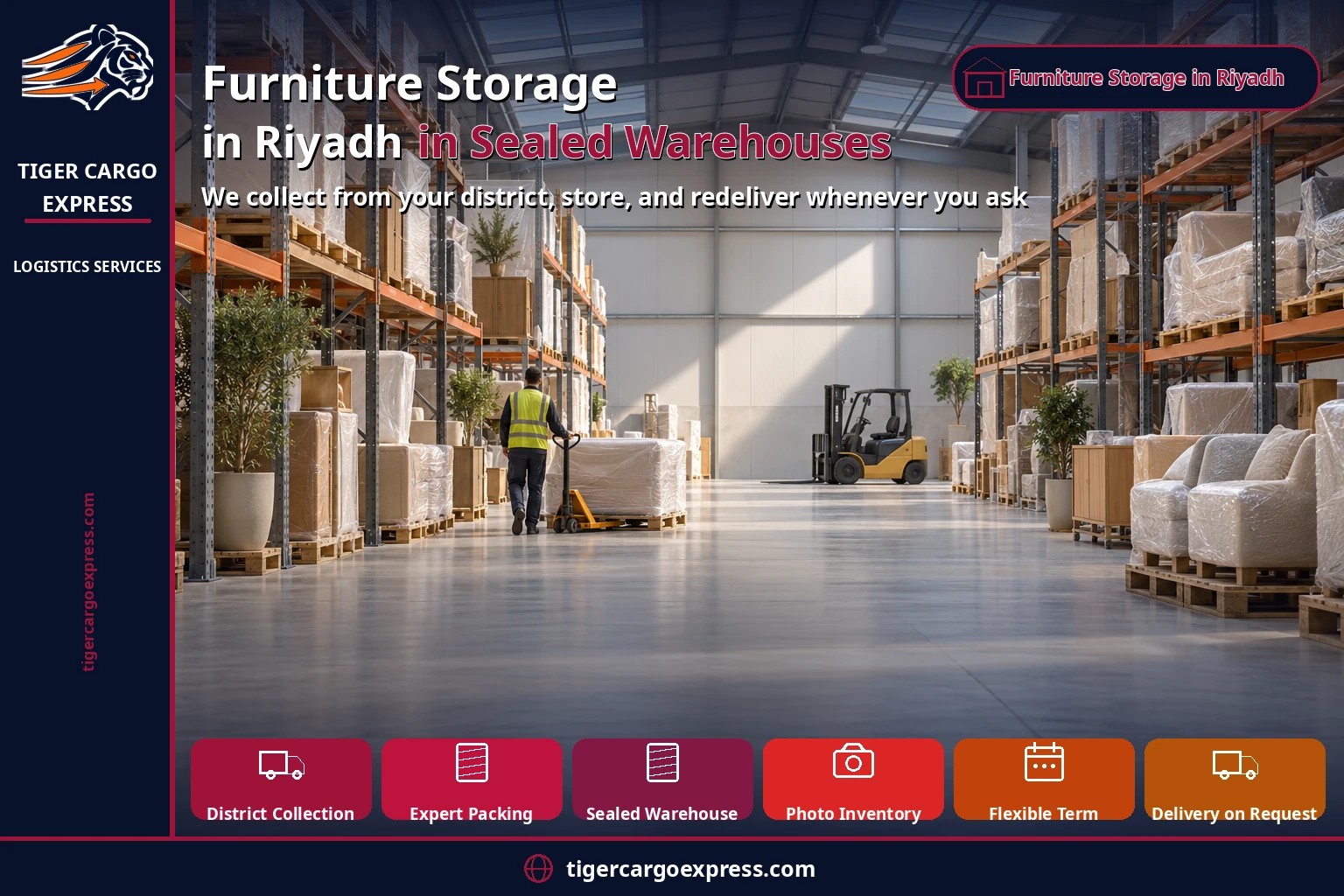
Furniture storage in Riyadh in a sealed warehouse with collection from your district, packing and delivery whenever you ask — and we found pages advising you to store 'before the rainy season to avoid humidity', while Riyadh is a dry inland city and humidity is not its problem. What actually threatens your furniture here is two things: the dust that lodges between fabric fibres and does not come out by wiping, and the daily temperature swing that expands and contracts timber until its joints loosen. The remedy for the first is sealed doors, and for the second an insulated roof and stability rather than cold.
Guide contentsShowHide
Looking for a furniture storage company in Riyadh that knows what actually threatens your furniture in an inland city? Tiger Cargo Express — headquartered in Riyadh — collects your furniture from your district, stores it in a sealed warehouse and returns it whenever you ask. To book: 0506688227
I read the storage pages in Riyadh before writing this one, and found one advising you to store “before the rainy season to avoid humidity”.
Riyadh is a dry inland city — humidity is not its problem. Anyone warning you about it here has copied text written for a coastal city. What actually threatens your furniture in Riyadh is two things nobody mentions: dust, and the daily swing in temperature between night and day.
2real dangers
1our head office is here
0charge for the survey
20+years in the field
Dust — the first enemy in an inland city
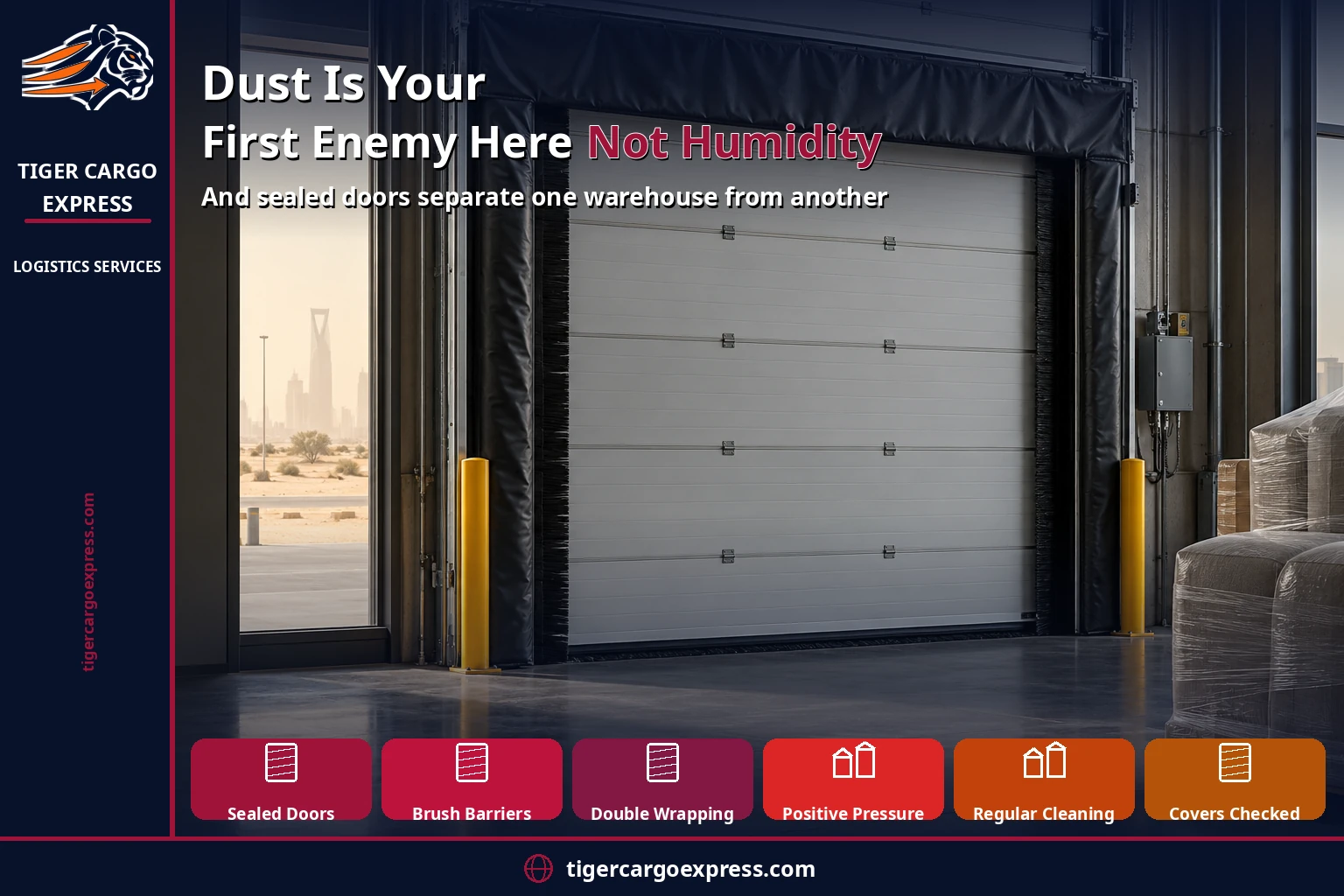
And it is what separates one warehouse from another.
And sealed doors separate one warehouse from another.
Dust in Riyadh is not surface dirt to be wiped away. It is fine particles that enter through any opening, settle into fabric weave and between timber joints, and act as an abrasive with every movement of air.
Where it settles
What it does
Can it be wiped later?
Inside fabric weave
It lodges between fibres and does not come out by wiping
No — it needs deep cleaning
Between timber joints
It abrades with any movement
Very difficult
On painted surfaces
Fine scratches accumulate
A scratch cannot be wiped
Inside appliances
It reaches the circuits through the vents
It needs dismantling
In drawer runners
It makes their movement rough
By partial cleaning
On glass and mirrors
Wiped away easily
Yes — and this alone
Which is why inspecting a warehouse starts at its door rather than inside itThe first thing we ask any warehouse is not its area but how it closes. A door leaving a two-centimetre gap admits dust every day for months. Our warehouse doors carry brush seals and rubber curtains — and you will not find a single storage page in Riyadh mentioning this, because it neither photographs nor markets like ‘armed guarding’.
And four layers we place between your furniture and the dust
The sealed doorBrush seals and rubber curtains — the first layer and the most important.
Individual wrappingEvery piece wrapped on its own rather than the load as one mass.
The bay coverA second cover over the whole bay once it is stacked.
Regular cleaningOf the floors and aisles — because what is lifted no longer settles.
And the second danger: temperature swing rather than heat
A fine distinction that changes everything.
And a steady temperature matters more than a low one.
Everyone advertises “air-conditioned warehouses” and assumes the point is lowering the temperature. The truth is that timber suffers less from steady high heat than it does from repeated rising and falling.
The condition
What happens to timber
The result after months
Steady high heat
It settles into one state
Limited change
A large daily swing
It expands by day and contracts by night
Joints loosen and veneer separates
Steady moderate heat
The ideal state
Nothing worth noting
A slow seasonal shift
It adapts gradually
A slight change
A warehouse with no roof insulation
A sharp daily swing
The worst of all
And this explains something that puzzles manyWhy does furniture come out of an ‘air-conditioned’ warehouse with loosened joints? Because air conditioning that runs for hours and stops for hours creates a sharper daily swing than leaving the warehouse alone would. What is needed is stability rather than cold — and steady moderate heat beats cold that fluctuates. Which is why we measure and log daily rather than settling for the word ‘air-conditioned’ on our page.
What we store in Riyadh
Your home’s contentsFrom one room to a whole house, dismantled and reassembled by a carpenter.
Your electrical appliancesAfter disconnection, cleaning and drying — each with its own preparation.
Your cartons and libraryEach with a code you call it by rather than describing and searching for it.
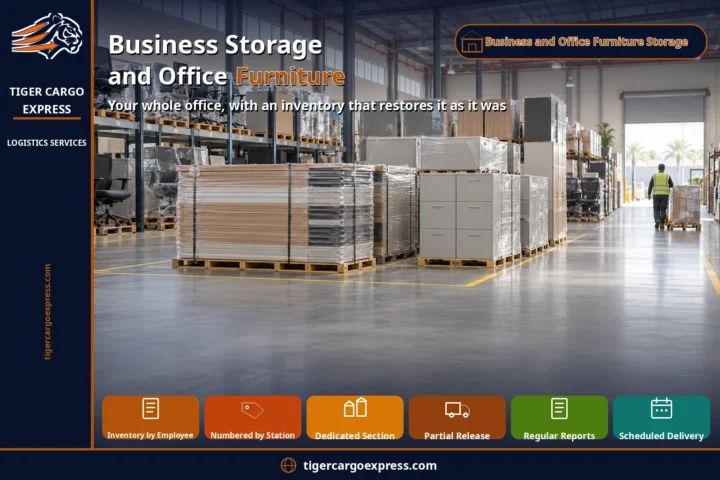
Your company’s fit-outNumbering that ties every item to its employee so it returns straight to them.
Your commercial goodsWith a dedicated space and its own log.
Whatever precedes a shipment or a moveTemporary storage until the departure date.
A private room or space in a shared warehouse?
A question clients ask and nobody explains to them.
Some companies offer two options: a private closed room, or space inside a shared warehouse. And the difference is not in the price alone but in whom each suits.
The item
Space inside a warehouse
A private closed room
The cost
Lower
Around a third higher
Access to your belongings
By prior arrangement
Easier and faster
Repeated partial withdrawal
Possible but needs arranging
Clearly the better fit
A short term (one to three months)
The better fit
An added cost for no reason
A long term with no need for access
The better fit — and cheaper
You pay for a feature you will not use
Commercial goods moving in and out
Not suitable
The better fit
Household furniture awaiting a home
The better fit
With no justification
And our rule in recommendingWill you need access to your belongings during storage? If the answer is no — and it is the answer for most people storing a household — then space inside the warehouse is cheaper and costs you nothing. And if you will be going in and out monthly, the closed room earns its difference. We recommend by your usage rather than by what earns us more — because anyone who paid a difference they never used feels it.
How is a storage price calculated?
By the cubic metre per month — this is the correct unit, not “by the room” nor “by the piece” nor “by the unit”. The volume of what you store is what occupies space, and space is what is paid for.
What you store
Volume dismantled
Space in a warehouse
A closed room
One bedroom
4 – 6 m³
SAR 300 – 450
SAR 420 – 620
A one-bedroom flat
7 – 10 m³
SAR 450 – 660
SAR 620 – 900
A two-bedroom flat
12 – 16 m³
SAR 680 – 990
SAR 930 – 1,350
A three-bedroom flat
18 – 24 m³
SAR 950 – 1,380
SAR 1,300 – 1,880
A small villa
28 – 40 m³
SAR 1,420 – 2,100
SAR 1,950 – 2,850
A large villa
45 – 65 m³
SAR 2,200 – 3,250
SAR 3,000 – 4,400
And three figures rather than oneCollection once, the monthly, and delivery once. Anyone giving you a single ‘all-inclusive’ figure is hiding two from you. We write all three separately in our quote — so you know what you pay today, what you pay each month, and what you pay the day you take your furniture back.
And why do we measure the volume dismantled?
Because dismantling shrinks your volume by around a third — and you pay on volume every month. A two-bedroom flat assembled occupies around twenty-four cubic metres, and dismantled around fourteen. The difference is ten metres — around five hundred riyals a month and six thousand a year.
Which is why dismantling with us sits within the service rather than as an extra lineAnd anyone charging it separately profits twice: once on the dismantling fee, and once on the surplus space you pay for monthly because you did not dismantle. Ask any quote: does the price include dismantling? — the answer separates two offers that look alike.
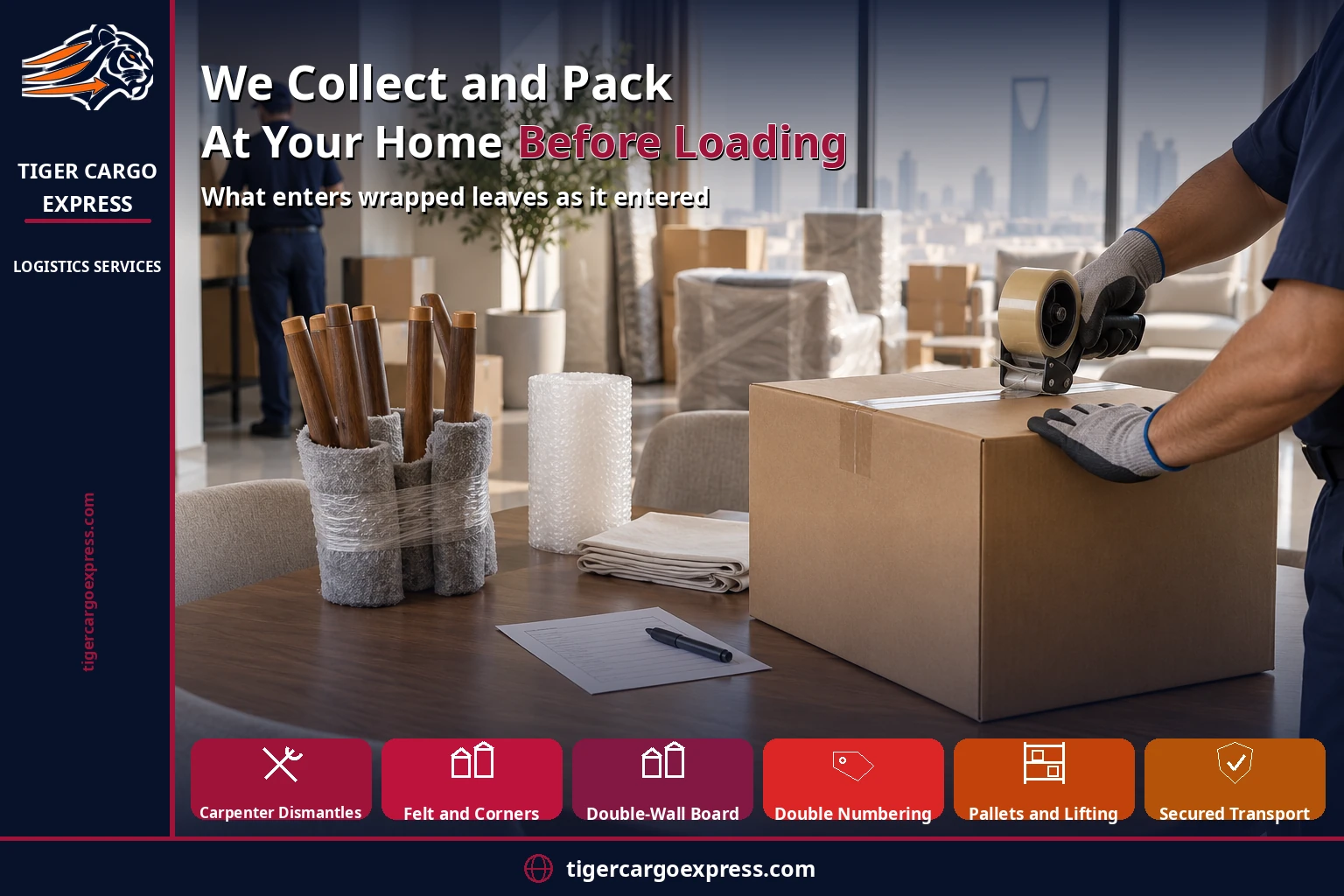
We collect and pack at your home before loading
What enters wrapped leaves as it entered.
What enters the warehouse wrapped leaves as it entered. Anyone loading their furniture exposed and then wrapping it at the warehouse has already exposed it to dust on the road and in the loading yard before it even arrived.
What the service includes
A free inspectionWherever you are in Riyadh — we work out the volume and fix the three lines for you.
Our carpenter is your carpenterThe hand dismantling your room today is the one assembling it the day you take it back.
Two layers on soft furnishingsOne blocking dust and a second guarding against abrasion.
A code on two facesSo it is seen however the box settles inside the bay.
A coded schedule sent to youEach code has an entry stating what is inside it.
Straight through to the storeNo intermediate stop and no unloading on the way.
And every category has its preparation before entry
The category
Its specific risk in Riyadh
What we do
Fabrics and majlis seating
Dust lodges between the fibres
Double wrapping sealed from underneath
Timber
It expands and contracts with the daily swing
Fully dismantled and stored flat on a support
Leather
It dries and cracks in dry air
A breathable cover and distance from heat sources
Appliances
Dust reaches the circuits through the vents
Cleaning and sealing the vents before wrapping
Glass and mirrors
Broken by pressure rather than impact
Always a padded upright rack
Rugs
Folded, they trap dust in the creases
Rolled rather than folded
And the last line goes against what everyone doesA rug is rolled around a tube rather than folded. Folding creates permanent lines in its weave and traps dust inside the creases where cleaning never reaches. Rolling keeps it flat and leaves its whole surface under one layer — a step costing extra minutes at packing and saving you a rug.
Inside the warehouse — racking, codes and inspection aisles
Every bay has its code and every piece its place.
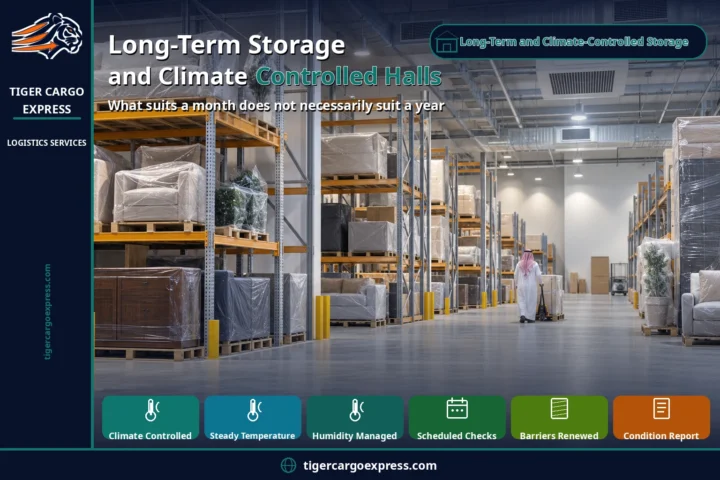
Our Riyadh warehouse is sealed, insulated and its floor sealed over, and every bay in it has its code and its log.
What we commit to
Why in Riyadh specifically
What it prevents
Doors with brush seals
Dust enters through gaps rather than walls
A daily accumulation over months
A sealed floor rather than raw concrete
Raw concrete itself sheds dust
An internal dust source
Pallets under everything
Nothing touches the floor
Rare dampness and accumulated dust
Roof insulation
The roof is the first source of thermal swing
Daily expansion and contraction
A gap from external walls
A wall exchanges heat with outside
A swing on adjoining surfaces
A logged daily reading
Because stability is what is needed, not cold
Fluctuation nobody notices
And the roof insulation line is the most important in practiceBecause the roof takes the sun directly all day and then cools at night. A warehouse whose walls are insulated and whose roof is not lives through a sharp daily swing despite looking sealed and tight. Ask any warehouse about its roof rather than its walls — the answer reveals a great deal.
Riyadh districts we collect from
The northAl Narjis · Al Yasmin · Al Malqa · Hittin · Al Arid · Al Qirawan
The centreAl Olaya · Al Sulaymaniyah · Al Malaz · Al Mursalat · Al Wurud · Salah Al Din
The eastAl Rawdah · Al Naseem · Al Rimal · Al Yarmouk · Qurtubah · Ghirnatah
The westAl Uraija · Dhahrat Laban · Al Suwaidi · Badr · Diriab
The southAl Shifa · Al Mansourah · Al Dar Al Baida · Namar · Ukaz
Outside RiyadhAl Kharj · Diriyah · Huraymila · Al Muzahimiyah — by prior arrangement
And our head office is in Al Uraija Al GharbiyahAnd this is not a detail on an ‘About us’ page but an operational advantage. The survey, the collection and the delivery all set out from inside Riyadh rather than from another city, and you can visit the warehouse yourself before you book — we encourage it, because what you see with your own eyes spares you everything you read.
When and how does storage end?
Your situation
What we do
Note
You want everything
We take it out, deliver and reassemble at your destination
On a date you set
You want a piece or a box
Withdrawal by code from the schedule
Arranged a working day ahead
You want to extend
We renew monthly at the same price
No renewal fee
You want to add items
Added to your bay with their new codes
And we tell you the volume difference before collection
You want a move to another city
We ship it from our warehouse directly
No intermediate move
You want delivery to someone else
On a documented authorisation from you
We verify their identity
And the fifth row concerns manyAnyone who stored in Riyadh and then moved to Jeddah, Dammam or abroad needs no move from warehouse to truck to another warehouse. It is packed for the move inside our own warehouse and loaded straight from it — so a whole stage of cost and handling falls away, and every extra handling is another chance of a scratch.
The difference between two months’ storage and a year’s
It is not in the price alone but in the method and the position. A long term means longer exposure to the thermal swing and a greater accumulation of dust.
The item
Short storage (1–3 months)
Long storage (6 months and over)
The covers
One cover suffices
Individual wrapping + a bay cover
The position
Any available bay
Further from doors and external walls
Inspection
At entry and exit
Periodic during the term
Appliances
Ordinary cleaning
Cleaning and finer vent sealing
Timber
Ordinary wrapping
Deeper dismantling and flat storage on a support
The monthly price
The standard rate
Lower — a longer term is cheaper
Which is why we ask about your expected term from the first callNot only to price but to decide where to place your bay and how to wrap it. Anyone who said ‘two months’ and then stayed a year finds their furniture in a position never chosen for a year. And if your plan changes, tell us — we move the bay and rewrap rather than leaving it while knowing its position no longer suits.
Questions clients ask before deciding
Is my furniture placed with other clients’?No — a bay carrying your code alone is assigned to you, even in the shared warehouse. Your pieces are not set flush against anyone else’s in the same space. And the reason is purely operational: if they were mixed, requesting a piece by its code would become impossible.
And if I fall behind on a month’s payment?We write to you and reach an arrangement — and nobody’s furniture is held suddenly and without notice. But we ask you to be candid with us if your circumstances tighten, because it is easier to handle before the months accumulate.
Do you offer insurance on the contents?We set out your available options and explain what each covers and what it does not. We do not sell you ‘comprehensive insurance’ as a marketing phrase without your knowing its limits — because insurance whose exclusions you do not know does not reassure you the day you need it.
How long does collection from my home take?A two-bedroom flat usually takes one day, including dismantling, wrapping, coding and loading. A villa takes two. And we set your appointment by the hour rather than the day, and tell you if we are running late.
Does the amount change after we agree?It will not. We calculate the volume after dismantling and fix the three lines for you in writing before you sign. And what is written is what is paid — revisited only if you yourself add to or remove from your contents.
What if I want to switch from space to a closed room?Possible at any time — we move your bay and adjust your monthly price from the following month. And the reverse too, if you find you do not need the room.
How the process runs
1Your first callWe ask roughly how much you have, which district, and whether you intend to visit your furniture during the term.
2The survey visitAt no charge — we calculate the volume after dismantling and propose either space or a room.
3Collection dayThe carpenter dismantles, then two layers of wrapping, then coding, then straight to the store.
4The coded schedule reaches youBeside every code an entry setting out what was put in it.
5While it stays with usA temperature measured and logged, a periodic walk-through, and your access by appointment.
6Retrieval dayWe take it down, deliver and assemble — with the same crew that dismantled at your home.
When do you need storage in Riyadh?
Your situation
The usual term
What we recommend
Refurbishment or renovation
One to three months
Space inside a warehouse — the cheaper option
Moving between two homes
Two weeks to a month
You may need no storage at all
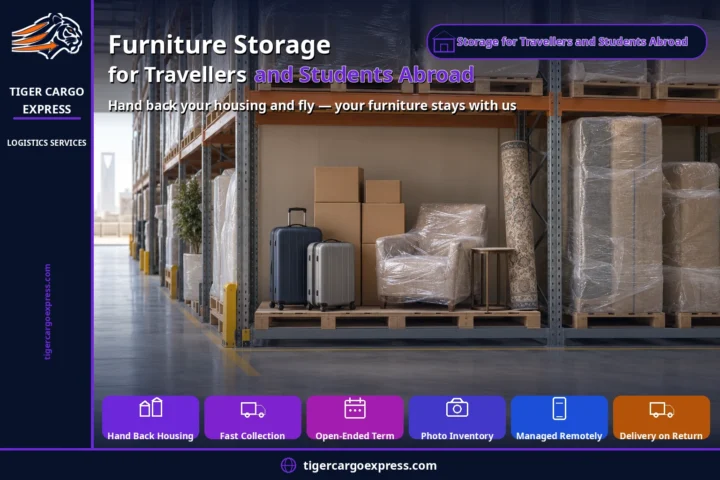
Travel or study abroad
A year or more
Space inside a warehouse on an open term
A smaller temporary home
Six months to a year
A closed room — because you will be going in and out
Letting your home furnished
By the contract
A precise schedule because the furniture returns whole
Commercial goods
By your cycle
A closed room with its own log
And the second situation may need no warehouseAnyone moving between two homes with three or four days between them needs no storage. Their load stays on the truck, secured, and is delivered on its date — so they pay for one move rather than two moves and storage. And we tell them so even though we lose the storage line, because it is not one they should pay.
What we do not store
Anything edible — insects reach it however tightly it is sealed
Paints and similar rapidly flammable liquids
Gas cylinders and every vessel under pressure
Live plants and materials that decompose
Medicines and medical supplies
Your cash, jewellery and original papers — keep them in your own hands
Anything classified hazardous, and expired batteries
How to reduce your bill
What you do
How much it saves
Why it works
Separate every piece into its parts
A quarter to a third of the bill
The space shrinks and the charge is on it
Do not pay the room’s difference needlessly
Around a third
So long as you will not visit your furniture during the term
Leave out what you will not return to
By as much as you leave out
No sense paying months’ rent on what you will dispose of
Tell us the term from the outset
A tenth to a fifth
A longer commitment lowers the monthly rate
Empty the drawers
It spares you damage
The load inside works the joints loose as the timber moves
Standardise your carton sizes
Around a tenth
Even stacking consumes less space
How to compare two quotes
Five questions — three of them specific to Riyadh.
1On what basis do you calculate the price?By the cubic metre or ‘by the unit’? Anyone not knowing my volume does not know my price.
2How do your warehouse doors close?A question about dust — and anyone not understanding it has not thought about it.
3Is the warehouse roof insulated?Walls alone do not suffice — and the roof is the first source of the swing.
4Do you measure the temperature and log it?‘Air-conditioned’ is not an answer — what is needed is stability, not cold.
5Does the price include dismantling?Dismantling shrinks my volume — so anyone charging it separately profits twice.
An example of the wrong comparisonA quote of SAR 150 ‘per unit’ looks very cheap. But ask: how many units does my home need? If a two-bedroom flat needs five or six, you face SAR 700 to 900 — close to our quote, but you do not know it until you ask. A vague unit makes comparison impossible, and that is exactly what makes it useful to whoever uses it.
What we guarantee and what we do not
Sealed doors and an insulated roofBecause dust and thermal swing are Riyadh’s real dangers.
A logged daily temperature readingBecause stability is what is needed, not cold — and ‘air-conditioned’ is not an answer.
A recommendation fitting your usageSpace or a closed room — by your need rather than by what earns us more.
Three figures in writingEntry, monthly and exit — with dismantling within the service.
And what we do not promise: we will not say “fifty per cent off” nor “one hundred per cent secure”. And we will not warn you about humidity in a dry city, because that is text copied from another one. What we commit to: a correct diagnosis of what threatens your furniture here, itemised figures, and a warehouse you can visit.
Five recurring mistakes
Believing humidity is Riyadh’s dangerRiyadh is a dry inland city. Anyone warning you about humidity here has copied text written for a coastal city.
Asking about air conditioning without asking about stabilityAir conditioning that runs and stops creates a sharper daily swing. What is needed is steady moderate heat rather than cold that fluctuates.
Paying the closed room’s difference without needing itIf you will not be going in and out, space inside the warehouse is a third cheaper and costs you nothing.
Folding a rug rather than rolling itFolding creates permanent lines and traps dust in the creases where cleaning never reaches.
Storing furniture assembledThe volume rises by a third and you pay by the cubic metre per month — so the difference accumulates every month.
Why Tiger Cargo Express?
Our head office is in RiyadhAl Uraija Al Gharbiyah — with the survey and collection from inside the city.
We diagnose Riyadh’s danger, not another city’sDust and thermal swing — not humidity copied from a coastal page.
Sealed doors and an insulated roofThe first layer against dust, and the first barrier against the daily swing.
We recommend by your usageSpace or a closed room — and we tell you when you do not need the dearer one.
Visit the warehouse before you bookWe encourage it — and anyone who objects has answered you.
Verify that we are properly registeredRegistration 5800108005 and a documented national address — sent whenever you ask.
Ask for a free survey and visit the warehouseSend your Riyadh district, roughly what you have and your expected term — and the estimate reaches you within an hour.Call 0506688227Message on WhatsApp
Frequently asked questions about furniture storage in Riyadh
What actually threatens my furniture in Riyadh?Two things: dust, and the temperature swing between night and day. Humidity is not a dry inland city’s problem — and anyone warning you about it here has copied text written for a coastal city.
Why is dust so dangerous?Because it is not surface dirt to be wiped away. It is particles lodging between fabric fibres and timber joints, acting as an abrasive with every movement. And what lodges in a sofa’s weave does not come out by wiping but needs deep cleaning.
And what role do the warehouse doors play?They are the first layer and the most important. A door leaving a two-centimetre gap admits dust every day for months. Ours carry brush seals and rubber curtains — ask any warehouse about its doors before you ask about its area.
Is it not enough for the warehouse to be air-conditioned?No — because what is needed is stability, not cold. Timber suffers less from steady high heat than from repeated rising and falling. And air conditioning that runs for hours and stops for hours may create a sharper swing than leaving the warehouse alone would.
Why do you ask about the warehouse roof?Because the roof takes the sun directly all day and then cools at night. A warehouse whose walls are insulated and whose roof is not lives through a sharp daily swing despite looking tight. So ask about the roof rather than the walls.
A closed room or space inside a warehouse?The decisive question: will you need access to your belongings during storage? If the answer is no — and it is the answer for most people storing a household — space is a third cheaper and costs you nothing. If you will be going in and out monthly, the room earns its difference.
How is the price calculated?By the cubic metre per month — not ‘by the unit’ and not by the room. A dismantled two-bedroom flat is around fourteen metres, costing SAR 680 to 990 a month as space and SAR 930 to 1,350 as a closed room. And it has three figures rather than one.
Why do you stress dismantling?Because it shrinks your volume by around a third — and you pay on volume every month. A two-bedroom flat assembled is around twenty-four metres and dismantled around fourteen. The difference is around five hundred riyals a month and six thousand a year — which is why dismantling with us sits within the service.
How do you store rugs?Rolled around a tube rather than folded. Folding creates permanent lines in the weave and traps dust in the creases where cleaning never reaches. Rolling keeps it flat and leaves its whole surface under one layer.
Can I visit the warehouse?Yes — and we encourage it. What you see with your own eyes spares you everything you read: the doors, the pallets, the aisles and the floor. And anyone who objects to you visiting their warehouse has answered you.
Which districts do you collect from?Any district in Riyadh: Al Narjis, Al Yasmin, Al Malqa, Hittin, Al Olaya, Al Malaz, Al Rawdah, Al Naseem, Al Rimal, Al Uraija, Al Suwaidi, Al Shifa and Namar. And our head office is in Al Uraija Al Gharbiyah, with outside Riyadh by prior arrangement.
What are the shortest and longest terms?From one month to as long as you wish. And longer terms carry a lower monthly price — so set your expected term in advance to get its correct rate.
Which categories do you refuse to accept?Anything edible however it is wrapped, along with paints, liquids and whatever ignites, pressurised bottles, live plants, medications, and your official papers, jewellery and cash.
Do you store electrical appliances?Yes — after disconnection, cleaning and drying. And we seal their ventilation openings before wrapping, because Riyadh’s dust reaches the circuits through them. Final acceptance follows knowing the appliance’s type and condition.
In summary
I read the storage pages in Riyadh before writing this one, and found one advising you to store “before the rainy season to avoid humidity”. Riyadh is a dry inland city — humidity is not its problem.
What actually threatens your furniture here is two things: the dust that lodges between fabric fibres and does not come out by wiping, and the daily temperature swing that expands and contracts timber until its joints loosen. The remedy for the first is sealed doors, and for the second an insulated roof and stability rather than cold.
And one question decides which option suits you: will you need access to your belongings during storage? If the answer is no, space inside the warehouse is a third cheaper and costs you nothing — and we tell you so even though the closed room earns us more.
Send your Riyadh district, roughly what you have and your expected term, and the estimate with its three figures reaches you within an hour. 0506688227
Your furniture is in safe handsSealed doors · An insulated roof · A daily reading · A recommendation fitting your usageCall 0506688227Message on WhatsApp
Other storage options
Storage in Riyadh is one option within our storage service — and the right one depends on how long you need it, what you are storing and whether you will be travelling.