Business and Office Furniture Storage 0506688227 Downtime Is the Cost, Not the Invoice
Guide summary
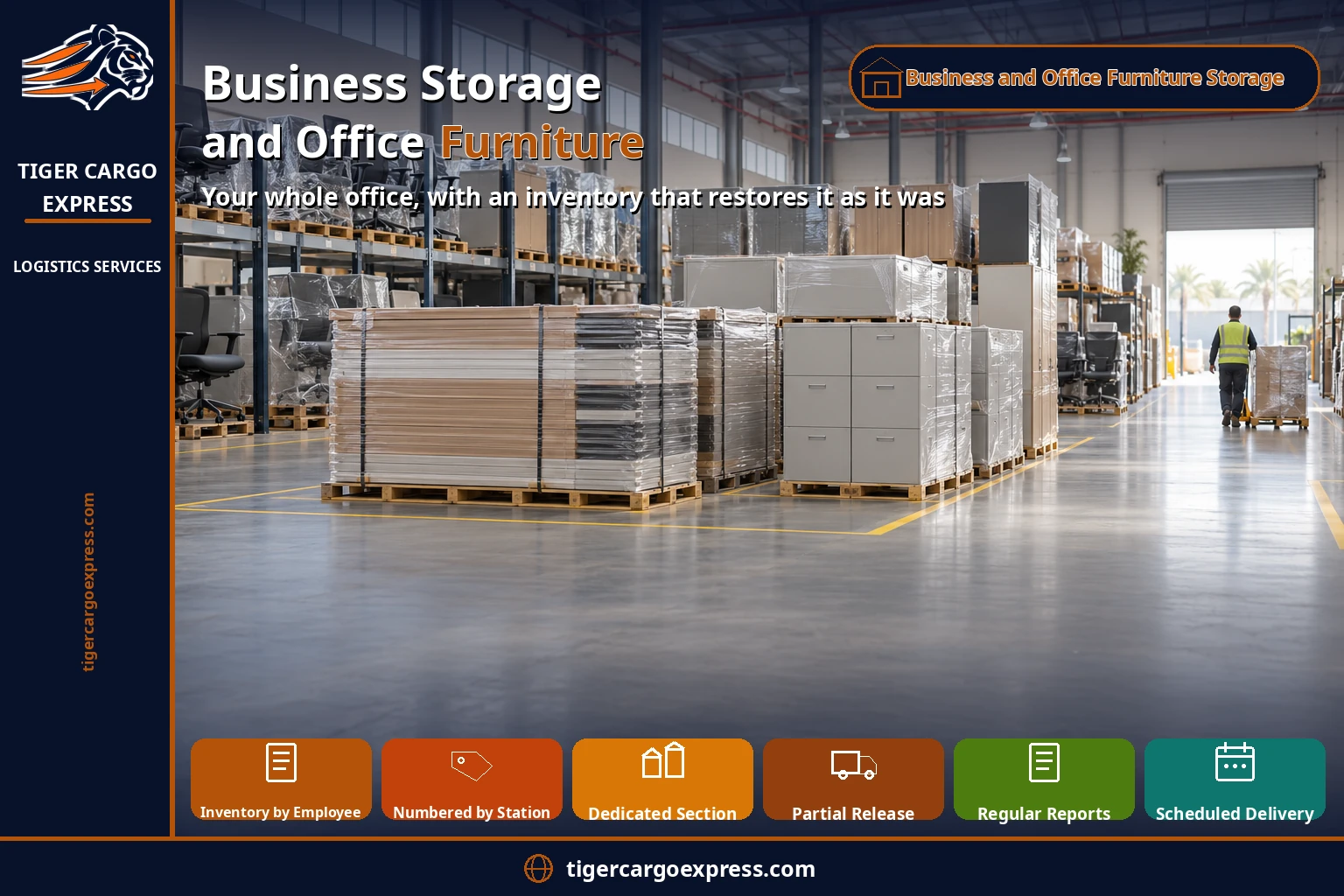
Storage for office furniture, equipment and commercial goods in a dedicated section with a movement log and periodic reports — storage pages mention businesses in a passing line within content written for families, then go back to talking about bedrooms. A company needs what a family does not: a tax invoice that enters its books, signed authorities because its staff change, frequent partial release, and a movement log. And before all of that: not to stop. The gap between two quotes is a thousand or two, and one downtime day exceeds it several times over. So we ask first: when must you not stop?
Guide contentsShowHide
Looking for office furniture and business storage that counts your days of downtime rather than your invoice alone? Tiger Cargo Express stores your office furniture, equipment and goods in a dedicated section with a movement log and periodic reports. To book: 0506688227
Storage companies mention businesses in a single passing line within pages written for families: “we serve individuals, families, companies and offices.” Then they go back to talking about bedrooms.
And a company needs what a family does not: a tax invoice, signed authorities rather than named individuals, scheduled release, and a movement log. And before all of that: not to stop working.
1dedicated section for your company
0days of downtime
24hours for a scheduled release
20+years in the field
The invoice is not the cost — downtime is the cost
And this is a calculation you will find on no storage page.
When your company moves its furniture into storage, you look at the quote and compare it with another. The gap between them is a thousand riyals or two. Meanwhile a single day of downtime may cost you several times that.
Your team’s size
Approximate cost of one downtime day
The gap between two quotes
5 staff
It exceeds any discount
A few hundred
10 staff
Several times the gap
One to two thousand
20 staff
Many times over
Two to three thousand
With customer service halted
Not measured in salaries alone
—
With a client delivery delayed
It may cost the contract itself
—
Which is why we build the arrangement around time rather than priceThe first question we ask is not ‘how much furniture do you have’ but ‘when must you not stop’. Then we build the schedule on that: working outside hours, at the weekend, or in stages. It may cost you more on our invoice and save you several times over in your operations — and we give you both figures so you compare them rather than comparing two quotes.
And three arrangements that prevent downtime
Working outside office hoursEvenings or nights — so your staff arrive in the morning to a ready office.
Working at the weekendThursday and Friday — the commonest for mid-sized offices.
Moving in stagesOne section works while another moves — for companies that cannot close.
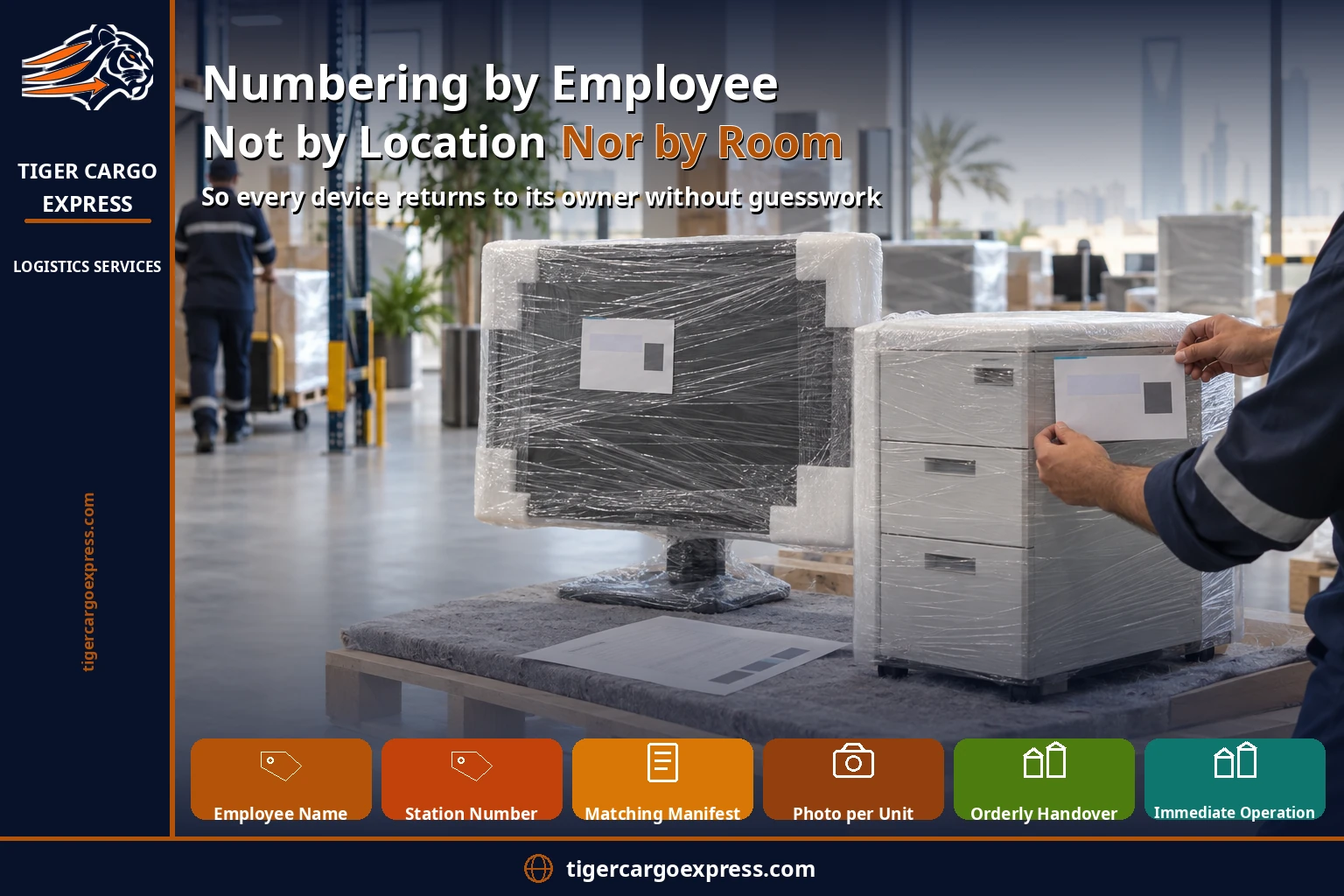
And numbering by employee rather than by location
And this is what turns assembly into a handover.
So every device returns to its owner without guesswork.
The usual numbering in offices is by location: “second floor”, “right-hand hall”, “sales department”. And this works at dismantling and fails at assembly — because your new office may not carry the same layout.
The numbering
At dismantling
At assembly
By floor or hall
Clear
Meaningless if the layout changed
By department
Clear
Useful if the layout stayed the same
By number alone
Fast
It needs a list and a search
By the employee’s name
Clear
Every piece knows its owner
And the difference shows in hours of assembly rather than minutes of dismantlingAn office of twenty staff has twenty identical screens and twenty identical drawer units. Numbering by location makes our crew ask, guess and rearrange. But an employee’s name on their screen, drawer and chair turns assembly into direct distribution — and everyone sits at their own things without hunting for anything. That saves hours, and hours here are the cost.
And what we actually label
The employee’s name on their screen, computer, drawer and chair
The station number if you run a numbering system
The department — as a second layer rather than a first
The box’s contents by item and count
What needs dismantling and what does not
What must work first — so those pieces are assembled ahead of the rest
And the last line is an operational sequence rather than a formalityNot everything needs to work on the first day. We ask you: which pieces, once working, let you resume? We assemble those first and hand you a working office, then complete the rest — rather than assembling everything in order and handing over at the end of the day.
And the paperwork a company needs and a family does not
A family pays and is done. A company needs what enters its books. And this is a line you will not find on storage pages because they are written for individuals.
What your company needs
Why
What we provide
A compliant tax invoice
So it enters your expenses and what is deductible is deducted
An invoice with our tax number
A written contract with clauses
Not a verbal understanding with a representative
A contract setting the term, price and authorities
Signed authorities
Staff change
A list of who may make requests
A documented movement log
Because the inventory is an accounting responsibility
Every entry and exit with its date
Periodic reports
For whoever tracks assets with you
A report on the condition of what you hold
One point of contact, not a rep
A company needs an entity to speak to
A named person tracking your file
And the authorities line matters most over the long runBecause a company is an entity that stays while its staff change. Whoever signed the contract may leave after a year, and whoever requests a release afterwards may be someone we have never met. Which is why we ask for a signed list of who may make requests, updated whenever you wish — so we do not hand over to whoever says ‘I am from the company’, and do not stall you because the original signatory has gone.
We collect and pack your office outside working hours
So your work does not stop for a single day.
Prior coordination is what makes that possible. Working outside hours needs arrangements with building management, security and the lifts — and we handle that for you.
What the service includes
A survey and a timetableWe visit, measure and set a schedule by the hour beginning after your staff leave.
Coordination with building managementEntry permits, lifts and security — handled by us rather than you.
Labelling by employee nameOn the screen, drawer and chair — so assembly becomes a handover.
Professional dismantling of tablesWith reinforced corners and screws documented in numbered bags.
Technical packing for equipmentAnti-static wrapping for devices and servers.
We hand over a working officeWe assemble what must work first, then complete the rest.
And every office category has its preparation
The category
Its risk
What we do
Screens
The panel breaks under pressure, not impact
Always upright in a padded rack
Computers and servers
Static electricity and dust
Anti-static wrapping and sealed vents
Meeting tables
The edges and corners suffer first
Reinforced corners and full dismantling
Filing cabinets
The weight inside works their joints loose
Always emptied before lifting
Office chairs
The gas lifts and the castors
Lowered, secured and stacked inverted
Paper archives
Moisture and insects
Closed boxes on a raised pallet
And the paper archive deserves a question before storageDo you actually need it? Many companies store a paper archive for years and never open it once, and the cost of storing it exceeds the cost of digitising it. We say so during the survey — because if what you need is the information rather than the paper, digitising once costs less than an endless monthly rent.
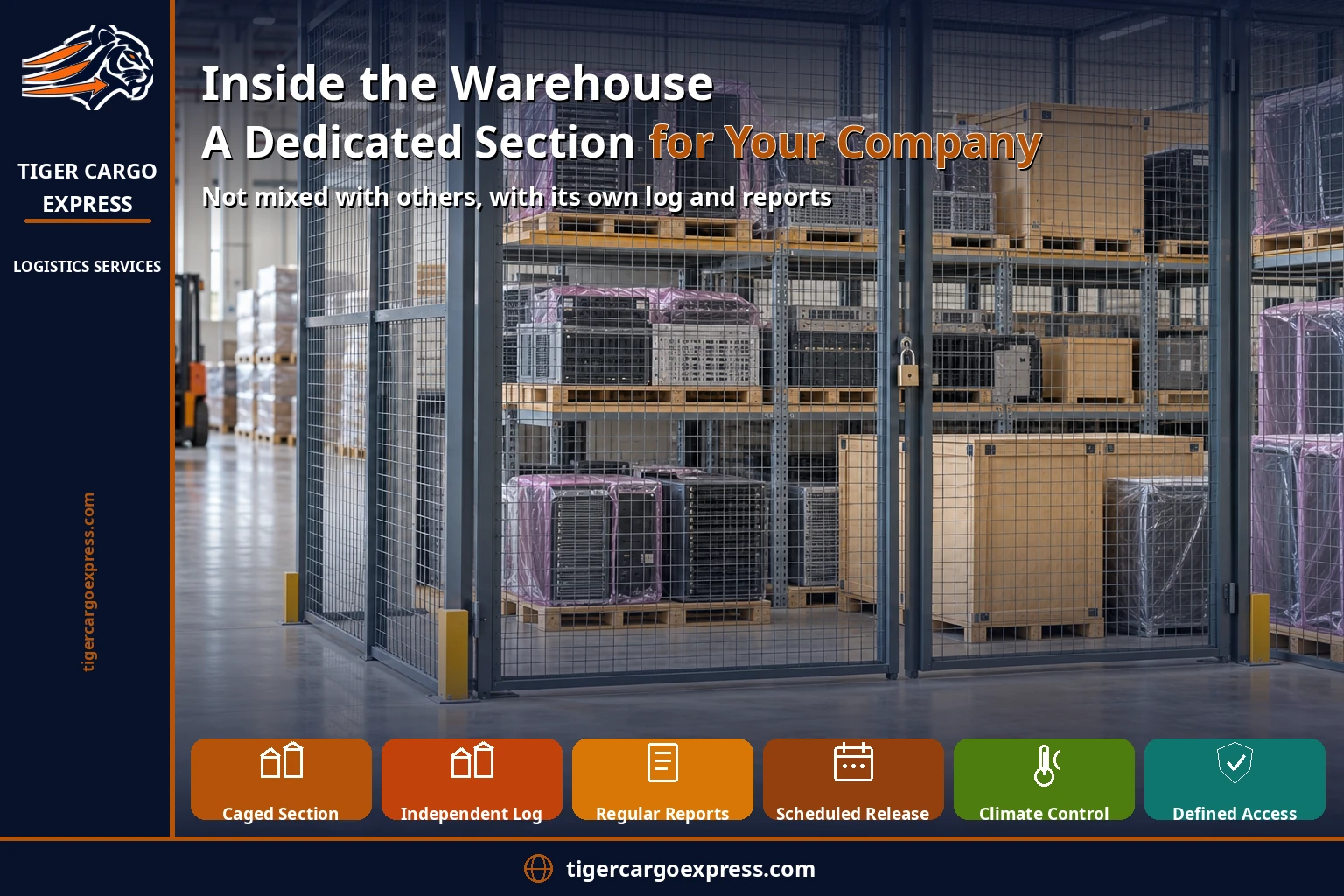
Inside the warehouse — a dedicated section for your company
Not mixed with others, with its own log and reports.
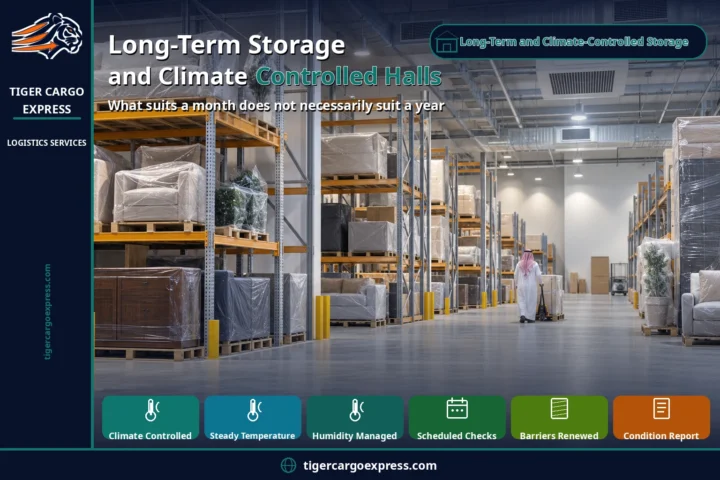
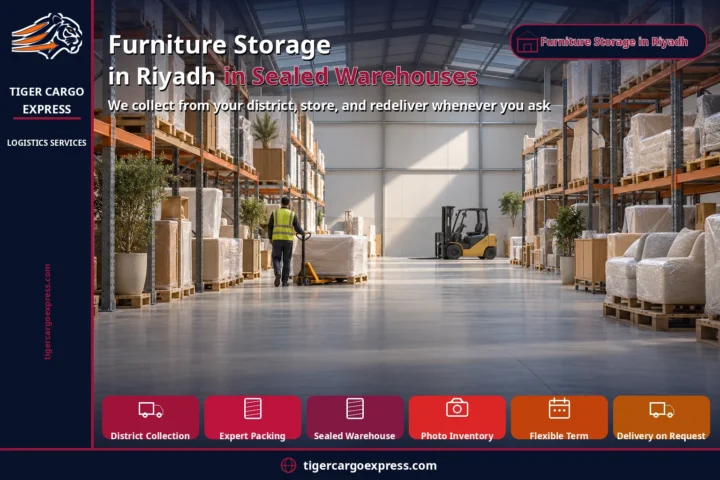
A company’s furniture is not stacked with individuals’. It sits in a caged section with its own gate, code and log — because what marks commercial storage is movement rather than stillness.
What we commit to
Why for companies specifically
What it prevents
An independent caged section
Because partial release is frequent
Opening other people’s bays on every request
A documented movement log
The inventory is an accounting responsibility for you
A discrepancy between your books and reality
Authorities defined by name
Staff change
Handing over to someone without authority
Periodic reports
For whoever tracks the assets
A year without knowing your assets’ condition
A sub-section for IT equipment
Sensitive to dust and static
Mixing it with ordinary furniture
Climate control with a logged reading
Equipment is more sensitive than timber
Damage that shows only when switched on
And the caged section is an operational necessity rather than a luxuryBecause a company goes in and out and a family does not. Someone storing their home opens it once on the way out; someone storing their office may request equipment three times a month. A dedicated section makes every request a simple operation inside your space alone — rather than opening, rearranging and restacking other people’s bays.
Partial release — without opening the whole section
Request only what you need and the rest stays sealed.
What a company needs most is not storage but access. You may need five chairs for a temporary office, a particular device, or an archive box for one specific year.
What you request
How
The timing
A piece or two
A message with their code or owner’s name
Within 24 hours
A set for a temporary office
A list of what you need
One working day
A recurring scheduled release
An agreed schedule set in advance
With no request each time
Returning what you withdrew
By prior arrangement
Added to the log
Adding new furniture
Telling us the volume
We adjust your space and price
Final handover
On a date you set
Two to three days to prepare
And the third line serves seasonal businessesAnyone needing equipment in particular seasons does not want to request it each time. We set a schedule with you: these pieces go out in this month and return in that one. And we prepare them ahead of their date without your having to remember — turning storage from a warehouse into an extension of your own stockroom.
Business storage prices
By the cubic metre per month — and a dedicated section costs more than shared space, but it is necessary for anyone going in and out.
What you store
Volume dismantled
Shared space
A dedicated section
An office of 5 staff
6 – 9 m³
SAR 400 – 590
SAR 550 – 810
An office of 10 staff
11 – 16 m³
SAR 640 – 950
SAR 880 – 1,300
An office of 20 staff
20 – 30 m³
SAR 1,050 – 1,550
SAR 1,440 – 2,130
An office of 40 staff
38 – 55 m³
SAR 1,850 – 2,730
SAR 2,540 – 3,750
IT equipment only
By count
Not suitable
A dedicated sub-section
Commercial goods
By your cycle
Not suitable
With a release schedule
And three lines sit outside the monthly rateCollection once, delivery once, and partial release by its frequency. We write them separately in the quote with a tax invoice for each line — because what enters your books should be itemised rather than a lumped figure. And if your releases are frequent we agree a monthly package instead of charging each time.
How the process runs with a company
1A first call with one questionWhen must you not stop? And how many staff do you have?
2A survey visit in your own timeWe measure, count the stations and ask: what must work first?
3A quote with a timetable rather than a price aloneBy the hour — with the contract and the authorities list.
4Coordination with building managementPermits, lifts and security — handled days before the date.
5The night of dismantling and packingOutside hours, labelled by employee name, with a list drawn up in front of you.
6The list and the log reach youWith an itemised tax invoice.
7During storageRelease within 24 hours, periodic reports, and authority updates whenever you wish.
8Handover dayWe assemble what works first and hand you a working office, then complete the rest.
And the commonest case: moving between two premises
And what everyone gets wrong is treating it as storage, when it is really a move with a time gap.
The gap between premises
What you actually need
Note
Two to four days
You may need no storage
The load stays secured and is delivered on its date
One to two weeks
Short storage in shared space
The cheapest — and no release expected
One to three months
A dedicated section if you will be withdrawing
By your need for access
More than three
A dedicated section with a schedule
And the new premises may run later still
Undefined
Do not commit to a term
Fit-outs usually run past their date
And we say the first line even though we lose the contractAnyone moving with a three-day gap needs no warehouse. Their load stays loaded and secured and is delivered on its date — so they pay for one move rather than two moves and storage. We say so at the survey, because a storage line the client never needed is discovered one day — and never forgotten.
Questions companies ask before signing
Can we visit the section during storage?Yes, by prior arrangement — and we welcome it. Whoever tracks their company’s assets needs to see them rather than read about them. And your section is caged and independent so a visit disrupts nobody else — we set a time that suits your working day.
Who signs the contract and who collects?Whoever holds the authority in your company signs, and whoever you place on the authorities list collects. They may be two different people — and that is normal. The list is updated by a letter from you whenever your team changes, with no need to re-contract.
What if our contract ends and our new premises are not ready?We renew monthly at the same price with no renewal fee.Fit-outs usually run late — a recurring pattern rather than an exception. So we do not put you before a rushed decision because a date expired on a piece of paper.
Do you work with government and semi-government entities?Yes — with their usual documentation procedures. But tell us early if you have particular procurement or pre-qualification requirements, because some of them take time — and we do not want to stall you over a paper that takes a fortnight.
How do we reconcile your inventory with our accounting records?By the dated movement log — every entry and exit with its date and who requested it. You send it to your accountant to reconcile against your books. And if you run a fixed-asset system with a number per item, give us your numbers and we use them instead of ours.
Can storage become a move to another city?Yes, and straight from our warehouse. A company that stored in Riyadh and opened a Jeddah branch has its furniture packed where it stands and loaded from there — with no removal, transfer and intermediate storage. And every handling that falls away is another chance of a scratch that falls away with it.
When does a company need storage?
Your situation
The usual term
What marks it
Moving between two premises
Weeks to three months
The priority is not stopping rather than the price
Refitting your current premises
One to six months
Usually with frequent partial release
A temporary reduction in space
A year or more
It may become permanent — work out the case
Shifting to remote work
Open
The furniture is surplus rather than stored — a decision rather than a deferral
Project or exhibition furniture
Seasonal
An agreed release schedule
A paper archive
Years
Ask: is digitising cheaper?
And the fourth case deserves candourA company that shifted to remote work and stored its office furniture ‘until it decides’ will most likely never return to it. And storing twenty staff’s furniture for two years may exceed the cost of replacing it should you ever need it. So work out the case plainly — a deferred decision here is paid for monthly.
And commercial goods run on a different arrangement
Goods are not furniture — they enter and leave on a cycle, and their inventory is reconciled against your books.
An inventory by item and quantityNot by box — because your books are by item.
A dated movement logEvery entry and exit documented for reconciliation against your stock.
An agreed release scheduleFor anyone with a known cycle — with no request each time.
A periodic balance reportWhat entered, what left and what remains.
And we tell you what we cannot doWe are not a logistics warehouse with a full inventory management system. If your cycle is daily across dozens of lines, you need a specialist provider rather than us. What we suit: storage on a weekly or monthly cycle with a clear inventory — and we say so before you sign rather than after two months of friction.
What we do not store
Anything edible — and companies forget the hospitality and kitchen boxes
Paints, liquids and whatever ignites
Gas cylinders and every vessel under pressure
Medicines and medical supplies
Batteries inside devices — removed and recorded
Original documents and company seals — keep them in your own safe
Hazardous materials and expired batteries
And the documents line concerns companies specificallyOriginal contracts, seals and cheques are not stored in a warehouse. Keeping them is a legal responsibility of yours rather than a service to be bought, and we do not accept them even if you ask. An ordinary paper archive we do store — after asking you whether digitising it costs less.
How to compare two quotes
Six questions — and the first has nothing to do with price.
1When do you work — inside hours or outside?One day of downtime exceeds the gap between two quotes.
2How do you label? By location or by employee name?Location labelling is meaningless if our new office layout differs.
3Do you issue a compliant tax invoice?Because it enters our books rather than our pocket.
4Who is entitled to request a release?Our staff change — so the authority is by name rather than by acquaintance.
5How long does releasing one piece take?Because we will request more than once, not once.
6Is our section independent or mixed?Mixed means opening other people’s bays on every request.
An example of the wrong comparisonA quote of SAR 800 a month looks cheaper than ours at 1,100 for a ten-person office. But ask about the timing: if the work happens inside office hours you face a day or two of disruption. And three hundred riyals a month does not equal one day of downtime — the gap is paid once, and the downtime is paid out of your whole productivity.
What we guarantee and what we do not
A schedule built around your timeOutside hours, at the weekend or in stages — to avoid downtime.
Labelling by employee nameSo assembly becomes direct handover rather than searching and guessing.
A tax invoice, a contract and authoritiesWhat enters your books rather than a verbal understanding with a rep.
A dedicated section and release within 24 hoursBecause a company goes in and out and a family does not.
And what we do not promise: we are not a logistics warehouse with a full inventory system, and anyone on a daily cycle across dozens of lines needs a specialist provider. We will not accept your original documents or company seals however much you ask. And we will ask about your paper archive: is digitising cheaper? — even though that reduces your volume with us.
Five recurring mistakes with companies
Comparing two quotes without counting downtimeOne downtime day for twenty staff exceeds the gap between any two quotes. So start with the timing rather than the price.
Labelling by location rather than by employee‘Second floor’ is meaningless if your new office layout differs. An employee’s name works in any layout.
Settling for a verbal understanding with a representativeA company needs a contract, a tax invoice and signed authorities — because its staff change while its entity remains.
Storing the paper archive without askingMuch of it is never opened, and the cost of storing it for years exceeds the cost of digitising it once.
Deferring the decision on surplus furnitureA company that shifted to remote work and stored ‘until it decides’ pays monthly for a decision it never took.
Why Tiger Cargo Express?
We start with the downtime question, not the priceWhen must you not stop? — then we build the schedule on that.
We label by employee nameSo everyone sits at their own things without searching — and hours here are the cost.
A tax invoice, a contract and authoritiesWhat your company needs and a family does not — and what those pages omit.
A caged section with a movement logBecause partial release is frequent for you rather than once.
We assemble what must work firstSo we hand you a working office and then complete — not a finished one at day’s end.
Verify that we are properly registeredRegistration 5800108005 and a documented national address — sent whenever you ask.
Start with the downtime question rather than the price questionSend your staff count and your date — and the schedule and estimate with its invoice reach you within an hour.Call 0506688227Message on WhatsApp
Frequently asked questions about business storage
What should we calculate first?Days of downtime rather than the invoice. The gap between two quotes is a thousand or two, and one downtime day for ten staff exceeds that several times over — measured not in salaries alone but in halted customer service and delayed deliveries.
How do you prevent our work stopping?By three arrangements: working outside office hours so your staff arrive to a ready office, working at the weekend, or moving in stages — one section works while another moves. And we ask first: when must you not stop?
Why label by employee name?Because location labelling works at dismantling and fails at assembly — your new office may not carry the same layout. An employee’s name on their screen, drawer and chair turns assembly into direct distribution, so everyone sits at their own things without searching — and hours here are the cost.
Do you issue a tax invoice?Yes — a compliant invoice with our tax number, itemised by line. Because what enters your books should be itemised rather than a lumped figure — collection, monthly, delivery and partial release, each on its own line.
Our staff change — how do you handle that?By a signed list of who may make requests, updated whenever you wish. So we do not hand over to whoever says ‘I am from the company’, and do not stall you because the contract signatory has left. A company is an entity that stays while its staff change — the authority is by name rather than by acquaintance.
How long does releasing a piece take?Within twenty-four hours for one or two pieces, and a working day for a set. And for frequent releases we set a schedule in advance so the pieces come out on their dates with no request each time.
A dedicated section or shared space?Dedicated is a necessity for you rather than a luxury. A family opens its storage once on the way out; you may request three times a month. A caged section makes every request an operation inside your space alone rather than opening and restacking other people’s bays.
What does storing a ten-person office cost?Between SAR 880 and 1,300 a month in a dedicated section, and SAR 640 to 950 in shared space. And three lines sit outside the monthly rate: collection, delivery and partial release by its frequency — all with an itemised tax invoice.
How do you store servers and IT equipment?With anti-static wrapping and sealed ventilation openings, in a dedicated sub-section rather than mixed with the furniture — because they are more sensitive to dust and thermal shifts. Final acceptance follows knowing the equipment’s type and value.
Should we store our paper archive?We store it — but we ask you first: do you need it? Many companies store an archive for years and never open it once, and the cost of storing it exceeds the cost of digitising it. If what you need is the information rather than the paper, digitising once costs less than an endless rent.
And what about our original documents?We do not accept them even if you ask. Original contracts, seals and cheques are your legal responsibility to keep rather than a service to be bought. Keep them in your safe — an ordinary paper archive we do store.
Do you store commercial goods?Yes, with an inventory by item and quantity rather than by box, a dated movement log, and a periodic balance report. But we are not a logistics warehouse with a full inventory system — anyone on a daily cycle across dozens of lines needs a specialist provider, and we say so before signing.
What if we want to add furniture later?It is added to your section with its new codes and your log updated, and we adjust your space and monthly price from the following month. And we tell you the difference before collection rather than after.
We shifted to remote work — store or sell?Work it out plainly. Storing twenty staff’s furniture for two years may exceed the cost of replacing it should you ever need it. And a company that stored ‘until it decides’ pays monthly for a decision it never took — and we tell you so even though we lose the contract.
In summary
Storage pages mention businesses in a passing line within content written for families — then go back to talking about bedrooms.
And a company needs what a family does not: a tax invoice that enters its books, signed authorities because its staff change, frequent partial release, and a movement log reconciled against its inventory.
And before all of that: not to stop. The gap between two quotes is a thousand or two, and one downtime day exceeds it several times over. Which is why we ask first: when must you not stop? — and then build the schedule on that.
And labelling by employee name is what cuts the assembly hours — because location labelling works at dismantling and fails at assembly, while an employee’s name lets every piece find its owner in any new layout.
Send your staff count and your date, and the schedule and estimate with its invoice reach you within an hour. 0506688227
Your assets are in safe handsA schedule that avoids downtime · Labelling by employee · An invoice and authorities · Release within 24 hoursCall 0506688227Message on WhatsApp
Other storage options
Office Storage is one option within our storage service — and the right one depends on how long you need it, what you are storing and whether you will be travelling.