
Long-Term Furniture Storage and Climate-Controlled Warehouses 0506688227 ‘Climate-Controlled’ Is Not a Specification
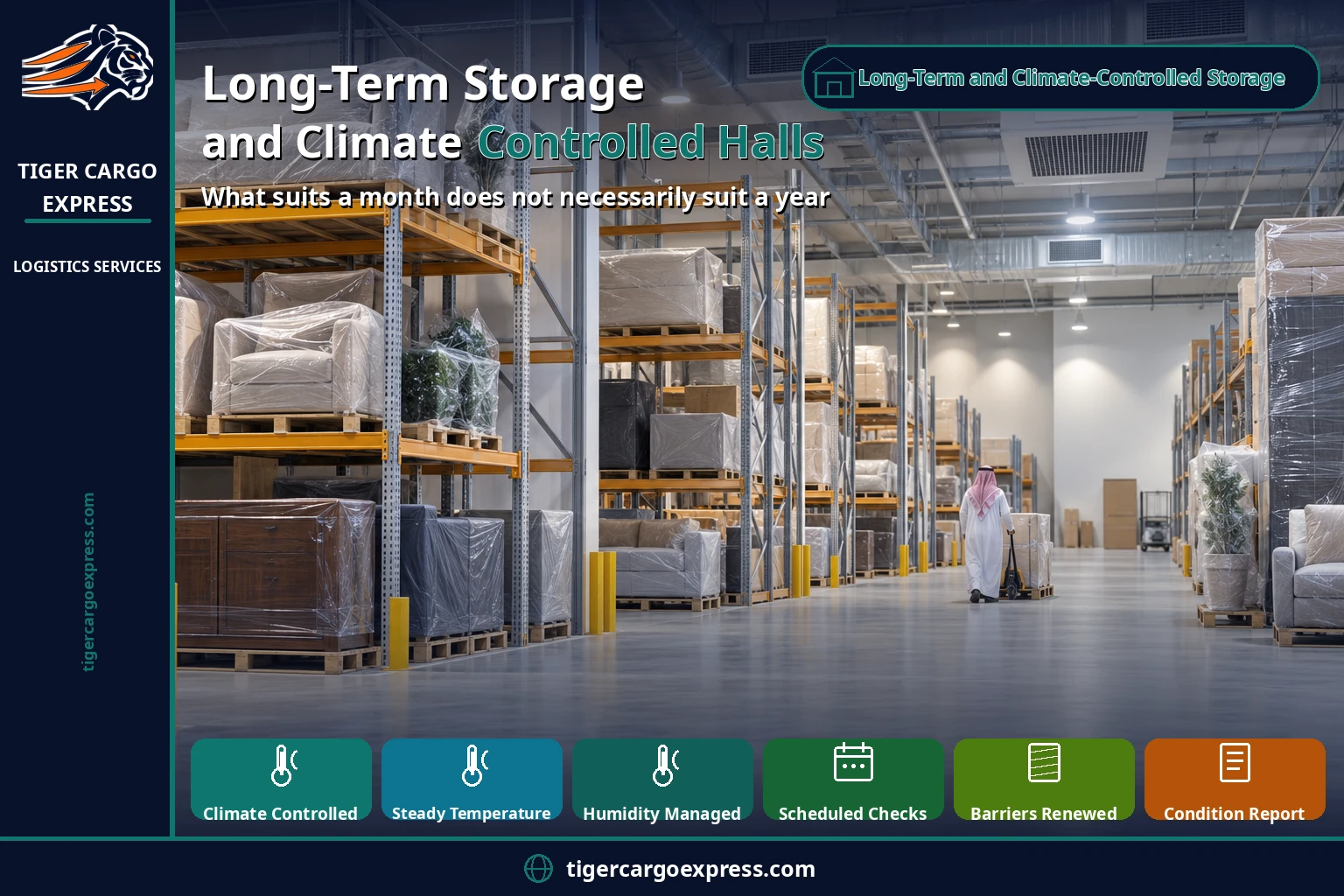
Furniture storage for six months, a year or longer with scheduled maintenance and periodic reports — and every storage page writes 'climate-controlled warehouses' while not one gives you a figure: no temperature range, no humidity percentage, and nothing on whether the cooling runs around the clock or in bursts. 'Climate-controlled' is an adjective that cannot be tested. And more important still, the protection itself is consumed: absorbent sachets saturate within two months and then become a moisture source pressed against your furniture. So long-term storage is scheduled maintenance rather than a one-off deposit.
Guide contents ShowHide
Looking for a long-term furniture storage warehouse that gives you figures rather than adjectives? Tiger Cargo Express stores your furniture for six months, a year or longer, with scheduled maintenance and periodic reports. To book: 0506688227
Every storage page writes “climate-controlled warehouses” — and not one of them gives you a figure. No temperature range, no humidity percentage, no word on whether the cooling runs around the clock or in bursts, and nothing about whether anyone measures and logs it at all.
And “climate-controlled” is an adjective rather than a specification. It is like a restaurant calling its food “fresh” — a phrase that can neither be tested nor compared. And in long-term storage in particular, the difference between one warehouse and another shows after a year rather than after a week.
‘Climate-controlled’ is not a specification — and these are the questions that test it
Five questions that turn a description into a figure.
| Ask about | The vague answer | The answer that can be tested |
|---|---|---|
| The temperature range | ‘Climate-controlled’ | A defined range within two degrees, held steady |
| The relative humidity | ‘Protected from humidity’ | A target percentage that is measured |
| Operating hours | ‘It runs all the time’ | Around the clock or in bursts? |
| Measurement | ‘We have devices’ | Is it logged? And where do I see the log? |
| Response to deviation | Usually no answer | What happens if the reading leaves the range? |
And why does stability matter in long-term storage specifically?
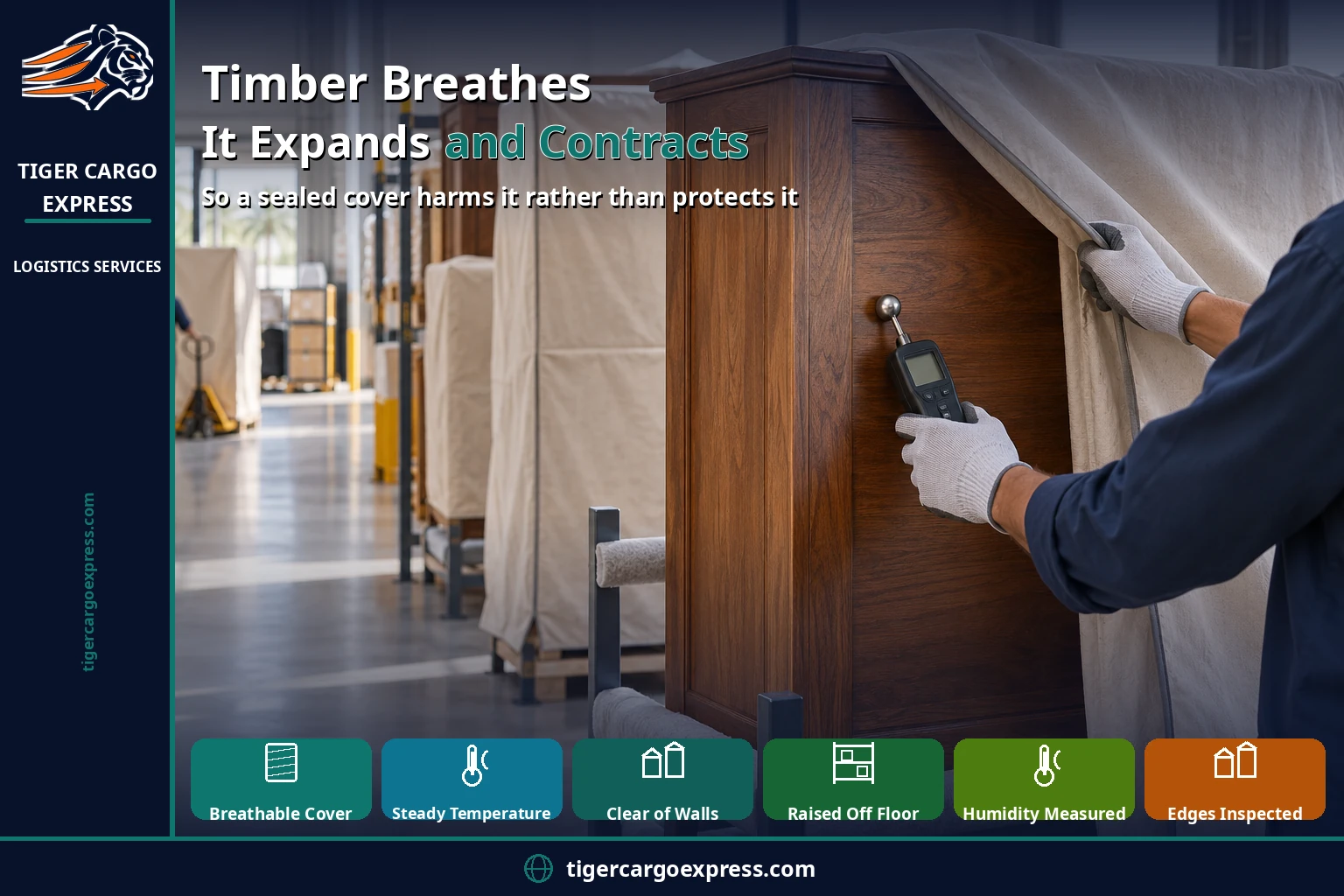
Because timber breathes — it absorbs moisture and expands, releases it and contracts. Over a fortnight no trace appears. Over a year of repeated expansion and contraction, joints loosen, veneer separates and cracks appear in the finish.
| The period | A stable environment | A repeatedly swinging one |
|---|---|---|
| A month | No difference worth noting | No difference worth noting |
| Three months | Nothing | The weaker joints begin to loosen |
| Six months | A slight change | Noticeable loosening and swelling edges |
| A year | A stable condition | Veneer separating and finish cracking |
| Two years | Limited change | Damage needing restoration |
And protection is consumed — long-term storage is maintenance rather than deposit
And this separates a month from a year more than anything else.
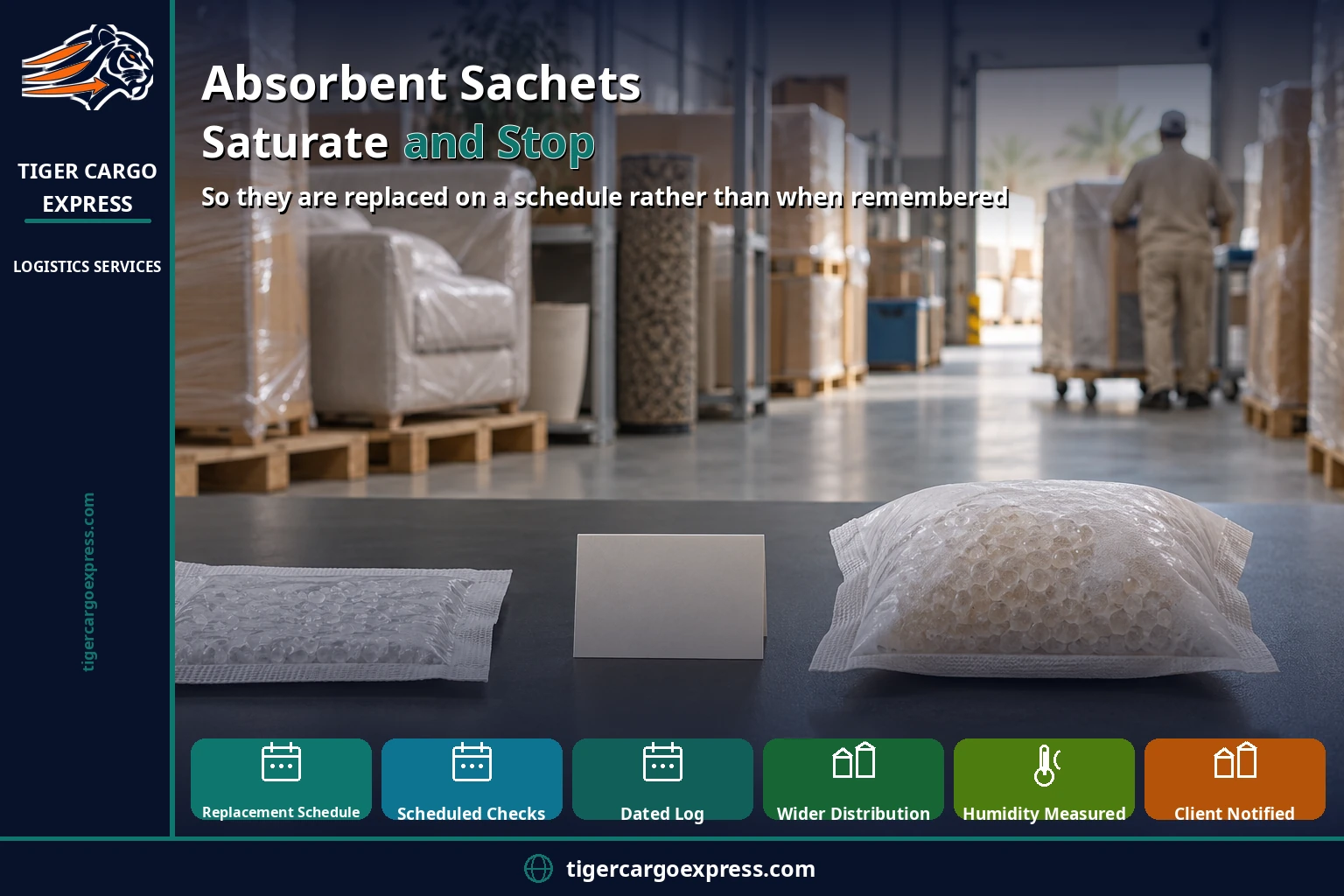
Many imagine long-term storage is short-term storage extended — wrap it well and leave it. This is wrong, because the protective materials themselves have a lifespan.
| The protective material | Its approximate life | What happens after it |
|---|---|---|
| Absorbent sachets | One to three months | They saturate and stop — and become damp themselves |
| Adhesive tape | Six months | It dries and loses grip so wrappings open |
| Ordinary cardboard | Six months | It softens and loses rigidity under weight |
| Plastic covers | A year | They grow brittle and crack with heat |
| Felt and foam | One to two years | They compress and lose thickness at load points |
| Straps | A year | They slacken so the load shifts |
Which is why we run a maintenance schedule rather than a one-off wrapping
| The action | The cycle | What is documented |
|---|---|---|
| Replacing absorbent sachets | Every two to three months | The replacement date in the log |
| Checking and resealing the wrappings | Every three months | Before and after photographs |
| Re-tensioning the straps | Every three months | A note in the log |
| A photographed bay inspection | Every six months | A report that reaches you |
| Reviewing the position | Every six months | Moving the bay if needed |
| Temperature and humidity readings | Daily | A log you can consult |
When does storing cost more than replacing?
A calculation you will find on no storage page — for an obvious reason.
Because the answer is sometimes: do not store. Storage is a recurring monthly rent, and furniture is a fixed value that declines. At some point the two lines cross.
| What you store | Approximate annual cost | When is it worth it? |
|---|---|---|
| A simple bedroom | Around SAR 4,000 | Usually not — if replacing costs less |
| A full ordinary household | Around SAR 9,000 | If you will be returning to it |
| Good or recent furniture | Around SAR 12,000 | Yes — replacing costs far more |
| Valuable or inherited pieces | By volume | Always yes — there is no substitute |
| Used appliances | Within the volume | Work it out — their value declines quickly |
| Furniture you would replace in a year anyway | Any amount | No — sell it or give it away |
But three things are not measured in money
When does storage turn from short-term to long-term?
The practical threshold is six months. Not a marketing figure but a point at which the working method itself changes.
| The item | Up to three months | Six months and beyond |
|---|---|---|
| The wrapping | One cover suffices | A breathable cover + a barrier layer |
| Absorbent sachets | Placed once and that is enough | Replaced on a schedule |
| Inspection | At entry and exit | Periodic, photographed, with a report |
| Position in the warehouse | Any available bay | Further from doors and walls |
| The straps | Tensioned once | Redone every three months |
| Timber | Assembled wrapping is acceptable | Fully dismantled and stored flat |
| The monthly price | The standard rate | Lower — a longer term is cheaper |
Long-term storage prices
By the cubic metre per month — and a longer term carries a lower monthly rate, because the collection and delivery costs spread across more months.
| What you store | Volume dismantled | 6 months (monthly) | 12 months (monthly) |
|---|---|---|---|
| One bedroom | 4 – 6 m³ | SAR 290 – 430 | SAR 260 – 390 |
| A one-bedroom flat | 7 – 10 m³ | SAR 430 – 630 | SAR 390 – 570 |
| A two-bedroom flat | 12 – 16 m³ | SAR 650 – 950 | SAR 580 – 850 |
| A three-bedroom flat | 18 – 24 m³ | SAR 900 – 1,320 | SAR 810 – 1,190 |
| A small villa | 28 – 40 m³ | SAR 1,360 – 2,000 | SAR 1,220 – 1,800 |
| A large villa | 45 – 65 m³ | SAR 2,100 – 3,100 | SAR 1,890 – 2,790 |
We collect and pack with materials for a year, not a month

Short-term packing materials are cheaper — and cost you more over the long run. Cardboard that softens after six months collapses under what sits on it, and a cover that grows brittle leaves your furniture exposed while you know nothing of it.
What we use in long-term storage specifically
| Instead of | We use | Why |
|---|---|---|
| Ordinary cardboard | Double-wall board | It keeps its rigidity under weight for a year |
| A fully sealed plastic cover | A breathable cover | A sealed one traps moisture and creates mould |
| Ordinary adhesive tape | Tape that withstands the term | Ordinary tape dries and loses its grip |
| Thin felt | Thick felt at the load points | Thin felt compresses and loses its thickness |
| Marker-pen numbering | A printed label on two faces | Handwriting fades after months |
| Direct stacking | Pallets and timber separators | Continuous weight distorts whatever is beneath |
And every category has its preparation before a year in storage
| The category | What a year does to it | The preparation required |
|---|---|---|
| Solid timber | It expands and contracts so its joints loosen | Fully dismantled and stored flat on a support |
| Chipboard | Its edges are the first to swell | Reinforced edges and fully raised off the base |
| Leather | It dries, cracks and loses its suppleness | A breathable cover and distance from heat sources |
| Fabrics and mattresses | They trap moisture and never dry | A sealed bag with sachets that are replaced |
| Appliances | Moisture reaches their circuits | Longer drying and sealing the vents |
| Batteries inside devices | They leak and ruin the device | All removed before storage |
Inside the warehouse — scheduled checks rather than at handover
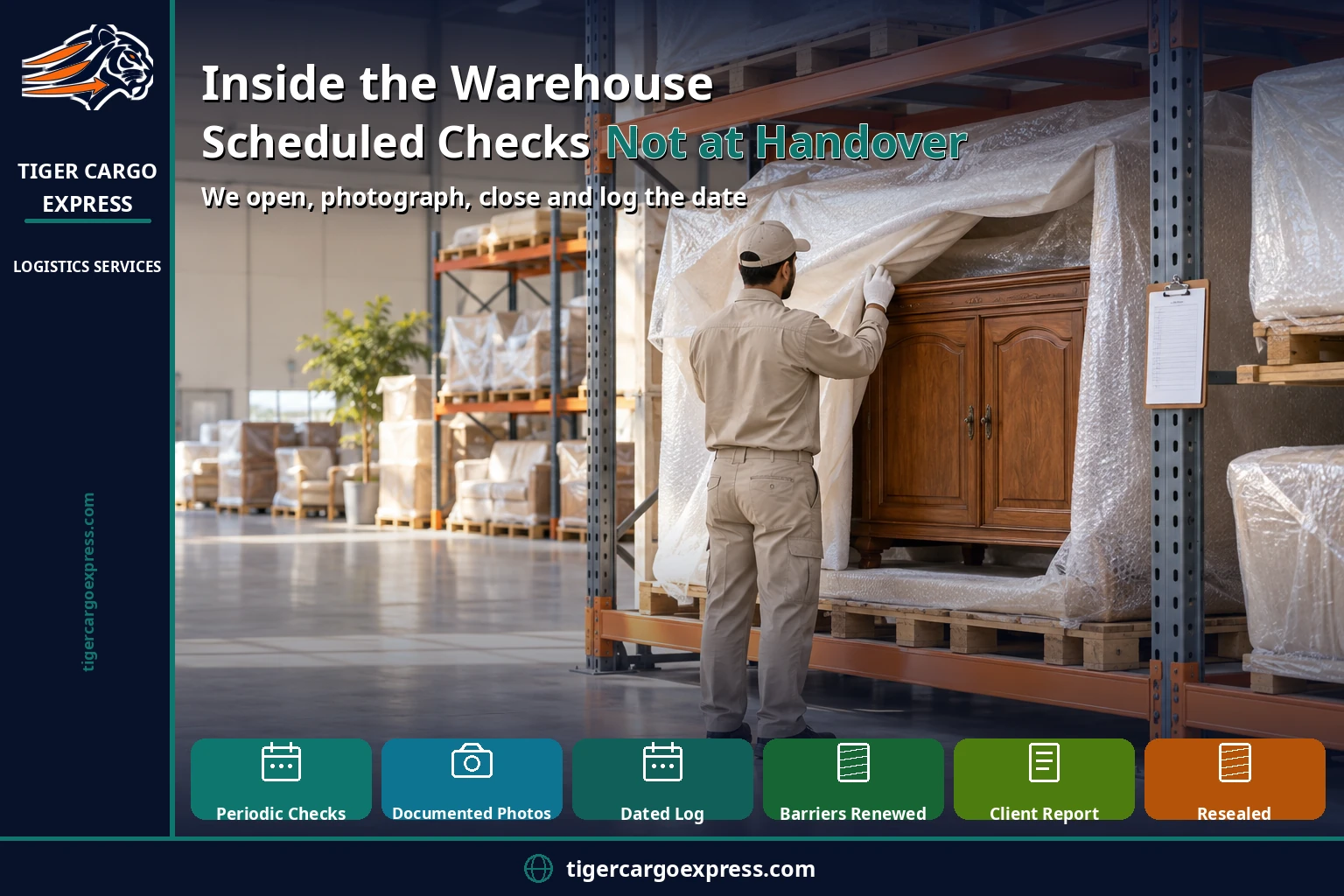
A warehouse inspected once at handover is not inspected. What is discovered on the way out cannot be repaired — an inspection is useful when it precedes damage rather than when it documents it.
| What we do every six months | Why | What it prevents |
|---|---|---|
| We open the bay and photograph | To see rather than to assume | A late discovery after a year |
| We replace what has been consumed | The sachets, tapes and straps | Protection stopped while you think it running |
| We review the position | It may sit near a door or a wall | Continuous needless exposure |
| We inspect the base and edges | The first places any trace appears | The spread of what began small |
| We reseal and log the date | So it is a record rather than a memory | Reliance on whoever remembers |
| We send you the report | Because the furniture is yours | An inspection whose result you never learn |
A timeline — what happens to your furniture month by month?
Damage does not arrive all at once — it advances in stages. This is its map in an unregulated warehouse, and what meets it with us.
| The period | With no maintenance | With scheduled maintenance |
|---|---|---|
| The first month | Nothing | Nothing |
| The second month | The sachets approach saturation | They are replaced — the first cycle |
| The third month | The sachets are saturated and protection has stopped | Wrapping check and re-tensioning |
| The sixth month | An odour begins · joints loosen | A photographed inspection + a report reaches you |
| The ninth month | The tape has dried and wrappings opened | A third replacement cycle |
| A year | Marks, swelling and separating veneer | A second inspection — and a stable condition |
| Two years | Damage needing restoration | It comes out close to how it went in |
Questions clients ask before deciding
Who needs long-term storage?
| Your situation | The usual term | What marks your case |
|---|---|---|
| A scholarship or study abroad | Two to four years | The longest — and it needs remote management |
| Work outside the Kingdom | A year or more | It may extend with no set end |
| Building or finishing a home | One to two years | It usually runs longer than expected |
| A family inheritance not yet divided | By circumstance | Pieces with no substitute — safekeeping matters more than price |
| Seasonal or surplus furniture | Practically permanent | Work out the case for it carefully |
| A company between two premises | A year | It needs scheduled partial release |
Managing your storage while outside the Kingdom
What we do not store
- Anything edible — and the risk doubles over a year
- Paints, liquids and whatever ignites
- Gas cylinders and every vessel under pressure
- Live plants and materials that decompose
- Medicines and medical supplies
- Batteries inside devices — removed before storage
- Your cash, jewellery and original papers — keep them with you
How to compare two long-term quotes
Six questions — and the first separates the serious from the rest.
What we guarantee and what we do not
And what we do not promise: we will not say furniture keeps for “ten years” unconditionally. A long term needs continuous maintenance, maintenance is a cost, and a cost is paid. And we will not say “comprehensive insurance” without your knowing its limits — because insurance whose exclusions you do not know does not reassure you the day you need it.
Five recurring mistakes in long-term storage
Why Tiger Cargo Express?
Frequently asked questions about long-term storage
In summary
Every storage page writes “climate-controlled warehouses” — and not one gives you a figure. “Climate-controlled” is an adjective that cannot be tested, and the difference between one warehouse and another shows after a year rather than after a week.
So ask about the figures: the temperature range, the humidity percentage, whether the cooling runs around the clock or in bursts, and whether the reading is logged. And intermittent is worse than steady because it creates a daily swing — stability is what is needed rather than cold.
And more important still, the protection itself is consumed. Absorbent sachets saturate within two months and then become a moisture source pressed against your furniture; the tape dries, the cardboard softens and the straps slacken. So long-term storage is scheduled maintenance rather than a one-off deposit — we replace, inspect, photograph and send you the report.
And we work out the case with you honestly: your monthly cost × the expected months, against the cost of replacing what you store. And if replacing costs less we tell you not to store — even though we lose the whole contract.
Send what you have and your expected term, and the estimate and maintenance schedule reach you within an hour. 0506688227
Other storage options
Long-Term Storage is one option within our storage service — and the right one depends on how long you need it, what you are storing and whether you will be travelling.
Related Shipping Guides
Continue with practical guidance connected to the same route or shipping decision.
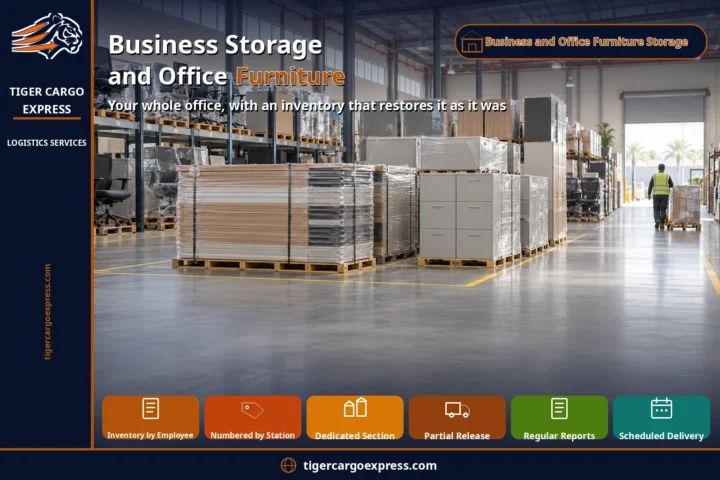
Business and Office Furniture Storage 0506688227 Downtime Is the Cost, Not the Invoice
Storage for office furniture, equipment and commercial goods in a dedicated section with a movement log and periodic reports —…
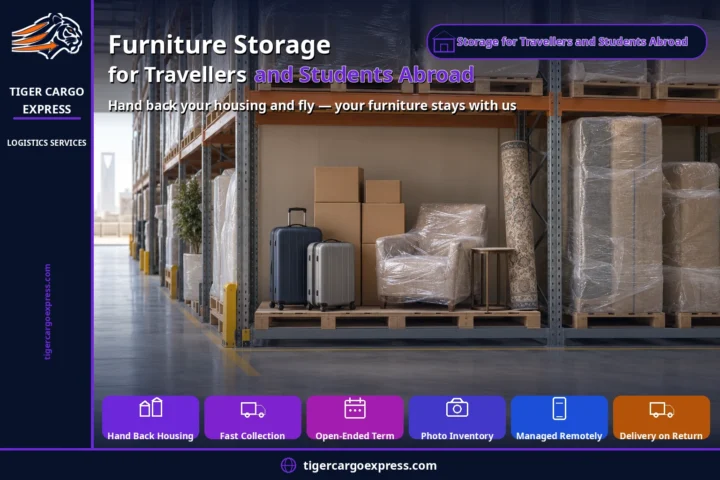
Furniture Storage for Travellers and Students Abroad 0506688227 What You Arrange Before the Flight, Not After
Furniture storage for students abroad and travellers, with collection on your housing handover day, an open term and remote management…

Furniture Storage Company in Riyadh 0506688227 Dust and Temperature Swing, Not Humidity
Furniture storage in Riyadh in a sealed warehouse with collection from your district, packing and delivery whenever you ask —…
Send your shipment details and get a written quote
We reply within 60 minutes during working hours — with what the price includes and what it does not, stated before you commit.