Furniture Storage Company in Jeddah 0506688227 How the Price Is Calculated and What Coastal Humidity Does
Guide summary
Furniture storage in Jeddah in a secured warehouse with home collection, packing and delivery whenever you ask — and storage pages in Jeddah all resemble one another: discounts, armed guarding and scattered figures, answering neither of the two questions that matter. First: how is the price calculated? By the cubic metre per month, with three figures rather than one, and dismantling shrinks your volume by a third so it saves you every month. And second: what does a coastal city's humidity do over months? Its effect is cumulative rather than sudden, and the barrier protecting you saturates and stops — so it is replaced on a dated schedule. And a photo inventory lets you withdraw one piece by its code.
Guide contentsShowHide
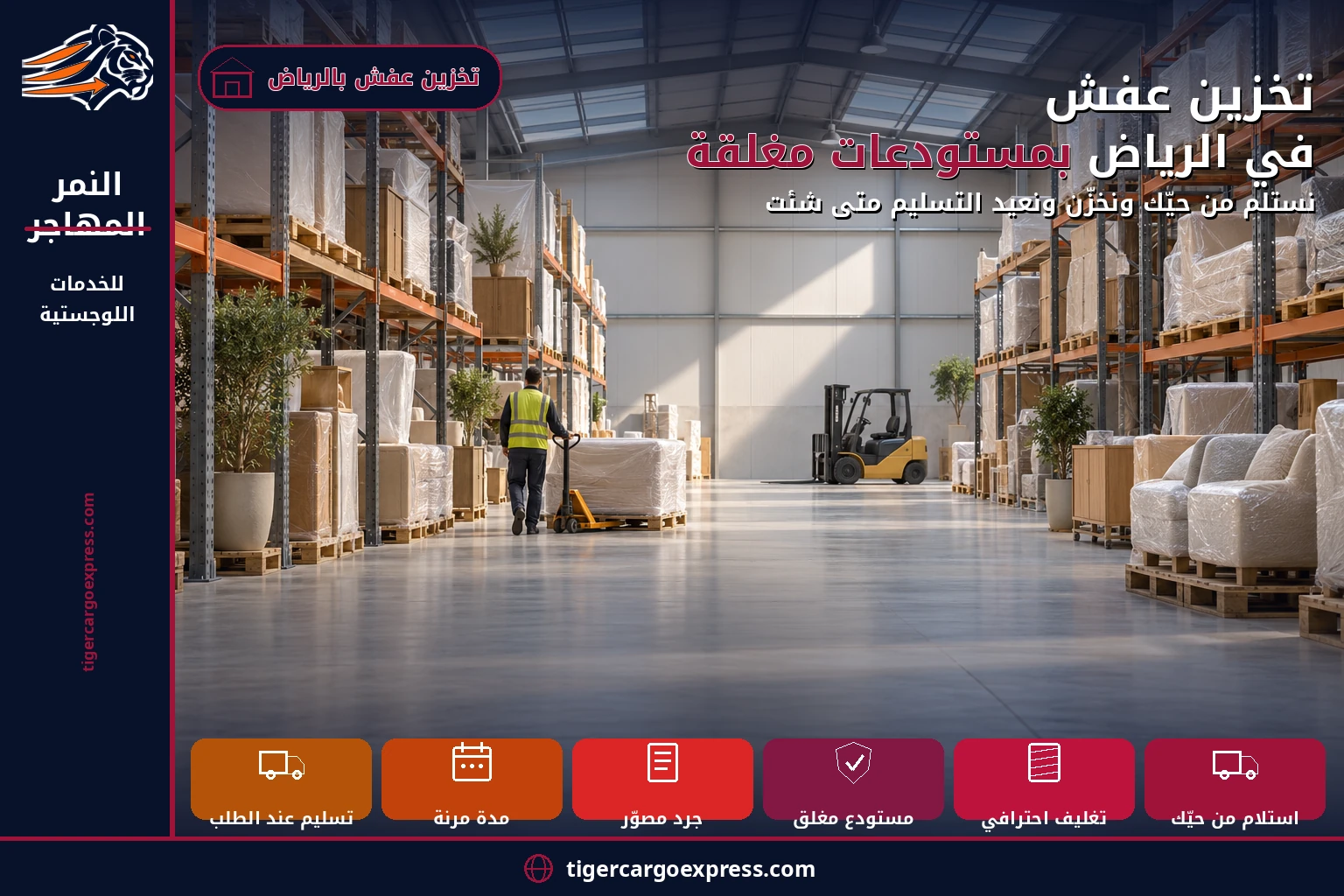
Looking for a furniture storage company in Jeddah that tells you how the price is calculated rather than how big the discount is? Tiger Cargo Express collects your furniture from your home, stores it in a secured warehouse, and returns it whenever you ask. To book: 0506688227
Open any storage page in Jeddah and you will find the same thing: “sixty per cent off”, “armed security guards”, and scattered figures that mean nothing. And you will find no answer to two simple questions.
First: on what basis is the price calculated? By the cubic metre, by the room, or by the month? And second: what happens to my furniture in a humid coastal city over months?
2questions nobody answers
1photo inventory that stays with you
0charge for the survey
20+years in the field
How is a storage price actually calculated?
And this is what you will read here and not find on a competitor’s page.
Storage is priced by the cubic metre per month — not by the room and not by the piece. Which means your bill is set by two things: how many cubic metres you occupy, and how many months you stay.
What you store
Approximate volume dismantled
Monthly cost
One bedroom
4 – 6 m³
SAR 320 – 480
A one-bedroom flat
7 – 10 m³
SAR 480 – 700
A two-bedroom flat
12 – 16 m³
SAR 720 – 1,050
A three-bedroom flat
18 – 24 m³
SAR 1,000 – 1,450
A small villa
28 – 40 m³
SAR 1,500 – 2,200
A large villa
45 – 65 m³
SAR 2,300 – 3,400
And why do we say ‘dismantled’?Because dismantling shrinks your volume by around a third — and you pay on volume. An assembled wardrobe occupies three times what its panels occupy, and an assembled bed twice what its frame does. We dismantle with a carpenter within the service rather than as an extra line — because dismantling saves you every month for the whole storage term, not once.
And three lines are charged once rather than monthly
Collection from your homeOnce at entry — by your district, the floor and whether there is a lift.
Dismantling and packingOnce at entry — and it shrinks your monthly bill thereafter.
Delivery and reassemblyOnce at exit — by your destination inside or outside Jeddah.
So beware an ‘all-inclusive price’ with no breakdownBecause storage is three figures rather than one: entry, monthly, and exit. Anyone giving you a single figure either means the monthly alone, so the entry lines surprise you, or means one month, so you think it is everything. We write all three separately — so you know what you pay today, what you pay each month, and what you pay at exit.
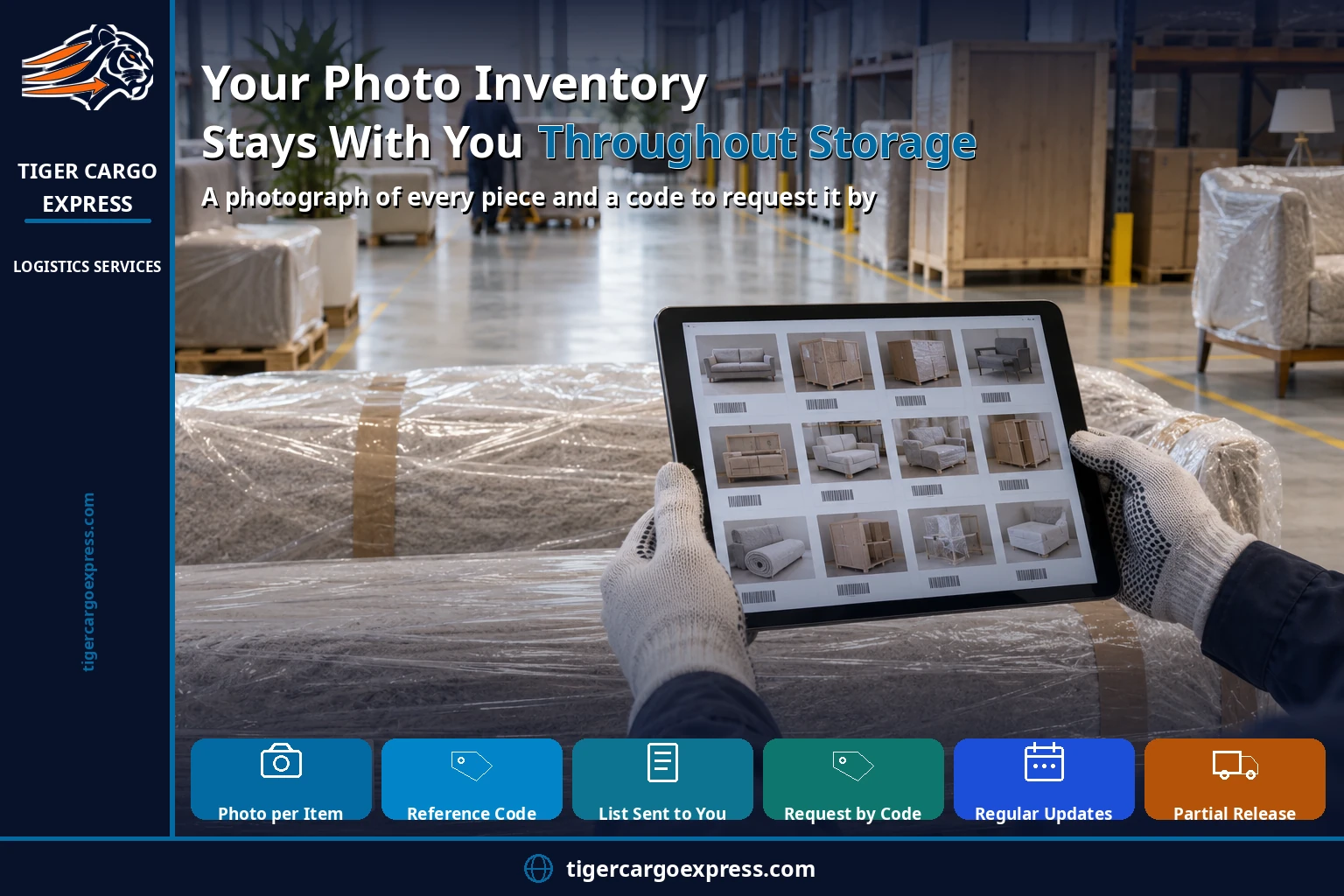
The photo inventory — your furniture stays visible to you
And this is what worries anyone storing most: what happens to my things while I cannot see them?
A photograph of every piece and a code to request it by.
When the warehouse doors close, you lose visual contact with your furniture. Months may pass without you knowing whether the table is sound or where they put the boxes of books.
What we do
When
What it gives you
We photograph every piece at packing
Before entry
Its original condition documented
We give every piece a reference code
At numbering
You request it by code rather than description
We send you the full list
A day after storage
Browse what you have whenever you wish
We photograph at every periodic check
Regularly
Reassurance without a visit
We photograph at handover
At exit
A direct comparison with what entered
And the real benefit is not reassurance but partial releaseA photographed list lets you request one specific piece without opening your whole store. Want your desk? Send its code. Need the box of books? Send its code. Anyone storing without a photo inventory has to open the bay and search — or postpone their need until everything comes out at once.
What we store in Jeddah
Your whole householdA room or a home — dismantled by a carpenter and reassembled by one.
Your electrical appliancesFridge, washer and air conditioner — each with its own preparation before storage.
Your boxes and booksWith codes you request them by rather than descriptions you search.
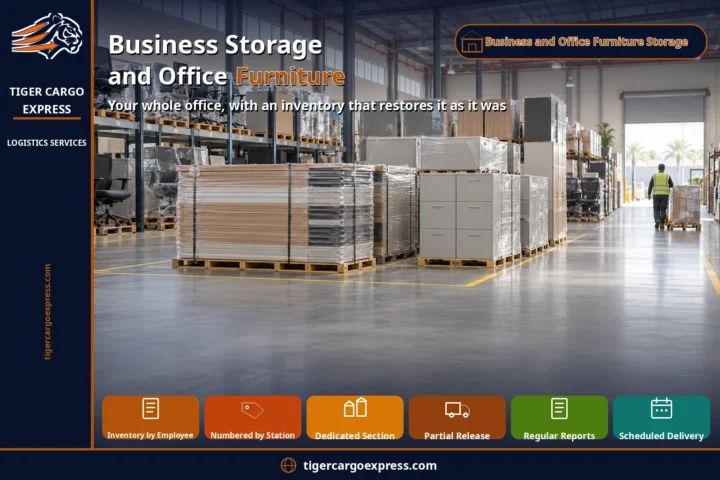
Your office furnitureWith numbering that returns every piece to its owner.
Your commercial goodsWith a dedicated space and its own log.
Whatever precedes an international shipmentTemporary storage until the sailing date.
And the temporary storage line concerns our international clientsAnyone who handed back their Jeddah housing before their shipment’s sailing date needs somewhere for their furniture. We keep it at no charge until the loading date so long as it ships with us — because it is the same warehouse and the same shipment.
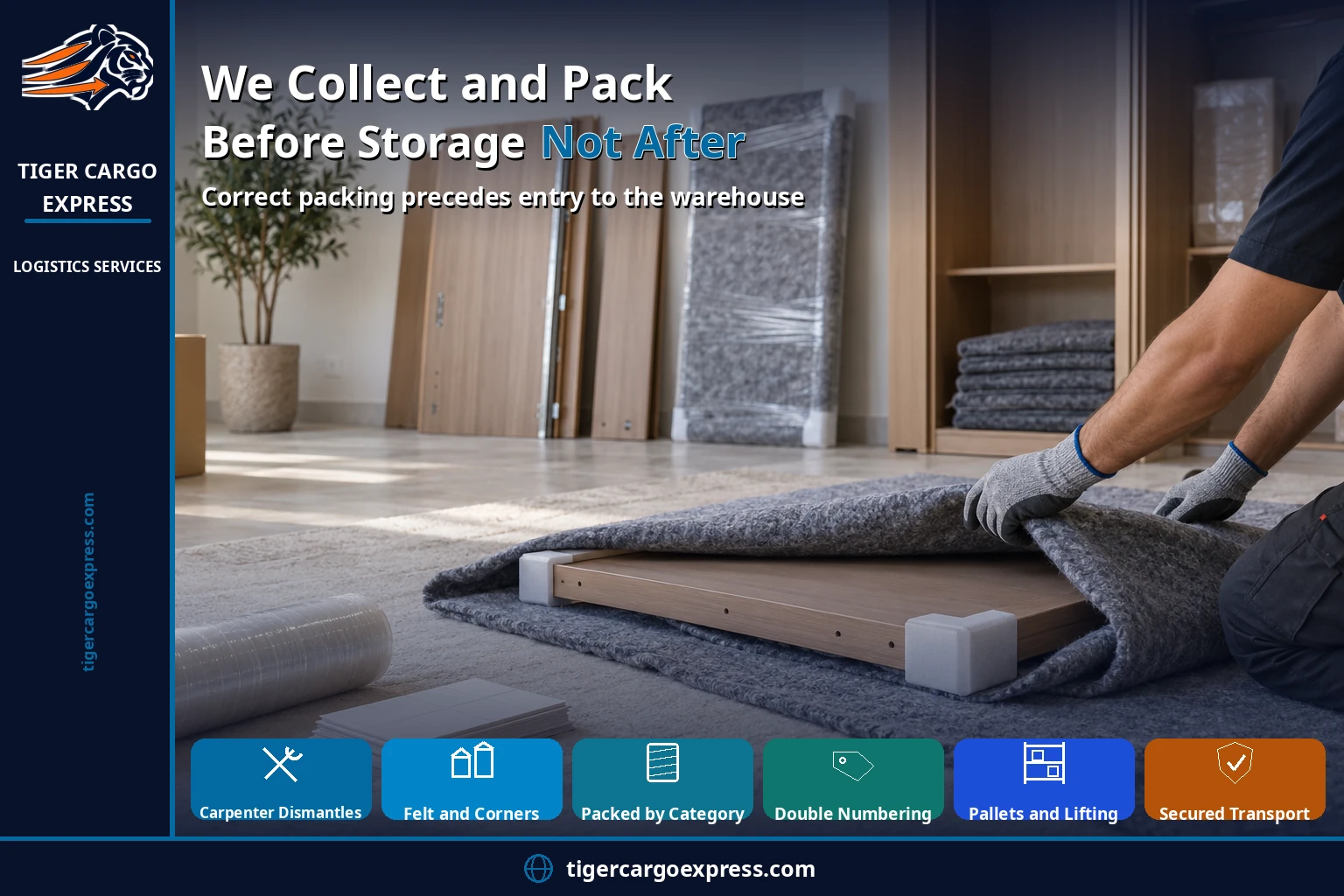
We collect and pack before storage rather than after
Correct packing precedes entry to the warehouse.
Correct packing precedes entry to the warehouse. What enters exposed stays exposed for months, and nobody will rewrap it once it is stacked in its bay.
What the service includes
A survey with no chargeWe come to you in any Jeddah district, measure the volume and give you the three figures.
A carpenter dismantles and rebuildsWhoever took your wardrobe apart is who assembles it the day you receive it.
Packed by categoryTimber differs from glass differs from fabric — each with its own material.
Numbered on two facesSo the box reads in any position within the bay.
A photo inventory sent to youA photograph and a code for every piece — browse it whenever you wish.
Secured transport to the warehouseNo handover at an intermediate point and no additional handling.
And every category has its packing
The category
Its risk in long storage
What we do
Timber
It breathes, so it swells or its veneer separates
A breathable cover rather than sealed plastic
Fabrics and mattresses
They absorb moisture and never dry
A sealed bag with an absorbent material
Glass and mirrors
Broken by pressure rather than impact
Always a padded upright rack
Appliances
Moisture reaches their circuits
Drained and dried before wrapping
Leather
It dries and cracks over time
A breathable cover and distance from heat
Books and papers
The most affected by moisture
Closed boxes on a raised pallet
And a fridge needs what may not occur to youIt is disconnected, emptied and left open for days until it dries completely before wrapping. A fridge wrapped with residual moisture inside becomes a sealed damp environment for months — and comes out with an odour that never leaves and sometimes with internal mould. We leave it slightly ajar inside its cover rather than sealing it — the opposite of what everyone does.
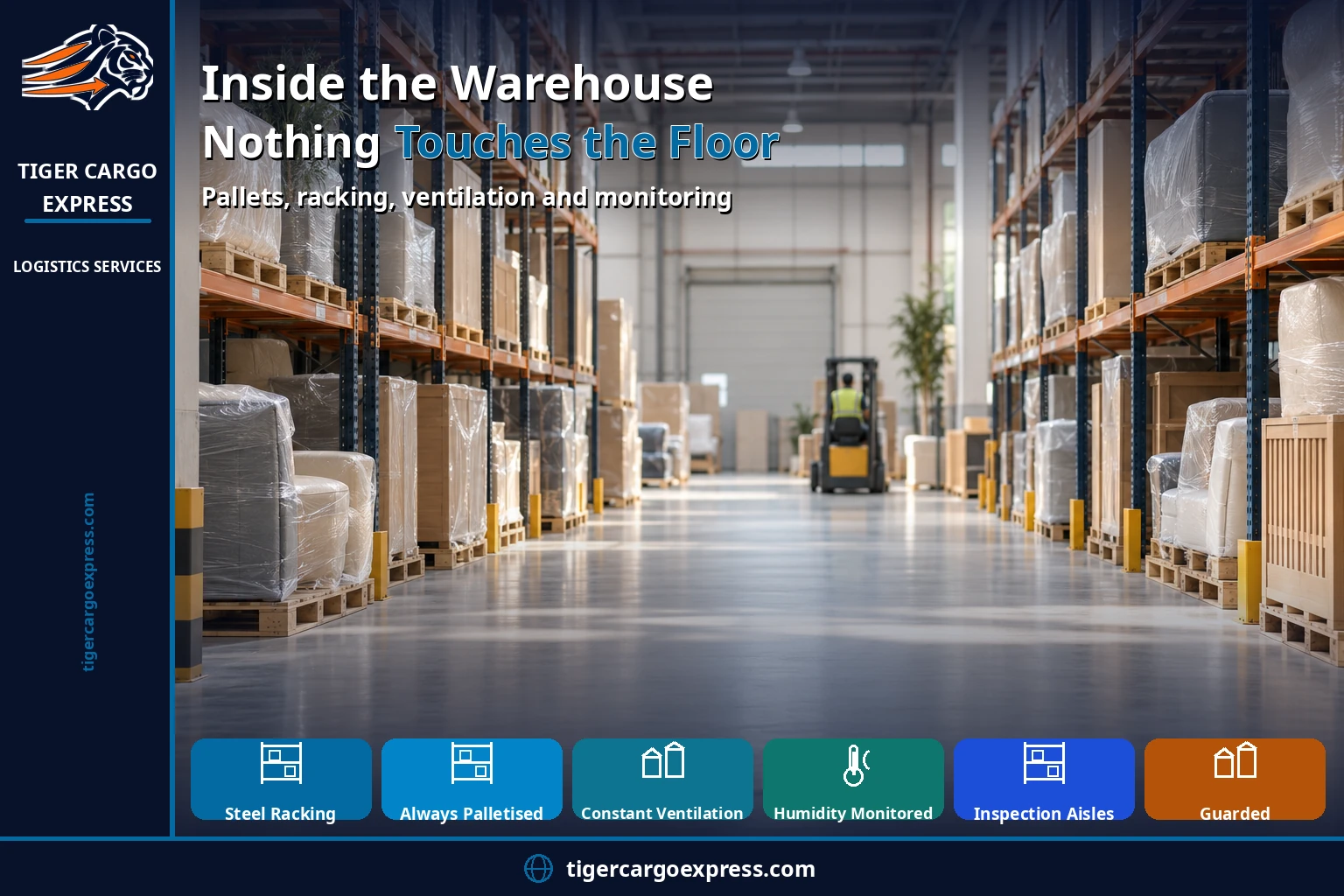
Inside the warehouse — nothing touches the floor
Pallets, racking, ventilation and monitoring.
The first rule in any respectable warehouse: no piece is placed directly on the floor. The floor is the coldest point in the building, and there the air condenses and moisture runs down and settles.
What we commit to
Why
What it prevents
Pallets under everything
The floor is the coldest point and moisture settles there
Dampness from the base
A gap from the walls
An external wall exchanges heat with outside
Condensation on adjoining surfaces
Numbered steel racking
Every bay has its code and its contents logged
Pieces lost or mixed
Inspection aisles between bays
We pass and inspect without moving anything
Late discovery of any problem
Constant ventilation
Still air traps moisture
Odours and mould
Round-the-clock monitoring
Cameras and guarding
Unauthorised access
And the aisles are an operational line rather than a decorative oneA warehouse filled to its last centimetre is never inspected. Anyone stacking bays flush against each other with no aisles gains capacity and loses the ability to walk through and look — so they discover no dampness or damage until handover day. We leave aisles that cost us space and spare you a surprise.
Jeddah’s humidity — the factor no page mentions
Barriers here are a foundation rather than an option.
Jeddah is a coastal city on the Red Sea, and its humidity is not a climatic detail but the first storage factor. You will not find a single storage page in Jeddah that mentions it — though it is what decides your furniture’s condition after six months.
The period
What happens with no barriers
What happens with barriers
Two weeks
Nothing visible
Nothing
A month
Moisture accumulating with no visible trace
The barrier absorbs
Three months
An odour begins in the fabrics
The barrier is replaced and continues
Six months
Marks and swelling in timber edges
A stable condition
A year
Damage that is hard to repair
It comes out as it went in
And the danger is that the effect is cumulative rather than suddenThere is no day you open your bay and find a disaster. There is a slow accumulation you never see because you never open it — and then you discover all of it at once on handover day. Which is why many sell ‘armed guarding’ and ‘cameras’ — because they are visible and photograph well, while the barrier that actually protects your furniture neither photographs nor markets.
And four measures we commit to for that reason
A barrier cover around whatever absorbsFabrics, mattresses and leather — before they enter the bay.
Absorbent sachets distributedNot in one place — wider distribution delays saturation.
Barriers replaced on a scheduleBecause a sachet saturates and stops — so it is replaced rather than forgotten.
Periodic photographed checksWe open, photograph, reseal and log the date.
And the third line is the real differenceAn absorbent sachet has a capacity it absorbs and then stops working. A sachet placed in the first month may be saturated by the second — so it sits for the rest of the year doing nothing while you believe your furniture is protected. We replace them on a dated schedule rather than when we remember, and tell you so in a report.
Jeddah districts we collect from
The northObhur North · Obhur South · Al Shati · Al Naeem · Al Murjan · Al Sawari
The centreAl Hamra · Al Rawdah · Al Salama · Al Andalus · Al Zahra · Al Faisaliyah
The eastAl Safa · Al Rabwah · Al Nuzha · Al Naseem · Al Ajwad · Al Samer
The southAl Khumrah · Quwaizah · Al Thaghr · Bryman · Al Waziriyah · Al Hamdaniyah
The west and Al BaladAl Baghdadiyah · Al Sharafiyah · Al Kandarah · Musharifah
1You call and we ask three questionsRoughly what you have, which district, and how long you expect.
2We come and measure with no chargeWe work out the dismantled volume and give you the three figures in writing.
3Collection dayA carpenter dismantles, then packing by category, then numbering and photographing, then loading.
4Your photo inventory reaches youWithin a day of storage — a list with photographs and codes.
5During storagePeriodic photographed checks, barriers replaced on schedule, and partial release whenever you ask.
6Handover dayWe take out, photograph, deliver and reassemble — with the same crew that dismantled.
When and how does storage end?
Your situation
What we do
Note
You want everything
We deliver and reassemble at your destination
On a date you set
You want one piece
Partial release by code
Without opening your whole store
You want to extend
We renew monthly at the same price
No renewal fee
You want to ship abroad
We ship it from our warehouse directly
No intermediate move and no extra handling
You want delivery to someone else
With a documented authorisation from you
We verify their identity
You want to close it while travelling
We deliver to your agent on your authorisation
And the photo inventory supports the handover
And the fourth row saves you a whole stageAnyone who stored with us and then decided to ship abroad needs no move from one warehouse to another. It is packed for international shipping inside our own warehouse and loaded from there to the port. And Jeddah Islamic Port is minutes away — so a whole stage of cost and handling falls away.
When do people actually need storage?
Five situations — each with a different arrangement.
Your situation
The usual term
What we arrange for you
Renovation or refurbishment
One to three months
Short storage with delivery on the same date
Moving between two homes
Two weeks to a month
The shortest — and we may keep it on the truck if it is days
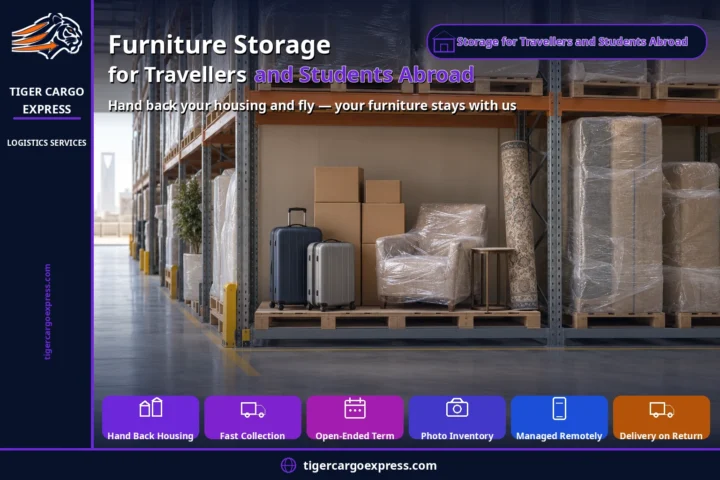
Travel or study abroad
A year or more
An open term and remote management by message
A smaller temporary home
Six months to a year
Partial release of what you need gradually
Selling or letting your home furnished
By the contract
A precise inventory because the furniture returns to you whole
Awaiting an international shipment
Weeks
Free if it ships with us
And the second situation may need no storage at allAnyone moving between two homes with three or four days between them needs no warehouse. Their load stays loaded and secured with us and is delivered on its date — so they pay for one move rather than two moves and storage. And we tell them so even though we lose the storage line, because it is not one they should pay.
The difference between a month’s storage and a year’s
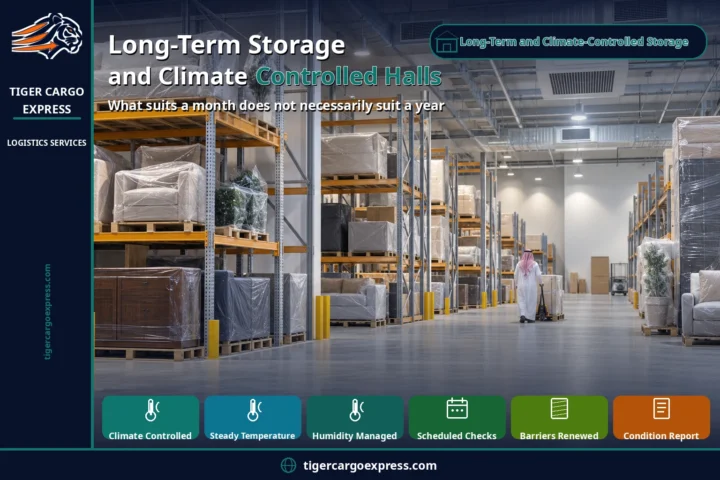
It is not in the price alone but in the method. What suits two months does not necessarily suit a year, and the difference shows in the packing, the position and the follow-up.
The item
Short storage (1–3 months)
Long storage (6 months and over)
The covers
One cover suffices
A breathable cover + a barrier layer
Absorbent sachets
Placed once
Replaced on a dated schedule
Inspection
At entry and exit
Periodic and photographed
Position in the warehouse
Any available bay
A bay further from doors and walls
Appliances
Ordinary drying
Longer drying and an internal check
Reports
Not required
A periodic report reaches you
Which is why we ask about your expected term from the first callNot only to price but to decide how we pack. Anyone who said ‘two months’ and then stayed a year finds their furniture packed in a way never designed for a year. And if your plan changes, tell us — we repack and adjust the position rather than leaving it as it was while knowing it no longer suits.
Questions clients ask before deciding
Can I visit the warehouse before booking?Yes — and we encourage it. What you see with your own eyes spares you everything written on any page: the pallets, the gap from the walls, the aisles between bays, the ventilation. And anyone who objects to you visiting their warehouse has answered you.
Is my furniture mixed with other people’s?No — every client has their own bay with its code. Pieces are not stacked with other people’s in the same space. And this is not a luxury but an operational necessity: mixing makes partial release impossible and the inventory meaningless.
What if I am late with a monthly payment?We contact you and reach an arrangement — and we do not hold anyone’s furniture without notice. But be candid with us if your circumstances change, because solutions are arranged before accumulation rather than after.
Can I add items later?Yes — and they are added to your own bay with their new codes. Your photo inventory is updated and your volume and monthly price adjusted from the following month. And we tell you the difference before we collect rather than after.
How can I be sure my furniture is in condition?By the photo inventory at entry and the periodic photographed checks after it. So you compare what you see today with what went in, with no visit and no promises. And a photograph is more honest than the phrase ‘our warehouses are secure’.
Do you store for less than a month?Yes, but a month is the smallest pricing unit. And anyone needing a handful of days between two homes may need no storage at all — and we tell them so plainly.
What we do not store — and we say so plainly
Foodstuffs of every kind — they attract insects however sealed
Liquids, paints and flammable materials
Gas cylinders and any pressurised vessel
Live plants and any organic material
Medicines and medical materials
Cash, gold and original documents — keep them with you
Hazardous materials and damaged batteries
And the foodstuffs line is the most neglectedA forgotten bag of rice in a kitchen box is enough to draw insects into your whole bay — and then into those beside it. We go through the kitchen boxes in particular during packing and ask you about them, because one client’s forgotten packet can cost ten others.
How to reduce your storage bill
Method
Expected saving
How
Dismantle everything possible
25 to 35% monthly
The volume falls and the price is per cubic metre
Sort before you store
Directly proportional
What you will part with does not deserve months of rent
Estimate your term honestly
10 to 15%
Longer terms carry a lower monthly price
Consolidate small boxes
5 to 10%
Boxes of similar size stack better
Empty drawers and cabinets
It prevents damage
Weight inside a drawer works its joints loose
Set your term in advance
10 to 20%
Long-term storage carries a different price
And the first line has the largest effectBecause it saves you every month rather than once. Anyone storing a two-bedroom flat assembled pays on around twenty-four cubic metres, and anyone storing it dismantled pays on fourteen. The difference is ten metres — around five hundred riyals a month — and six thousand in a year.
How to compare two storage quotes
Five questions — and nobody answers the first.
1On what basis do you calculate the price?By the cubic metre or by the room? Anyone not knowing my volume does not know my price.
2Give me the three figuresEntry, monthly and exit — not one ‘all-inclusive’ figure.
3Does the price include dismantling?Dismantling shrinks my volume — so anyone charging it separately profits twice.
4What exactly do you do about humidity?Jeddah is coastal — and anyone answering ‘an air-conditioned warehouse’ has not understood the question.
5Can I withdraw one piece?Without opening my whole store? And a photo inventory is what makes that possible.
An example of the wrong comparisonA quote of SAR 400 a month looks cheaper than ours at 720 for a two-bedroom flat. But ask: does the four hundred include dismantling? If it does not, you are paying on twenty-four metres rather than fourteen — and your real bill is higher than ours, before we even count the collection line that was never mentioned.
What we guarantee and what we do not
Three figures in writingEntry, monthly and exit — not one figure hiding what follows.
A photo inventory sent to youA photograph and a code for every piece, with partial release by code.
Barriers replaced on a scheduleBecause a sachet saturates and stops — and a schedule prevents forgetting it.
Dismantling within the serviceBecause it shrinks your monthly bill rather than ours.
And what we do not promise: we will not say “zero damage” nor “sixty per cent off”. And we will not photograph armed guards for you — a warehouse is measured by its pallets, its barriers and its aisles rather than by pictures of its guarding. What we commit to: itemised figures, a photo inventory you see for yourself, and barriers on a dated schedule.
Five recurring mistakes — all of them avoidable
Accepting an ‘all-inclusive price’ with no breakdownStorage is three figures rather than one: entry, monthly and exit. And a single figure hides two.
Storing furniture assembledThe volume rises by around a third and you pay by the cubic metre per month — so the difference accumulates every month.
Storing a fridge before it driesResidual moisture becomes a sealed environment for months, and it comes out with an odour that never leaves and sometimes with mould.
Forgetting a food packet in a kitchen boxA forgotten bag of rice is enough to draw insects into your whole bay and then into those beside it.
Assuming a barrier works foreverA sachet saturates and stops. Anyone not replacing it on a schedule leaves their furniture unprotected while believing it protected.
Why Tiger Cargo Express?
We explain how the price is calculatedBy the cubic metre per month — in three written figures rather than one.
A photo inventory that stays with youA photograph and a code for every piece — request it by code and release it partially.
We deal with Jeddah’s humidityBarriers replaced on a dated schedule rather than when we remember.
Dismantling within the serviceBecause it shrinks what you pay every month — rather than once.
Your port is minutes awayStored and then decided to ship? It ships from our warehouse directly.
Ask for our official papersCommercial registration 5800108005 and an approved national address — we send both to anyone who asks.
Ask for a free survey and three figures in writingSend your Jeddah district, roughly what you have and your expected term — and the estimate reaches you within an hour.Call 0506688227Message on WhatsApp
Frequently asked questions about furniture storage in Jeddah
How is a storage price calculated?By the cubic metre per month — not by the room and not by the piece. A dismantled two-bedroom flat occupies around fourteen metres and costs between SAR 720 and 1,050 a month. And it has three figures rather than one: collection once, the monthly, and delivery once.
Why do you stress dismantling?Because dismantling shrinks your volume by around a third — and you pay on volume every month. A two-bedroom flat assembled is around twenty-four metres and dismantled around fourteen. The difference is around five hundred riyals a month — six thousand in a year. Which is why dismantling with us sits within the service rather than as an extra line.
What is the photo inventory?A photograph of every piece and a reference code to request it by, with a full list reaching you within a day of storage. And its real benefit is not reassurance but partial release: you request one specific piece by its code without us opening your whole store.
What about Jeddah’s humidity?It is the first storage factor in a coastal city — and no competing page mentions it. Its effect is cumulative rather than sudden: nothing in two weeks, an odour at three months, marks and swelling at six. We handle it with barrier covers and absorbent sachets replaced on a dated schedule.
Why replace the sachets on a schedule?Because an absorbent sachet has a capacity it absorbs and then stops. A sachet placed in the first month may be saturated by the second, then sit for the rest of the year doing nothing while you believe your furniture is protected. So we replace them on a schedule and tell you in a report.
Can I withdraw one piece?Yes — by its reference code and without opening your whole store. Want your desk? Send its code. Need the box of books? Send its code. Anyone storing without a photo inventory has to open the bay and search or postpone their need.
How do you store a fridge?It is disconnected, emptied and left open for days until it dries completely before wrapping. A fridge wrapped with residual moisture becomes a sealed damp environment for months — and comes out with an odour that never leaves and sometimes with internal mould. We leave it slightly ajar inside its cover.
What do you not store?Foodstuffs of every kind, liquids, paints and flammables, gas cylinders, live plants, medicines, and cash, gold and original documents. And a forgotten bag of rice is enough to draw insects into your whole bay and then into those beside it.
What are the shortest and longest terms?We store from one month to as long as you wish. And longer terms carry a lower monthly price — so set your expected term in advance to get its correct rate.
What if I am travelling at handover time?We deliver to your agent on a documented authorisation from you, and verify their identity. And the photo inventory supports the handover so your agent knows exactly what they received.
I stored and then decided to ship abroad — what do I do?You need no move from one warehouse to another. It is packed for international shipping inside our own warehouse and loaded from there to the port. And Jeddah Islamic Port is minutes away — so a whole stage of cost and handling falls away.
Which districts do you collect from?Any district in Jeddah: Obhur, Al Shati, Al Hamra, Al Rawdah, Al Salama, Al Safa, Al Nuzha, Al Khumrah, Bryman, Al Hamdaniyah, Al Baghdadiyah and Al Sharafiyah. And the survey is free in all of them, with outside Jeddah by prior arrangement.
Does the price rise after booking?No. We measure the dismantled volume and write you the three figures before you commit. And what we write is what you pay — the only revision being if you change what you store.
Do you store office furniture and goods?Yes — office furniture with numbering that returns every piece to its owner, and commercial goods with a dedicated space and its own log. Both with a photo inventory and periodic reports.
In summary
Storage pages in Jeddah all resemble one another: discounts, armed guarding and scattered figures. And they answer neither of the two questions that actually matter to you.
First: how is the price calculated? By the cubic metre per month — with three figures rather than one: entry, monthly and exit. And dismantling shrinks your volume by a third so it saves you every month rather than once.
And second: what happens in a coastal city over months? Humidity works slowly and shows late — nothing in two weeks, an odour at three months, damage at six. And the barrier protecting you saturates and stops — so it is replaced on a dated schedule rather than when we remember.
And what reassures you more than any promise remains: a photo inventory that stays with you, a photograph and a code for every piece — browse it whenever you wish, and withdraw one piece without opening your whole store.
Send your Jeddah district, roughly what you have and your expected term, and the estimate with its three figures reaches you within an hour. 0506688227
Your furniture is in safe handsThree figures in writing · A photo inventory · Barriers on a schedule · Dismantling within the serviceCall 0506688227Message on WhatsApp
Other storage options
Storage in Jeddah is one option within our storage service — and the right one depends on how long you need it, what you are storing and whether you will be travelling.