تخطي إلى المحتوى
Cold Chain

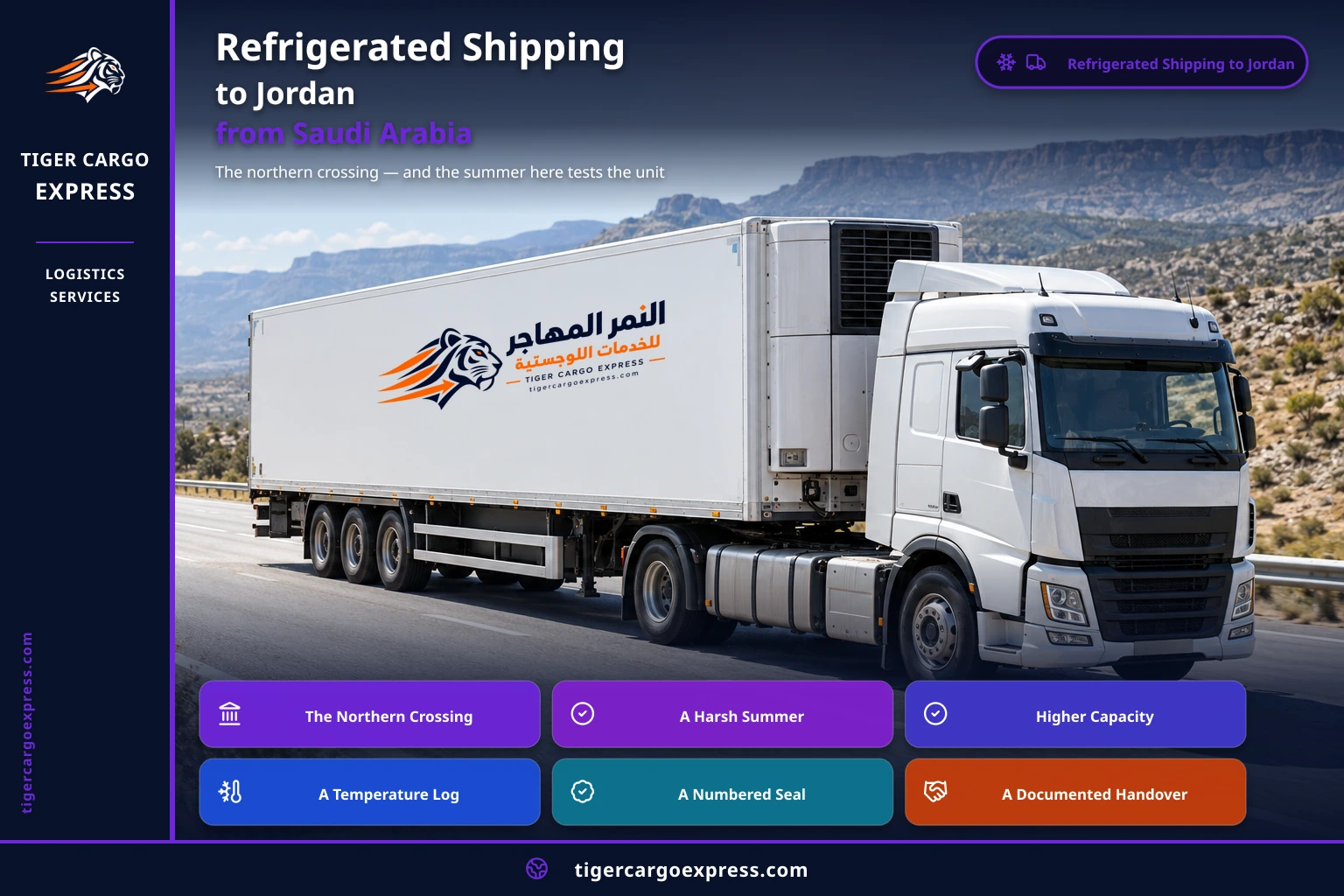
Refrigerated and Frozen Shipping from Saudi Arabia to Jordan 0506688227 The summer tests the unit rather than the road
Refrigerated and Frozen Shipping from Saudi Arabia to Jordan 0506688227 The summer tests the unit rather than the road
Guide summary

Refrigerated and frozen shipping from Riyadh, Jeddah and Dammam to Jordan — 1,300 kilometres with an independent temperature log handed to you and written conditions on the carrier. We own no refrigerated fleet but carry through a network we select, set conditions for and monitor. What sets this line apart: The summer tests the unit rather than the road. The duration is two days with one overnight stop, and a full chilled load is SAR 9,380 to 14,280 outside the peak. And the temperature log is timestamped at the crossing rather than on arrival — so the stage and the party are known rather than only that a deviation occurred.

Refrigerated and frozen shipping from Saudi Arabia to Jordan with an independent temperature log and written conditions on the carrier. Tiger Cargo Express — two days with one overnight stop over 1,300 kilometres. To book: 0506688227

Most refrigerated shipping pages list the destinations and then repeat the same services for each. As though the road to Jordan were the road to anywhere else.

It is not. Every line has its hours, its borders and what it consumes of the unit and the shelf life alike.

1,300kilometres
Twotrip duration
1single responsibility
20+years in the field

The summer tests the unit rather than the road

A unit sufficient in winter may not be at the height of the heat.

The summer tests the unit rather than the road
A unit sufficient in winter may not be at the height of the heat.
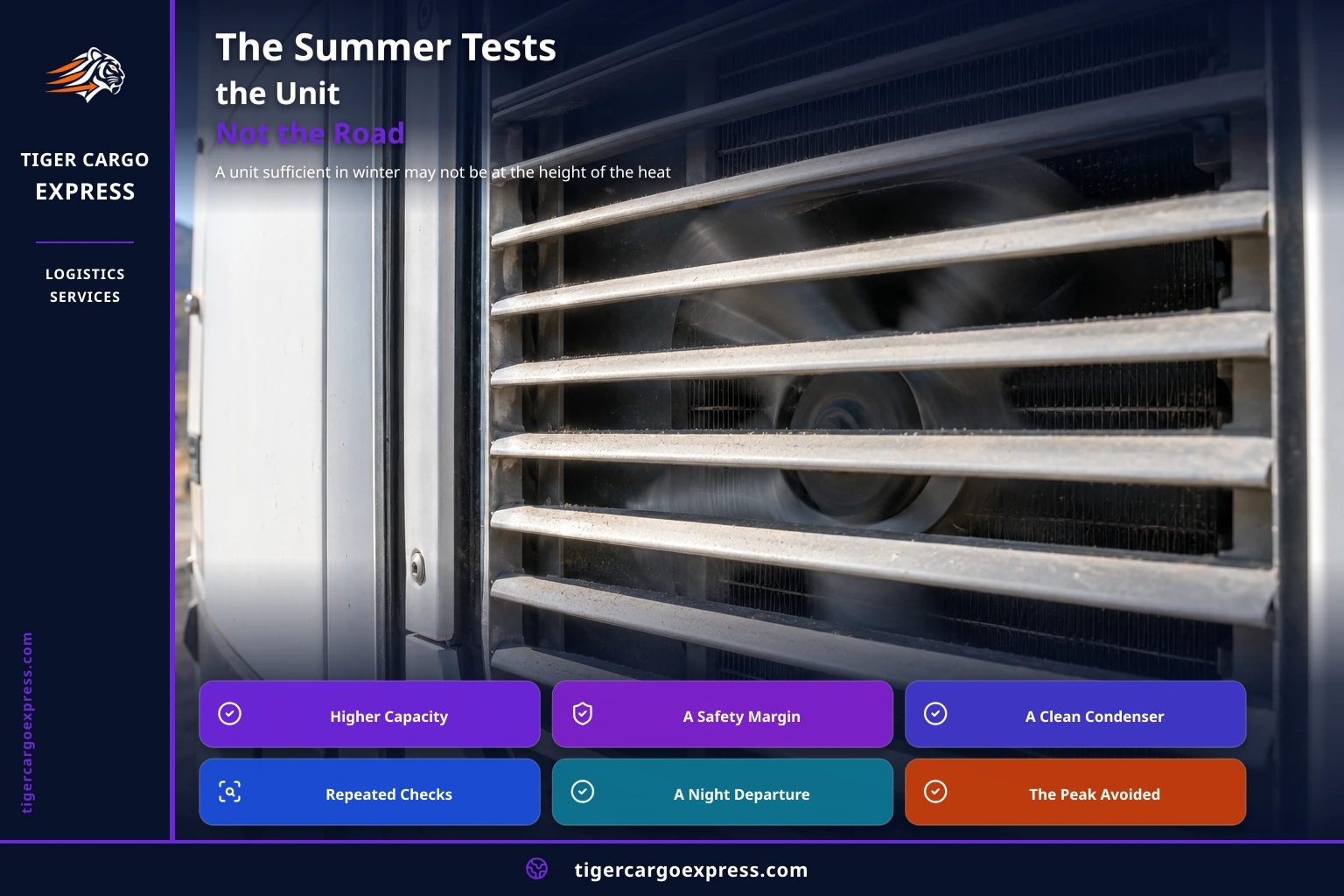
A refrigeration unit is rated by its capacity to remove heat — not by reaching a temperature. The hotter it is outside, the more heat leaks into the body — so the unit works harder to remove more, and may reach its limit.

Outside temperature Heat leaking in The unit’s margin
Mild Little Wide
High Moderate Sufficient
Peak summer High and continuous It narrows
Peak + a long stand High with no airflow cooling the condenser It may run out
Peak + a dusty condenser The unit cannot shed its heat It runs out
Peak + an overload More than it was designed for It runs out
And a dusty condenser is the most dangerous item on the listBecause it shows in no report and appears in no unit specification. A unit removes heat by shedding it through a condenser — and a condenser blocked by road dust sheds nothing, so the unit runs and consumes without cooling as it should. We require the condenser to be inspected and cleaned before departure in the summer months — minutes of work that prevent a complete failure mid-route.

A pre-departure check rather than a post-one
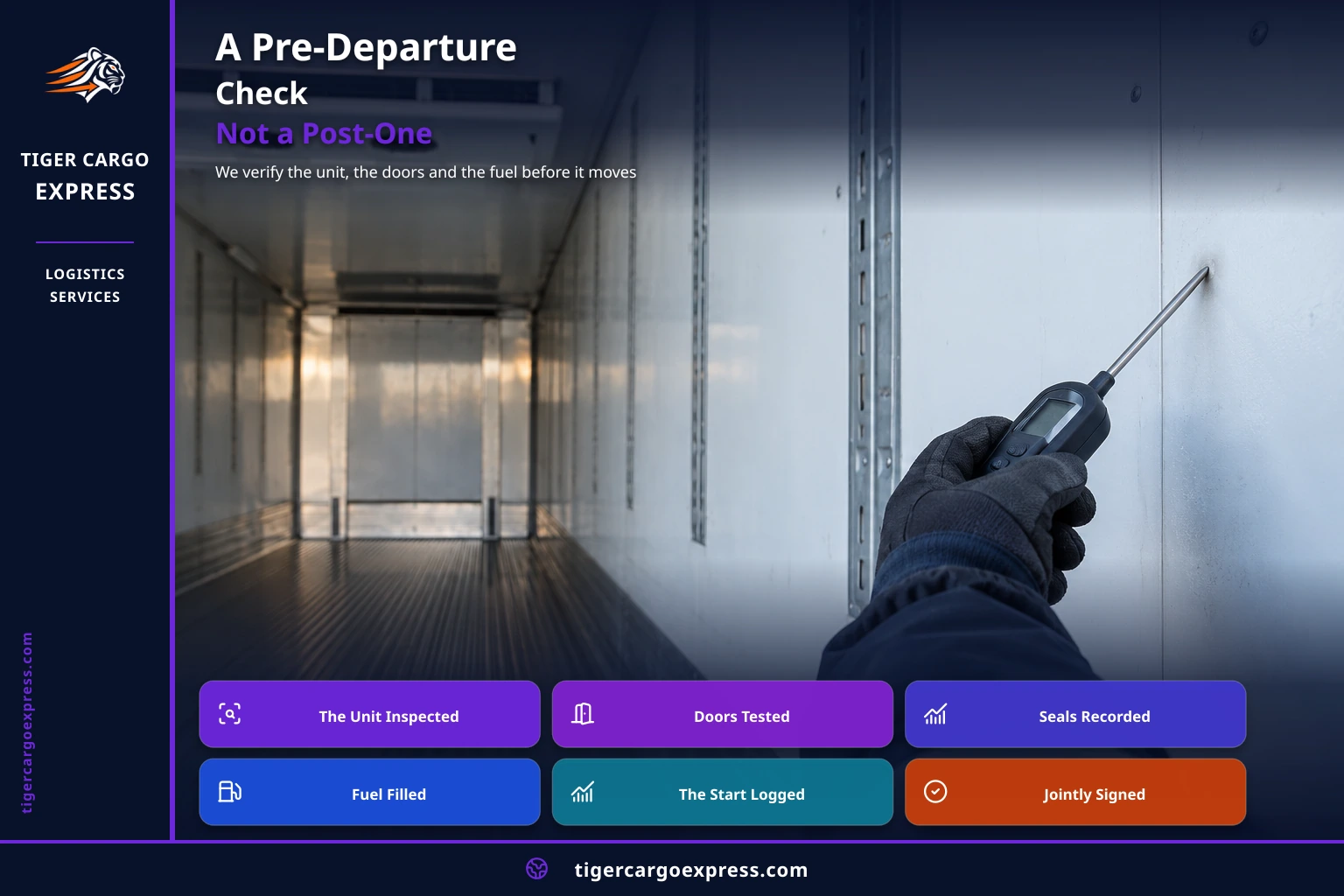
A pre-departure check rather than a post-one
We verify the unit, the doors and the fuel before it moves.

A check after departure is not a check but a discovery. We verify six items before the lorry moves — each fixed in minutes beforehand and in days afterwards.

  • The unit runs and actually reaches the set point — not merely that it turns
  • Door gaskets compressed and sound, with no cracks or hardening
  • The condenser clean — which matters in the hot months in particular
  • The unit’s tank full and its running range calculated against the line’s distance
  • The logger fitted inside the load, working and documented with a photograph
  • The seal numbered, its number recorded and sent to you before departure
And the first item is got wrong more than you would thinkA unit that turns is not necessarily a unit that cools. It may run with its fan turning while the condenser sheds nothing, or short of gas so it works to no effect. We measure inside the body rather than listen to the unit — the measurement takes a minute and the difference is a whole load.

The consignments we serve on the Jordan line

Full frozen consignmentsA lorry load or a share in one.
Short-lived chilled consignmentsOn the fastest route with the least waiting.
Fish and seafoodThe most sensitive to fluctuation — with a deeper margin.
Baked goods and doughsWhere thawing ruins the texture first.
Prepared mealsOn a chain unbroken from production to handover.
Goods on a repeating cycleWith an agreed shipping schedule.

The temperature log at the crossing, not on arrival
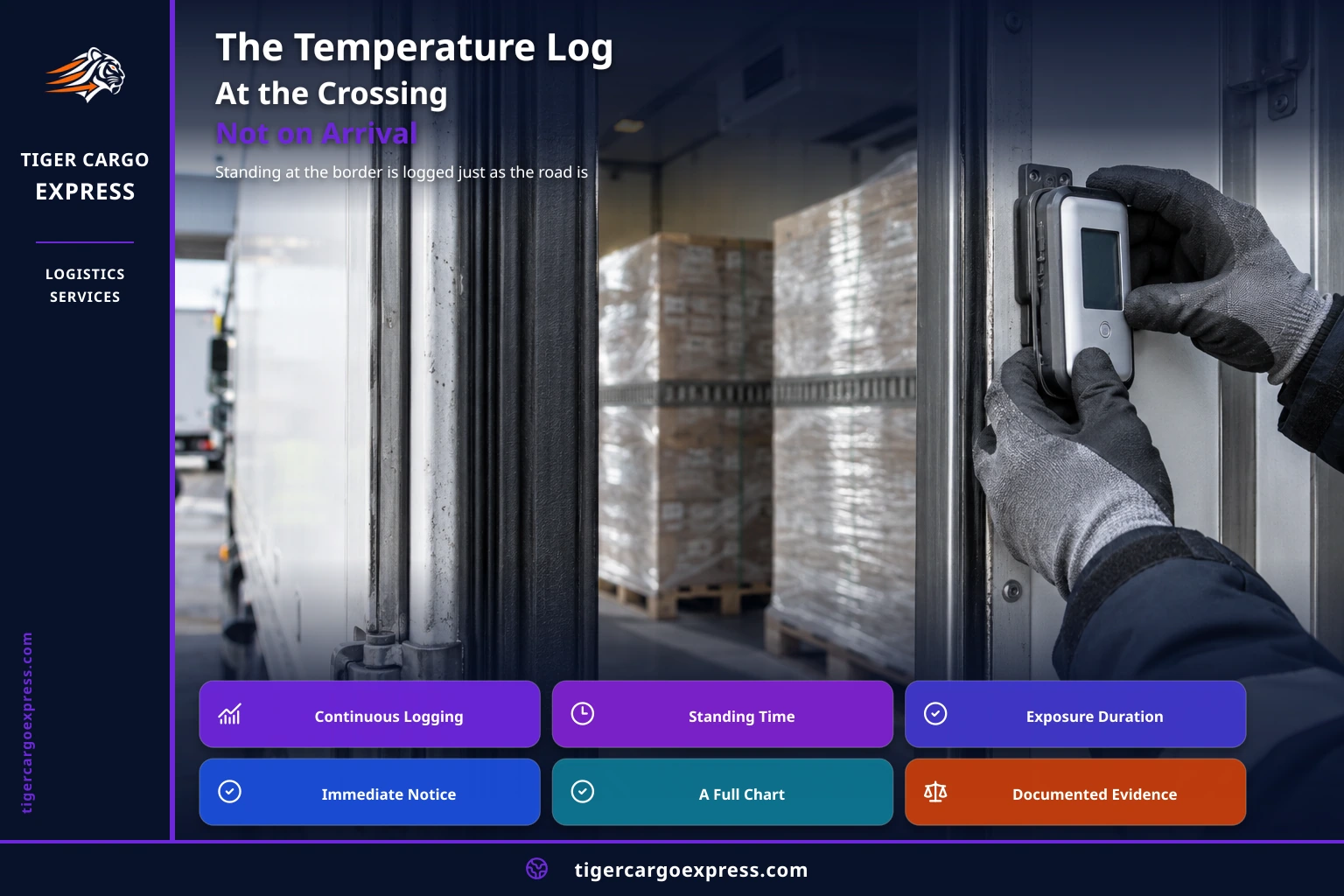
The temperature log at the crossing, not on arrival
Standing at the border is logged just as the road is.

Most deviations on international lines happen standing rather than moving. The reason is simple: standing combines high ambient heat, no airflow and a long time in one place.

The item On the road At the border
Airflow over the condenser Strong None
Ambient heat Renewed Trapped between vehicles
Exposure duration Moving Fixed and long
Chance of the unit being switched off It does not happen It does
What shows in the log A steady line The most important thing read in it
And we require entry and exit times at every pointNot merely a temperature figure. The chart alone says a rise occurred; the timestamp says where it occurred and who held the load then — and between the two lies the difference between a complaint and a claim.

Refrigerated shipping prices to Jordan

The table is indicative — the final figure follows knowing the item and the set point.

The load Outside the peak In peak seasons
A part load (up to 5 pallets) SAR 3,260 – 4,990 SAR 3,651 – 5,588
A half load (6–14 pallets) SAR 5,710 – 8,670 SAR 6,395 – 9,710
A full chilled load SAR 9,380 – 14,280 SAR 10,505 – 15,993
A full frozen load SAR 10,600 – 16,110 SAR 11,872 – 18,043
A consignment with special requirements By survey By survey
And the unit’s running-hours line is written separatelyRather than folded into the figure with no statement. Over 1,300 kilometres the unit runs for hours we estimate and write, and what exceeds them beyond our control we bear up to a written limit. Anyone giving you a single figure without mentioning this line leaves a door open.

The timetable and coverage

The stage The duration
Loading at yours Half a day to a day
The road Two days with one overnight stop over 1,300 km
The borders A range written into the quote rather than a figure
Clearance and handover Half a day to a day
Coverage Amman, Zarqa, Irbid, Aqaba, Mafraq, Karak and Madaba

How to compare two quotes on this line

Four questions — and not one about the price.

1Will you hand me a temperature log?From an independent device or the unit’s reading? The difference is everything.
2Who bears the unit’s fuel while standing?A real line — and anyone omitting it leaves a door open.
3Do you pre-cool the vehicle before loading?‘The unit is running’ is not an answer — pre-cooling is a procedure with a duration.
4What if the unit fails on the road?‘It won’t’ is not a plan — and a plan is stated before rather than after.
An example of the wrong comparisonA quote ten per cent lower to Jordan. But ask about the crossing hours in their estimate: anyone estimating them lower than they are gives you a prettier figure and a longer duration — and on refrigerated freight the duration is the shelf life.

What we guarantee and what we do not

Written conditions on the carrierCapacity beyond the requirement, sound gaskets, and acceptance of the log and seal.
An independent log inside the loadNot a unit reading measuring its own air — and handed to you.
One responsibility before youWe do not refer you to the carrier — we settle with you and then with him.
An honest crossing-hours estimateNot an optimistic one — on refrigerated freight the duration is the shelf life.

And what we do not promise: We will not say the temperature will never deviate. Failures and border hours on the Jordan line happen, and what we guarantee is that you learn of them at once and that they are recorded rather than discovered when the door opens.

What shippers get wrong here

Assuming a unit works in summer as it does in winterA unit is rated by its capacity to remove heat rather than by reaching a temperature. Outside heat increases what leaks in and narrows the margin.
Neglecting the condenserIt shows in no report and no specification — and a condenser blocked by dust sheds no heat, so the unit runs without cooling.
Not asking for written conditionsSpoken conditions end at the first available carrier on a tight date. Ask for the sheet and compare what is on it.
Accepting a single-figure duration estimateCrossing hours are probabilistic rather than fixed. A range with its bounds is more honest than a figure that looks precise.
Not asking about the remaining shelf lifeAnyone not asking will ship you what arrives with no life — and it will be said the shipping spoiled it, when it did not.

Why us on this line?

We require the condenser inspected and cleaned in summerMinutes of work that prevent a complete failure mid-route.
We ask for higher capacity in the hot monthsNot the same capacity all year — the margin narrows as the outside heat rises.
An independent log inside the loadNot a unit reading measuring its own air — and handed to you with the consignment.
One responsibility before youWe do not refer you to the carrier — we settle with you and then with him.
We refuse the unfitEven the cheapest and even on your date.
Verify that we are properly registeredRegistration 5800108005 and a documented national address — sent whenever you ask.
Send the item, the set point and your destination in JordanAnd the estimate reaches you with our carrier conditions in writing.Call 0506688227Message on WhatsApp

Frequently asked questions about refrigerated shipping to Jordan

Why does the summer test the unit?Because a unit is rated by its capacity to remove heat rather than by reaching a temperature. The hotter it is outside, the more heat leaks into the body, so the unit works harder to remove more. One sufficient in winter may reach its limit at the height of the heat.
And what narrows the margin most dangerously?A dusty condenser — which shows in no report and no unit specification. A unit removes heat by shedding it through a condenser, and one blocked by road dust sheds nothing, so it runs and consumes without cooling. We require it inspected and cleaned before departure in the summer months.
And do you change the conditions by season?Yes — we ask for higher capacity in the hot months. The same capacity does not give the same margin in July as in January, and anyone stipulating one figure all year has not counted the difference.
Where is the temperature logger placed?Inside the load rather than in the air path. Because the unit’s reading measures its returning air rather than your goods — the air may sit at its point while the heart of the load is degrees warmer because the air never reached it.
And how do you differ from a lorry owner?They sell you its space; we sell you that we refused the unfit. We inspect the vehicle, set seven conditions and refuse anyone not meeting them, and remain the only party before you.
Where do you deliver at the destination?Amman, Zarqa, Irbid, Aqaba, Mafraq, Karak and Madaba. And delivery is at your consignee’s warehouse rather than at the city limit — beyond by arrangement.
Do the conditions differ between chilled and frozen?Considerably. Frozen means a unit reaching −25, loading at −20 and logging by the minute; chilled means vertical stacking with gaps and open floor channels and a shelf-life calculation before the price.
And if the temperature deviates?It is logged with its timestamp and we notify you the moment it happens. And the timestamp identifies the stage and the party — so it is known in whose hands it occurred rather than only that it occurred. We decide with you while the consignment moves.
What do you ask about before the price?The set point, the item, the volume, the facilities, the destination and the remaining shelf life. The shelf life matters most — because it may lead us to tell you this line does not suit your goods.

In summary

The road to Jordan is not the road to anywhere else — and 1,300 kilometres have their own hours, borders and charge on the unit and the shelf life alike.

And the most important thing on this line: The summer tests the unit rather than the road.

And what we commit to on every line: written conditions on the carrier, capacity beyond the requirement, and one responsibility before you rather than a referral to a carrier.

Send the item, the set point and the remaining shelf life — the estimate reaches you within an hour. 0506688227

A chain unbroken from your warehouse to your destinationPre-cooling · A logger inside the load · A numbered sealCall 0506688227Message on WhatsApp
Shipping Guide

Related Shipping Guides

Continue with practical guidance connected to the same route or shipping decision.
Next step

Send your shipment details and get a written quote

We reply within 60 minutes during working hours — with what the price includes and what it does not, stated before you commit.