
Shipping, Furniture and Car Moving Company from Jeddah to Lebanon 0506688227 Sea Wins Clearly Here
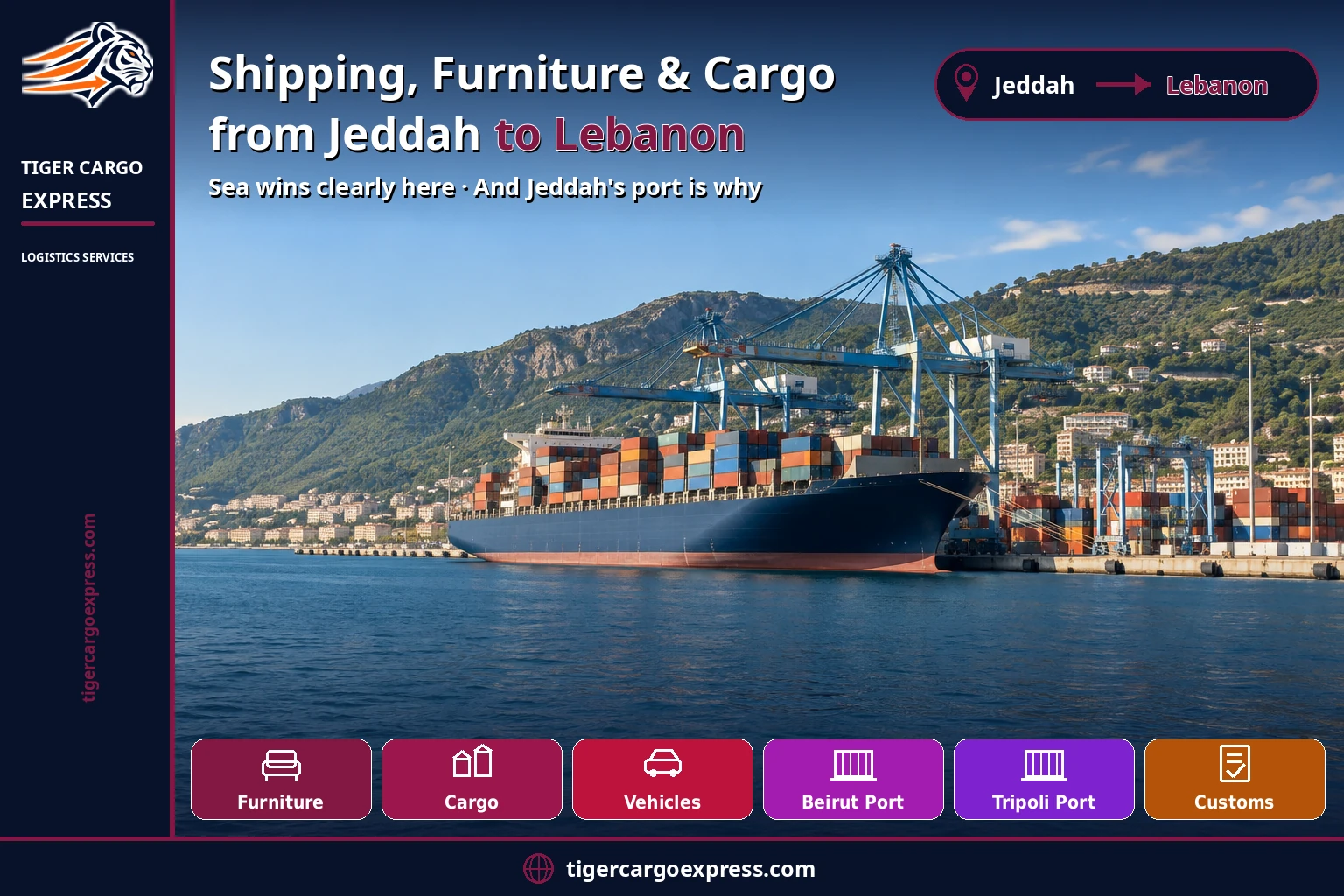
Shipping furniture, vehicles and cargo from Jeddah to Beirut, Tripoli, Sidon and the Bekaa — and Lebanon is the first destination in our series where we recommend sea without hesitation. Not because the sea is faster but because the road is heavier: three borders, two transit countries that are not your destination, and four customs files with two transit windows. Sea from Jeddah port reaches Beirut with two files and no more. We also add the Saudi certificate of origin, which means preferential customs treatment but cannot be issued retroactively. And what sets Lebanon apart remains: the last fifty metres.
Guide contents ShowHide
Looking for a shipping company from Jeddah to Lebanon that tells you sea or road in figures? Tiger Cargo Express ships furniture, vehicles and cargo from Jeddah to Beirut, Tripoli, Sidon, Tyre and the Bekaa. To book: 0506688227
In all our earlier articles we costed both routes and usually recommended road. Here we say something different without hesitation: sea wins.
And not because the sea is faster — but because the road to Lebanon crosses three borders and passes through two countries that are not your destination: Jordan and then Syria. Sea from Jeddah port reaches Beirut with no transit country at all.
Sea wins clearly here — and Jeddah is why
And this is the first decisive recommendation in the whole series.
Work it out with me. The road from Jeddah to Beirut climbs north to the Haditha crossing, then traverses Jordan on a transit declaration with a window, then enters Syria at Nasib, then traverses Syria on a second transit declaration, then reaches the Lebanese border.
| The item | Road across three borders | Sea from Jeddah port |
|---|---|---|
| Number of borders | Three | One at arrival |
| Transit countries | Jordan and Syria | None |
| Customs files | Four or more | Two |
| Possible stopping points | Three crossings | The arrival port alone |
| Pre-leg to the port | Not applicable | Zero — the port is in your city |
| Chance of boxes being opened | At every crossing | Once |
| Our recommendation | For special cases | The vast majority |
And Jeddah’s port settles it
The certificate of origin — a paper worth money rather than a formality
And most people shipping do not know its value.

In our earlier articles the certificate of origin was a paper that is asked for and prepared. On the Lebanon lane it holds an entirely different position.
Lebanon and Saudi Arabia are both parties to the Greater Arab Free Trade Area, which means goods of documented Saudi origin enter Lebanon on preferential customs treatment — leaving only whatever tax is levied.
| The case | What is paid | The difference |
|---|---|---|
| Goods with a documented Saudi certificate of origin | Preferential customs treatment | A real saving |
| The same goods with no certificate | Full duty | You pay what could have been avoided |
| Goods originating in a third country | By that country’s agreements | The certificate does not help here |
| Used personal effects | Unrelated to the certificate | The personal exemption regime |
What we ship from Jeddah to Lebanon
Furniture moving from Jeddah to Lebanon
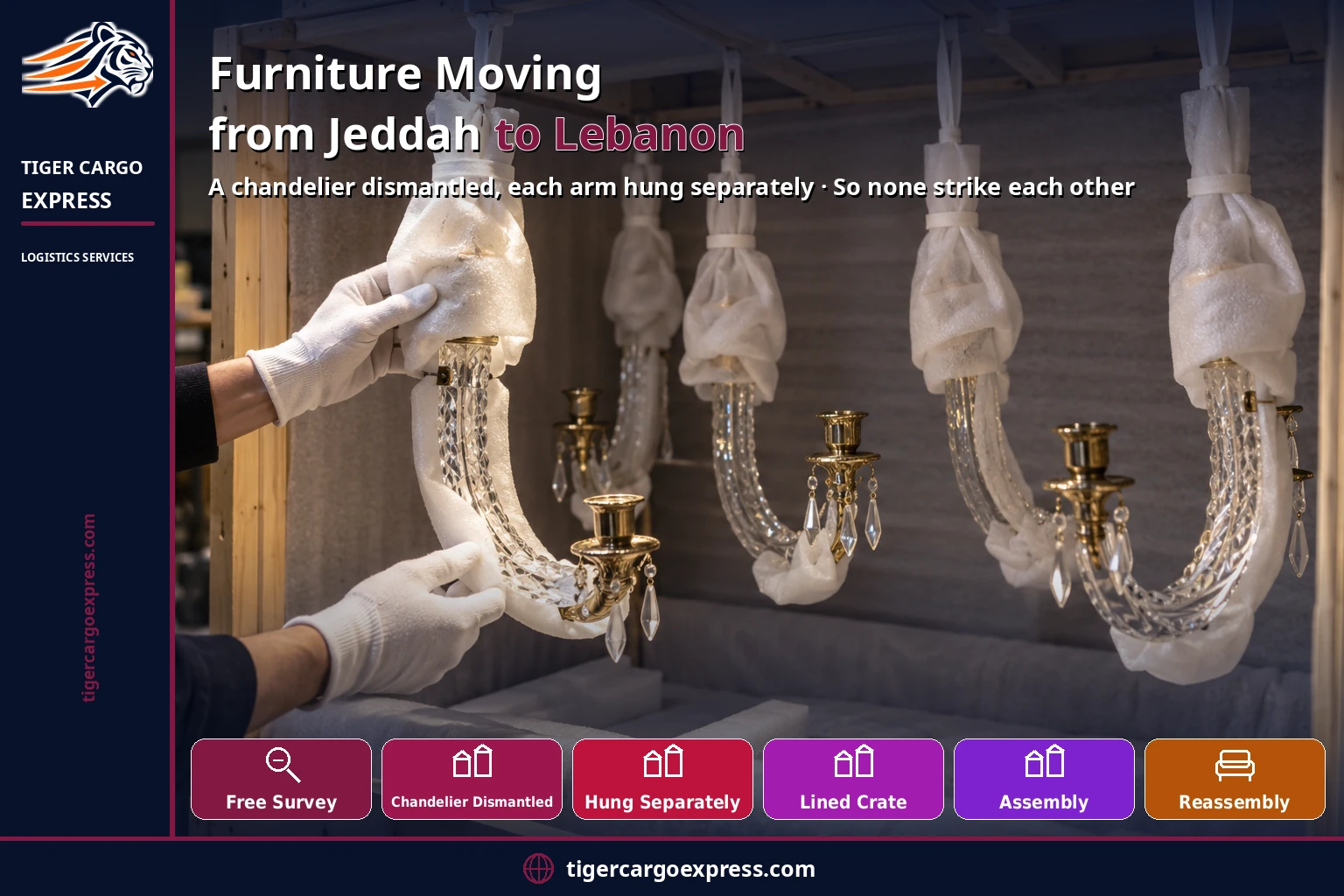
We visit you first and measure what you have with no fee, and a carpenter comes with us to take apart whatever needs it. Then each category is wrapped by what suits it and numbered, then it is loaded at your own city’s port and sails to Beirut, arriving as assembled rooms rather than boxes.
What the service includes
The chandelier — the piece that breaks itself
Most chandeliers that arrive broken were not broken by an external impact but by their own parts striking one another. The glass arms and hanging drops move inside the crate with every vibration, breaking each other while perfectly protected from outside.
| The method | What happens en route | The result |
|---|---|---|
| Wrapping the whole chandelier in a blanket | The parts move inside the wrapping | It arrives protected outside and broken inside |
| Placing it in a crate with filling | The filling presses but does not stop movement | Usually partial breakage |
| Removing the arms and hanging each piece | No contact between parts | It arrives whole |
| Removing the arms and stacking them | They rub against each other despite removal | Scratches on the glass |
| Leaving the drops hanging | They swing and collide | The most prone to breaking |
Furniture moving prices from Jeddah to Lebanon
| Home size | Beirut and its suburbs | Tripoli and the north | Sidon and Tyre | The Bekaa |
|---|---|---|---|---|
| Studio or single room | SAR 3,400 – 5,000 | SAR 3,600 – 5,300 | SAR 3,600 – 5,300 | SAR 3,700 – 5,500 |
| Two-bedroom flat | SAR 5,000 – 7,500 | SAR 5,300 – 7,900 | SAR 5,300 – 7,900 | SAR 5,500 – 8,200 |
| Three-bedroom flat | SAR 7,300 – 10,900 | SAR 7,700 – 11,500 | SAR 7,700 – 11,500 | SAR 8,000 – 11,900 |
| A small whole home | SAR 10,400 – 15,600 | SAR 11,000 – 16,400 | SAR 11,000 – 16,400 | SAR 11,400 – 17,000 |
| A large whole home | SAR 15,000 – 22,500 | SAR 15,800 – 23,700 | SAR 15,800 – 23,700 | SAR 16,400 – 24,500 |
Car shipping from Jeddah to Lebanon
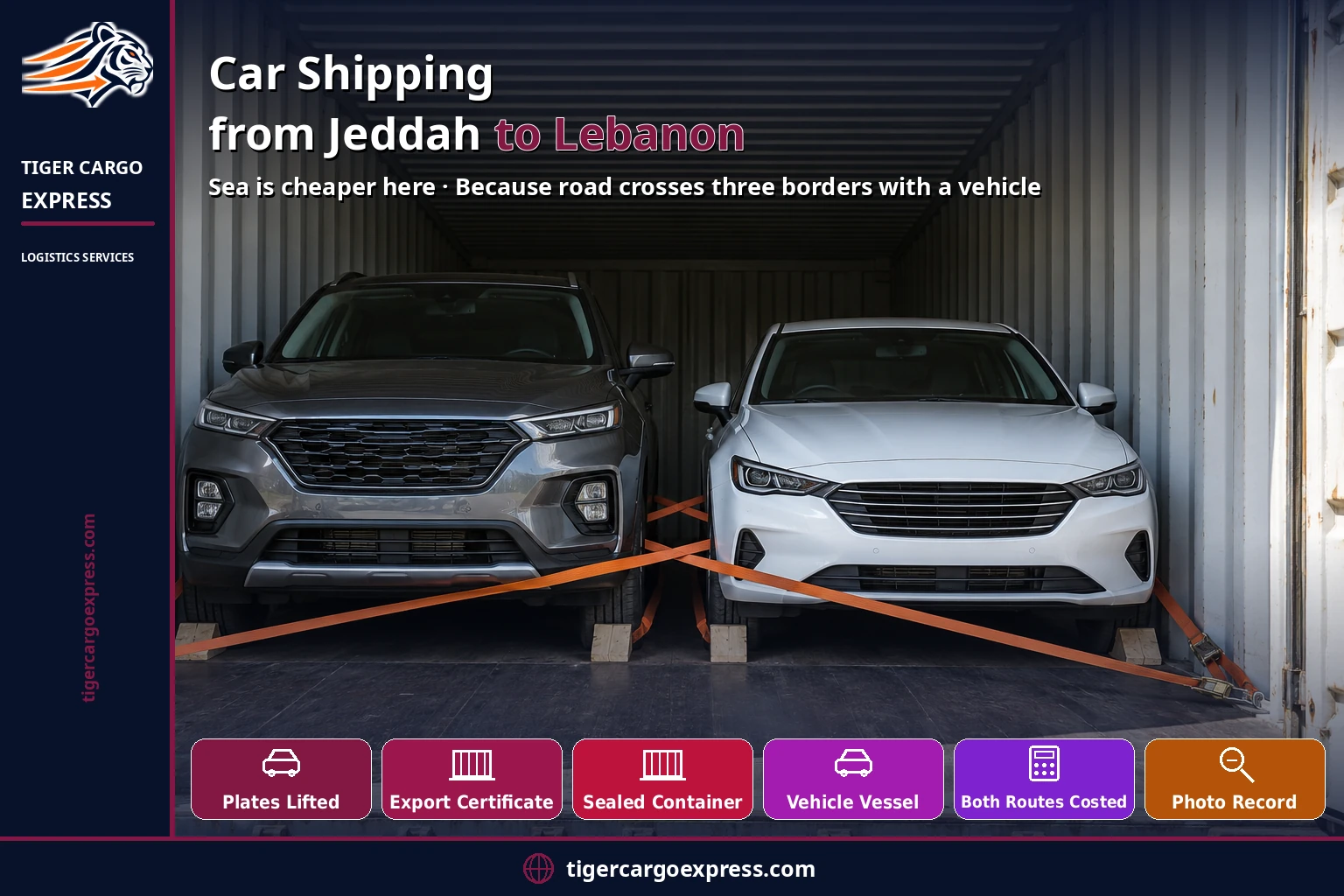
Shipping a vehicle here is a striking example of sea’s advantage. A vehicle by road crosses three borders and is inspected at each, with a declaration and a window for every transit — and a vehicle is tracked in its own right rather than within a load.
What precedes its loading
| The method | Protection | Price range | Note |
|---|---|---|---|
| A single sea container | Complete — sealed once | SAR 5,200 – 8,600 | Our recommendation |
| Two vehicles in a forty-foot | Complete — and the cost divides | By both models | Cheapest for anyone shipping two |
| With your furniture in one container | Complete — and it saves considerably | By total volume | A whole home with a vehicle |
| A road carrier | Good — but three borders | SAR 6,000 – 9,500 | For special cases |
| Non-running | By arrangement | After survey | It is pushed inside the container |
The last fifty metres — where the truck has to stop
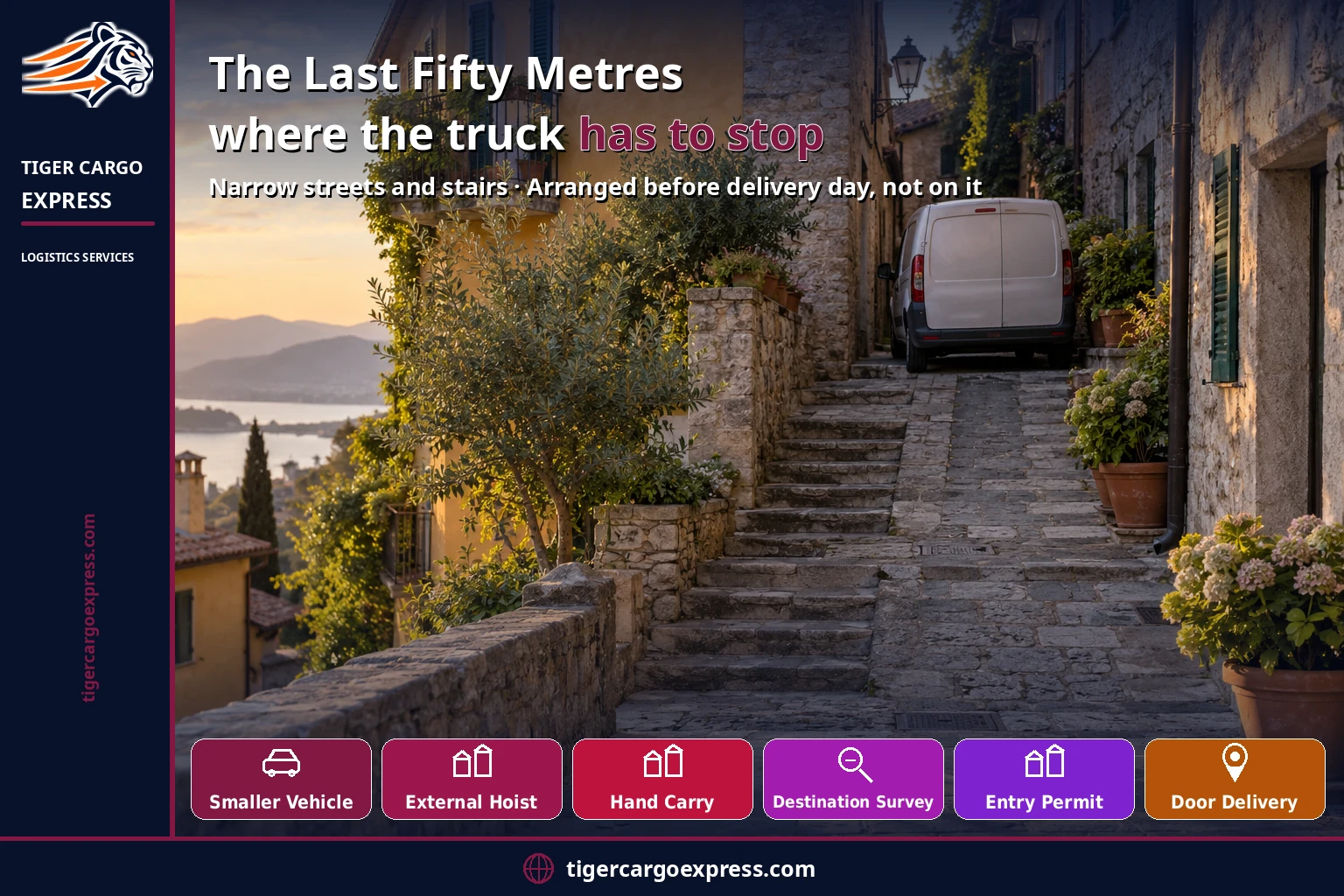
On all our earlier lanes arrival ended at the consignee’s door. In Lebanon it may end fifty metres before it — where the street narrows, or the stairs begin, or the road climbs beyond what a loaded truck can take.
| What you find in Lebanon | Why it holds things up | What we arrange in advance |
|---|---|---|
| Narrow mountain streets | A large truck cannot enter them | A smaller vehicle transfers from the stopping point |
| Stairs between street and entrance | No lift and no ramp | Hand carrying costed into the quote |
| Old buildings with no lift | Large pieces cannot go up | An external hoist or deeper dismantling |
| Narrow lifts | The wardrobe will not fit even dismantled | A hoist through the balcony or window |
| Narrow balconies | The hoist itself needs space | We ask for photographs before booking |
| Districts with entry permits | The truck stops at the barrier | A permit requested before the delivery date |
Lebanese cities we cover
Where we collect from inside Jeddah
From any district, and the visit costs nothing. These are some of the areas we cover:
Where does your shipment’s time go?
| Where | How long it takes | What happens |
|---|---|---|
| At your home | One to two days | We survey, dismantle, wrap and number |
| To the port | Minutes | The port is inside your city |
| Clearance and loading | 1 to 3 days | The export declaration and the bill of lading |
| The sailing | By schedule | Through Suez into the Mediterranean |
| Discharge and clearance in Beirut | 2 to 5 days | The Lebanese import declaration |
| To your city | Hours | Lebanon is a small country |
| The last fifty metres | Two hours to a day | By the street and the stairs |
Documents required
For your furniture and belongings
- Your identity document valid and photographed legibly
- Your passport — and check it remains valid past your cargo’s arrival
- Whoever awaits it in Lebanon: name, number, city and full address
- An inventory by item and count for every box — we write it with you at loading
- Proof of your relocation or return if you want the personal effects exemption
- The sea bill of lading — we issue it and track its arrival to your consignee
For your vehicle
- A valid registration bearing nobody’s name but yours
- A statement that the finance ended, wherever it existed
- Evidence its plates were cancelled on Absher
- The traffic department’s approval for its departure
- The invoice or sale contract establishing its value
- Full vehicle details for estimating its Lebanese duty
For a commercial shipment
- An invoice hiding no description and reducing no value
- A statement per parcel: what is in it, its weight and its measurements
- The company’s registration in force
- Its tax number
- A documented certificate of origin — worth money here rather than a formality
- The sea bill of lading
Prohibited and restricted items
Absolutely prohibited
- Narcotics and psychotropic substances in every form
- Weapons, ammunition and their parts
- Radioactive and toxic materials
- Counterfeit goods
- Material contrary to public morals
- Cash and gold within ordinary shipments
Categories with entry conditions
| The category | Its restriction | What is asked of you |
|---|---|---|
| Your own medicines | They do not cross without medical support | An approved report or prescription, and a purely personal quantity |
| Perfumes and sterilising agents | Treated as flammable materials | A sealed container and disclosure before stacking |
| Wireless communication devices | Subject to regulatory approval | Notifying us early so the permit can be arranged |
| Appliances in their original boxes | Read as new goods rather than effects | The purchase invoice with an explicit declaration |
| Preserved foodstuffs | Health checked before entry | A shelf life of no less than ten days |
| Plants and seeds | Agricultural quarantine | A phytosanitary certificate |
For those shipping boxes rather than homes
You may have no more than bags for your mother in Beirut or a screen you bought in Jeddah. We accept them with no count condition.
| Carton count | Approximate price per carton | Note |
|---|---|---|
| One carton | SAR 290 – 430 | Up to 30 kg |
| Two cartons | SAR 255 – 370 | The fixed cost divides |
| Three to five | SAR 215 – 315 | The most common for family consignments |
| Six to ten | SAR 185 – 270 | Clearly the cheapest |
| More than ten | SAR 155 – 230 | By count and city |
And offices have their own table
| Item | Price range | Note |
|---|---|---|
| A full single workstation | SAR 460 – 850 | Including dismantling and wrapping the screen |
| Meeting table | SAR 1,080 – 1,880 | Dismantled and wrapped with reinforced corners |
| Filing cabinet | SAR 255 – 540 | Per unit, emptied before lifting |
| Servers and IT equipment | SAR 1,380 – 3,420 | Timber crates and anti-static wrapping |
| A full office (10 staff) | SAR 6,350 – 10,850 | An all-in package with numbering and inventory |
How to compare two quotes on this lane
Five questions — and the first settles everything after it.
What we guarantee and what we do not
And we are frank about our limits: sailing dates change and container rates are seasonal, and clearance duration at Beirut port is not ours alone. We will not describe ourselves as “the cheapest” nor as those who “cannot be matched” — but a recommendation with its argument, a measurement you see with your own eyes, and a question about your destination before we price.
How to reduce your shipping cost
| Method | Expected saving | How |
|---|---|---|
| Ask about the certificate of origin | It can exceed the freight itself | If your shipment is commercial and Saudi in origin |
| Dismantle everything possible | 20 to 35% | The measure is the cubic metre — and dismantling shrinks it directly |
| Combine the home and the car | 15 to 25% | In one container rather than two shipments |
| Gather your boxes | 25 to 40% | The box price falls plainly with the count |
| Send photographs of your destination early | Prevents an urgent rate | The hoist is reserved rather than summoned |
| Book outside peak seasons | 10 to 15% | Summer is the return season and peak demand |
When does transit lengthen on this lane?
- Summer — the expatriate return season and peak demand
- Global peak shipping seasons — they raise container rates
- Congestion at Beirut port — it lengthens discharge and clearance
- Suez Canal works or congestion — they affect the sailing
- Mediterranean weather — it can delay berthing
Five recurring mistakes — all of them avoidable
Why Tiger Cargo Express?
Frequently asked questions about shipping from Jeddah to Lebanon
In summary
Lebanon is the first destination in our series where we recommend sea without hesitation.
Not because the sea is faster but because the road is heavier: three borders, two transit countries that are not your destination, four customs files with two transit windows, and three possible stopping points. Sea from Jeddah port — minutes from you rather than nine hundred kilometres — reaches Beirut with two files and no more.
And we added what nobody mentions: the Saudi certificate of origin is not a formality but preferential customs treatment — though it is issued before shipping and never retroactively.
And what sets Lebanon apart from all our destinations remains: the last fifty metres. A narrow mountain street, a flight of stairs, a building with no lift — they can take what a day’s journey takes. Which is why we ask about your destination in photographs rather than by address.
Send your location in Jeddah, your city in Lebanon and a photograph of your consignee’s street, and the quote reaches you within an hour. 0506688227
Where does Lebanon sit on our map?
Shipping from Jeddah to Lebanon is one lane within a wider region — and the Middle East guide explains the rules governing it and its neighbours together.
Related Shipping Guides
Continue with practical guidance connected to the same route or shipping decision.
Furniture and Car Shipping Company from Saudi Arabia to the Gulf 0506688227
⚠️ "How much does shipping to Kuwait cost?" is a question missing three things. Shipping from Riyadh is not shipping…
Shipping Company from Saudi Arabia to the Middle East 0506688227 — Overland Guide
The Middle East overturns all of it: it is the only destination whose journey starts at your front door rather…
Shipping Company from Saudi Arabia to Oceania 0506688227 — The Biosecurity Guide
On every preceding continent the question was: what is inside your shipment? Oceania asks an entirely different one: what is…
Send your shipment details and get a written quote
We reply within 60 minutes during working hours — with what the price includes and what it does not, stated before you commit.