
Car and Furniture Shipping Company from Saudi Arabia to Austria 0506688227 The Mountain Decides Your Truck and Your Date
Car and furniture shipping from Saudi Arabia to Austria — and Austria is the port of Koper's largest market, at close to thirty-eight per cent of its throughput, which alone tells you where your shipment should enter. But Austria is landlocked and two thirds mountain, so the last kilometre is a pass rather than a motorway: height and weight limits, night driving bans, sectoral restrictions, and passes that close seasonally. And your vehicle faces three interlocking items: a tax at first registration, an individual approval from your province's inspection authority, and one month only on foreign plates.
Guide contents ShowHide
Looking for a shipping company from Saudi Arabia to Austria that knows the last kilometre of your shipment is a mountain pass rather than a motorway? Tiger Cargo Express ships furniture, vehicles and cargo to Vienna, Graz, Linz, Salzburg and the rest of Austria — by sea, rail and air, with dismantling, packing and reassembly, customs clearance at both ends, and insurance on the load. To book: 0506688227
We start with news in your favour: Austria is the port of Koper’s largest market by far, at close to thirty-eight per cent of its throughput. That alone tells you where your shipment should enter — we come from Suez, and the Adriatic lies directly ahead.
Then begins the part nobody explains.
Austria is landlocked, and two thirds mountain. The road from the port to your door is not measured in kilometres but in passes, tunnels and restrictions: height and weight limits, night driving bans on particular corridors, sectoral restrictions on certain kinds of load, and passes that close seasonally.
At other destinations inland haulage was a line item. Here it is an engineering decision: the mountain decides your truck type, its departure hour and your delivery date.
What do we ship from Saudi Arabia to Austria?
Traffic combining people relocating for work and study with staff of international organisations.
The mountain decides — four restrictions that govern your shipment
Because these restrictions determine what kind of vehicle actually reaches your door. Anyone living in a narrow alpine valley may find a large truck cannot get there at all, so their shipment needs a smaller vehicle for the final leg — a cost item and an extra stage.
And anyone planned for on the basis of “a truck to the door” who then discovers on delivery day that the road will not take it pays for a full reorganisation on the spot. We ask about the road leading to your house — not just its address — before we book.
The entry port — and why Koper is obvious here
Austria is landlocked, but its maritime position is among the best in this group for anyone coming from Suez. And the numbers speak: Austria is the single largest market for the port of Koper, at around thirty-eight per cent of its throughput.
That is no coincidence: the Adriatic is around two thousand nautical miles shorter from us than the northern ports and five to seven days faster, and at the same time closer by road to southern Austria, Graz and Vienna than Hamburg is.
| Port | Sea | When it suits you best |
|---|---|---|
| ⭐ Koper | The Adriatic | The default by a wide margin — and the port’s largest market is Austria itself |
| Trieste | The Adriatic | A strong Adriatic alternative with an excellent rail network into Austria |
| Hamburg | The North Sea | More frequent schedules — but the longest by sea and the furthest by road |
| Rotterdam | The North Sea | A wide network with a Rhine barge option — a long routing for Austria |
Because a train is not subject to the night driving bans that apply to trucks, and is not affected by mountain route restrictions the way roads are.
So the most efficient routing for most of our Austrian shipments is: a vessel to Koper, then a train to an inland terminal in Vienna, Linz, Graz or Salzburg, then a short truck run for the final leg alone. Your exposure to the mountain restrictions is cut to the shortest possible distance.
Conditions for removal goods relief in Austria
Austria is an EU member and applies its framework for removal goods relief: anyone resident outside the Union for twelve continuous months who transfers their normal residence to Austria brings in used furniture and belongings free of duty and VAT.
| Condition | What it means in practice |
|---|---|
| Residence outside the Union | Twelve continuous months before the move — evidenced by documents. |
| Prior ownership and use | Used goods in reasonable household quantities — new items in original packaging assessed separately. |
| Transfer of normal residence | Austria is your main home — furniture for a mountain holiday home is not relieved. |
| Arrival within the deadline | A set period from your move date — measured to your door, not to the quay. |
| Local residence registration | The basis of official dealings — obtained early, not when the container lands. |
| Restriction on disposal | Goods admitted under relief cannot be sold or lent for a set period after import without prior notification. |
What we set out is the framework as we work with it in practice; rules and traffic restrictions are updated from time to time and vary from province to province. So we review the current conditions and routes with you before booking. We prepare the file and coordinate the timing — we do not provide legal or tax advice.
Shipping for embassies, consulates and their staff
And Vienna is a special case in this series: a seat of international organisations.
Shipments for diplomatic and consular missions and their staff do not go through the removal goods route and are not bound by its conditions — not the one-year residence condition, not the arrival deadline, and not the restriction on disposal. The basis here is the status of the mission or of your accreditation with it.
Vienna is not only a capital hosting bilateral missions — it is a seat of a number of international organisations. The consequence is that accredited people in the same city belong to different accreditation categories: a bilateral mission to the state, a permanent mission to an organisation, or an international official of the organisation itself.
And each category has its own channel and treatment. So the first question we ask on Vienna files is not “how large is the shipment” but “accredited to whom exactly?” — and the answer is settled before the bill of lading is issued, not after, because the consignee’s name and title are built on it.
The common error: a bill made out to a person in a general capacity, and then the discovery that their actual status follows a different channel — so the file starts again.
- ▸ We settle the accreditation category before issuing the bill of lading — the step that precedes everything else on Vienna files.
- ▸ We start with the competent department, not the individual — the official correspondence is the foundation of the file.
- ▸ We match consignee name and title between the correspondence and the bill of lading word for word before issuing it.
- ▸ We schedule sailing around the accreditation date rather than around when the furniture is ready.
- ▸ We document the inventory to a higher standard and hand it over endorsed by both sides.
- ▸ We handle everything in confidence — information, contents and movement schedules alike.
And we are clear: what the exemption covers and how far it extends is for the competent authorities in the receiving state and the organisation concerned to determine, each through its own official channels. Our role is purely logistical. We work in both directions: foreign missions in the Kingdom, and Saudi missions in Vienna.
Car shipping from Saudi Arabia to Austria
Three items — and one of them starts counting from the day of import.
Austria drives on the right as Saudi Arabia does, so there is no conversion stage. But registering a vehicle passes through three separate items you should know before booking a container.
Meaning it is not a figure someone issues to you but a return whose accuracy you carry. We prepare it within the file rather than leaving you to face it alone.
Provincial is the operative word: Austria has nine provinces, each with its own authority. We identify the one competent for your province of residence, not the port’s or the terminal’s.
Anyone resident in Austria may not use their vehicle without Austrian registration beyond one month from its import. It is among the shortest windows we have met in this series.
And there is a procedural detail worth noting: when the vehicle is entered in the approval database a temporary registration block is imposed, and it is not lifted until the tax is paid. Meaning the three items are interlocking rather than sequential — and a delay in one freezes what follows.
Which is why we arrange secure parking for the vehicle and cost it as a declared line — because it is a real period in which the vehicle may not be used.
And a point many never consider: vehicles built outside the Union may need technical modifications, among them items relating to the headlights and other components. A small item in itself, but it adds to the time and the cost — and it is discovered at inspection rather than before, unless we review the model early.
Furniture moving from Saudi Arabia to Austria
And the delivery here is planned as carefully as the shipping itself.
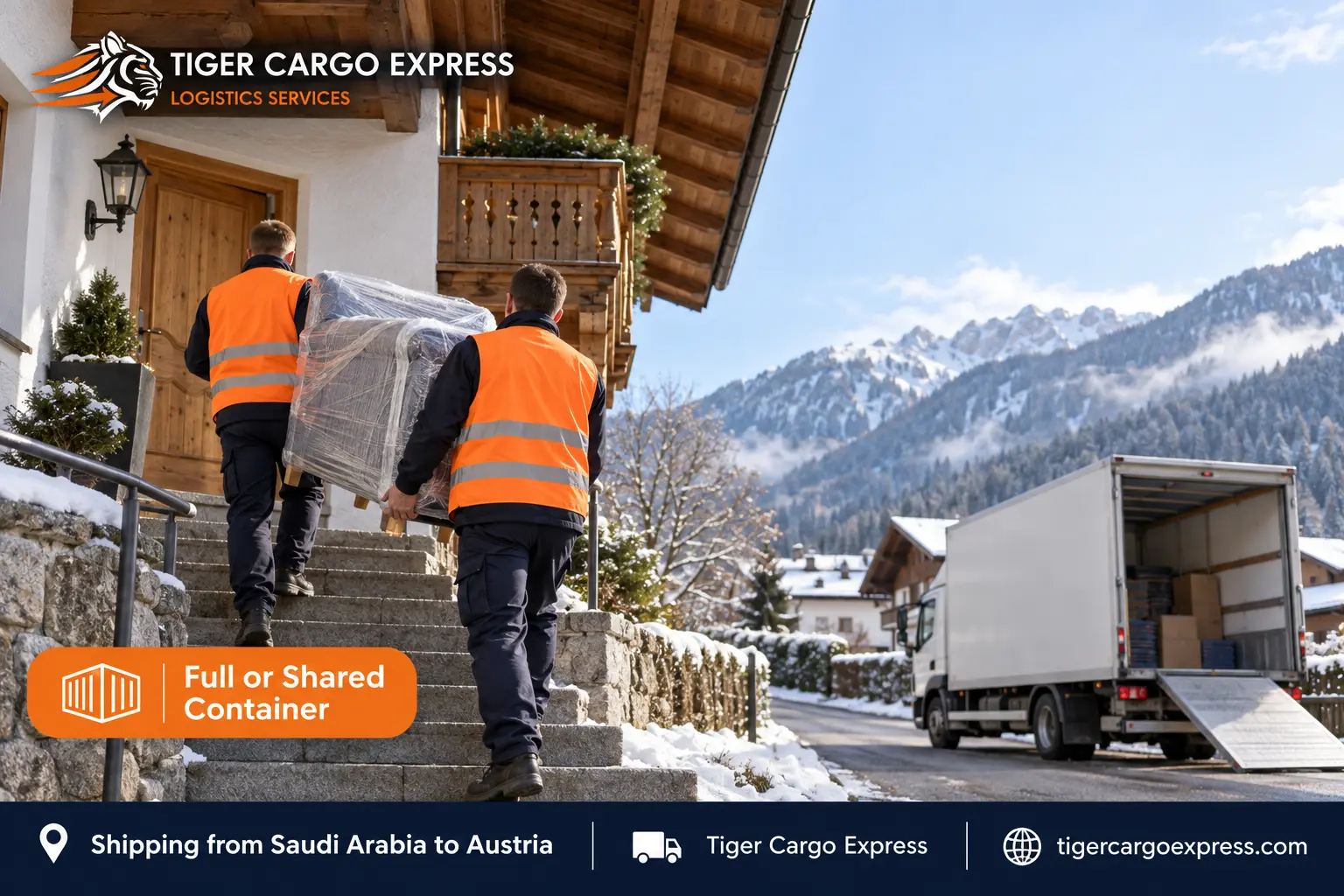
Our first question on Austrian files is not “how large is your load” but “how does the road reach your house?” Austrian mountain houses are often on a slope, up a narrow road, with external steps — and a large truck may not reach them at all.
- ▸ Survey and assessment: volume in cubic metres, and deciding what is dismantled and what needs a crate.
- ▸ Studying the final road: its width, its gradient and whether a truck can stand there — before booking, not on delivery day.
- ▸ Professional dismantling: bedrooms, kitchens and shelving — full dismantling cuts volume, and volume is your invoice.
- ▸ Lashing that allows for mountain roads: bends and gradients stress a load more than level road does.
- ▸ Multi-layer packing: bubble, then blankets, then stretch film, with glass and mirrors in lined crates.
- ▸ Cold and condensation protection: a sharp alpine winter and heated homes — we advise an acclimatisation period before assembly.
- ▸ Unpacking and reassembly: in your new home — not boxes left at the bottom of the track.
Three ways to ship — sea, rail and air
Full container or shared load?
| Aspect | Full container | Shared load |
|---|---|---|
| When it suits you | A whole home, a vehicle, or volume close to container capacity | A small flat, a student’s belongings, or part of a home |
| ⭐ At a mountain destination | May need stripping at an inland terminal and then a smaller vehicle — if your road is narrow | A real advantage here — it already arrives on a smaller vehicle suited to narrow roads |
| Transit | Shorter — no waiting for a load to fill | Longer — consolidation, then deconsolidation, then inland transport |
| Cost | A fixed rate — better value the closer you get to filling it | Per cubic metre — better value for small volumes only |
Note the second row — it is the reverse of what we said for Czechia. At a flat destination a full container involves less handling because it moves inland as it is. But at a mountain destination up a narrow road the opposite may hold: the full container needs stripping at a terminal and then a smaller vehicle, while a shared load already arrives on a suitable one.
Austrian cities we cover
Door delivery from Vienna in the east to Vorarlberg in the west.
Graz
Linz
Salzburg
Innsbruck
Klagenfurt
Villach
Wels
St. Pölten
Dornbirn
Steyr
Wiener Neustadt
Feldkirch
Braunau
Klosterneuburg
Baden
Shipping prices from Saudi Arabia to Austria
Indicative figures — the final quote is built on the survey and on the road leading to your house.
| Shipment type | Price range | Unit and notes |
|---|---|---|
| Shared load (LCL) | Request a quote — set by survey | Per cubic metre with a minimum — and it suits narrow mountain roads |
| 20ft container | Request a quote — set by survey | Suits a mid-sized flat, or a vehicle with belongings |
| 40ft container | Request a quote — set by survey | Suits a full house — and we check whether it can reach your address |
| ⭐ Port to your door | Set in the quote, by your destination | A principal line — and it changes with the mountain routing, not the distance |
| ⭐ Final leg on a smaller vehicle | Set in the quote, by your destination | If the road to your house will not take a large truck — an item specific to Austria |
| Car shipping | Request a quote — set by survey | Freight only — excluding the tax, individual approval and roadworthiness certificate |
Note the fifth row — a line you will not find in any other quote. Anyone living in an alpine valley or a mountain village may need a final leg on a smaller vehicle. It is not a “surcharge” but a real stage with its own equipment and crew — and we declare it in the quote rather than springing it on you on delivery day.
What actually sets your price?
Documents required for shipping to Austria
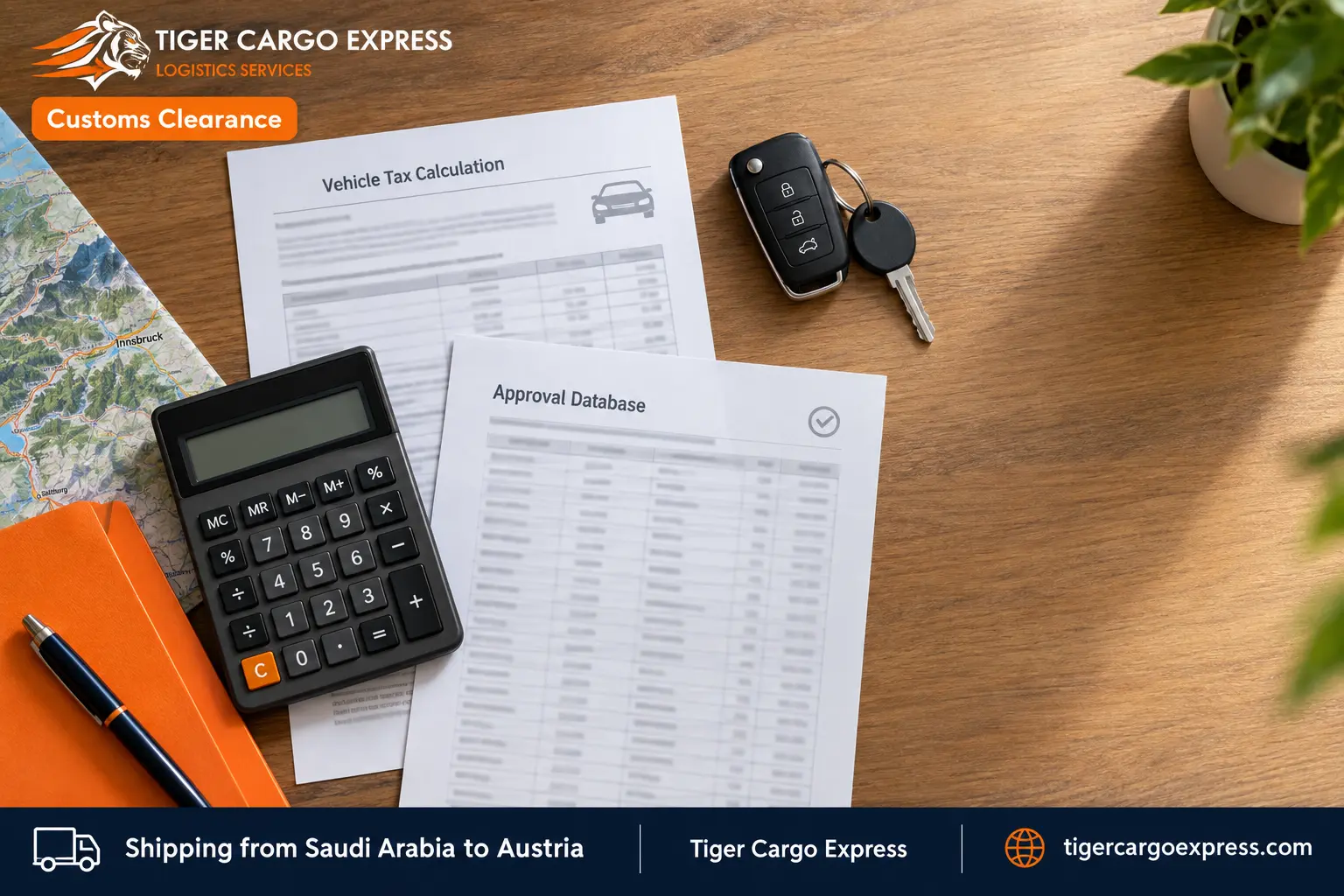
First: how does the road reach your house? Its width, its gradient and whether a truck can stand at it. That sets the vehicle type and the number of stages.
Second: what is your vehicle’s chassis number? From it we know whether it needs an individual approval, which sets its standing time and the cost of its route.
Both are asked before booking. Anyone starting with volume and price and reaching them late has built a schedule on an incomplete basis.
Customs clearance and standing charges
We handle clearance at both ends. A container has a limited free period starting from discharge rather than from your notification, after which a daily charge applies for it remaining and another for late return to the shipping line.
For shipments arriving from outside the Union, customs duty and import VAT are collected at the Union’s external border — that is, at the entry port rather than in Austria. We prepare the file on that basis from the start.
In the vehicle file specifically: the one-month window runs from the vehicle’s import, not from the end of its clearance. Clearance is a step inside the window, not outside it.
And alongside it sits the temporary registration block imposed when the vehicle is entered in the approval database, which is not lifted until the tax is paid. Meaning you face a short window and an interlocking chain at the same time — which is why we prepare the whole vehicle file before sailing rather than leaving it until after arrival.
Prohibited and restricted items
- ▸ Flammables and pressurised goods: aerosols, paints, solvents, fuel and gas — excluded entirely, and Alpine tunnel restrictions on them are strict.
- ▸ Alcohol and tobacco: outside the removal goods relief, with their own excise regime.
- ▸ New items in original packaging: the prior-use condition is examined and new goods are assessed separately.
- ▸ Liquids liable to freeze: an alpine item — any liquid that may freeze, expand and burst its container on a high pass.
- ▸ Food and animal or plant products: tightly restricted under European sanitary and phytosanitary controls.
- ▸ Plants, seeds and soil: effectively prohibited — Austria guards its mountain environment strictly.
- ▸ Weapons, ammunition and replicas: including souvenirs — with their own permit regime.
- ▸ Untreated timber: every crate and pallet needs approved treatment and marking.
Packing and insurance
The challenge here is threefold: a sea voyage, then a rail or mountain road leg, then a final stage that may be on a smaller vehicle. And every transition between stages is additional handling.
Inland delivery after the port
- ▸ Narrow mountain roads: measured before booking — and they may impose a smaller vehicle for the final leg.
- ▸ Houses on a slope with external steps: very common in Austria — they need a larger crew and more time.
- ▸ Restricted historic centres: Vienna, Salzburg and Innsbruck — the municipal permit is arranged in advance.
- ▸ The winter season: restricted passes and mandatory equipment — a mountain delivery in winter needs a written margin.
- ▸ Driving bans in defined hours: the delivery schedule is built on them, not on office hours alone.
The reverse direction — Austria to Saudi Arabia
We work both directions on the same ports and routes. The dominant traffic out of Austria is industrial equipment, machinery, precision engineering products, winter sports equipment and furniture, alongside returnees’ effects.
Note that the mountain transit restrictions work in both directions: loading out of an alpine valley is subject to the same road and vehicle considerations. And we review your list before loading because Saudi import restrictions follow their own logic, particularly for cosmetics and foodstuffs.
How to choose a shipping company to Austria
Our written guarantees
How to lower the cost of your shipment
- ▸ Photograph the road leading to your house. Two or three photos can save you a whole stage we would otherwise add at short notice.
- ▸ Enter via Koper. The Adriatic saves you on sea and land alike — and Austria is its largest market for a reason.
- ▸ Allow rail to a terminal near you. Cheaper than long road haulage and less exposed to restrictions.
- ▸ Review your vehicle model before booking. Individual approval varies sharply — and may change your decision.
- ▸ Avoid a mountain delivery at the height of winter if your schedule is flexible — the margin is wider and the cost higher.
- ▸ Sort before you pack. Every cubic metre is paid for here at sea and on the mountain alike.
- ▸ Allow full dismantling. It cuts volume appreciably, and volume is the invoice.
When do rates rise and transits lengthen?
| Period | What happens |
|---|---|
| Deep winter | The hardest period here — restricted passes, mandatory equipment, and a mountain delivery needing a wider margin. |
| The winter tourism season | Congestion on the mountain roads into the tourist valleys — and delivery there is hard to schedule. |
| August and September | Start of the academic year and a wave of work relocations — pressure on containers and packing crews. |
| Peak import season | Pressure on Adriatic berths and on inland train capacity at the same time. |
| Disruption on sea lanes | Rerouting lengthens transit and moves rates — we tell you as soon as we know. |
How we work: five steps
Five recurring mistakes — all avoidable
- ▸ Giving the address without describing the road. The mistake most specific to Austria — an address does not tell you whether a truck can get there.
- ▸ Overrunning the one-month window on foreign plates. Among the shortest in this series — and it runs from import, not from clearance.
- ▸ Assuming the three items are sequential. They interlock — and the registration block is not lifted until the tax is paid.
- ▸ Choosing Hamburg out of habit. Austria is Koper’s largest market — and the Adriatic saves on sea and land alike.
- ▸ Issuing a Vienna bill of lading before settling the accreditation category. Bilateral or to an organisation? Confusing them restarts the file.
Why Tiger Cargo Express?
Because we ask about the road before we ask about the volume. In a country two thirds mountain, your address is not enough — the road leading to it is what sets the vehicle type, the number of stages and the cost.
And we declare the final mountain leg as a separate line where it is needed, and prefer rail because it cuts your exposure to the transit restrictions. Anyone quoting you on the basis of “a truck to the door” without seeing the road has made an assumption that may cost you a full reorganisation on delivery day.
Frequently asked questions about shipping from Saudi Arabia to Austria
In summary
Shipping to Austria opens with good news and closes with a decisive detail. The good news: Austria is the port of Koper’s largest market at around thirty-eight per cent, because the Adriatic is both shorter to us by sea and closer to Austria by road. The decisive detail: a country two thirds mountain, where the last kilometre is a pass rather than a motorway — and the mountain decides your truck type, its departure hour and your delivery date. Three things matter here: studying the road to your house before booking, preferring rail to shorten the restricted stretch, and a vehicle file ready before sailing because the one-month window runs from import. Tiger Cargo Express gives you all three in writing before you ship.
Send your shipment details — approximate volume, origin city, your province and a description of the road to your house, when you move, and if a vehicle is included, its chassis number and technical data — and we reply with a detailed quote with its stages declared within 60 minutes. 0506688227
Where does Austria sit on our map?
Shipping to Austria is one lane within a wider region — and the full Europe guide explains the rules governing it and its neighbours together: the route, the customs framework, and the challenge that lane is priced around.
Related Shipping Guides
Continue with practical guidance connected to the same route or shipping decision.
Furniture and Car Shipping Company from Saudi Arabia to the Gulf 0506688227
⚠️ "How much does shipping to Kuwait cost?" is a question missing three things. Shipping from Riyadh is not shipping…
Shipping Company from Saudi Arabia to the Middle East 0506688227 — Overland Guide
The Middle East overturns all of it: it is the only destination whose journey starts at your front door rather…
Shipping Company from Saudi Arabia to Oceania 0506688227 — The Biosecurity Guide
On every preceding continent the question was: what is inside your shipment? Oceania asks an entirely different one: what is…
Send your shipment details and get a written quote
We reply within 60 minutes during working hours — with what the price includes and what it does not, stated before you commit.