
Car and Furniture Shipping Company from Saudi Arabia to Switzerland 0506688227 Your Customs Border Is a Road Barrier, Not a Quay
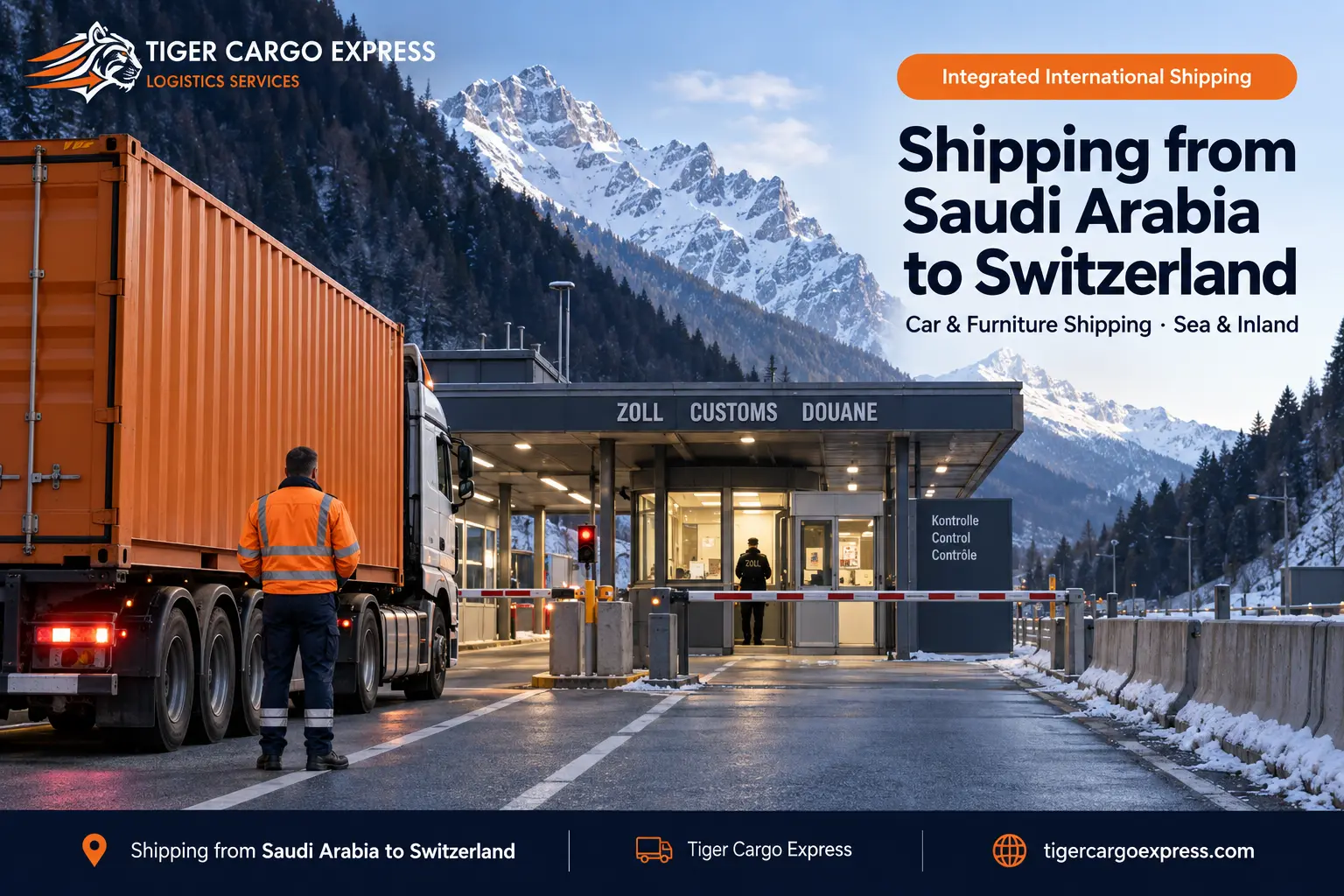
Switzerland is the only destination in this series that is both landlocked and outside the customs union. Its customs border is a road barrier in the mountains, where goods clear on a declaration in duplicate, Monday to Friday within office hours. And its rules are easier than you expect: six months of ownership rather than twelve, and a two-year arrival window, the longest in this series — against one decisive item: follow-up shipments are declared at the first import.
Guide contents ShowHide
Looking for a shipping company from Saudi Arabia to Switzerland that knows your shipment will never be cleared at a port at all? Tiger Cargo Express ships furniture, vehicles and cargo to Zurich, Geneva, Basel, Bern and the rest of Switzerland — by sea, road, river and air, with dismantling, packing and reassembly, customs clearance at both ends, and insurance on the load. To book: 0506688227
Across this whole series we have met two countries outside the European Union, and several with no coast.
Switzerland is the only one that is both: landlocked, and outside the customs union — outside the European Economic Area as well.
And what follows from that overturns the picture of shipping in your head: your customs border is not a quay but a road barrier in the mountains. Your shipment enters the European Union at some port, crosses it by land, and is then cleared at a border office — Monday to Friday within office hours, not at a port working through the night and the weekend.
And on arrival it will use the truck lane, not the car lane.
But the surprise is that Switzerland’s rules are easier than you expect: six months of ownership rather than twelve, and a twenty-four-month arrival window — the longest in this entire series.
What do we ship from Saudi Arabia to Switzerland?
Traffic dominated by people relocating into finance and pharma, staff of international organisations, and families.
Your customs border is a road barrier — what does that mean in practice?
Because ports run almost around the clock, so a container landing on Thursday evening is handled overnight. A border office works set hours on set days.
Which means a truck reaching the border after closing waits until the next day — and if that is Thursday evening, it may wait until Monday.
So we schedule your shipment’s arrival at the border against the office’s calendar, not the port’s, and allow a margin for it. Anyone scheduling with port logic loses whole days for no reason — and those days are charged as standing time.
Removal goods relief conditions — easier than you expect
Switzerland is outside the European Union, so its framework does not apply. It has its own independent system — and in several respects that system is more generous than the European one.
| Condition | In Switzerland | In EU states |
|---|---|---|
| ⭐ Ownership and use period | Six months of personal use abroad | Twelve continuous months of residence outside the Union |
| ⭐ Arrival window | Twenty-four months from the change of residence | A much shorter period, varying by state |
| Future-use undertaking | You undertake to continue using them personally in Switzerland | A restriction on disposal for a set period after import |
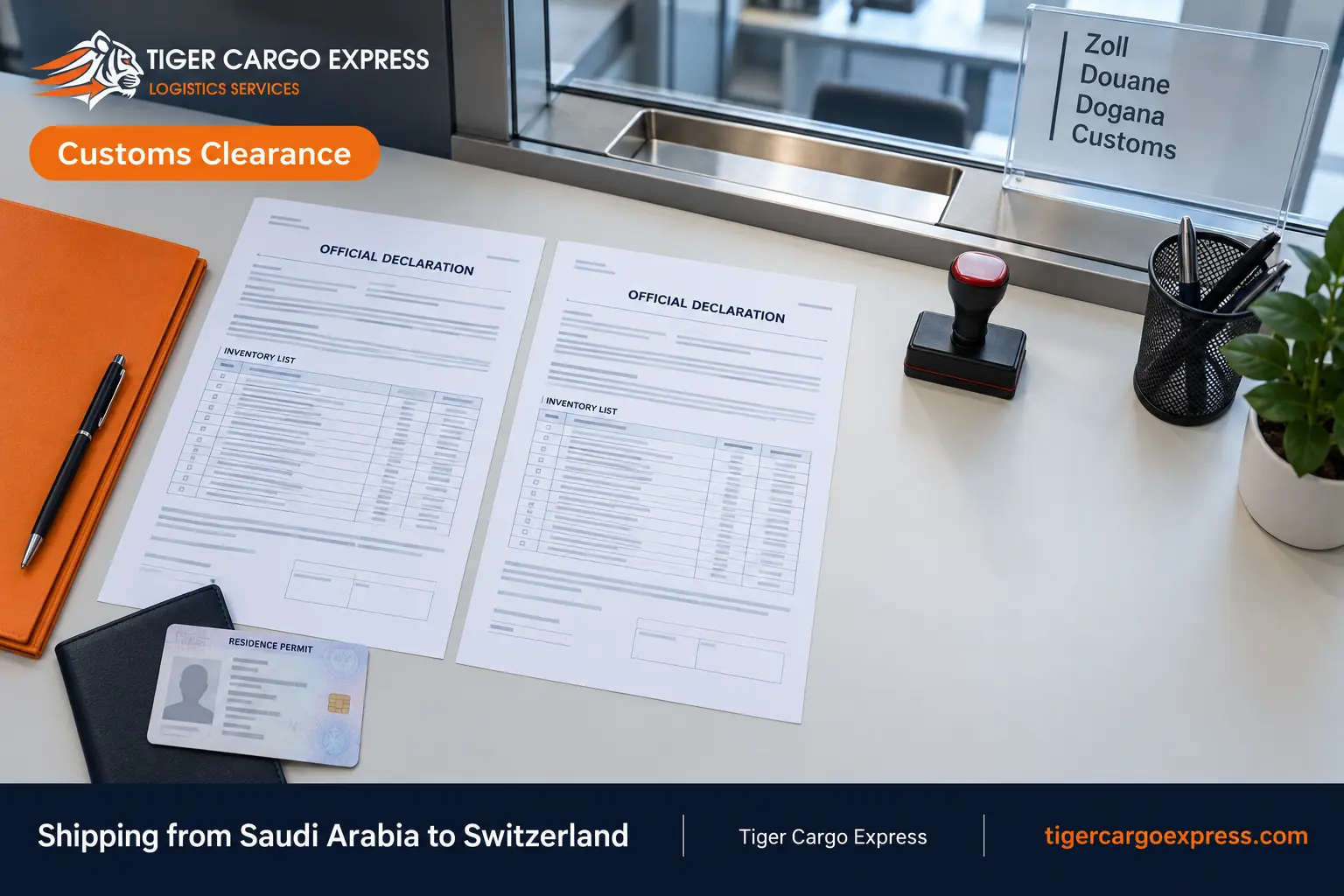
| The clearance form | A declaration specific to removal goods, presented in duplicate | An ordinary customs declaration with the inventory and documents |
| ⭐ Follow-up shipments | Declared on a separate list at the first import, not later | Usually handled within the general deadline |
| Residence registration | With the commune within fourteen days — the authority varies by canton | Varies by state |
This is the most consequential detail in the Swiss file, and it is the direct counterpart to that generous two-year window.
If you intend to bring your goods in in stages — very common with a window that long — the later consignments must be declared on a separate list at the first import, not when they arrive.
Anyone who brings in a first batch and only later decides to send the rest, without having declared it from the outset, has forfeited the single biggest advantage in the Swiss system.
Which is why we ask in the first minute: will you ship everything at once or in stages? — and we write the list with you before the first batch moves.
What we set out is the framework as we work with it in practice; rules and forms are updated from time to time, and some competences differ from canton to canton — and a secondary residence has particular exceptions outside the ordinary route. So we review the current conditions with you before booking. We prepare the file and coordinate the timing — we do not provide legal or tax advice.
Shipping for embassies, consulates and their staff
And Switzerland is the only case in this series with two missions in two cities and two cantons.
Shipments for diplomatic and consular missions and their staff do not go through the removal goods route and are not bound by its conditions — not the six-month rule, not the two-year window, and not the use undertaking. The basis here is the status of the mission or of your accreditation with it.
In Vienna the accreditation categories were multiple inside a single city. In Switzerland they are multiple across two cities and two different cantons:
▸ Bern — seat of the bilateral missions accredited to the Swiss Confederation.
▸ Geneva — seat of the permanent missions to the international organisations, and of those organisations’ staff.
And the difference is not only geographic: the canton differs, and the local procedures tied to it differ with it — from residence registration to vehicle registration.
So the first question on Swiss diplomatic files is: “accredited to whom, and in which city will you live?” — settled before the bill of lading is issued, because the answer sets the city, the canton and the most suitable border office all at once.
- ▸ We settle the accreditation category and the city before issuing the bill of lading — they set the canton and the border office together.
- ▸ We start with the competent department, not the individual — the official correspondence is the foundation of the file.
- ▸ We schedule arrival at the border against the office’s calendar — a mission moves to dates, so this matters to it more than to anyone.
- ▸ We match consignee name and title between the correspondence and the bill of lading word for word before issuing it.
- ▸ We document the inventory to a higher standard and hand it over endorsed by both sides.
- ▸ We handle everything in confidence — information, contents and movement schedules alike.
And we are clear: what the exemption covers and how far it extends is for the competent authorities in the receiving state and the organisation concerned to determine, each through its own official channels. Our role is purely logistical. We work in both directions: foreign missions in the Kingdom, and Saudi missions in Bern and Geneva.
Car shipping from Saudi Arabia to Switzerland
And here we will be candid: this is the most complex vehicle file in the group.

Switzerland drives on the right as Saudi Arabia does, so there is no conversion stage. But the vehicle file here combines two complications: it passes through an independent customs regime outside the Union, and its registration falls within the canton.
Because vehicle rules in Switzerland are complex and vary by the vehicle’s type, age and emissions — and any figure or firm rule we wrote here might not apply to your case.
And a second factor: competences differ across the twenty-six cantons. The authority registering your vehicle in Zurich is not the one in Geneva, and the local procedures may differ.
So instead of guessing: we ask for the chassis number, technical data, emissions data and your canton of residence, then review the position applying to your case specifically and give you a realistic picture — before you book a container. And we may suggest you do not ship it.
A seasonal note too: Switzerland is a mountain country and winter conditions call for appropriate vehicle equipment, which a car arriving from a hot climate will not have. Add it to your arithmetic after registration.
The entry port — and Switzerland has no coast either
Your shipment enters the European Union at a port, then crosses it by road or river to the Swiss border. Four entry points are open to you, on a different logic from the rest of this group.
| Entry point | Sea or river | When it suits you best |
|---|---|---|
| ⭐ Genoa | The Mediterranean — Italy | The shortest from Suez — serving the south and centre over a short Alpine crossing |
| Rotterdam | The North Sea — Netherlands | The widest network — and it opens the Rhine river route |
| ⭐ Basel | The Rhine — inside Switzerland | The closest thing Switzerland has to a port — river barges from Rotterdam and Antwerp |
| Antwerp | The North Sea — Belgium | A strong northern alternative with good river links to Basel |
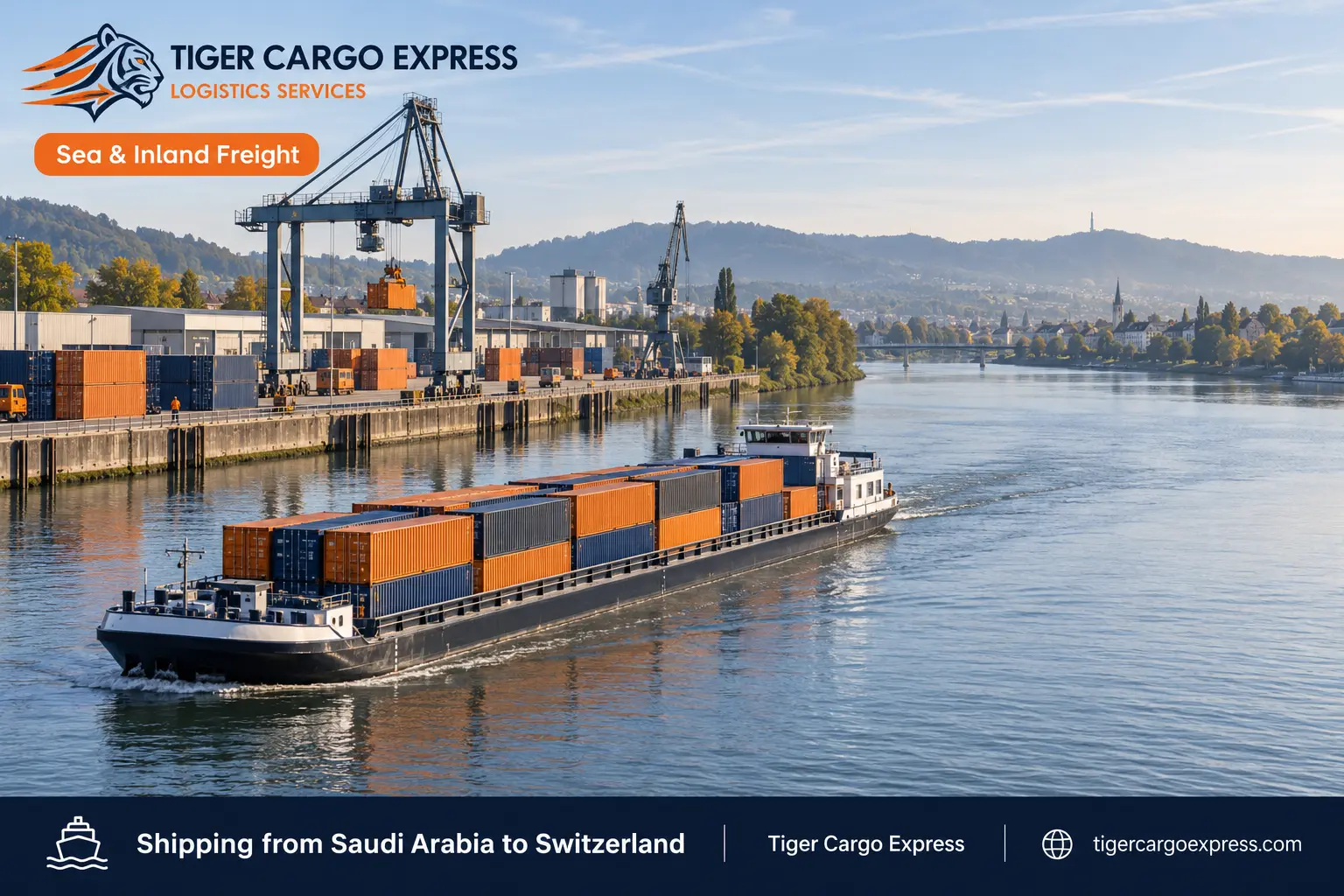
Switzerland has no sea, but it is not without water. The Rhine reaches it at Basel, where river harbours receive barges coming up from Rotterdam and Antwerp.
That gives Switzerland an advantage Czechia, Hungary and Austria do not have: a waterway that reaches inside its own borders. A river barge is slower than a truck but cheaper for large volumes, and it is not subject to road transit restrictions.
We propose it to anyone with a flexible schedule and a large volume, and rule it out for anyone in a hurry. And we always cost both routes for you.
Furniture moving from Saudi Arabia to Switzerland
From dismantling a piece in your home to reassembling it in your new one.
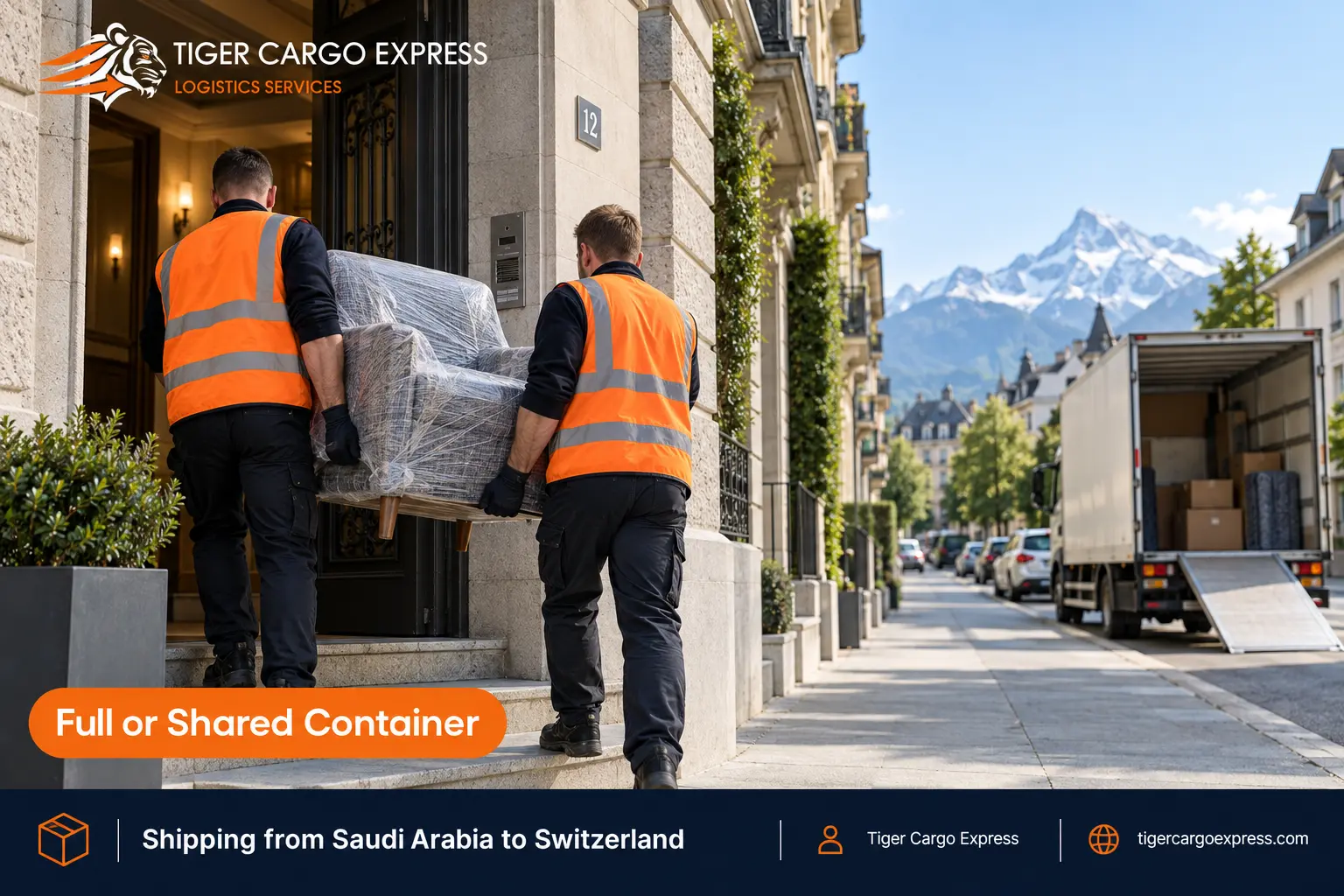
And the inventory matters more here than at any other European destination. Because clearance happens at a border office on a dedicated form, and the inventory is what the declaration is built on. Any vague entry means standing at a barrier, not waiting in a port yard.
- ▸ Survey and assessment: volume in cubic metres, and deciding what is dismantled and what needs a crate.
- ▸ Settling the batches early: a Swiss-specific item — if you ship in stages the list is declared at the first import.
- ▸ Professional dismantling: bedrooms, kitchens and shelving — full dismantling cuts volume, and volume is your invoice.
- ▸ A detailed valued inventory: written during the packing and handed over before sailing — the declaration is built on it.
- ▸ Multi-layer packing: bubble, then blankets, then stretch film, with glass and mirrors in lined crates.
- ▸ Cold and condensation protection: a sharp alpine winter and heated homes — we advise an acclimatisation period before assembly.
- ▸ Unpacking and reassembly: in your new home — not boxes left at the door.
Three ways to ship — sea, river and air
Full container or shared load?
| Aspect | Full container | Shared load |
|---|---|---|
| When it suits you | A whole home, a vehicle, or volume close to container capacity | A small flat, a student’s belongings, or part of a home |
| ⭐ And border clearance | One file in your name at the office — its schedule set against the opening hours | Consolidated and deconsolidated in the Union first — then your goods enter on their own file |
| ⭐ And the two-year window | Lets you ship in batches at a comfortable pace — provided the list is declared early | An excellent option for a small first batch before you settle in |
| Cost | A fixed rate — better value the closer you get to filling it | Per cubic metre — better value for small volumes only |
Note the third row — a Swiss advantage you will not find in the earlier articles: the twenty-four-month window means you can ship a small first batch now and complete it later at your leisure. But — and we repeat — the later consignments must be declared on a list at the first import. The flexibility is there, but its door opens once.
Swiss cities we cover
Door delivery across the German-, French- and Italian-speaking cantons.
Geneva
Basel
Bern
Lausanne
Winterthur
Lucerne
St. Gallen
Lugano
Biel
Thun
Köniz
Schaffhausen
Fribourg
Chur
Neuchâtel
Shipping prices from Saudi Arabia to Switzerland
Indicative figures — the final quote is built on the survey and on your destination canton.
| Shipment type | Price range | Unit and notes |
|---|---|---|
| Shared load (LCL) | Request a quote — set by survey | Per cubic metre with a minimum — well suited to a first batch |
| 20ft container | Request a quote — set by survey | Suits a mid-sized flat, or a vehicle with belongings |
| 40ft container | Request a quote — set by survey | Suits a full house, or two vehicles |
| ⭐ Union transit and haulage to your door | Set in the quote, by your destination | A principal line — and it includes the crossing of Union territory |
| ⭐ Clearance at the border office | Set in the quote, by your destination | An independent procedure outside the Union — a line unique to Switzerland |
| Car shipping | Request a quote — set by survey | Freight only — excluding inspection and cantonal registration |
Note the fifth row — a line that appears in no other European article in this series. Within the European Union clearance is paid once, on entry. Here your shipment crosses the Union and is then cleared at an independent border — a procedure with its own cost. Anyone folding it into “general charges” is giving you an incomplete figure.
What actually sets your price?
Documents required for shipping to Switzerland
First: which canton? It sets the border office and the routing, and the registration authority if a vehicle travels with you.
Second: one consignment or several? If several, the list must be declared at the first import — an opportunity that opens once.
Third: is a vehicle included, and what are its details? Its rules vary by type, age and emissions, and we review them for your case specifically.
All three are asked before booking. Anyone starting with volume and price and reaching them late has built a plan on an incomplete basis.
Clearance and standing charges — a different logic
We handle clearance at both ends. A container has a limited free period at the European entry port, after which a daily charge applies for it remaining and another for late return to the shipping line.
At EU destinations the standing time occurred in one place. Here your shipment may wait at the European port while the transit is arranged, and then wait at the border office if it arrives outside opening hours.
So the most valuable thing we bring to this lane is synchronising the two stages: arranging the transit before berthing rather than after, and timing the truck’s arrival at the border against the office’s calendar rather than the earliest possible slot.
A single day waiting at a closed barrier on a Thursday night can become three — and all three are charged.
Prohibited and restricted items
- ▸ Flammables and pressurised goods: aerosols, paints, solvents, fuel and gas — excluded entirely.
- ▸ Alcohol and tobacco: outside the removal goods relief, with their own duty regime.
- ▸ New items in original packaging: the prior personal use condition is examined and new goods are assessed separately.
- ▸ Liquids liable to freeze: an alpine item — any liquid that may freeze, expand and burst its container on a high pass.
- ▸ Food and animal or plant products: restricted under Swiss sanitary and phytosanitary controls independent of the European ones.
- ▸ Certain animals and breeds: and some restrictions are set at cantonal rather than federal level.
- ▸ Weapons, ammunition and replicas: including souvenirs — with their own permit regime.
- ▸ Untreated timber: every crate and pallet needs approved treatment and marking.
Packing and insurance
The challenge here is threefold: a sea voyage, then a road or river crossing of the Union, then entry across an independent border. And every transition is additional handling.
Inland delivery after the border
- ▸ Narrow streets in the old centres: Zurich, Bern and Lucerne — measured before booking, not on delivery day.
- ▸ Buildings in protected centres: restrictions on large vehicle access — the municipal permit is arranged in advance.
- ▸ Houses on a mountain slope: common in the alpine cantons — and they may impose a smaller vehicle for the final leg.
- ▸ The winter season: restricted passes, and mountain delivery needs a written margin in the schedule.
- ▸ The canton’s language: German, French or Italian — we arrange the local coordination in your region’s language.
The reverse direction — Switzerland to Saudi Arabia
We work both directions on the same routes. The dominant traffic out of Switzerland is precision machinery, medical equipment, pharmaceutical products, watches and engineering equipment, alongside returnees’ effects.
Note that exporting from Switzerland begins with an independent customs procedure before entering the Union — the same logic running in reverse. And we review your list before loading because Saudi import restrictions follow their own logic, particularly for cosmetics and pharmaceutical products.
How to choose a shipping company to Switzerland
Our written guarantees
How to lower the cost of your shipment
- ▸ Use the two-year window. Ship a small first batch now and complete it once you have settled — provided the list is declared from the outset.
- ▸ Ask about the Basel river route. With a large volume and a flexible schedule it may save you a great deal.
- ▸ Avoid reaching the border on a Thursday evening. A simple operational point that saves days of standing charges.
- ▸ Review your vehicle model early. The rules are complex — and the right decision may be not to ship it.
- ▸ Insist on an inventory written during the packing. The declaration is built on it — and any vague entry means standing at a barrier.
- ▸ Sort before you pack. Every cubic metre is paid for here at sea, on land and at the border.
- ▸ Describe the street leading to your home. Swiss old centres are narrow — and discovering that on delivery day costs more.
When do rates rise and transits lengthen?
| Period | What happens |
|---|---|
| Public holidays | The most Swiss-specific factor — border offices close, and some holidays are cantonal rather than federal, so they vary by region. |
| Deep winter | Restricted Alpine passes and slower mountain delivery — we allow a written margin. |
| August and September | Start of the academic year and a wave of work relocations — pressure on containers and packing crews. |
| Rhine water levels | A river factor found nowhere else in this series — low water affects barge scheduling. |
| Disruption on sea lanes | Rerouting lengthens transit and moves rates — we tell you as soon as we know. |
How we work: five steps
Five recurring mistakes — all avoidable
- ▸ Not declaring follow-up shipments at the first import. The mistake most specific to Switzerland — it forfeits the biggest advantage in its system.
- ▸ Scheduling with port logic. The border office works set hours — and a Thursday evening may cost you until Monday.
- ▸ Assuming EU rules apply. Switzerland is entirely outside them — the six-month rule and the two-year window are its own.
- ▸ Insurance that ends at the Union’s border. An EU-wide policy leaves the final stage exposed.
- ▸ Ignoring the canton. Competences differ across twenty-six cantons — vehicle registration above all.
Why Tiger Cargo Express?
Because we ask in the first minute: will you be shipping in stages? — the question that decides whether you benefit from the twenty-four-month window or forfeit it. The list is declared at the first import, and its door opens once.
And we schedule your arrival at the border against the office’s calendar rather than the port’s, and declare border clearance as a separate line because Switzerland is outside the Union and that is a procedure with its own cost. Anyone treating you like an ordinary European destination has missed that your border is a road barrier, not a quay.
Frequently asked questions about shipping from Saudi Arabia to Switzerland
In summary
Switzerland is the only destination in this series that is both landlocked and outside the customs union. Your border is a road barrier working office hours, not a quay working through the night — and that alone changes your schedule. But its rules are more generous than you expect: six months of ownership rather than twelve, and a twenty-four-month window, the longest in the series. Against that stands one decisive item: follow-up shipments are declared at the first import. Three things matter here: a batch list prepared from the outset, scheduling against the border office’s calendar, and insurance that extends beyond the Union. Tiger Cargo Express gives you all three in writing before you ship.
Send your shipment details — approximate volume, origin city and your canton in Switzerland, when you move, whether you will ship in one consignment or several, and if a vehicle is included, its technical data — and we reply with a detailed quote with its stages declared within 60 minutes. 0506688227
Where does Switzerland sit on our map?
Shipping to Switzerland is one lane within a wider region — and the full Europe guide explains the rules governing it and its neighbours together: the route, the customs framework, and the challenge that lane is priced around.
Related Shipping Guides
Continue with practical guidance connected to the same route or shipping decision.
Furniture and Car Shipping Company from Saudi Arabia to the Gulf 0506688227
⚠️ "How much does shipping to Kuwait cost?" is a question missing three things. Shipping from Riyadh is not shipping…
Shipping Company from Saudi Arabia to the Middle East 0506688227 — Overland Guide
The Middle East overturns all of it: it is the only destination whose journey starts at your front door rather…
Shipping Company from Saudi Arabia to Oceania 0506688227 — The Biosecurity Guide
On every preceding continent the question was: what is inside your shipment? Oceania asks an entirely different one: what is…
Send your shipment details and get a written quote
We reply within 60 minutes during working hours — with what the price includes and what it does not, stated before you commit.