
Car and Furniture Shipping Company from Saudi Arabia to Czechia 0506688227 Four Seas to Choose From, and the Nearest Is Not the Best Known
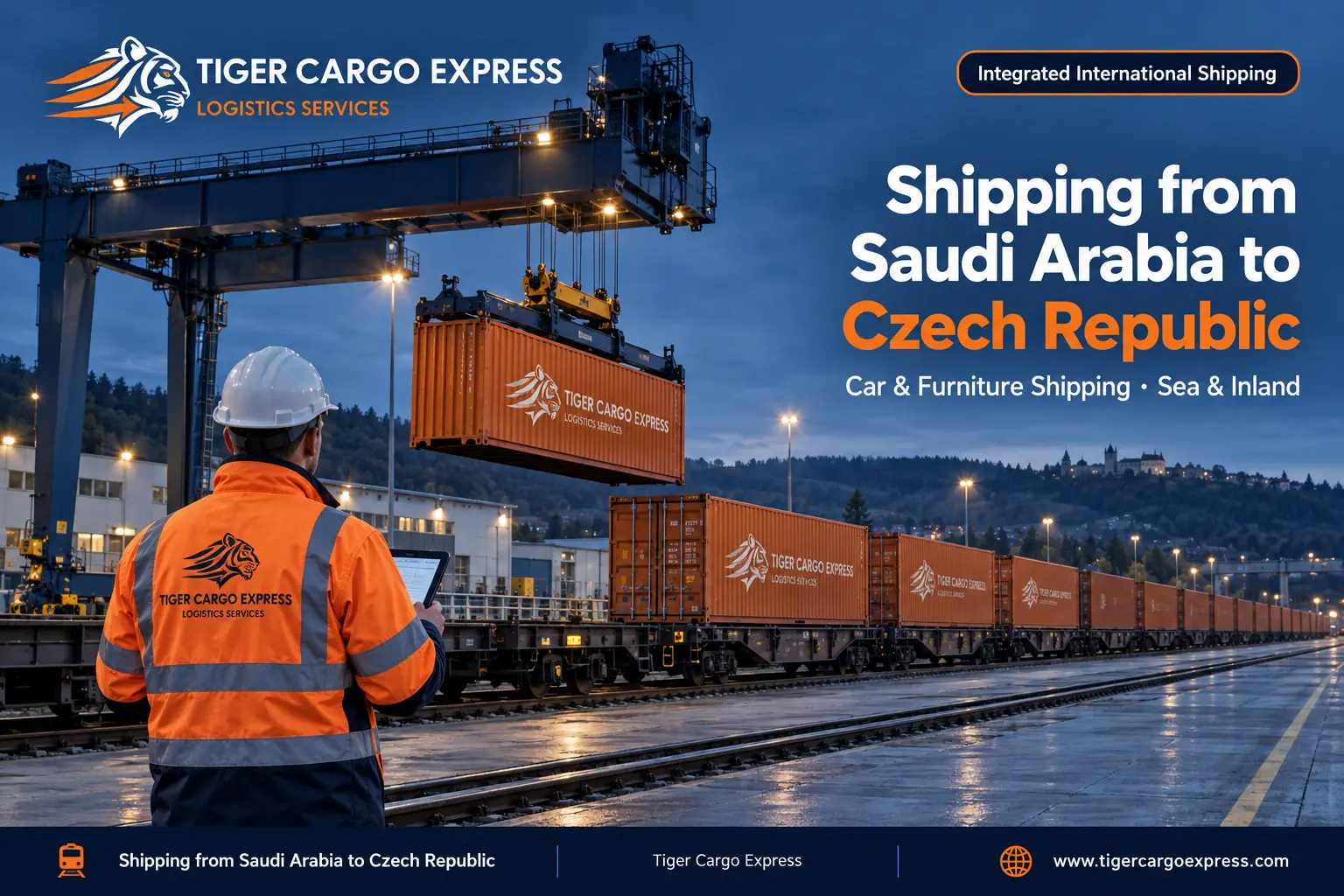
Shipping cars and household goods from Saudi Arabia to the Czech Republic involves a unique logistical consideration: as the Czech Republic is landlocked, the port of entry is not within the country itself but is a choice to be made among four different seas. The crucial factor altering the calculation is the route via the Suez Canal; from Suez, the Adriatic route is approximately 2,000 nautical miles shorter—and five to seven days faster—than the route to the North Sea. While a shipment bound for Hamburg must circumnavigate the entire European continent, one bound for Koper has effectively reached its destination.
Guide contents ShowHide
Looking for a shipping company from Saudi Arabia to Czechia that knows the most important decision about your shipment is taken before a single item is packed? Tiger Cargo Express ships furniture, vehicles and cargo to Prague, Brno, Ostrava, Plzeň and the rest of Czechia — by sea, rail and air, with dismantling, packing and reassembly, customs clearance at both ends, and insurance on the load. To book: 0506688227
At every previous destination in this series the arrival port was a given: a country with a coast, with its own ports, and we chose between them.
Czechia is landlocked. The entry port is not in your country at all — which turns it from an operational detail into a strategic decision between four seas: the Adriatic, the Baltic, the North Sea and the Rhine.
Most people shipping to Czechia pick Hamburg out of habit. That is a reasonable choice for cargo arriving from Asia around the Cape of Good Hope.
But we do not come from there. We come out of the Suez Canal. And from Suez the Adriatic is around two thousand nautical miles shorter than the northern European ports, and five to seven days faster.
Head for Hamburg and you sail around all of Europe. Head for Koper and you have arrived.
What do we ship from Saudi Arabia to Czechia?
Traffic dominated by people relocating for industry and tech roles, students and families.
Why the route differs because we come from Suez
This is the point missed by everyone repeating ready-made advice about shipping to central Europe — because that advice is written for people shipping from China, not from the Gulf.
Look at how the port of Koper’s throughput splits across its markets: Austria alone accounts for around thirty-eight per cent of it, Hungary around twelve, Slovakia around nine.
Czechia does not exceed four per cent.
And not because the Adriatic does not suit it — but because the habit of shipping via the north is older and more entrenched in the Czech market. Which is exactly the gap we use in your favour: a shorter route in a market not yet used to it.
The entry port — and your country has no coast
Four real options, each with its own logic.
| Sea | Port | When it suits you best |
|---|---|---|
| ⭐ The Adriatic | Koper · Trieste | The shortest from Suez — and a strong fit for southern and central Czechia and Brno |
| The Baltic | Gdańsk | A direct ocean connection at an ice-free port — suits northern Czechia and Ostrava |
| The North Sea | Hamburg · Rotterdam · Antwerp | The widest network and most frequent schedules — but the longest from Suez |
| The Rhine | River barges from Rotterdam | For large, unhurried consignments — a limited option for Czechia |
We do not claim the Adriatic is always the answer. Liner schedules change, and in a given month a service to Hamburg may be better timed than one to Koper despite the distance. But we cost all four options for you before booking rather than assuming one.
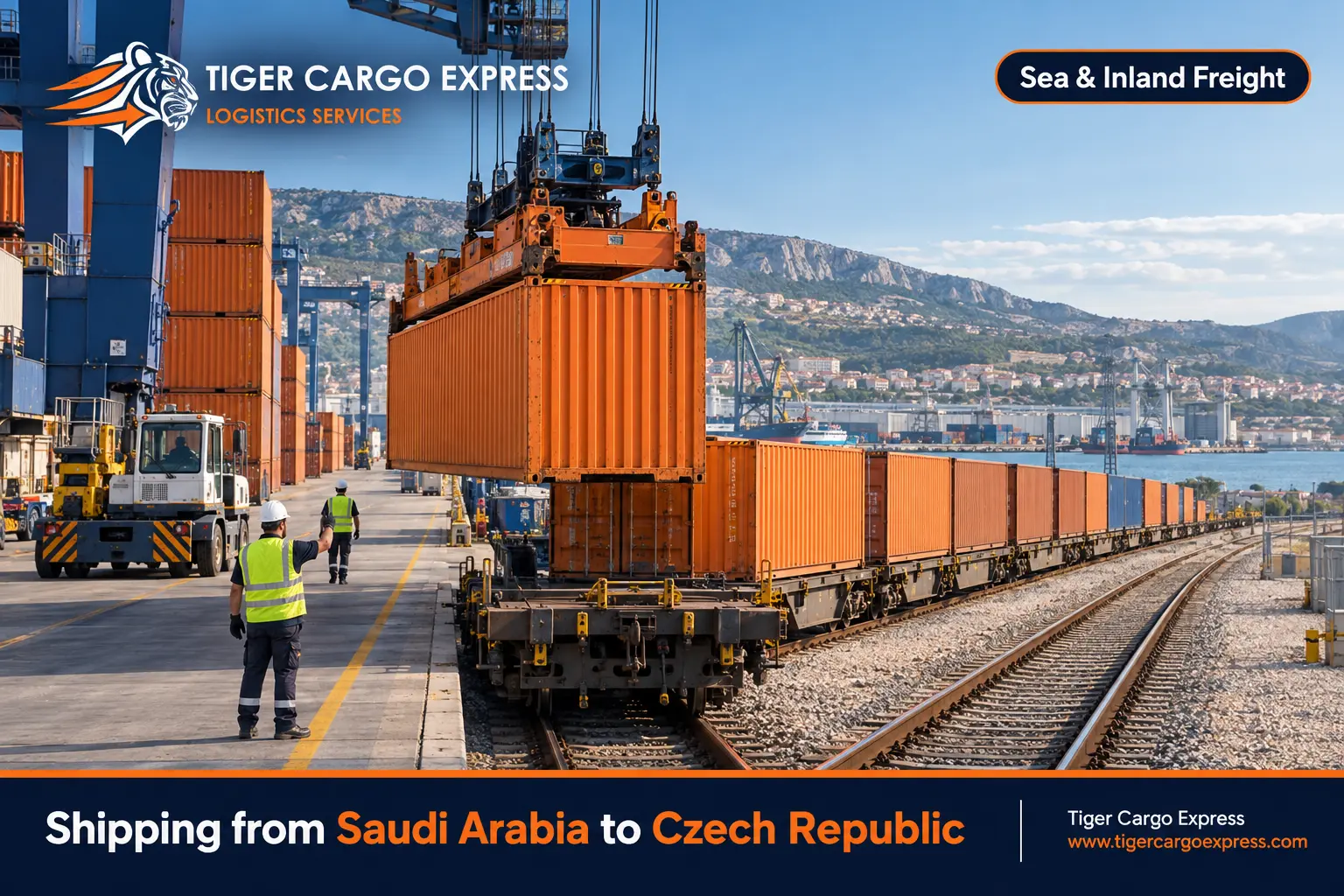
From the port to your address in Czechia is a full journey with its own schedule and cost: either a rail leg to an inland terminal — Prague, Mělník, Ostrava or Brno — then a short truck run, or direct road haulage from the port.
Which is why we make inland haulage a separate declared line in our quote. Anyone quoting you “to the port” in a landlocked country leaves half the journey at your own expense.
Conditions for removal goods relief in Czechia
Czechia is an EU member and applies its framework for removal goods relief: anyone resident outside the Union for twelve continuous months who transfers their normal residence to Czechia brings in used furniture and belongings free of duty and VAT.
| Condition | What it means in practice |
|---|---|
| Residence outside the Union | Twelve continuous months before the move — evidenced by documents. |
| Prior ownership and use | Used goods in reasonable household quantities — new items in original packaging assessed separately. |
| Transfer of normal residence | Czechia is your main home — furniture for an investment property is not relieved. |
| ⭐ Arrival within the deadline | A set period from your move date — and it covers the road leg, not the sea leg alone. |
| Czech proof of residence | The basis of official dealings — obtained early, not when the container lands. |
| Restriction on disposal | Goods admitted under relief cannot be sold or lent for a set period after import without prior notification. |
This point belongs to landlocked countries alone: the relief deadline does not stop when the ship berths, because the shipment has not arrived yet. A road or rail leg still lies ahead of it, on its own schedule.
So anyone planning around “the sea arrival” has already lost days — or a week — of their window to the stage after the port. Which is why our quote gives you two dates, not one: the berthing date, and the delivery date to your door.
What we set out is the framework as we work with it in practice; rules and periods are updated from time to time and each case is assessed individually. So we review the current conditions with you before booking. We prepare the file and coordinate the timing — we do not provide legal or tax advice.
Shipping for embassies, consulates and their staff
The category best placed to choose its own route.
Shipments for diplomatic and consular missions and their staff do not go through the removal goods route and are not bound by its conditions — not the one-year residence condition, not the arrival deadline, and not the restriction on disposal. The basis here is the status of the mission or of your accreditation with it.
And in a landlocked country that produces a practical difference found at no coastal destination: a mission is bound by no arrival deadline, so it alone can choose the entry port on the quality of the routing rather than on speed. Where a private client is sometimes forced to accept a further port because its schedule is sooner, a mission can afford to wait for the better service.
- ▸ We start with the mission’s administrative department, not with the individual — the official correspondence is the foundation of the file.
- ▸ We choose the port on routing rather than urgency — an advantage private clients do not have.
- ▸ We match consignee name and title between the correspondence and the bill of lading word for word before issuing it.
- ▸ We schedule sailing around the accreditation date rather than around when the furniture is ready.
- ▸ We document the inventory to a higher standard and hand it over endorsed by both sides.
- ▸ We handle everything in confidence — information, contents and movement schedules alike.
And we are clear: what the exemption covers and how far it extends is for the competent authorities in the receiving state to determine, and the mission has its own official channels. Our role is purely logistical. We work in both directions: foreign missions in the Kingdom, and Saudi missions in Czechia.
Car shipping from Saudi Arabia to Czechia
And its journey does not end at the quay.
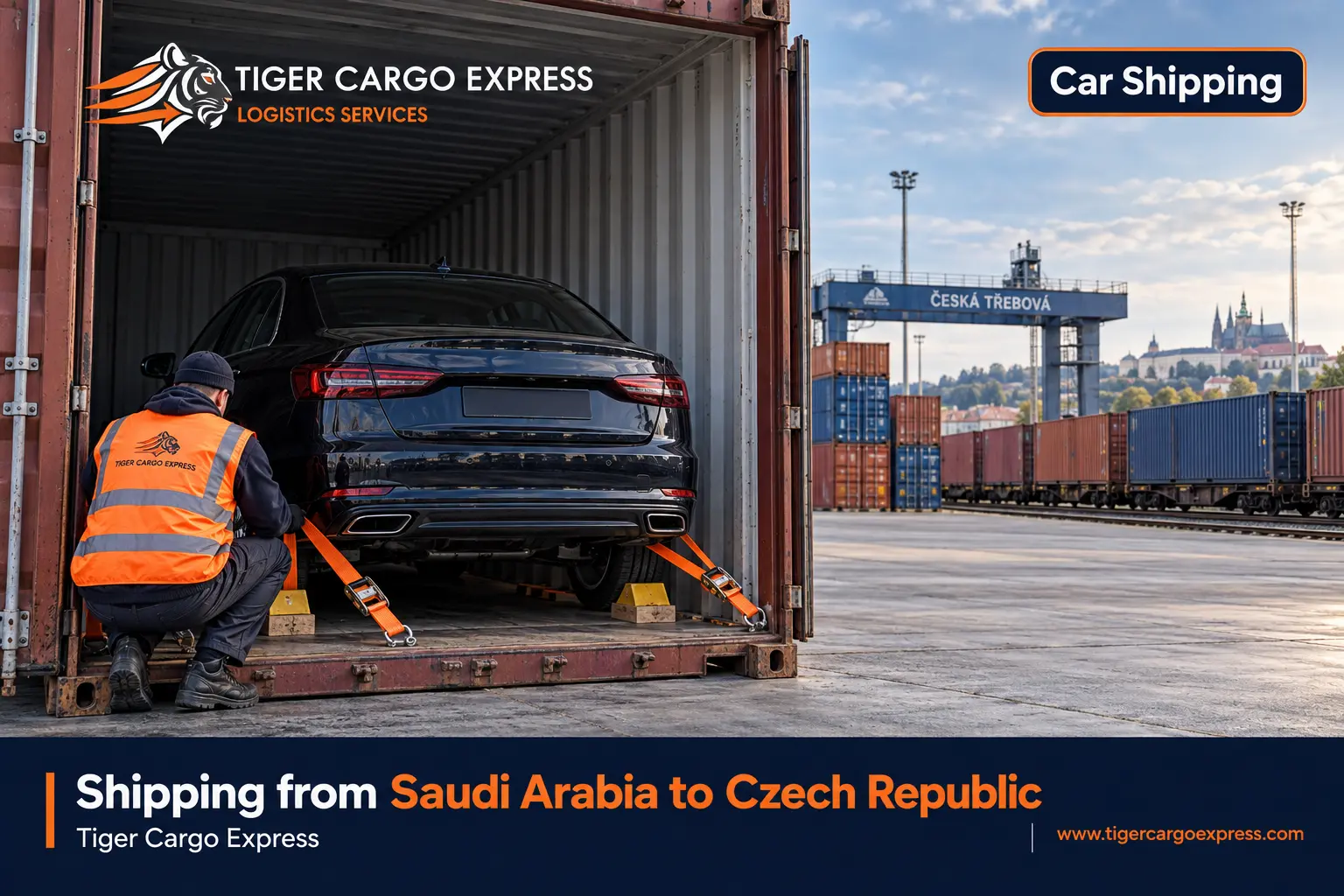
Czechia drives on the right as Saudi Arabia does, so there is no conversion stage. The vehicle follows a registration route familiar across EU states: customs clearance, then a technical inspection, then registration, plates and insurance.
Registering any vehicle in a European state requires evidence that it conforms to the European specification. Vehicles built for a non-EU market do not always carry that evidence, so they need an individual approval route that varies by model and year.
Which is why we ask for your vehicle’s technical data and chassis number before booking, to review its position and put a realistic picture in front of you rather than letting you discover it on arrival. And we may suggest not shipping it if its model faces a long route.
A seasonal note too: Czechia requires tyres suited to winter conditions, and a vehicle arriving from a hot climate will not be equipped for that. Add it to your arithmetic after registration.
Furniture moving from Saudi Arabia to Czechia
From dismantling a piece in your home to reassembling it in your new one.
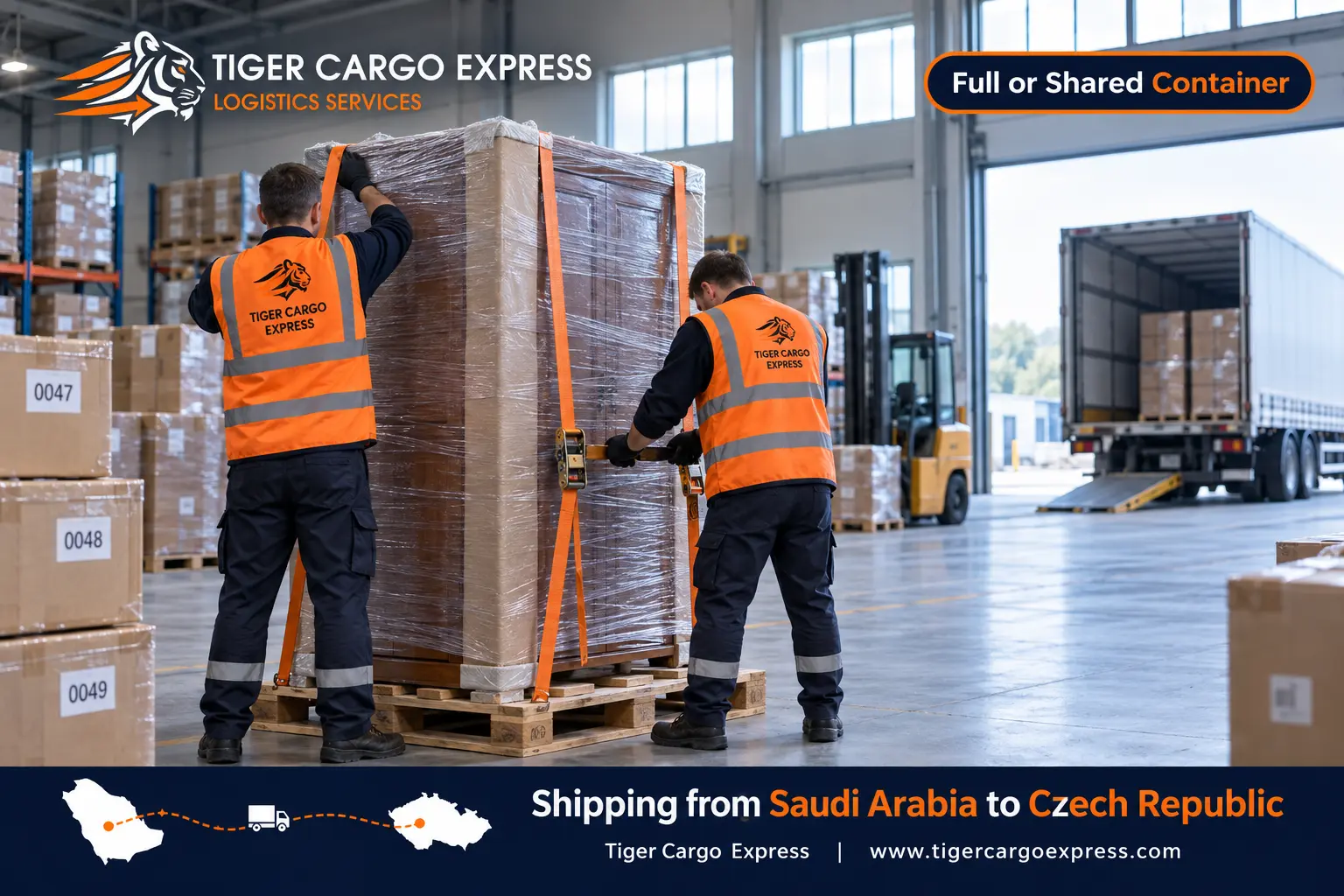
A consideration belonging to this group alone: your shipment will be moved twice — once by sea and once by road or rail. Vibration on the road and the handling involved in transferring from quay to train add a strain that does not exist for a shipment arriving at a port inside its own country. We pack and lash for both journeys.
- ▸ Survey and assessment: volume in cubic metres, and deciding what is dismantled and what needs a crate.
- ▸ Professional dismantling: bedrooms, kitchens and shelving — full dismantling cuts volume, and volume is your invoice.
- ▸ Lashing that allows for the road leg: the load is secured for road and rail, not for sea alone — a real difference here.
- ▸ Multi-layer packing: bubble, then blankets, then stretch film, with glass and mirrors in lined crates.
- ▸ Cold and condensation protection: a cold continental winter and heated homes — the gap with Saudi Arabia’s climate is large.
- ▸ Treated and stamped timber crates: a European condition of entry — applied to every crate we build.
- ▸ Unpacking and reassembly: in your new home — not boxes left at the door.
Three ways to ship — sea, rail and air
And here rail enters this series for the first time as a genuine option.
We say plainly: air freight has stronger logic in landlocked countries than in coastal ones. Because its advantage here is not skipping the sea alone but skipping two stages. So someone moving on a tight deadline into an empty home may need a larger air batch than they would at a coastal destination.
Full container or shared load?
| Aspect | Full container | Shared load |
|---|---|---|
| When it suits you | A whole home, a vehicle, or volume close to container capacity | A small flat, a student’s belongings, or part of a home |
| ⭐ In a landlocked country | Moves inland as it is, with no stripping at the port — less handling | Is stripped at the foreign port and your goods reloaded — extra handling and a stage added |
| Transit | Shorter — no waiting for a load to fill and no deconsolidation | Longer — consolidation, then deconsolidation, then inland transport |
| Cost | A fixed rate — better value the closer you get to filling it | Per cubic metre — better value for small volumes only |
Note the second row — it belongs to landlocked countries: a full container can be moved inland as it is, opening for the first time near your home. A shared load is necessarily stripped at the foreign port. That is not a difference in price but in how many times your furniture is handled.
Czech cities we cover
Door delivery across Bohemia, Moravia and Silesia.
Brno
Ostrava
Plzeň
Liberec
Olomouc
České Budějovice
Hradec Králové
Ústí nad Labem
Pardubice
Zlín
Havířov
Kladno
Most
Opava
Frýdek-Místek
Shipping prices from Saudi Arabia to Czechia
Indicative figures — the final quote is built on the survey and on the entry port chosen.
| Shipment type | Price range | Unit and notes |
|---|---|---|
| Shared load (LCL) | Request a quote — set by survey | Per cubic metre with a minimum — with inland transport added |
| 20ft container | Request a quote — set by survey | Suits a mid-sized flat, or a vehicle with belongings |
| 40ft container | Request a quote — set by survey | Suits a full house, or two vehicles |
| ⭐ Port to your door | Set in the quote, by your destination | A principal line, not a minor one — and it changes with the port chosen |
| Car shipping | Request a quote — set by survey | Freight only — excluding inspection, approval, registration and tyres |
| Air freight | Request a quote — set by survey | By volumetric weight — and it bypasses both the sea and road stages |
Note the fourth row. This is the line that separates our quote from others in this group. Transport from the port to your door in a landlocked country is not a “last mile” but a full stage whose cost changes with the port. And anyone hiding it inside “general charges” prevents you from comparing the four ports at all.
What actually sets your price?
Documents required for shipping to Czechia
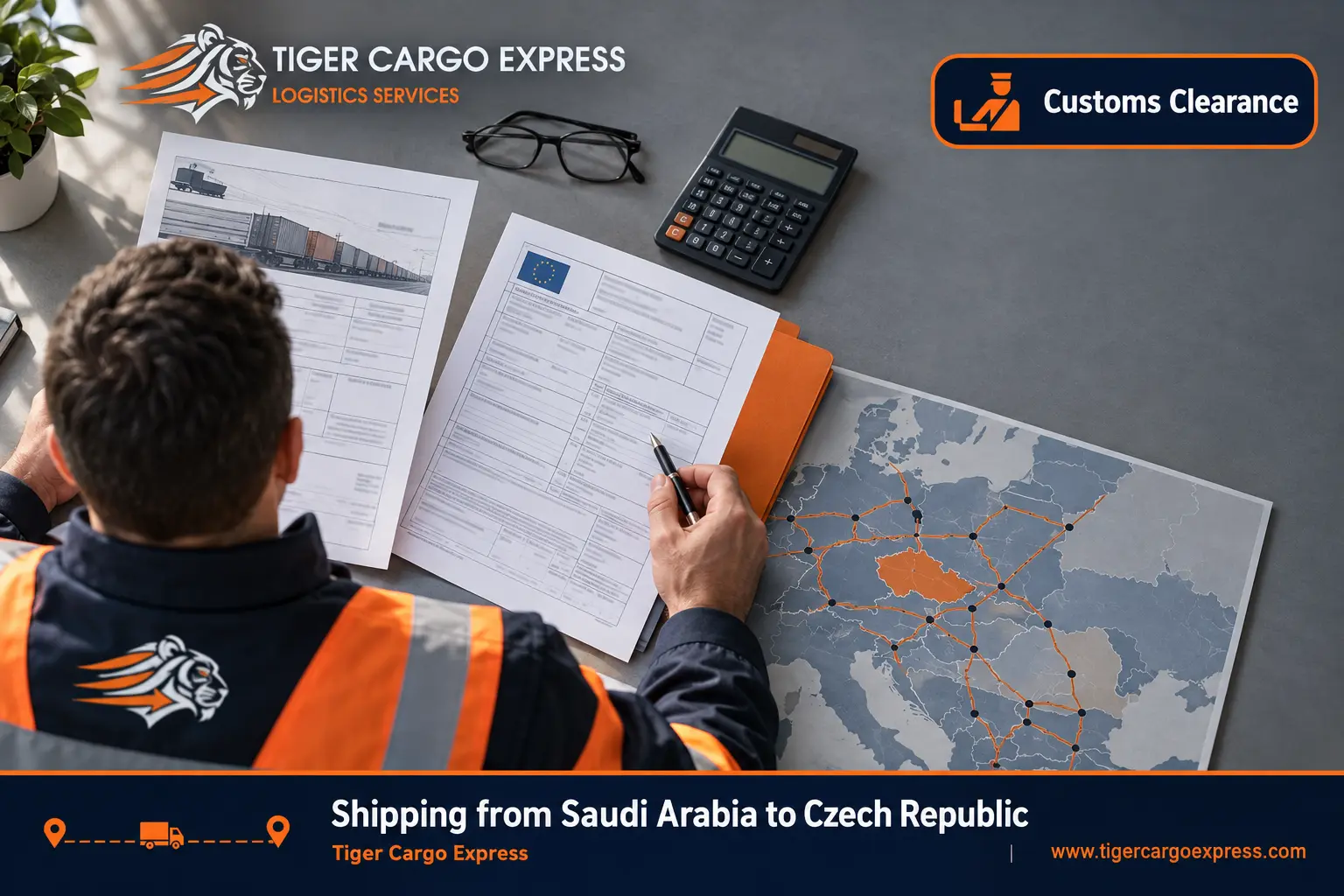
In a landlocked country your shipment passes through a port in one state, perhaps across the territory of a second, before reaching the third. So the documents must be prepared on the basis of “Czechia” rather than the entry port, from the moment the bill of lading is issued.
The error we see: a bill issued to the port alone, so the shipment is treated as having arrived — and standing charges begin in a country you never intended to stay in. We fix the final destination on the first document.
Customs clearance — and where exactly does it happen?
We handle clearance at both ends. A container has a limited free period starting from discharge rather than from your notification, after which a daily charge applies for it remaining and another for late return to the shipping line.
But the more important question in a landlocked country is not when clearance happens but where. There are two routes: clearing at the foreign entry port, or moving the shipment under customs transit to an office inside Czechia and clearing it there.
There is no single right answer — it is a decision we take with you based on the port, the schedule and the nature of your shipment. Anyone deciding it for you without explaining it is choosing what suits them, not you.
Prohibited and restricted items
- ▸ Flammables and pressurised goods: aerosols, paints, solvents, fuel and gas — excluded entirely.
- ▸ Alcohol and tobacco: outside the removal goods relief, with their own excise regime.
- ▸ New items in original packaging: the prior-use condition is examined and new goods are assessed separately.
- ▸ Liquids liable to freeze: a continental item — any liquid that may freeze, expand and burst its container during the road leg.
- ▸ Food and animal or plant products: tightly restricted under European sanitary and phytosanitary controls.
- ▸ Plants, seeds and soil: effectively prohibited, and soil residue on garden tools triggers inspection.
- ▸ Weapons, ammunition and replicas: including souvenirs — with their own permit regime.
- ▸ Untreated timber: every crate and pallet needs approved treatment and marking.
Packing and insurance
The challenge here is twofold: a sea voyage, then a road or rail journey across borders. Add to both a cold continental climate and homes heated through winter.
Inland delivery after the port
- ▸ The distance from the port is a full journey: scheduled to a fixed day and costed as a separate line rather than assumed.
- ▸ Old buildings in city centres: narrow stairs and no lift — an item costed in advance in Prague and Brno.
- ▸ Restricted historic centres: limits on large vehicle access — the permit is arranged in advance.
- ▸ Continental winters: may slow the mountain roads on the borders — we allow a margin in the schedule.
- ▸ Local working hours: the delivery window is built on the actual hours in your area rather than a general assumption.
The reverse direction — Czechia to Saudi Arabia
We work both directions on the same ports and routes. Czechia is a long-established industrial base, so outbound traffic is wide: industrial equipment, automotive parts, glass and crystal, and machinery, alongside returnees’ effects.
Czech glass and crystal need particular care: fragile, high-value pieces requiring a different packing standard and a carefully valued policy. Note too that Saudi import restrictions follow their own logic, particularly for cosmetics and foodstuffs — we review your list before loading.
How to choose a shipping company to Czechia
Our written guarantees
How to lower the cost of your shipment
- ▸ Ask for the four-port comparison. The biggest saving on this lane comes from the port decision, not from haggling over a rate.
- ▸ Ask about the Adriatic specifically. We come from Suez, and few companies will cost it for you unprompted.
- ▸ Compare only door-to-door prices. Comparing a “to the port” rate with a “to the door” rate compares two different things.
- ▸ Allow rail if your schedule can take it. It is cheaper than long road haulage over central European distances.
- ▸ Sort before you pack. Every cubic metre is paid for twice here: at sea and on land.
- ▸ Allow full dismantling. It cuts volume appreciably, and volume is the invoice.
- ▸ Describe your home precisely. An old building with no lift? A restricted historic centre? Discovering it on delivery day costs far more.
When do rates rise and transits lengthen?
| Period | What happens |
|---|---|
| August and September | Start of the academic year and a wave of work relocations — pressure on containers and packing crews. |
| Peak import season | Pressure on port berths and on inland train capacity at the same time — a double squeeze here. |
| Year-end holidays | An extended administrative pause — and we avoid letting a vehicle arrive in that window specifically. |
| Deep winter | Mountain roads on the Czech borders run slower — the road leg needs a wider margin. |
| Disruption on sea lanes | Rerouting lengthens transit and moves rates — and may reverse which port is best. |
How we work: five steps
Five recurring mistakes — all avoidable
- ▸ Assuming Hamburg is the answer. The mistake most specific to this lane — a market habit built on cargo that does not come from Suez.
- ▸ Accepting a price that ends at the port. In a landlocked country that leaves half the journey unpriced.
- ▸ Counting the customs window from the berthing date. The shipment has not arrived — a full road leg still lies ahead.
- ▸ A bill of lading made out to the port rather than to Czechia. The shipment is treated as arrived, and charges begin in a transit country.
- ▸ Insurance that ends at the quay. Your shipment crosses countries after it — and the most handling-intensive stage is there.
Why Tiger Cargo Express?
Because we ask about your city before we ask about your volume. In a landlocked country your address is what determines your entry port — and the port is what determines your transit, your price and your whole routing.
And we give you a written four-port comparison by transit and cost to your door, and remind you that we come from Suez rather than around the Cape — a single sentence that changes the arithmetic. Anyone quoting you “a price to Hamburg” has chosen one route out of four on your behalf without telling you the other three exist.
Frequently asked questions about shipping from Saudi Arabia to Czechia
In summary
Shipping to Czechia differs from everything before it in one line: your country has no coast, so the entry port is a decision rather than a given. Four seas lie in front of you, and a full week and a different cost separate them. And the fact that settles the choice: we come from Suez, and from Suez the Adriatic is two thousand miles shorter and five to seven days faster. Three things matter here: a four-port comparison, a price that runs to your door rather than to the quay, and two dates in the quote, because your window runs to the second. Tiger Cargo Express gives you all three in writing before you ship.
Send your shipment details — approximate volume, origin city and your city in Czechia, when you move, and if a vehicle is included, its chassis number and technical data — and we reply with the port comparison and a detailed quote within 60 minutes. 0506688227
Where does the Czech Republic sit on our map?
Shipping to the Czech Republic is one lane within a wider region — and the full Europe guide explains the rules governing it and its neighbours together: the route, the customs framework, and the challenge that lane is priced around.
Related Shipping Guides
Continue with practical guidance connected to the same route or shipping decision.
Furniture and Car Shipping Company from Saudi Arabia to the Gulf 0506688227
⚠️ "How much does shipping to Kuwait cost?" is a question missing three things. Shipping from Riyadh is not shipping…
Shipping Company from Saudi Arabia to the Middle East 0506688227 — Overland Guide
The Middle East overturns all of it: it is the only destination whose journey starts at your front door rather…
Shipping Company from Saudi Arabia to Oceania 0506688227 — The Biosecurity Guide
On every preceding continent the question was: what is inside your shipment? Oceania asks an entirely different one: what is…
Send your shipment details and get a written quote
We reply within 60 minutes during working hours — with what the price includes and what it does not, stated before you commit.