
Furniture Shipping Company from Saudi Arabia to Japan 0506688227 Your Paper Is in Your Pocket, Not in Our File
Furniture shipping from Saudi Arabia to Japan — the destination whose decisive paper stays in your own pocket. The declaration is submitted in two copies on entry, both sealed, one returned to you — and it becomes your responsibility for six months. One declaration covers the whole family. And the quantity standard here is a judgement, not a figure.
Guide contents ShowHide
Looking for a shipping company from Saudi Arabia to Japan that knows the most important paper in your file will not be in our file at all? Tiger Cargo Express ships furniture, cargo and boxes to Tokyo, Osaka, Nagoya and the rest of Japan — by sea and air, with dismantling, packing and reassembly, customs clearance at both ends, and insurance on the load. To book: 0506688227
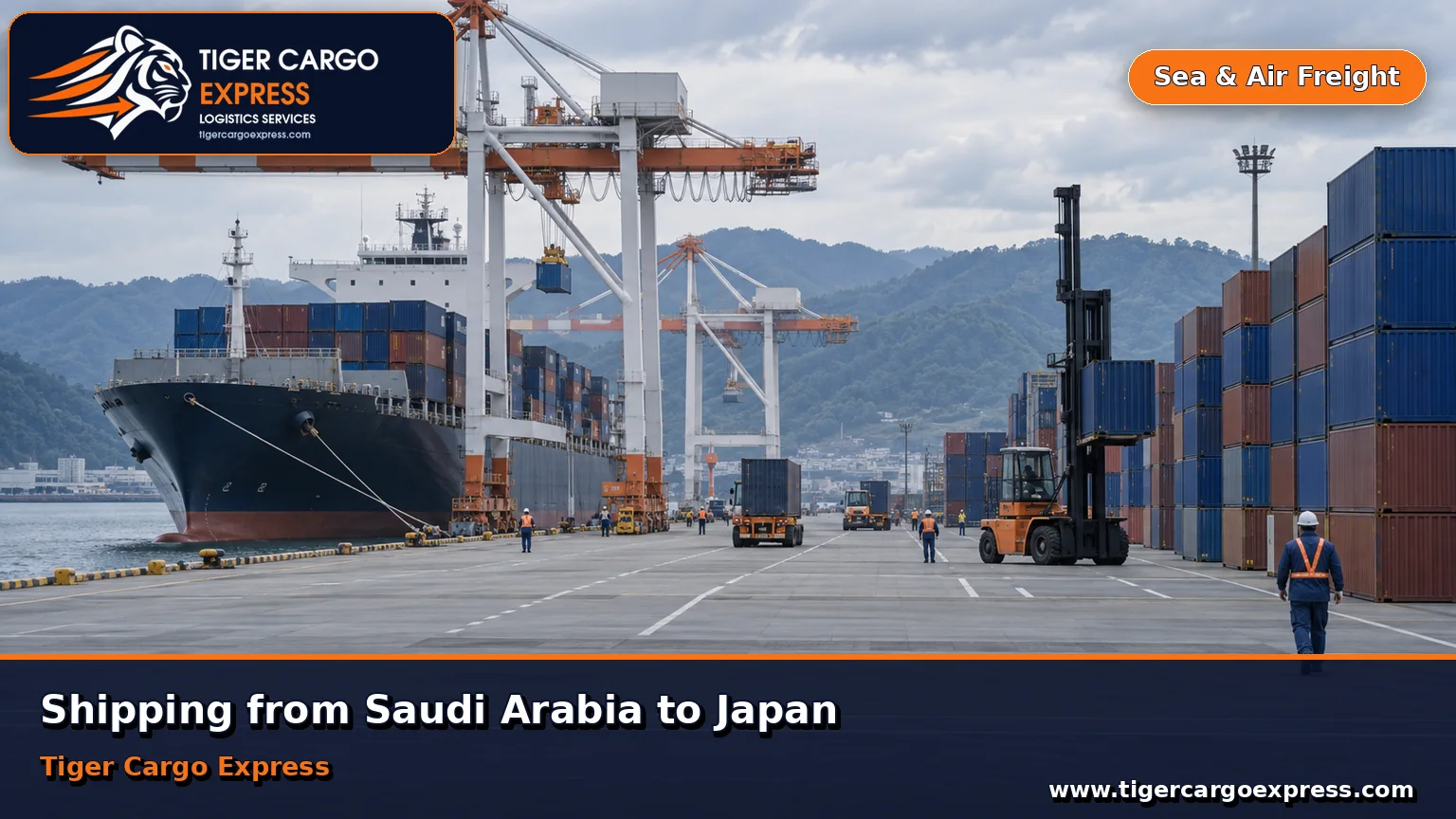
The route heads east through the Strait of Malacca then north into the East China Sea — ending at ports among the most disciplined in the world.
What sets Japan apart from every destination before it in our series is this:
The paper that relieves your shipment stays in your own pocket — and nobody can carry it for you.
At every previous destination we gathered your papers and kept them in your file with us: Malaysia’s receipts, China’s permit, Indonesia’s inventory. Here we cannot.
Because the customs declaration is submitted in two copies on your entry, the officer seals both, keeps one and returns the other to you. And that copy stays with you — possibly for six months — until your shipment arrives and it is presented for clearance.
What do we ship from Saudi Arabia to Japan?
The traffic on this lane is largely professional and academic: people relocating on work contracts, researchers and students, and returning Japanese nationals.
The customs declaration — two copies, one comes back to you
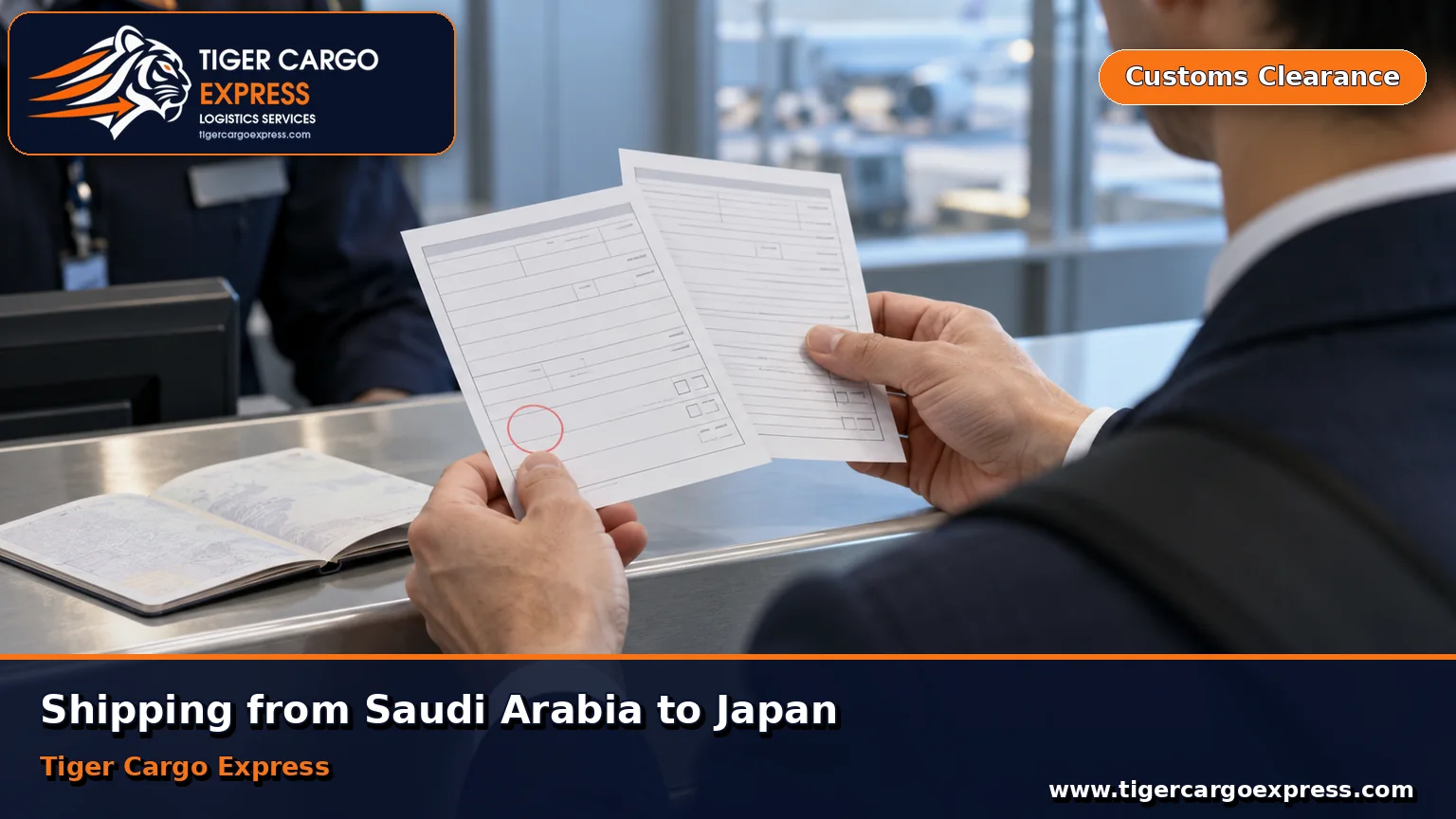
The document is called the Declaration of Accompanied Articles and Unaccompanied Articles. It comes in two versions by status: the Japanese form for Japanese nationals and the English form for non-Japanese — with other languages available too.
You obtain it on the aircraft or at the customs counter in the airport, or pre-submit it electronically through the digital entry platform — and the paper form always remains available.
① You submit two copies of the declaration on entry — not one.
② The officer seals both and keeps one as the customs record.
③ And returns the other to you sealed — and it becomes your responsibility.
④ That copy is presented when your shipment arrives so it clears relieved.
And here is the fundamental difference from all our destinations: this is a paper we cannot obtain for you nor carry in your place. Our agent cannot stand in the arrivals hall for you, nor receive a seal in your name.
⚠️ And if the declaration is not completed and sealed on entry, the shipment may become liable to duty and tax — not because you do not qualify, but because the proof was not sealed at the time.
⭐ And one declaration covers the whole family
Only one written declaration per family is required. That is a real convenience: no form per person.
But turn it over and read it from the other side: the entire family’s entitlement rests on one paper, in one person’s pocket, for six months.
Compare that with Korea, where each family member must be registered separately. There it is distributed; here it is concentrated.
So we advise two simple practical steps:
▸ Photograph the sealed copy the moment you receive it and send it to us straight away.
▸ Keep the original somewhere that is not opened daily — not in your travel wallet.
The photograph reassures us; the original is what is presented.
What we set out is the framework as we work with it in practice, and some details are decided case by case by the competent authority. Requirements are subject to updating. So we review the position in force with you before booking. We prepare the file and coordinate the timing — we do not provide legal, tax or immigration advice.
Three conditions that work with the declaration
The paper alone is not enough — it works alongside three further conditions:
This unsettles anyone used to figures. The system gives you no ceiling in cubic metres or in value for household effects; it says instead: “within the limit deemed reasonable” and “quantitatively appropriate” and not for sale.
Compare that with what came before:
▸ 🇵🇭 The Philippines: three tiers, each with a figure
▸ 🇲🇾 Malaysia: six months per item — a measurable criterion
▸ 🇯🇵 Japan: “reasonable” — and no number
A judgement-based standard is not a flaw but a mercy for anyone whose inventory is clean: an ordinary family home is not much questioned. But it is hard on anyone shipping ten refrigerators or fifty identical items — that reads as trade, not effects.
So we review your list with one question: “does this look like a family’s home?” — if it does, it moves; if it looks like a warehouse, we revisit it with you.
Alongside used effects, there is an allowance for newly purchased articles of up to two hundred thousand yen per person.
Which means new items are not penalised as they are in Malaysia — they have a window of their own.
⚠️ But on one condition: keep the receipts for new items translated into English — an untranslated receipt may not serve you when it matters.
And we separate the new into its own line within the inventory before packing, rather than mixing it with the used.
Shipping for embassies, consulates and their staff
The one category here that does not carry its paper in its pocket.
Shipments for diplomatic and consular missions and their staff do not pass through the personal-effects route and are not bound by its conditions — not the unaccompanied baggage declaration, not the more-than-a-year residence requirement, not the custody window. The basis here is the status of the mission or of your accreditation with it, and the reference framework is the Vienna Convention on Diplomatic Relations of 1961.
We explained above that our ordinary client carries a personal burden nobody can carry for them: a sealed paper in their pocket for six months.
An accredited officer does not carry that burden. The official correspondence precedes their arrival and stands in place of the individual step, and status is evidenced through the channel rather than through a seal.
The “reasonable quantity” standard is likewise not read against mission cargo on personal-effects logic — a full office fit-out is not “a family’s home”.
And the first question here is: “what is the consignee’s status, and who corresponds with us officially?” — not “was your declaration sealed?”
- ▸ We settle the status first and build the file on it — not the other way round.
- ▸ We do not put mission cargo through the individual declaration route nor seek a seal that does not concern it.
- ▸ We start with the competent department, not the individual — the official correspondence is the foundation of the file.
- ▸ We match consignee name and title between the correspondence and the bill of lading word for word before issuing it.
- ▸ We document the inventory to a higher standard and hand it over endorsed by both sides.
- ▸ We handle everything in confidence — information, contents and movement schedules alike.
And we are clear: what the exemption covers and how far it extends is for the competent authorities in the receiving state to determine, and the mission has its own official channels. Our role is purely logistical. We work in both directions: foreign missions in the Kingdom, and Saudi missions in Tokyo.
Car shipping from Saudi Arabia to Japan
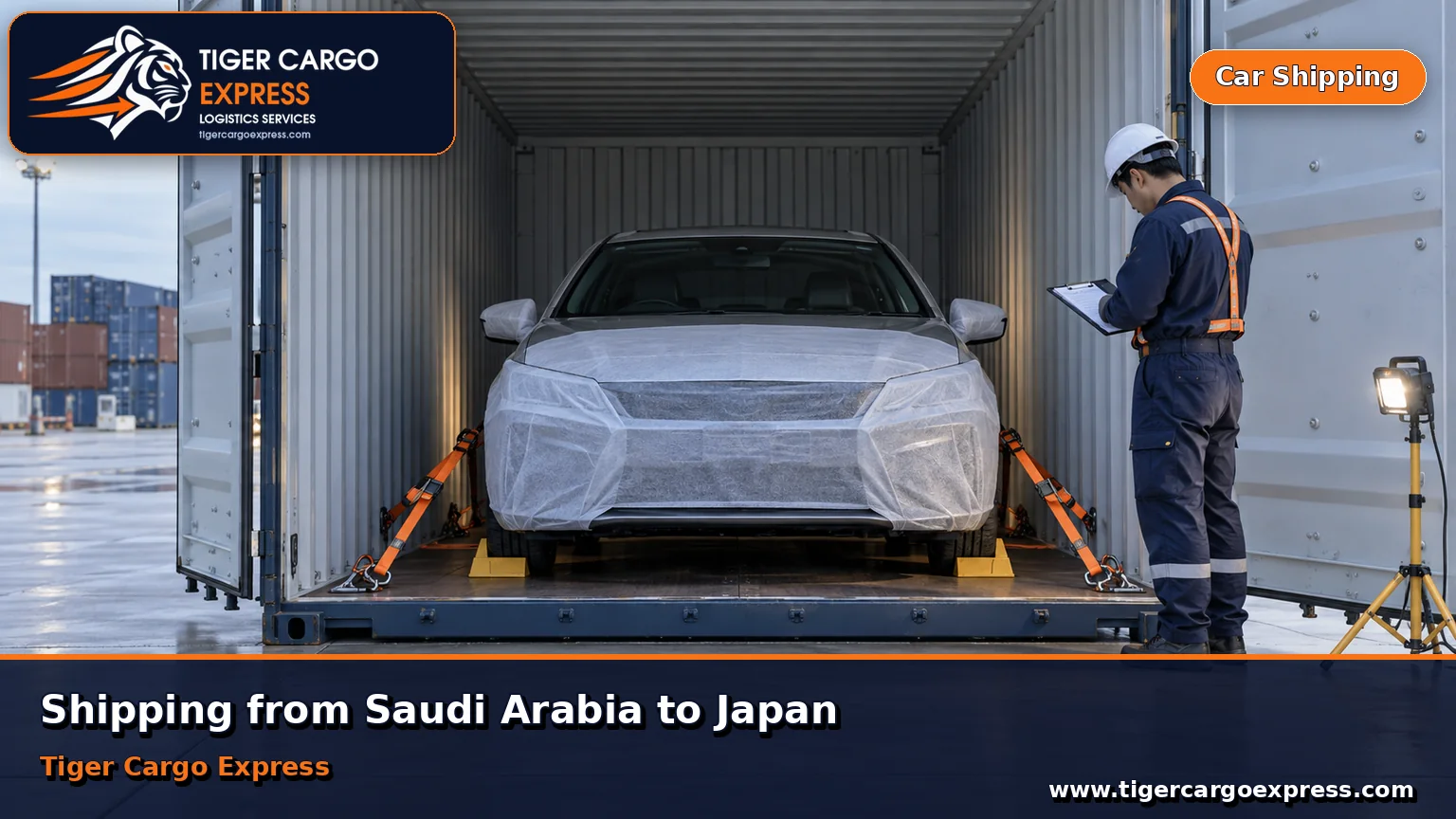
We start with the fact before any figure: a vehicle sits outside the personal-effects relief, on an independent route with its own requirements.
For reasons that combine at this destination in particular:
▸ Outside the relief — no status protects it.
▸ Specification and technical inspection requirements before registration.
▸ ⭐ Japan drives on the left — left-hand-drive vehicles are indeed used there but are not the norm, which may affect daily driving and resale value.
▸ ⭐ Proof of a parking space — registering a vehicle in most Japanese cities requires evidence that you have somewhere to park it. This is a constraint with no parallel in the whole series, and it takes by surprise anyone who has not heard of it.
The result is that the freight may be the smallest line on the bill.
And Japan has a long-established, well-regulated used-car market with excellent prices and condition. So in most cases selling here and buying there works out cheaper, and we say so even when it costs us the whole line.
If your case genuinely justifies it, we review the model, year of manufacture and specification with you before booking, and prepare its file separately from the household file — because mixing them stalls both.
Furniture moving from Saudi Arabia to Japan
And the question we open with here is not about your furniture but about your new home.
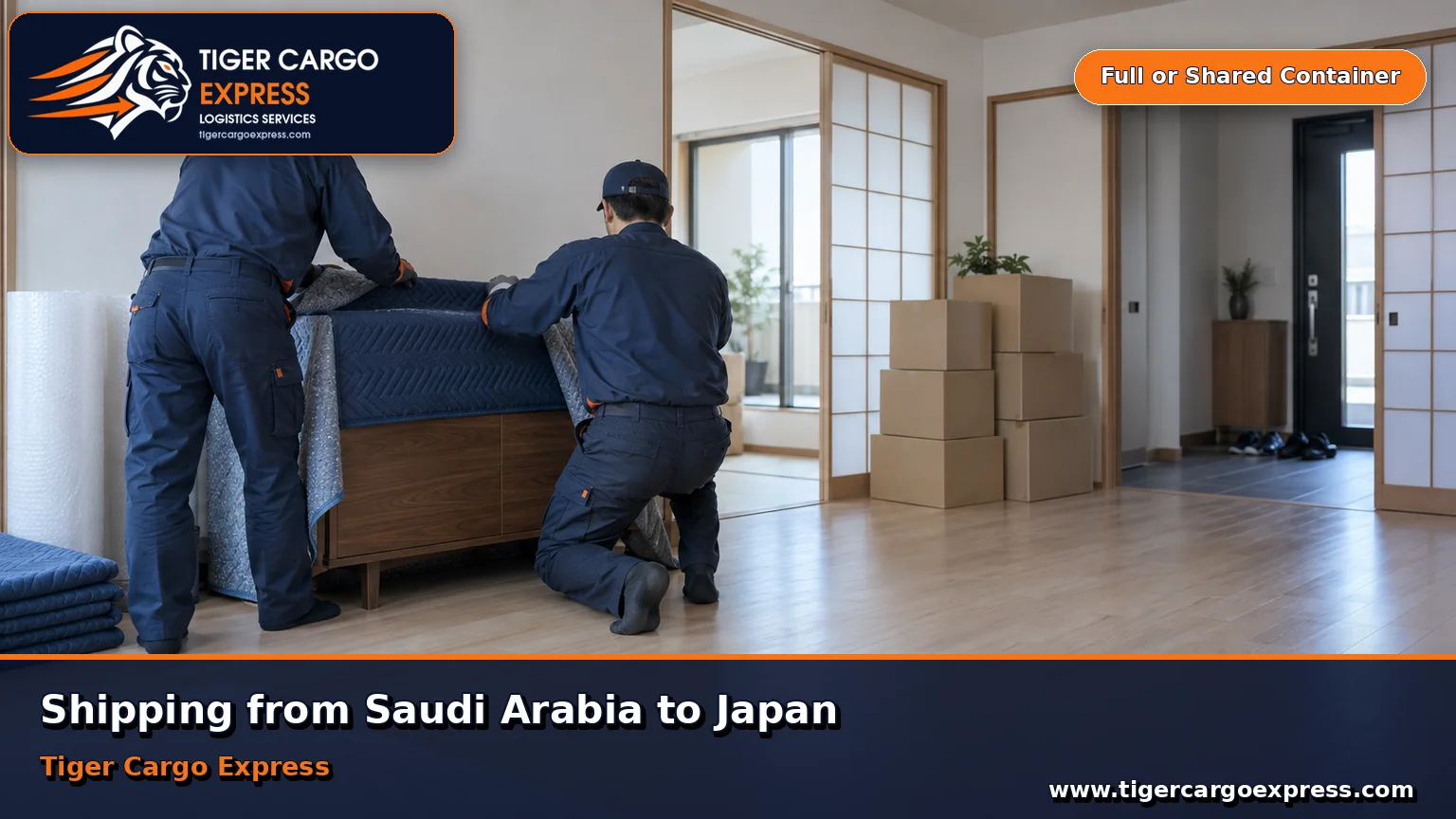
Japanese homes are compact and precisely calculated, and corridors, staircases and lifts are narrower than anyone arriving from a spacious house expects.
A three-seat sofa or a large wardrobe may fit the container easily and not fit the door.
So we ask before pricing: “do you know your new home’s dimensions and the width of its entrance?” — and we ask for photographs or measurements where possible.
An item that arrives and cannot get in is the worst possible outcome: you paid to ship it, then you pay to dispose of it.
- ▸ ⭐ Matching dimensions first: the measurements of large items against the entrance, stairs and lift — before we price.
- ▸ ⭐ The declaration reminder before you travel: sent in writing — “submit two copies and keep the sealed one” — and we ask for a photograph of it the moment you receive it.
- ▸ Survey and assessment: volume in cubic metres — even for a few boxes, because we serve small shipments, not containers only.
- ▸ Separating the new into its own line: with receipts translated into English — because it has an allowance of its own.
- ▸ A detailed inventory in English or Japanese: with precise descriptions, stating the number of packages or containers because it feeds into the declaration.
- ▸ ⭐ Keys for anything locked: locked cases and boxes — their keys or combinations are handed over with the file, because the examination may need them.
- ▸ Professional dismantling and clean packing: with approved treatment for every crate or pallet — and the standard is enforced strictly here.
Ports of entry
| Port | Location | Best for |
|---|---|---|
| ⭐ Yokohama · Tokyo | Tokyo Bay | The most frequent — serving the capital and its wide region |
| ⭐ Kobe · Osaka | The Kansai region | The natural choice for Osaka and Kyoto — saving a long overland leg |
| Nagoya | Central Japan | For the central industrial region — and among the busiest ports |
| Hakata | Kyushu — the south-west | For Fukuoka and the south-west — removing a long transit |
| Air — Tokyo and Osaka | The international airports | Urgent and small — and usually where your declaration is sealed |
Japan is a long archipelago stretching from the north to the south-west. Anyone living in Fukuoka whose shipment routes through Tokyo pays for a long overland journey that could have been avoided. We weigh the port by your city, not by what is convenient for us.
Ways to ship — sea and air
The client completes the declaration thinking only of their sea container — forgetting they will post two boxes later, or send a small air shipment.
And when the postal parcel arrives, it is not named on the declaration.
So we sit with you before you travel and list everything you will send by any means, so all of it is written onto the declaration at once.
The declaration is completed once — the shipments may be three.
Full container, shared load or boxes?
| Aspect | Full container | Shared load | Boxes or air |
|---|---|---|---|
| When it suits you | A whole home | A room or two plus appliances | Curated essentials — the most common for Japan |
| ⭐ Against your new home’s size | Needs careful verification — homes are compact | A balanced option for most cases | The best fit — leaving you to buy the right sizes there |
| The declaration | One sealed copy suffices | The same copy | Do not forget to name them on it and mark “unaccompanied baggage” |
| Pricing | A fixed container rate | Per cubic metre with a minimum | Per box or by volumetric weight |
Note the second row — and we favour the smaller shipment here more than at any other destination. Homes are compact and local furniture is designed for their dimensions. It may well be cheaper and smarter to ship what cannot be replaced and buy what can be replaced there.
Japanese cities we cover
Door delivery from Hokkaido to Kyushu.
Yokohama
Osaka
Nagoya
Sapporo
Fukuoka
Kobe
Kyoto
Kawasaki
Saitama
Hiroshima
Sendai
Chiba
Kitakyushu
Niigata
Shizuoka
Shipping prices from Saudi Arabia to Japan
The final quote is built on the survey and your delivery city — and on your new home’s dimensions.
| Shipment type or line | Price | Unit and notes |
|---|---|---|
| ⭐ Boxes and small shipments | Request a quote — set by survey | Per box or by weight — the most common for this destination |
| Shared load (LCL) | Request a quote — set by survey | Per cubic metre with a minimum |
| 20ft / 40ft container | Request a quote — set by survey | After verifying the entrance dimensions |
| Air freight | Request a quote — set by survey | By volumetric weight — and listed on the same declaration |
| ⭐ Declaration follow-up and clearance | Set in the quote, by your destination | A line with no parallel — reminding you before departure and tracking the sealed copy |
| Approved timber treatment | Set in the quote, by your destination | For every crate or pallet — and the standard is enforced strictly |
| ⚠️ The vehicle file | Set after your file is reviewed | Entirely separate — preceded by specification checks and proof of parking |
Note the first row — placed at the top deliberately. Japan is one of the few destinations where we openly favour the smaller shipment, because the home is compact and local furniture is designed for it.
What actually sets your price?
Documents required
First: when do you arrive, and through which airport? — so we can send you the declaration reminder well before you travel, and because your arrival precedes your shipment.
Second — and most particular to Japan: what are your new home’s dimensions and the width of its entrance? — because the answer may change what you ship at all, not merely its price.
And the second question is one nobody else generally asks — so a client ships a large wardrobe and then discovers it will not go up the stairs, paying disposal costs on top of freight.
We would rather you knew that before packing than at the door of your new home.
Clearance and standing charges
We handle clearance at both ends. A container has a limited free period at the arrival port starting from discharge rather than from your notification, after which a daily charge applies for it remaining and another for late return to the shipping line.
Japanese ports are among the most disciplined in the world, and procedures there are organised and predictable. Delay here is rarely the port’s doing.
The sealed copy of the declaration: either it was not completed on entry, or it was lost, or its holder could not produce it in time.
And this is a kind of delay our agent cannot fix on your behalf — unlike every other destination, where we can refile a paper or correct a statement.
So we act preventively three times:
▸ Before you travel: a written message setting out exactly what to do in the arrivals hall.
▸ On your arrival: we ask for a photograph of the sealed copy and store it in your file.
▸ Before berthing: we remind you to bring the original to the clearance appointment.
The photograph proves the seal was obtained — the original is what is presented.
Prohibited and restricted items
- ▸ Flammables and pressurised goods: aerosols, paints, solvents, fuel and gas — excluded entirely.
- ▸ Weapons, ammunition and replicas: including souvenirs — under a strict permit regime.
- ▸ ⭐ Plants, fruit and vegetables: with or without roots — they need a plant quarantine certificate before the customs examination.
- ▸ ⭐ Meat and meat products: fresh and processed — they need an animal health certificate from the exporting country’s authority, and enforcement is very precise.
- ▸ Rice: a curious but real line — with an annual limit of one hundred kilograms.
- ▸ Counterfeit goods: seizure and penalties — and enforcement is active.
- ▸ New goods in quantity: treated commercially — and the first thing to take you outside the “reasonable” standard.
- ▸ ⭐ Untreated timber: every crate, pallet and wooden brace needs approved treatment and marking — and the standard is enforced here more strictly than you may be used to.
Japan takes particular care over its cultural properties, and antiques and older artworks may need an export permit when taken out of the country.
This does not concern you on entry — but it will concern you the day you leave. Anyone who acquires an antique piece during their stay may be surprised by it on the way out.
We mention it now for a simple reason: so you know before you buy, not after you pack.
Packing and insurance
The challenge on this lane is a standard of cleanliness and precision higher than you may be used to, compact homes that demand smaller pieces, and a climate ranging from bitter northern winters to humid summers.
Inland delivery after clearance
- ▸ ⭐ Narrow residential streets: many addresses a large truck cannot reach — so we plan the final leg with a smaller vehicle.
- ▸ ⭐ Strict parking rules: parking is not improvised here — the time and place are arranged in advance.
- ▸ Compact entrances and staircases: measured before delivery day rather than on it — and they may require further dismantling.
- ▸ Building schedules: many buildings set moving hours — we book them with management in advance.
- ▸ Distances across the archipelago: the network is excellent — but the right port removes an entire journey.
The reverse direction — Japan to Saudi Arabia
We work both directions on the same ports and routes. The dominant traffic out of Japan is cars and vehicles, spare parts, precision machinery and equipment, electronics and specialised industrial products, alongside the effects of those returning or finishing a posting.
And note two lines here: export permits for cultural properties and antiques as explained above, and tax-free purchases bought during your stay, which are exported with you on departure. We review your list before loading, as we review Saudi import restrictions.
How to choose a shipping company to Japan
Our written guarantees
How to lower the cost of your shipment
- ▸ ⭐ Ship less than you think. The most honest advice on this lane — homes are compact and local furniture is designed for their dimensions.
- ▸ Measure your entrance before you decide. An item that will not fit is a double loss — shipping it, then disposing of it.
- ▸ Request the declaration on arrival and keep the sealed copy. The cheapest action with the largest consequence on this lane.
- ▸ List all your shipments on one declaration. It is completed once — and an unlisted postal parcel is a problem.
- ▸ Keep receipts for new items translated. They have their own allowance — but an untranslated receipt may not serve you.
- ▸ Choose the port by your city. Kobe and Hakata remove long overland journeys.
- ▸ Allow full dismantling. It cuts volume and makes the climb possible in a narrow corridor — two benefits, not one.
When do rates rise and transits lengthen?
| Period or situation | What happens |
|---|---|
| ⭐ The moving season — March and April | The peak of domestic moving in Japan as the fiscal and academic year begins — local movers are booked out and dearer. We book delivery very early. |
| The New Year holiday | A broad administrative and operational pause in early January — we schedule around it, not into it. |
| The Golden Week holidays — late April into May | A run of consecutive holidays affecting clearance and delivery alike. |
| Typhoon season — late summer and autumn | It can halt handling for days — and we allow a written margin. |
| Disruption on sea lanes | Moves rates generally — though its effect is smaller here because we do not pass through the Suez Canal. |
How we work: five steps
Five recurring mistakes — all avoidable
- ▸ Not completing the declaration on entry. The mistake most specific to Japan — and the shipment may become liable to duty despite your entitlement.
- ▸ Losing the sealed copy. It is your responsibility alone for six months — photograph it immediately and keep the original out of your travel wallet.
- ▸ Forgetting to list postal parcels or the air shipment. The declaration is completed once and the shipments may be three.
- ▸ Shipping large pieces without measuring the entrance. A double loss — shipping them, then disposing of them.
- ▸ Being casual about timber treatment. The standard here is enforced more strictly than you may be used to.
Why Tiger Cargo Express?
Because we state our limits plainly: there is a paper in this file that we cannot carry for you. And anyone who does not tell you that leaves your family’s entire entitlement resting on a step you may not know to take.
So we send you a written reminder before you travel, ask for a photograph of the sealed copy on receipt, and list every one of your shipments on a single declaration before you go. And we ask a question nobody else asks: “what are your new home’s dimensions?” — then tell you plainly what will not fit through its door, even when that shrinks your shipment and our invoice with it.
Frequently asked questions about shipping from Saudi Arabia to Japan
In summary
Japan is the destination whose decisive paper stays in your own pocket: a declaration submitted in two copies on entry, both sealed, one returned to you — and it becomes your responsibility for six months. One declaration covers the whole family, which is a convenience and a responsibility at once. The quantity standard here is a judgement rather than a figure: “within the limit deemed reasonable”. And the home is compact — so your piece may fit the container and not the door. Three things matter here: the declaration reminder before you travel, listing every shipment on it at once, and matching dimensions before pricing. Tiger Cargo Express gives you all three before you ship.
Send your shipment details — approximate volume, origin city and your city in Japan, your travel date and arrival airport, and your new home’s dimensions and entrance width where possible — and we reply with a detailed quote within 60 minutes. 0506688227
Where does Japan sit on our map?
Shipping to Japan is one lane within a wider region — and the full Asia guide explains the rules governing it and its neighbours together: the route, the customs framework, and the challenge that lane is priced around.
Related Shipping Guides
Continue with practical guidance connected to the same route or shipping decision.
Furniture and Car Shipping Company from Saudi Arabia to the Gulf 0506688227
⚠️ "How much does shipping to Kuwait cost?" is a question missing three things. Shipping from Riyadh is not shipping…
Shipping Company from Saudi Arabia to the Middle East 0506688227 — Overland Guide
The Middle East overturns all of it: it is the only destination whose journey starts at your front door rather…
Shipping Company from Saudi Arabia to Oceania 0506688227 — The Biosecurity Guide
On every preceding continent the question was: what is inside your shipment? Oceania asks an entirely different one: what is…
Send your shipment details and get a written quote
We reply within 60 minutes during working hours — with what the price includes and what it does not, stated before you commit.