
Car and Furniture Shipping Company from Saudi Arabia to Finland 0506688227 Ice Class Is a Condition of Arrival, Not a Weather Forecast

Car and furniture shipping from Saudi Arabia to Finland by sea to Helsinki or Kotka. Every Finnish port freezes in a normal winter — so assistance restrictions are imposed setting a minimum ice class a vessel must meet before it is given icebreaker escort. A non-compliant ship may wait at anchor for days. So the winter question is not "will the weather delay my shipment?" but "is the ship I booked even allowed to arrive?"
Guide contents ShowHide
Looking for a shipping company from Saudi Arabia to Finland that knows winter there is a booking decision rather than a weather risk? Tiger Cargo Express ships furniture, vehicles and cargo to Helsinki, Tampere, Turku, Oulu and the rest of Finland — by sea and air, with dismantling, packing and reassembly, customs clearance at both ends, and insurance on the load. To book: 0506688227
At every previous destination in this series, weather was a risk: it might delay you, it might not.
Here it is a condition of entry.
Because every Finnish port freezes in a normal winter. As the ice hardens, “assistance restrictions” are imposed setting a minimum ice class a vessel must hold to be given icebreaker escort into port. A ship that does not meet that threshold may wait at anchor for days.
So the winter question is not “will the weather delay my shipment?” but “is the ship I booked even allowed to arrive?” — and that is settled when the service is chosen, not on arrival.
What do we ship from Saudi Arabia to Finland?
Traffic dominated by people relocating for tech and engineering roles, researchers and families.
Ice class — what it is and why it concerns you
When the northern Baltic freezes, not every vessel can force a path through it. Ice demands a strengthened hull and powerful propulsion — and not every container ship has either.
So a classification exists known as ice class: grades describing how far a vessel’s hull is strengthened and how well it can operate in ice. And a ship’s grade is not a technical detail for mariners — it is what decides whether it reaches your port at all.
Finland operates an icebreaker fleet that cuts channels through the sea and escorts vessels. But the service is not open to everyone: as conditions harden, the competent authority issues assistance restrictions setting, for each port, a minimum ice class and deadweight. A vessel below the threshold is not given icebreaker escort.
The consequence is not a minor delay: a non-compliant ship may be held at anchor for days until conditions ease or spare icebreaker capacity appears. Even compliant ships may queue — and waiting times can exceed twenty-four hours during cold snaps.
Three features that make this unlike any other delay
The season map — when to ship and when not to
| Period | Port conditions | What it means for you |
|---|---|---|
| May — October | Open, unrestricted | The best shipping window — a wide schedule, calmer prices and smooth delivery |
| November | Restrictions begin in the north | Northern Bothnian Bay ports first — the south is still open |
| December — March | Restrictions widen and tighten | Ice class becomes a condition — booking needs scrutiny of the vessel, not the price |
| From mid-March | Restrictions progressively lifted | The south first, then the north — and a relaxation applies the moment it is issued |
The rule we give every Finland-bound client: if your schedule is flexible, ship between May and October. And if it is not, there is no problem shipping in winter at all — but on a service whose vessel’s class we have verified against the current restrictions at your arrival port, rather than on the cheapest quote available.
Assistance restrictions and their thresholds are updated weekly and vary by port and by the severity of the season, and we give no categorical promise of a winter arrival date. What we give is verification of the vessel’s class before booking, a schedule with a written margin, and immediate notice of any change. Customs and relief matters we review with you before booking — and we do not provide legal or tax advice.
Conditions for removal goods relief in Finland
Finland is a member of the European Union and applies the European framework for removal goods relief: anyone resident outside the Union for twelve continuous months who transfers their normal residence to Finland brings in used furniture and belongings free of duty and VAT.
| Condition | What it means in practice |
|---|---|
| Residence outside the Union | Twelve continuous months before the move — evidenced by documents. |
| Prior ownership and use | Used goods in reasonable household quantities — new items in original packaging assessed separately. |
| Transfer of normal residence | Finland is your main home — a summer house by a lake is not relieved. |
| ⭐ Arrival within the deadline | A set period from your move date — and the ice season must be counted into it, not ignored. |
| The Finnish personal identity code | The basis of official dealings — obtained early, not when the container lands. |
| Restriction on disposal | Goods admitted under relief cannot be sold or lent for a set period after import without prior notification. |
This is the most important point in the whole guide after ice class itself: the relief deadline does not pause because the sea froze. Someone who moves in November and leaves the shipping until January has put their consignment into the hardest navigational month and into the middle of their customs deadline at the same time.
So our quote includes a timeline joining the two: your customs deadline on one hand, the restriction season on the other — letting you see where they cross before you book. And we may advise bringing the shipping forward by weeks to avoid the crossing entirely.
Shipping for embassies, consulates and their staff
And scheduling booked before the ice season rather than through it.
Shipments for diplomatic and consular missions and their staff do not go through the removal goods route and are not bound by its conditions — not the one-year residence condition, not the arrival deadline, and not the restriction on disposal. The basis here is the status of the mission or of your accreditation with it.
But one item no status exempts you from: the ice. Ice class is a navigational condition rather than a customs one, and it draws no distinction between a diplomatic shipment and a private one. So we handle mission files here on a single principle: ice class is stipulated in the shipping contract itself and never left to the carrier’s choice.
- ▸ We start with the mission’s administrative department, not with the individual — the official correspondence is the foundation of the file.
- ▸ We stipulate ice class in the shipping contract — we neither leave it to the carrier nor discover it at booking.
- ▸ We schedule the mission’s move ahead of the restriction season where possible — the calendar is a protective tool here.
- ▸ We match consignee name and title between the correspondence and the bill of lading word for word before issuing it.
- ▸ We document the inventory to a higher standard and hand it over endorsed by both sides.
- ▸ We handle everything in confidence — information, contents and movement schedules alike.
And we are clear: what the exemption covers and how far it extends is for the competent authorities in the receiving state to determine, and the mission has its own official channels. Our role is purely logistical. We work in both directions: foreign missions in the Kingdom, and Saudi missions in Finland.
Car shipping from Saudi Arabia to Finland
Finnish car tax — and a route we review before booking rather than after.
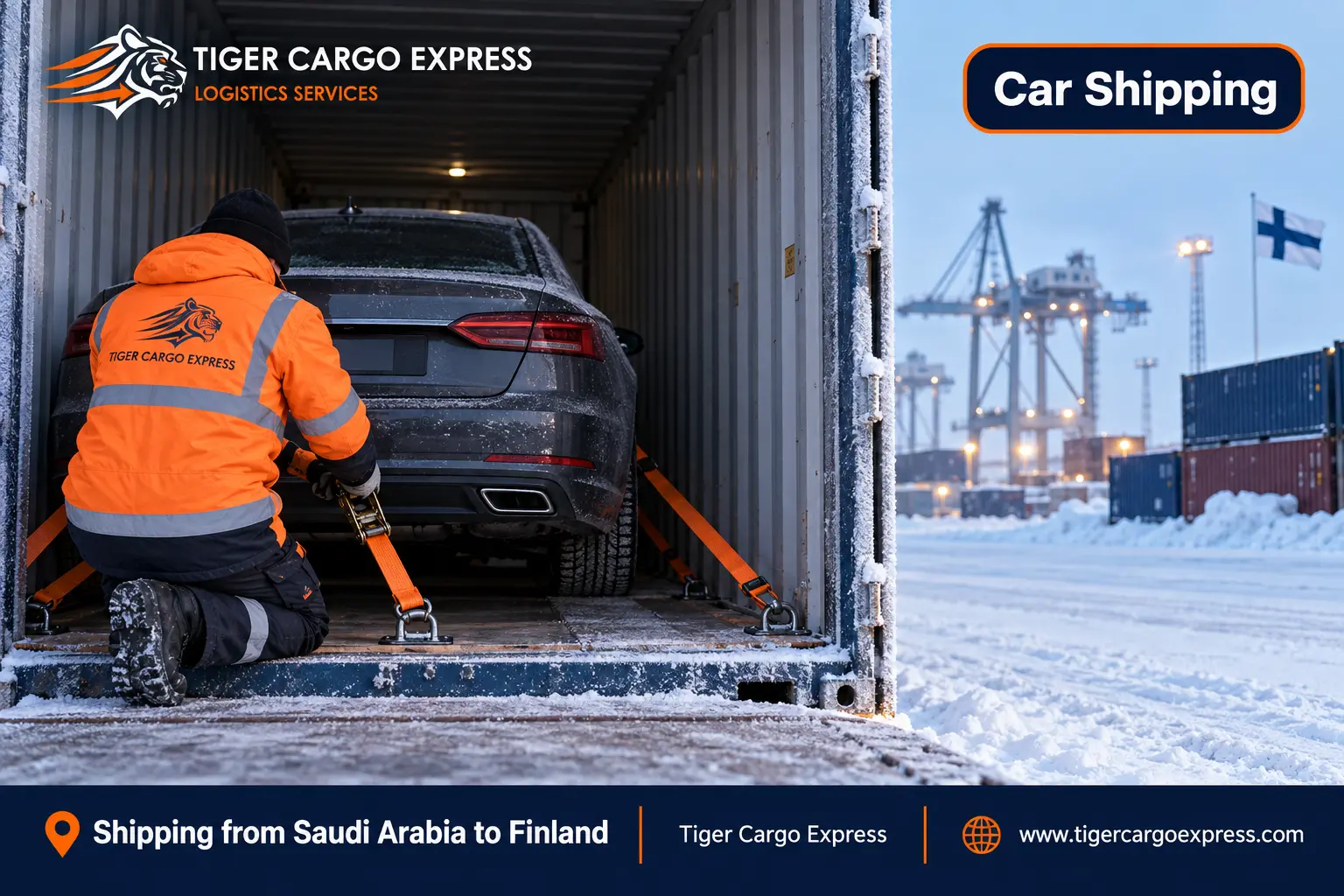
Finland drives on the right as Saudi Arabia does, so there is no conversion stage. But registering a vehicle passes through a separate financial item: Finnish car tax, calculated on the basis of the vehicle’s general value in the Finnish market and its carbon emissions.
Because the concessions tied to a transfer of residence in Finland have changed over the years and narrowed from what many people expect after reading older information. What was available to someone who moved years ago is not necessarily available today.
So we promise you no relief and give you no figure: we review the current position with you before booking and put two scenarios in front of you — with concessions and without — so you decide knowing. And we may tell you that selling the vehicle here and buying a replacement there is cheaper.
The vehicle route
Finland requires winter tyres seasonally, including studded tyres in certain areas and periods. A vehicle arriving from a hot climate will not be equipped for that at all. So add a full set of winter tyres after registration to your arithmetic — a real item rather than a detail, especially if your vehicle lands in November.
Arrival port — and which freezes least?
| Port | Location | Best suited to · and its winter status |
|---|---|---|
| Helsinki / Vuosaari | Gulf of Finland — the main port | Helsinki, Espoo and Vantaa — the least affected port, and restrictions reach it later |
| Kotka — Hamina | The eastern Gulf of Finland | The east, Lappeenranta and Kouvola — with harder ice than Helsinki |
| Turku | The south-west — by the archipelago | Turku and the south-west — and the archipelago complicates winter navigation |
| Rauma | The west coast — the Bothnian Sea | Pori, Tampere and the west — and more exposed to restrictions the further north you go |
The further south your arrival port, the later restrictions reach it, the milder they stay and the earlier they lift. So a winter shipment to Tampere may well be faster and safer arriving via Helsinki and going on by road than arriving at a western port that is closer on the map but harder frozen.
That is a calculation nobody makes by looking at distance alone — and we make it for you by season rather than by kilometres.
Furniture moving from Saudi Arabia to Finland
From dismantling a piece in your home to reassembling it in your new one.
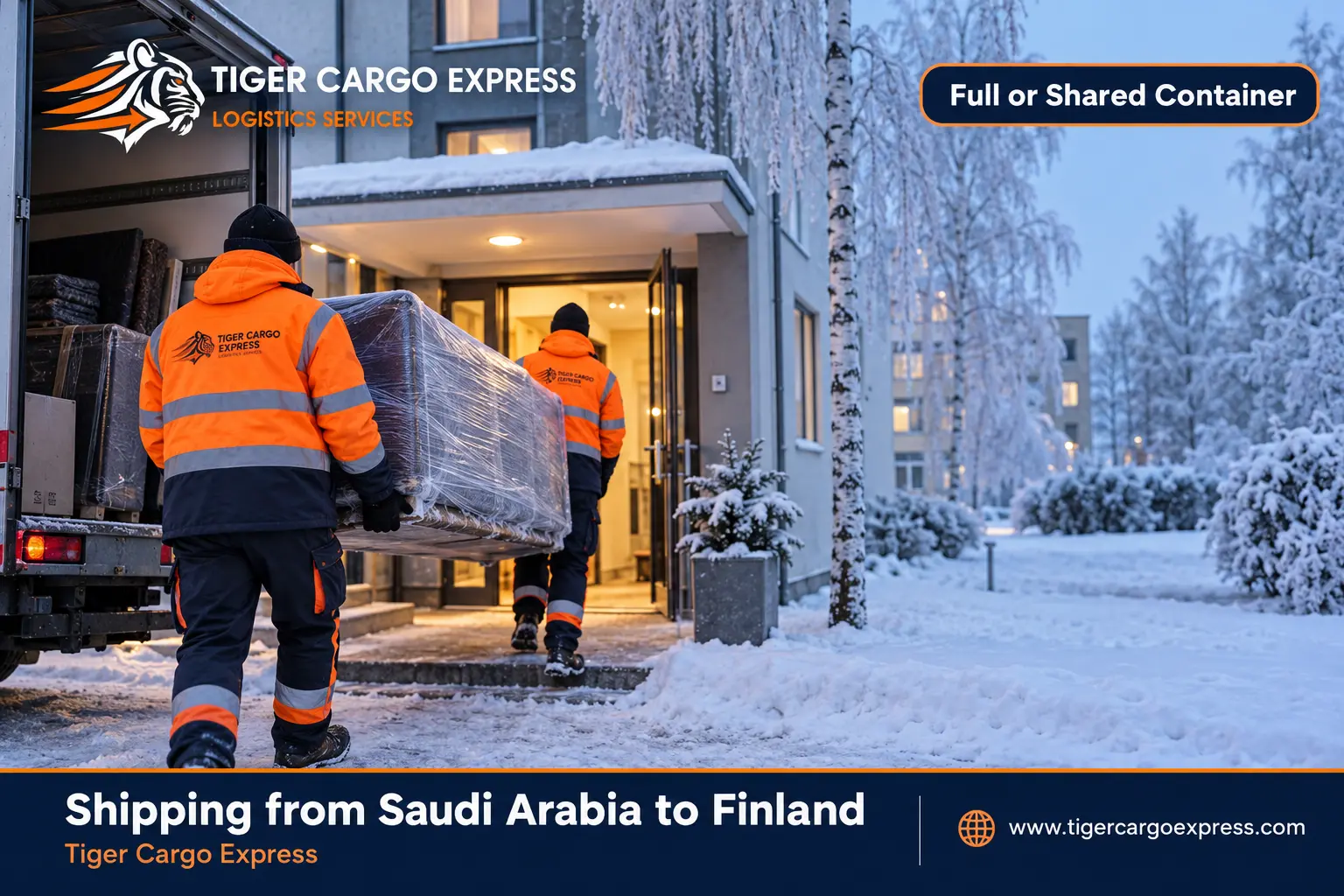
Packing here carries a consideration no previous destination did: the possibility that your container spends days in an open yard below freezing — whether waiting for an icebreaker or waiting for handling. Extreme cold does not damage furniture directly, but the swing between sub-zero and indoor heating is what splits timber and releases glue.
- ▸ Survey and assessment: volume in cubic metres, and deciding what is dismantled and what needs a crate.
- ▸ Professional dismantling: bedrooms, kitchens and shelving — full dismantling cuts volume, and volume is your invoice.
- ▸ Packing built for cold: extra insulating layers for timber and leather pieces — a winter shipment is packed sturdier than a summer one.
- ▸ Condensation protection: desiccant and barrier covers preventing moisture forming inside the container as temperature shifts.
- ▸ Glass and mirrors in lined crates: glass is more brittle in extreme cold — that is a property of the material, not an opinion.
- ▸ Treated and stamped timber crates: a European condition of entry — applied to every crate we build.
- ▸ Unpacking and reassembly: in your new home — with an acclimatisation period before final assembly if the shipment arrives at the height of winter.
Two shipping methods — sea and air
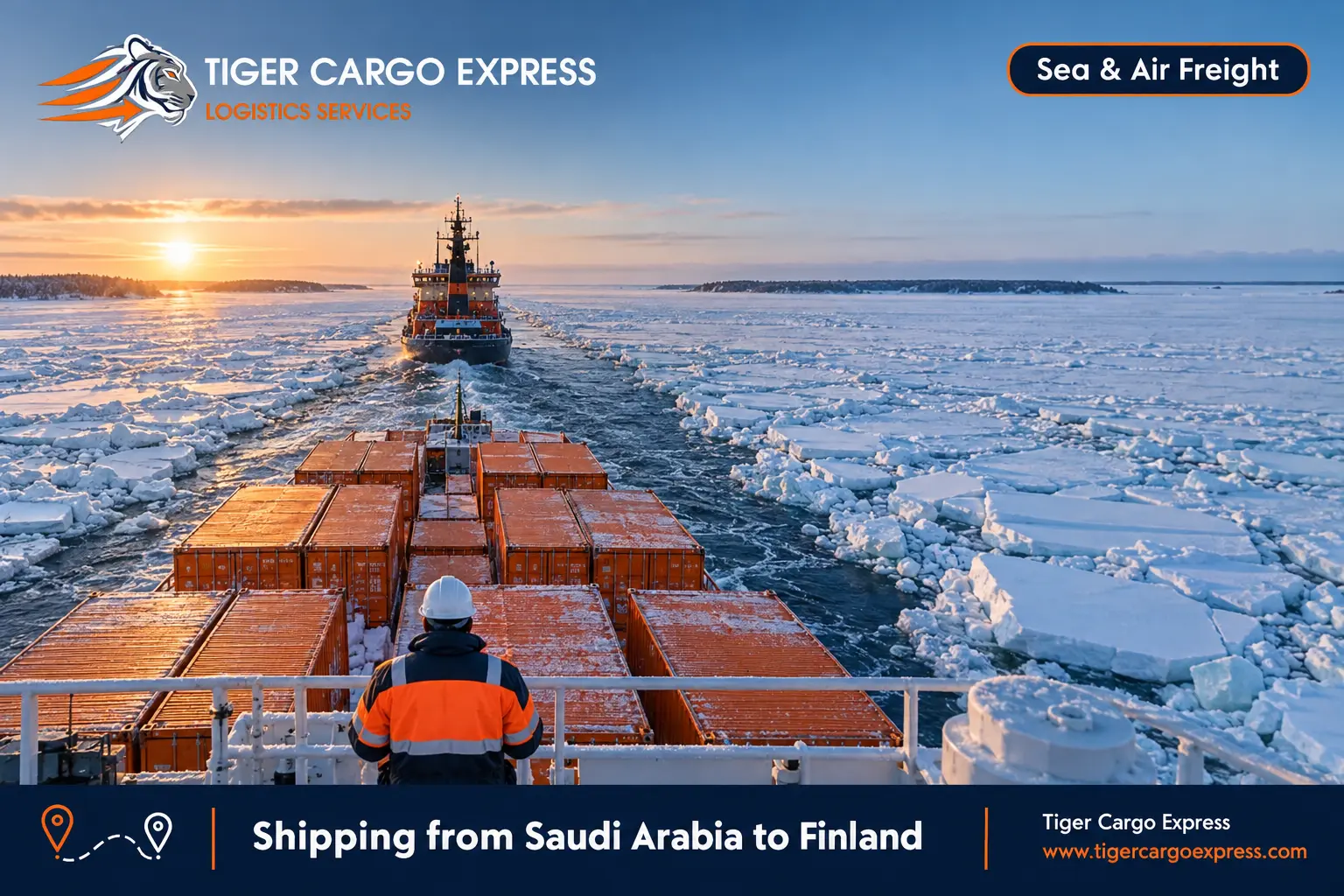
Many clients ask about the vessel leaving Jeddah or Dammam. But that ship will usually never enter the Baltic. What matters is the feeder vessel carrying your container from the transhipment port into Finland — because that is the ship facing the ice and the ship whose class is measured.
We ask about that vessel specifically on winter bookings, and fix the requirement in writing. Anyone who does not ask books on one ship and arrives on another without knowing it.
Full container or shared load?
| Aspect | Full container | Shared load |
|---|---|---|
| When it suits you | A whole home, a vehicle, or volume close to container capacity | A small flat, a researcher’s belongings, or part of a home |
| In the winter season | Greater control over which feeder vessel carries you, and when | Follows the consolidator’s schedule — and may move onto a vessel you did not choose |
| Transit | Shorter — no waiting for a load to fill | Longer — consolidation before sailing and deconsolidation after |
| Cost | A fixed rate — better value the closer you get to filling it | Per cubic metre — better value for small volumes only |
A seasonal rule we state plainly: in summer a shared load is an excellent option to Finland. But at the height of winter a full container buys you control over which feeder vessel carries you and when — control you do not have when your shipment is part of a consolidated load whose schedule someone else decides.
Finnish cities we cover
Door delivery from the south to Lapland.
Espoo
Tampere
Vantaa
Oulu
Turku
Jyväskylä
Lahti
Kuopio
Pori
Kotka
Joensuu
Lappeenranta
Vaasa
Hämeenlinna
Rovaniemi
Shipping prices from Saudi Arabia to Finland
Indicative figures following sea-freight pricing logic — the final quote is built on the survey and on the shipping season.
| Shipment type | Price range | Unit and notes |
|---|---|---|
| Shared load (LCL) | Request a quote — set by survey | Per cubic metre with a minimum — best suited to summer |
| 20ft container | Request a quote — set by survey | Suits a mid-sized flat, or a vehicle with belongings |
| 40ft container | Request a quote — set by survey | Suits a full house, or two vehicles |
| Car shipping | Request a quote — set by survey | Freight cost only — excluding car tax, inspection and winter tyres |
| ⭐ Winter season differential | Written into the schedule in days | A feeder vessel of a higher ice class — a declared line, not a hidden one |
| Air freight | Request a quote — set by survey | By volumetric weight — and it bypasses the ice season entirely |
Note that we give the winter differential its own line. Because arriving in winter requires a feeder vessel of a higher specification, and that has a real price. Anyone quoting you the same figure in July and in February either does not know the difference or will recover it later — and neither is in your favour.
What actually sets your price?
Documents required for shipping to Finland
When do you intend to move, and in which month do you want your shipment to arrive? The answer determines everything after it: the type of vessel, the price range, the date margin and the packing standard. In Finland alone the calendar is an operational item rather than background — and anyone starting from the paperwork before the calendar is building on nothing.
Customs clearance and standing charges
We handle clearance at both ends. A container has a limited free period starting from discharge rather than from your notification, after which a daily charge applies for it remaining and another for late return to the shipping line.
At most destinations the risk of delay falls after the container arrives: a stalled clearance or a missing document. Here the larger risk falls before arrival: a ship waiting at anchor.
And the difference matters practically: paperwork can be prepared early and that risk closed entirely — which is what we do — but ice cannot be prepared for with a document, only with a correct booking decision. So we close the customs file before sailing and spend all our attention on choosing the vessel.
Prohibited and restricted items
- ▸ Flammables and pressurised goods: aerosols, paints, solvents, fuel and gas — excluded entirely.
- ▸ Liquids liable to freeze: an item specific to Finland — any liquid that may freeze, expand and burst its container inside the box. We exclude it or empty it.
- ▸ Alcohol and tobacco: outside the removal goods relief, with their own regime.
- ▸ New items in original packaging: the prior-use condition is examined and new goods are assessed separately.
- ▸ Food and animal or plant products: tightly restricted under European sanitary and phytosanitary controls.
- ▸ Plants, seeds and soil: effectively prohibited — Finland guards its northern forests strictly.
- ▸ Weapons, ammunition and replicas: including souvenirs — with their own permit regime.
- ▸ Untreated timber: every crate and pallet needs approved treatment and marking.
Packing and insurance
The temperature gap between a loading yard in Riyadh in summer and a port yard in Finland in winter is the widest in this entire series — it can exceed sixty degrees between the two ends. That is not a climatic aside but an engineering fact concerning every piece in your container.
Inland delivery after the port
- ▸ Winter daylight hours: very short and shorter the further north — we build the delivery window on them, not on office hours.
- ▸ Snow-covered paths and entrances: may need clearing before delivery — arranged in advance rather than on the day.
- ▸ Truck parking in residential areas: limited in winter by snow banks — the permit is arranged in advance.
- ▸ Long inland distances: delivery in Lapland is a full road journey after the port — costed as a separate line.
- ▸ Unloading in the cold: a larger crew working at a faster pace to cut the time furniture is exposed to outside air.
The reverse direction — Finland to Saudi Arabia
We work both directions on the same services and ports. The dominant traffic out of Finland is industrial equipment, machinery, paper and timber products and furniture, alongside the effects of people returning after work or study.
Note that the ice season works in both directions: exporting from a Finnish port in winter is subject to the same assistance restrictions. And we review your list before loading because Saudi import restrictions follow their own logic, particularly for cosmetics and foodstuffs.
How to choose a shipping company to Finland
Our written guarantees
How to lower the cost of your shipment
- ▸ Ship between May and October if you can. The biggest saving on this lane comes from a calendar, not a negotiation.
- ▸ Bring the shipping forward rather than delaying it. Moving in November and shipping in January pays the season twice: in price and in margin.
- ▸ Choose a southern port in winter. Helsinki plus a road leg may be safer than a western port that is closer on the map.
- ▸ Review the vehicle route before booking. The rules have changed, and building on old information costs more than any freight item.
- ▸ Sort before you pack. Every cubic metre has a price — and its winter price is higher.
- ▸ Allow full dismantling. It cuts volume appreciably, and volume is the invoice.
- ▸ Describe the approach to your home. A long path? A snowed-in entrance? Discovering it on delivery day costs far more in winter.
When do rates rise and transits lengthen?
| Period | What happens |
|---|---|
| January — February | Peak ice — the hardest restrictions, the longest icebreaker queues and the highest seasonal differential. |
| July | The broad Finnish holiday season — administrative and delivery slowdown even though the sea is open. |
| August | Start of the academic year and a wave of work relocations — pressure on containers and packing crews. |
| An early cold season | Restrictions may begin weeks ahead of their usual date — which has happened in recent seasons. |
| Disruption on sea lanes | Rerouting lengthens transit and moves rates — we tell you as soon as we know. |
How we work: five steps
Five recurring mistakes — all avoidable
- ▸ Treating winter as a weather risk. The mistake most specific to Finland — it is a condition of entry settled at booking.
- ▸ Asking about the wrong ship. What matters is the feeder vessel entering the Baltic, not the one that left Saudi Arabia.
- ▸ Moving in November and shipping in January. It combines the hardest navigational month with the middle of your customs deadline.
- ▸ Summer packing for a winter shipment. Condensation as temperature shifts damages more than the cold itself.
- ▸ Building on old information about vehicle concessions. The rules have changed and narrowed — review before booking, not after.
Why Tiger Cargo Express?
Because we ask you about the month before we ask you about the volume. In Finland alone the calendar changes everything: which vessel carries your shipment, the price, the date margin and the packing standard.
Most of our competitors give you one price all year and then blame the weather for the delay. We make the seasonal differential a declared line and verify the feeder vessel’s class before booking — and we suggest better weeks if your calendar allows, even when that postpones our booking.
Frequently asked questions about shipping from Saudi Arabia to Finland
In summary
Shipping to Finland differs from everything before it in one line: winter here is not a risk but a condition. Every port freezes, and ice class decides whether your ship arrives or waits. Three things matter here: a calendar in which you choose the month before the volume, verification of the feeder vessel’s class rather than the first ship, and a timeline joining your customs deadline to the restriction season. Tiger Cargo Express gives you all three before you ship.
Send your shipment details — approximate volume, origin city, your Finnish city, the month you want it to arrive, when you move, and whether a vehicle is included — and we reply with a detailed quote within 60 minutes. 0506688227
Where does Finland sit on our map?
Shipping to Finland is one lane within a wider region — and the full Europe guide explains the rules governing it and its neighbours together: the route, the customs framework, and the challenge that lane is priced around.
Related Shipping Guides
Continue with practical guidance connected to the same route or shipping decision.
Furniture and Car Shipping Company from Saudi Arabia to the Gulf 0506688227
⚠️ "How much does shipping to Kuwait cost?" is a question missing three things. Shipping from Riyadh is not shipping…
Shipping Company from Saudi Arabia to the Middle East 0506688227 — Overland Guide
The Middle East overturns all of it: it is the only destination whose journey starts at your front door rather…
Shipping Company from Saudi Arabia to Oceania 0506688227 — The Biosecurity Guide
On every preceding continent the question was: what is inside your shipment? Oceania asks an entirely different one: what is…
Send your shipment details and get a written quote
We reply within 60 minutes during working hours — with what the price includes and what it does not, stated before you commit.