
Car and Furniture Shipping Company from Saudi Arabia to Poland 0506688227 The Only Baltic Port Ocean Ships Reach Directly
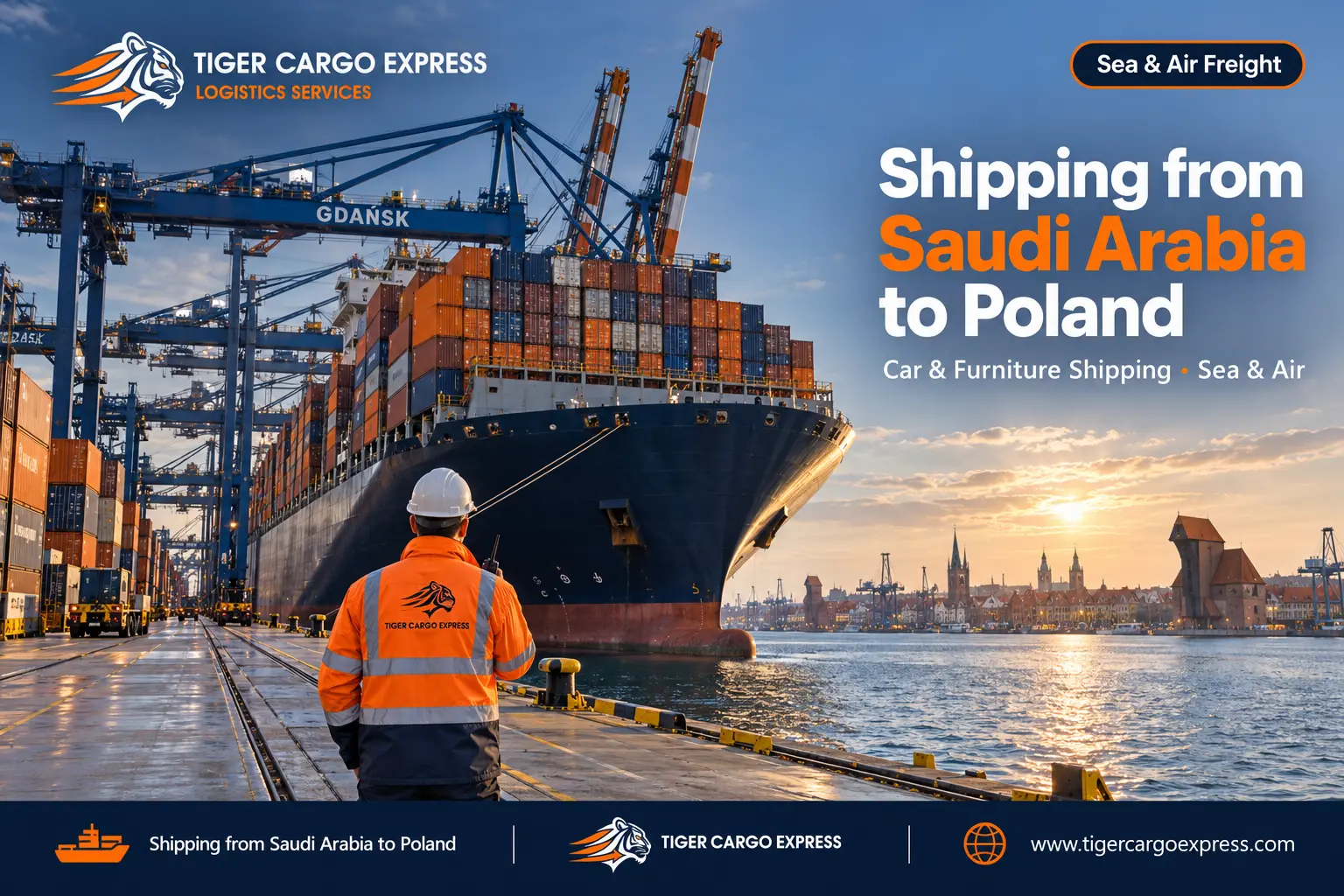
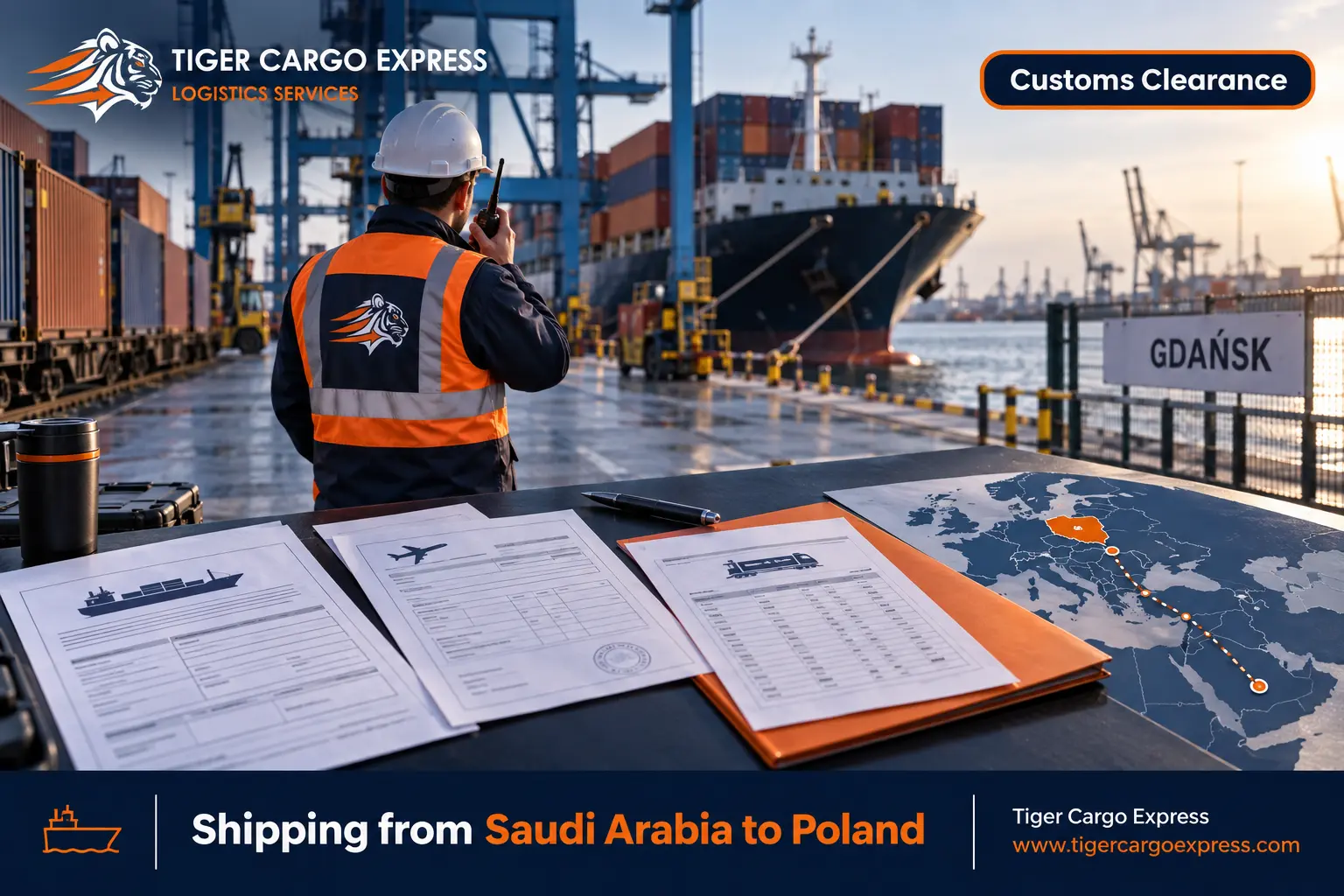
Shipping cars and household goods from Saudi Arabia to Poland by sea involves transport to either Gdańsk or Gdynia. Gdańsk is the only Baltic Sea port directly accessible to ocean-going vessels, while neighboring ports are served by short-haul feeder lines originating there. This offers two key advantages: less transshipment—resulting in shorter transit times and tighter scheduling—and a year-round, ice-free port, unlike its northern neighbors that freeze over.
Guide contents ShowHide
Looking for a shipping company from Saudi Arabia to Poland that knows why this lane differs from every Baltic route? Tiger Cargo Express ships furniture, vehicles and cargo to Warsaw, Kraków, Gdańsk, Wrocław and the rest of Poland — by sea and air, with dismantling, packing and reassembly, customs clearance at both ends, and insurance on the load. To book: 0506688227
At every previous Baltic destination in this series we told you the same thing: your shipment will be transhipped. A large vessel leaves Saudi Arabia, then an intermediate port, then a small feeder ship completes the journey.
Poland is the single exception.
Because Gdańsk is the only port in the Baltic Sea that ocean vessels reach directly, taking the largest container ships in the world — those exceeding twenty-four thousand TEU. Neighbouring ports are in fact fed from it by short-sea services.
Which means your shipment to Helsinki or Riga may pass through here anyway. So if Poland is your destination, you are in the best maritime position in the whole Baltic — at a deep-water port that does not freeze and works year-round.
What do we ship from Saudi Arabia to Poland?
Traffic combining people relocating for work and study, and commercial cargo transiting into central Europe.
Two advantages that follow from the direct call
And they belong to none of Poland’s Baltic neighbours.
A direct call removes the whole stage. The transit is shorter, and more importantly the date is precise — which is what actually matters to anyone planning a move or working to a customs deadline.
Meaning your February price is your July price, and your schedule does not shift with the season. That is a pricing and an operational advantage at once that its neighbours do not have.
Because many clients compare quotes on the figure alone, without noticing that a quote to another Baltic destination may carry an entire transhipment stage with its days, its margin and its extra handling.
So we put the number of transhipment calls explicitly in your quote — zero or one — because it explains the difference in transit and in date precision between one offer and another. Anyone not stating it leaves you comparing two figures that do not measure the same thing.
Poland is a gateway, not only a destination
The hinterland of Gdańsk does not stop at the Polish border. From it a road and rail network serves Poland, Czechia, Slovakia, Hungary, Ukraine, the Baltic states and eastern Germany — a market approaching a hundred and twenty million people.
| If your destination is | routing via Gdańsk means |
|---|---|
| Within Poland | A direct call with no transhipment, and a relatively short inland leg — the best case |
| Czechia or Slovakia | Entry at Gdańsk then road or rail — potentially cheaper than the North Sea ports |
| The Baltic states | A short-sea leg from Gdańsk — which is the actual route of most of their cargo anyway |
| Eastern Germany | An alternative worth costing against the busier North Sea ports |
So we tell clients bound for central Europe: do not assume the nearest port on the map is the best one. Entering at Gdańsk may be cheaper and faster even where it looks further — because the ship reaches it directly, without transhipment.
Liner schedules and their calling patterns change from season to season, and we do not promise a direct routing in all cases. What we give is verification of the service before booking and the number of transhipment calls stated explicitly in the quote. Customs and relief matters we review with you before booking — and we do not provide legal or tax advice.
Conditions for removal goods relief in Poland
Poland is an EU member and applies its framework for removal goods relief: anyone resident outside the Union for twelve continuous months who transfers their normal residence to Poland brings in used furniture and belongings free of duty and VAT.
| Condition | What it means in practice |
|---|---|
| Residence outside the Union | Twelve continuous months before the move — evidenced by documents. |
| Prior ownership and use | Used goods in reasonable household quantities — new items in original packaging assessed separately. |
| Transfer of normal residence | Poland is your main home — furniture for an investment property is not relieved. |
| Arrival within the deadline | A set period from your move date, measured in months — and the direct call gives you a comfortable margin within it. |
| The Polish identification number | The basis of official dealings — obtained early, not when the container lands. |
| Restriction on disposal | Goods admitted under relief cannot be sold or lent for a set period after import without prior notification. |
Entirely in your favour. Anyone moving to another Baltic destination faces a fixed customs deadline against an arrival date with a wide margin — because transhipment adds days that cannot be controlled.
Here the direct call means a narrower margin and more precise planning. That gives you greater freedom in choosing your move date without worrying that your deadline expires while your shipment sits in an intermediate port.
Shipping for embassies, consulates and their staff
And Poland is a corridor for missions whose shipment does not end at its border.
Shipments for diplomatic and consular missions and their staff do not go through the removal goods route and are not bound by its conditions — not the one-year residence condition, not the arrival deadline, and not the restriction on disposal. The basis here is the status of the mission or of your accreditation with it.
Poland adds a case found nowhere else in this series: a diplomatic shipment entering at Gdańsk whose final destination is a neighbouring country. The file then becomes transit rather than import, and needs a fundamentally different arrangement: documents prepared on the basis of the final destination rather than the port of entry, a seal that stays intact to arrival, and coordination with two missions rather than one.
- ▸ We start with the mission’s administrative department, not with the individual — the official correspondence is the foundation of the file.
- ▸ We fix the final destination in the documents from the moment the bill of lading is issued — transit is not import, and confusing the two creates the wrong route.
- ▸ We keep the seal intact to the destination and document every stage it passes through.
- ▸ We match consignee name and title between the correspondence and the bill of lading word for word before issuing it.
- ▸ We document the inventory to a higher standard and hand it over endorsed by both sides.
- ▸ We handle everything in confidence — information, contents and movement schedules alike.
And we are clear: what the exemption covers and how far it extends is for the competent authorities in the receiving state to determine, and the mission has its own official channels. Our role is purely logistical. We work in both directions: foreign missions in the Kingdom, and Saudi missions in Poland.
Car shipping from Saudi Arabia to Poland
An excise duty set by engine capacity — and a sworn translation of every document.
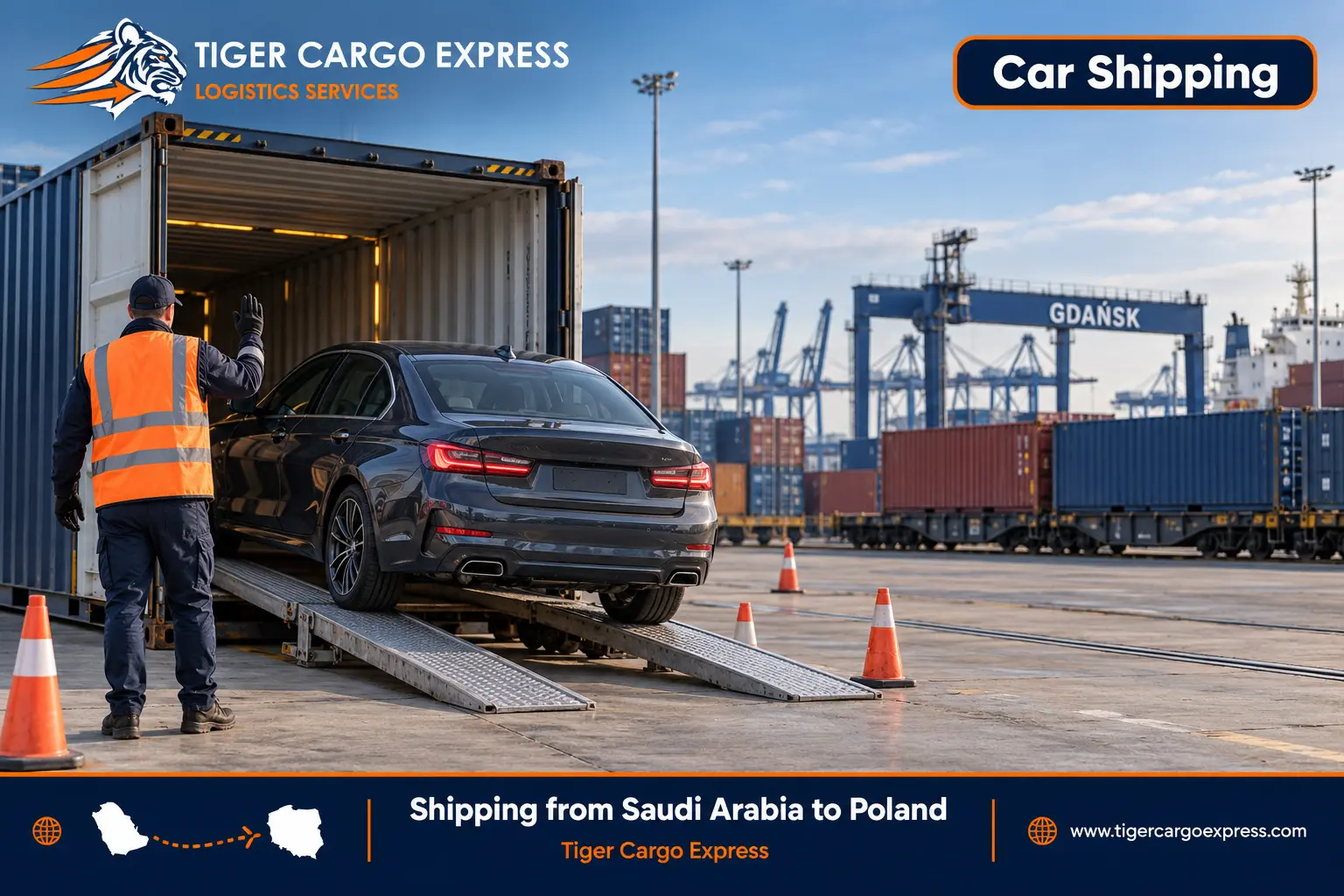
Poland drives on the right as Saudi Arabia does, so there is no conversion stage. Registering a vehicle passes through two separate items every prospective shipper should know.
And the point that matters for the Saudi market specifically: larger engines fall into a noticeably higher band. SUVs and large-capacity cars — common here — are affected more than others. We review the current position with you before booking.
It is a small stage but it stops the file outright if overlooked. We start arranging it early rather than after the car has landed and is standing still.
The vehicle route
A seasonal note too: Poland requires tyres suited to winter conditions, and a vehicle arriving from a hot climate will not be equipped for that. Add it to your arithmetic after registration.
Arrival port — which one for your city?
| Port | Location and character | Best suited to |
|---|---|---|
| Gdańsk | The north — the only deep-water Baltic port with a direct ocean connection | Nearly all of Poland — the default, with rail and road running inland from it |
| Gdynia | Adjacent to Gdańsk — the country’s second port | The north and centre — a good alternative depending on the service schedule |
| Świnoujście / Szczecin | The far west — near the German border | Szczecin and the west — saving a road leg for anyone living there |
Because the difference is not distance but the nature of the arrival. Ocean vessels reach Gdańsk directly, while other ports may receive transhipped cargo. And two or three hours of road haulage inside Poland is cheaper and more precise than a week of transhipment at a European port.
So we cost both routes for you and show the difference in days rather than kilometres — then you decide.
Furniture moving from Saudi Arabia to Poland
From dismantling a piece in your home to reassembling it in your new one.
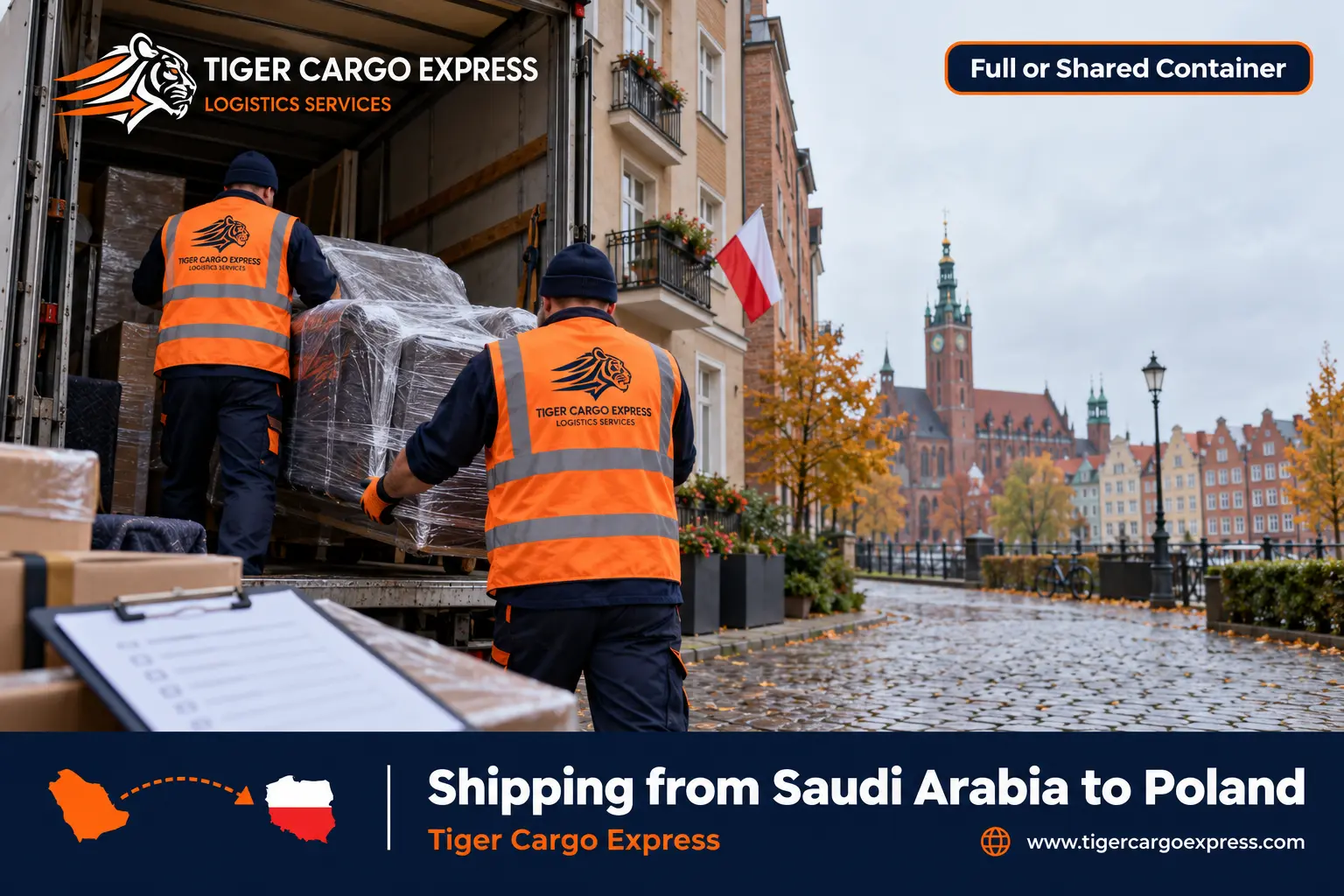
An advantage we mention in no other article in this series: a direct call means less handling. Every transhipment means lifting the container, setting it down and moving it across a yard — all of it vibration and impact. A shipment arriving without transhipment is handled twice instead of four times — and that is directly in your furniture’s favour.
- ▸ Survey and assessment: volume in cubic metres, and deciding what is dismantled and what needs a crate.
- ▸ Professional dismantling: bedrooms, kitchens and shelving — full dismantling cuts volume, and volume is your invoice.
- ▸ Multi-layer packing: bubble, then blankets, then stretch film, with glass and mirrors in lined crates.
- ▸ Cold and condensation protection: Polish winters are sharp indoors — and the gap with Saudi Arabia’s climate is large.
- ▸ Treated and stamped timber crates: a European condition of entry — applied to every crate we build.
- ▸ A detailed valued inventory: written during packing, handed to you before sailing and submitted with the file.
- ▸ Unpacking and reassembly: in your new home — not boxes left at the door.
Two shipping methods — sea and air
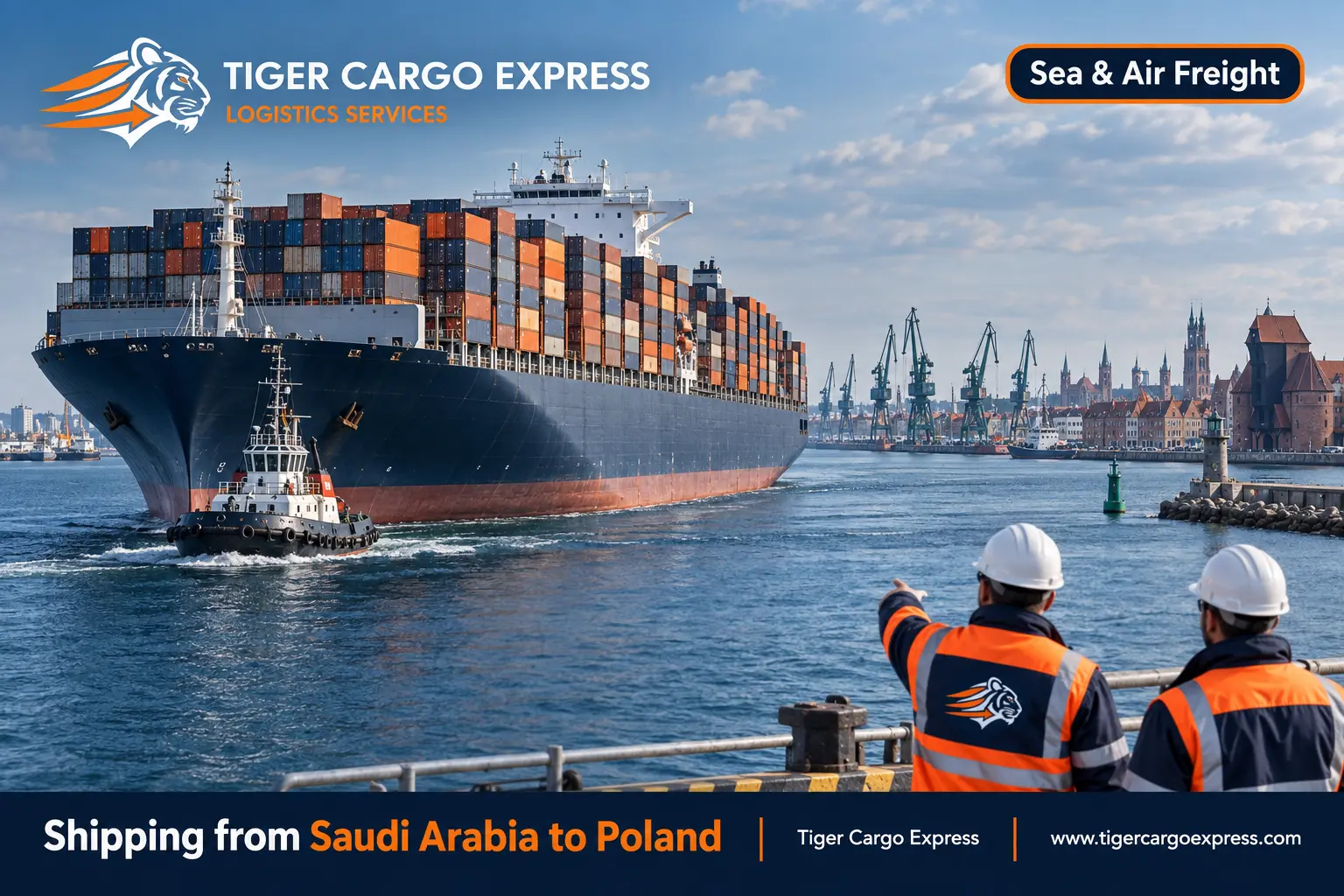
Full container or shared load?
| Aspect | Full container | Shared load |
|---|---|---|
| When it suits you | A whole home, a vehicle, or volume close to container capacity | A small flat, a student’s belongings, or part of a home |
| On this lane specifically | Takes the full benefit of the direct call — shortest transit and most precise date | Remains an excellent option here — consolidation is not compounded by a sea transhipment |
| Transit | Shorter — no waiting for a load to fill | Longer — consolidation before sailing and deconsolidation after |
| Cost | A fixed rate — better value the closer you get to filling it | Per cubic metre — better value for small volumes only |
Note the second row: at other Baltic destinations we warned you against a shared load in winter or alongside a vehicle, because transhipment widens the margin. Here, a shared load is an excellent option all year round — because the stage that spoiled it does not exist.
Polish cities we cover
Door delivery across the country.
Kraków
Łódź
Wrocław
Poznań
Gdańsk
Szczecin
Bydgoszcz
Lublin
Białystok
Katowice
Gdynia
Częstochowa
Radom
Sosnowiec
Toruń
Shipping prices from Saudi Arabia to Poland
Indicative figures following sea-freight pricing logic — the final quote is built on the survey.
| Shipment type | Price range | Unit and notes |
|---|---|---|
| Shared load (LCL) | Request a quote — set by survey | Per cubic metre with a minimum — an excellent option on this lane all year |
| 20ft container | Request a quote — set by survey | Suits a mid-sized flat, or a vehicle with belongings |
| 40ft container | Request a quote — set by survey | Suits a full house, or two vehicles |
| Car shipping | Request a quote — set by survey | Freight cost only — excluding excise duty, sworn translation and inspection |
| Sworn translation | Set after your file is reviewed | For the vehicle documents — a small item that stops the file if overlooked |
| Air freight | Request a quote — set by survey | By volumetric weight — for urgent cargo only, as the sea route here is relatively fast |
You will not find here the “winter season differential” we put in the Finland table, nor the “non-EU clearance” line we put in Norway’s, nor the “second sea leg” we put in Greece’s.
Because none of them exists on this lane. And that is Poland’s real advantage: not that its figure is lower, but that its quote has fewer lines.
What actually sets your price?
Documents required for shipping to Poland
Your car’s engine capacity. Because it sets the band on which the excise duty is calculated, and the gap between bands is material. Saudi-market vehicles with large engines are affected more than others.
And we start arranging the sworn translation early as well — a small-cost item that nonetheless stops the file outright if not prepared, and cannot be completed in a day.
Customs clearance and standing charges
We handle clearance at both ends. A container has a limited free period starting from discharge rather than from your notification, after which a daily charge applies for it remaining and another for late return to the shipping line.
When a container is transhipped at an intermediate port, its final arrival date is hard to pin down — so preparing the clearance file becomes guesswork. Prepare it early and it may go stale; leave it late and the container has already landed.
Here the arrival date is precise, which allows the clearance file to be prepared against a near-certain date. The practical result: faster clearance and a free period used in full rather than consumed by waiting.
Prohibited and restricted items
- ▸ Flammables and pressurised goods: aerosols, paints, solvents, fuel and gas — excluded entirely.
- ▸ Alcohol and tobacco: outside the removal goods relief, with their own excise regime.
- ▸ New items in original packaging: the prior-use condition is examined and new goods are assessed separately.
- ▸ Food and animal or plant products: tightly restricted under European sanitary and phytosanitary controls.
- ▸ Plants, seeds and soil: effectively prohibited, and soil residue on garden tools triggers inspection.
- ▸ Weapons, ammunition and replicas: including souvenirs — with their own permit regime.
- ▸ Counterfeits and IP infringements: seized and a case opened — and Gdańsk is a major gateway with tight controls.
- ▸ Untreated timber: every crate and pallet needs approved treatment and marking.
Packing and insurance
The voyage to Poland is the shortest in this group and the least handled, thanks to the direct call. But the climatic gap remains considerable: sharp winters and heated homes.
Inland delivery after the port
- ▸ Old buildings in historic centres: narrow stairs and no lift — an item costed in advance in Kraków and Warsaw.
- ▸ Restricted historic centres: limits on large vehicle access — the permit is arranged in advance.
- ▸ A good road network: a real advantage — inland transport in Poland is faster and cheaper than at most of its northern neighbours.
- ▸ Sharp winters: may slow roads in the mountainous south — we allow a margin in the schedule.
- ▸ Local working hours: the delivery window is built on the actual hours in your area rather than a general assumption.
The reverse direction — Poland to Saudi Arabia
We work both directions on the same services and ports. Poland is a large manufacturing base, so outbound traffic is wide: furniture, building materials, industrial equipment, spare parts and food products, alongside returnees’ effects.
Polish furniture in particular is among the country’s largest exports, and we ship it in commercial quantities for clients in the Kingdom. Note too that Saudi import restrictions follow their own logic, particularly for foodstuffs and cosmetics — we review your list before loading.
How to choose a shipping company to Poland
Our written guarantees
How to lower the cost of your shipment
- ▸ Use a shared load without hesitation. It is an excellent option here all year — with no sea transhipment compounding it.
- ▸ Work out your car’s engine capacity first. It is the item that may overturn the decision to ship the vehicle at all.
- ▸ Compare quotes by the number of calls, not the figure. Two quotes at the same price may be a week of transhipment apart.
- ▸ Do not pay a “winter season differential”. The port does not freeze — anyone charging you one is selling a line that does not exist.
- ▸ Sort before you pack. What you will not use does not deserve to cross two seas. Every cubic metre has a price.
- ▸ Allow full dismantling. It cuts volume appreciably, and volume is the invoice.
- ▸ Describe your home precisely. An old building with no lift? A restricted historic centre? Discovering it on delivery day costs far more.
When do rates rise and transits lengthen?
| Period | What happens |
|---|---|
| August and September | Start of the academic year and a wave of work relocations — pressure on containers and packing crews. |
| Peak Asian import season | Pressure on Gdańsk’s berths as a regional gateway — and handling time may lengthen. |
| Year-end holidays | An extended administrative pause — and we avoid letting a vehicle arrive in that window specifically. |
| Deep winter | The port does not stop — but roads in the mountainous south may slow, and we allow a margin. |
| Disruption on sea lanes | Rerouting lengthens transit and moves rates — we tell you as soon as we know. |
How we work: five steps
Five recurring mistakes — all avoidable
- ▸ Comparing quotes on the figure alone. The mistake most specific to this lane — two quotes at the same price may be a week of transhipment apart.
- ▸ Overlooking the sworn translation. A small-cost item that stops the vehicle file outright and cannot be done in a day.
- ▸ Ignoring engine capacity. It sets the excise band — and our market’s large-engined vehicles are affected most.
- ▸ Choosing a port that is nearer on the map. Its call may be indirect — and a short distance does not offset a week of transhipment.
- ▸ Confusing transit with import. Anyone bound for a neighbouring country needs a different file from the moment the bill of lading is issued.
Why Tiger Cargo Express?
Because we write the number of transhipment calls into your quote — a figure that explains the difference in transit and date precision between two offers that look alike. Most of our competitors give you a price and an estimated transit without saying how many times your container will be lifted and set down along the way.
And we also tell you what will not be in your invoice here: no winter differential, no second sea leg, no non-EU clearance. Poland’s advantage is that its quote has fewer lines, not merely a lower figure — and if someone adds a line that does not exist, ask them why.
Frequently asked questions about shipping from Saudi Arabia to Poland
In summary
Poland is not a Baltic destination like the others — it is the gateway its neighbours’ cargo passes through. Gdańsk is the only deep-water Baltic port ocean vessels reach directly, and it neither freezes nor closes. Three things follow: a shorter transit, a more precise date, and less handling. Two items remain for the vehicle: the excise band set by engine capacity, and the sworn translation. Tiger Cargo Express gives you all of it in writing before you ship.
Send your shipment details — approximate volume, origin city, your final destination inside Poland or beyond it, when you move, and if a vehicle is included, its engine capacity — and we reply with a detailed quote stating its call count within 60 minutes. 0506688227
Where does Poland sit on our map?
Shipping to Poland is one lane within a wider region — and the full Europe guide explains the rules governing it and its neighbours together: the route, the customs framework, and the challenge that lane is priced around.
Related Shipping Guides
Continue with practical guidance connected to the same route or shipping decision.
Furniture and Car Shipping Company from Saudi Arabia to the Gulf 0506688227
⚠️ "How much does shipping to Kuwait cost?" is a question missing three things. Shipping from Riyadh is not shipping…
Shipping Company from Saudi Arabia to the Middle East 0506688227 — Overland Guide
The Middle East overturns all of it: it is the only destination whose journey starts at your front door rather…
Shipping Company from Saudi Arabia to Oceania 0506688227 — The Biosecurity Guide
On every preceding continent the question was: what is inside your shipment? Oceania asks an entirely different one: what is…
Send your shipment details and get a written quote
We reply within 60 minutes during working hours — with what the price includes and what it does not, stated before you commit.