
Car and Furniture Shipping Company from Saudi Arabia to Norway 0506688227 Outside the EU and a Separate File from the First Document

Car and furniture shipping from Saudi Arabia to Norway by sea to Oslo or Larvik. Norway is in Europe but not in the European Union — its customs procedures are entirely separate, and everything you have read about "EU relief" does not apply. Three items everyone overlooks: a dedicated identification number applied for from Customs if you hold no Norwegian number, your professional equipment is not relieved even inside your household shipment, and no sale restriction on what enters under relief — unlike every one of its neighbours.
Guide contents ShowHide
Looking for a shipping company from Saudi Arabia to Norway that knows Norway is not a European country like the other European countries? Tiger Cargo Express ships furniture, vehicles and cargo to Oslo, Bergen, Stavanger, Trondheim and the rest of Norway — by sea and air, with dismantling, packing and reassembly, customs clearance at both ends, and insurance on the load. To book: 0506688227
If you have read a guide about shipping to Germany, Sweden or Denmark and assumed the same applies here — stop reading and start again.
Because Norway is in Europe but not in the European Union. It is a member of the European Economic Area, but it sits outside the customs union. Which means its customs procedures are entirely separate, and the “European framework for removal goods relief” on which every European guide is built does not apply to it.
It has rules of its own — some easier than the European ones, some stricter. And three items in them that everyone overlooks.
What do we ship from Saudi Arabia to Norway?
Traffic dominated by people relocating for energy, maritime and tech roles, researchers and families.
Why is the Norwegian file separate from the first document?
When you ship to Germany, Spain or Poland you are entering the European customs union: unified rules, a shared relief framework, and a container cleared once that then moves freely within the Union.
Norway is not part of that. Despite its close economic ties to Europe, it is a state with its own customs authority, its own rules and its own forms.
▸ You cannot copy any European guide onto your case — the conditions, forms and deadlines differ.
▸ If your container passes through a European port on the way, that is transit, not entry, and the real clearance happens in Norway.
▸ Firms that are excellent at clearing inside the Union are not thereby excellent at clearing here — they are two routes with two authorities.
▸ And conversely: some Norwegian rules are easier than their European counterparts — and we will show you exactly where.
Conditions for removal goods relief in Norway
Norway does grant full relief for the belongings of people relocating — on its own terms.
| Condition | What it means in practice |
|---|---|
| Continuous residence abroad | At least one year outside Norway before the move — and it must be evidenced. |
| Ownership and use during the stay | That you owned the goods and used them during your stay abroad — and will continue to use them in Norway. |
| Personal use | The goods are for the personal use of you and your household — not for sale or trade. |
| ⭐ The one-year deadline | Import within a reasonable time and no later than one year after your move — extendable for special reasons on application. |
| ⭐ The identification number | A Norwegian identification number is required — and there is a dedicated route for those without one, set out below. |
| The customs declaration | A declaration for the import of household goods — and the goods are not cleared until it is submitted correctly completed and signed. |
Three items everyone overlooks
What we set out is the framework as we work with it in practice; rules are updated from time to time and each case is assessed individually. So we review the current conditions with you before booking. We prepare the file and coordinate the timing — we do not provide legal or tax advice.
Shipping for embassies, consulates and their staff
The only category none of the three items above concerns.
Shipments for diplomatic and consular missions and their staff do not go through the removal goods route and are not bound by its conditions — not the one-year residence condition, not the one-year deadline, and not the professional equipment exclusion. The basis here is the status of the mission or of your accreditation with it, and the exemption rests on standing rather than on the fact of a move.
The first practical difference: no need for the identification number individuals require, because the consignee is the mission in its capacity rather than a person in their identity. The second matters more: professional equipment and office fit-out excluded from individual relief fall within the mission’s official shipment — a large difference in fit-out consignments.
- ▸ We start with the mission’s administrative department, not with the individual — the official correspondence is the foundation of the file.
- ▸ We do not request an identification number the consignee does not need — a common error that delays mission files for nothing.
- ▸ We match consignee name and title between the correspondence and the bill of lading word for word before issuing it.
- ▸ We schedule sailing around the accreditation date rather than around when the furniture is ready.
- ▸ We document the inventory to a higher standard and hand it over endorsed by both sides.
- ▸ We handle everything in confidence — information, contents and movement schedules alike.
And we are clear: what the exemption covers and how far it extends is for the competent authorities in the receiving state to determine, and the mission has its own official channels. Our role is purely logistical. We work in both directions: foreign missions in the Kingdom, and Saudi missions in Norway.
Car shipping from Saudi Arabia to Norway
The section where we need to be blunter than anywhere else in this guide.
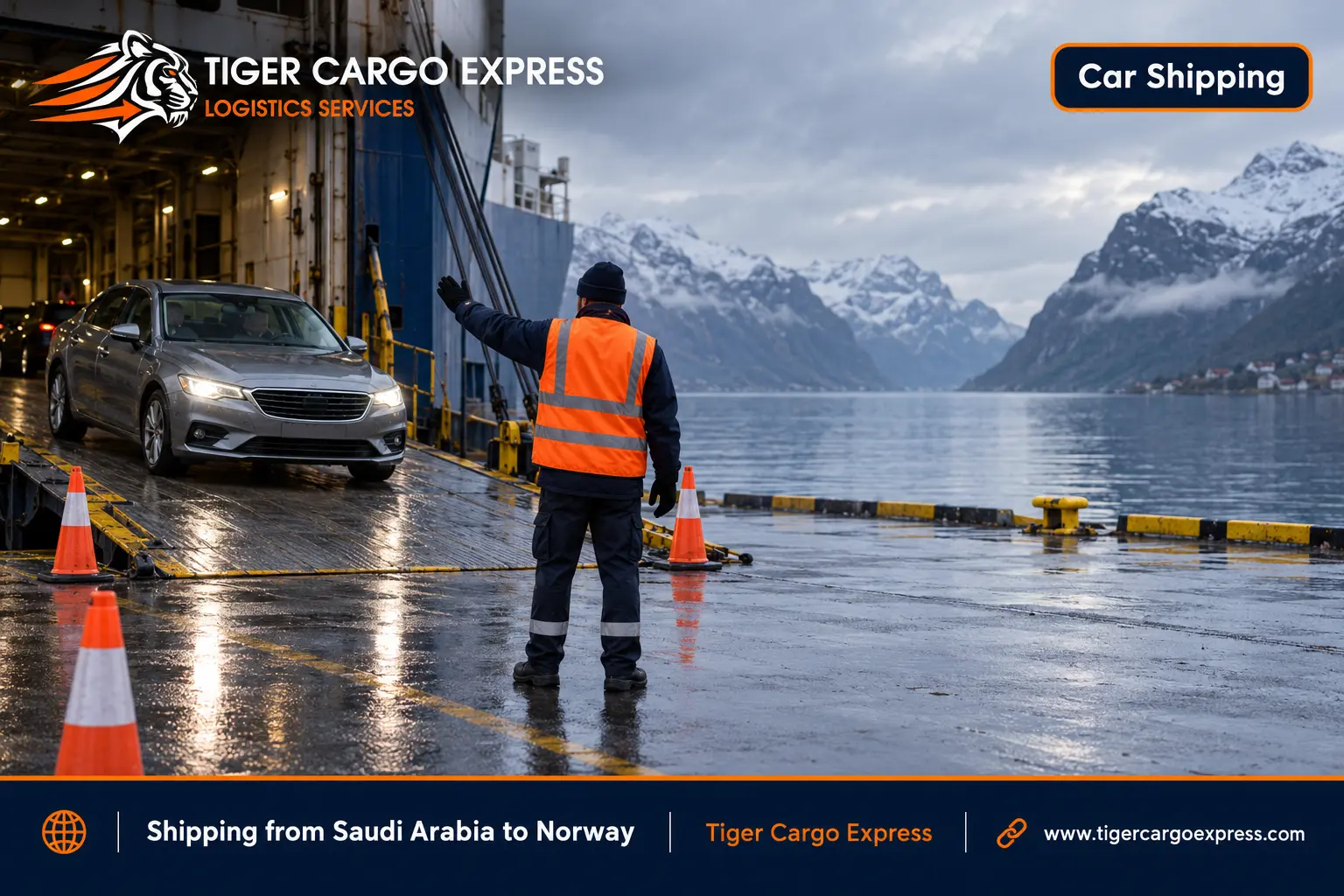
Norway drives on the right as Saudi Arabia does, so there is no conversion stage. But the similarity ends there.
While your household goods enter relieved if you meet the conditions, a vehicle accompanying your move must be declared and the applicable taxes paid on it. In other words, it is not treated like the rest of your belongings — it falls under a separate tax regime calculated on its characteristics.
Because Norway is among Europe’s most expensive markets for bringing in a vehicle, and because the calculation turns on several factors including engine size, emissions, weight and the vehicle’s age. So an ordinary car may cost far more to bring in than you expect — or far less, if it falls in a category that receives better treatment.
Which is why we give no figure: the assessment belongs to the competent authority and is built on your specific vehicle’s data. What we do is gather your details, put a realistic picture in front of you, and possibly advise you not to ship it.
The vehicle route
A practical note too: Norway is a mountainous, snowy country, and winter tyres are a seasonal requirement rather than a choice. A vehicle arriving from a hot climate will not be equipped for that — an additional cost item after registration that should enter your arithmetic now.
Which arrival port for your city?
| Port | Location | Best suited to |
|---|---|---|
| Oslo | The head of the Oslofjord — the main port | Oslo, Drammen, Fredrikstad and the east — the default for most shipments |
| Larvik | South of Oslo on the fjord | The south-east, Skien and Sarpsborg — depending on the service schedule |
| Stavanger | The south-west — the energy capital | Stavanger, Sandnes and Haugesund — saving a long road haul |
| Bergen | The west — on the fjord coast | Bergen and the west — avoiding the mountain crossing from Oslo |
Because Norwegian geography does not permit straight lines. The road from Oslo to Bergen crosses mountains, tunnels and high passes that may close in winter, and the distance on a map says nothing about the journey’s time or cost. Anyone shipping to Bergen via Oslo “because it is the capital” pays for a hard inland haul that was avoidable. We ask for your city before we choose the port — not after we book.
Furniture moving from Saudi Arabia to Norway
From dismantling a piece in your home to reassembling it in your new one.
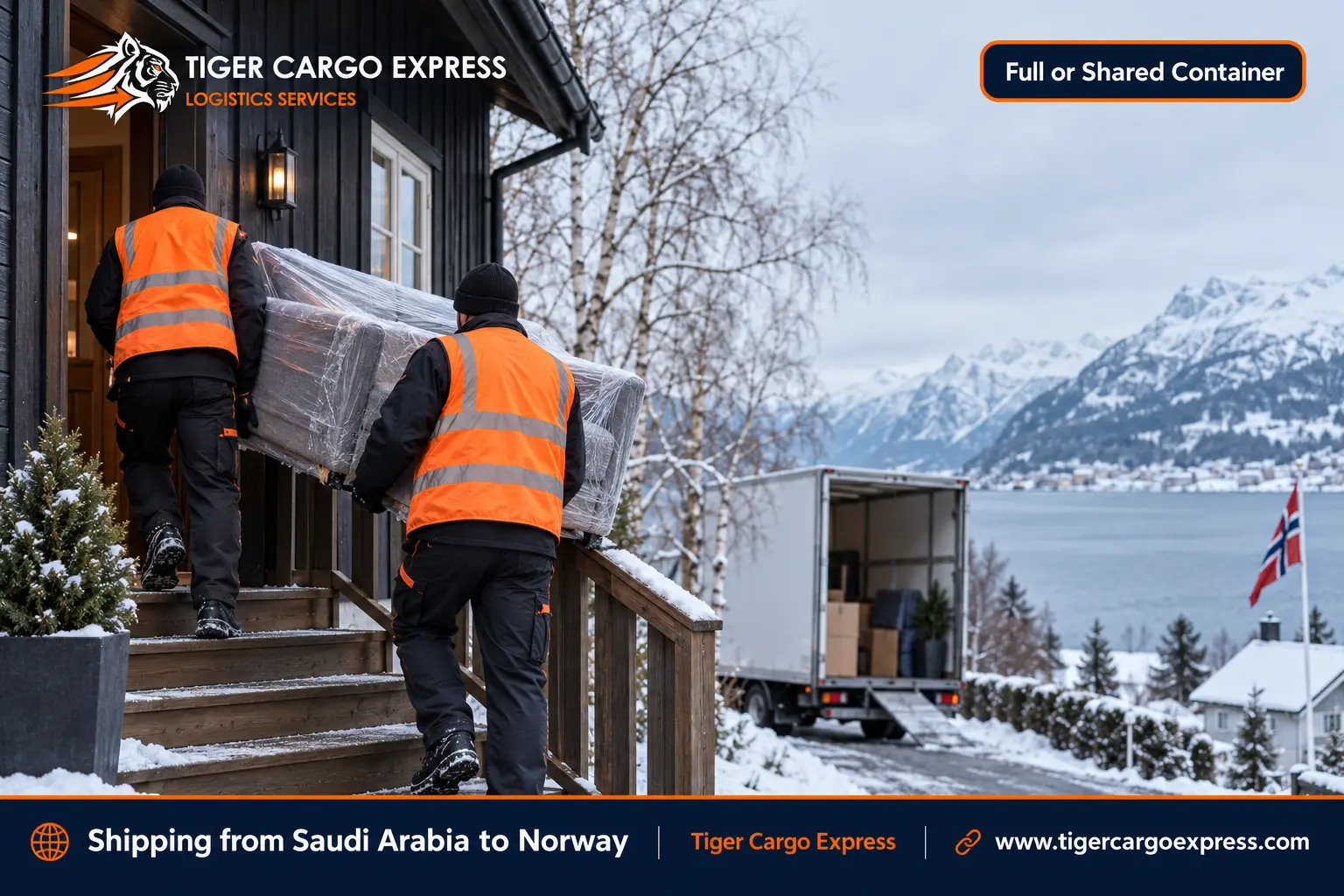
The inventory on this lane has a feature no other destination requires: it is best drawn up stating item by item what is new and what is used. Because new goods attract duty while used goods are relieved, and a list that separates them clearly eases clearance and shortens it. We prepare it that way from the outset rather than after being asked.
- ▸ Survey and sorting: volume in cubic metres — and an explicit separation of used, new and professional equipment.
- ▸ Professional dismantling: bedrooms, kitchens and shelving — full dismantling cuts volume, and volume is your invoice.
- ▸ Multi-layer packing: bubble, then blankets, then stretch film, with glass and mirrors in lined crates.
- ▸ Cold and damp protection: a cold, damp Norwegian climate — the climatic gap with Saudi Arabia is among the sharpest in this series.
- ▸ Treated and stamped timber crates: a condition of entry — applied to every crate we build.
- ▸ A detailed inventory distinguishing new from used: written during packing and handed to you before sailing.
- ▸ Unpacking and reassembly: in your new home — not boxes left at the door.
Two shipping methods — sea and air
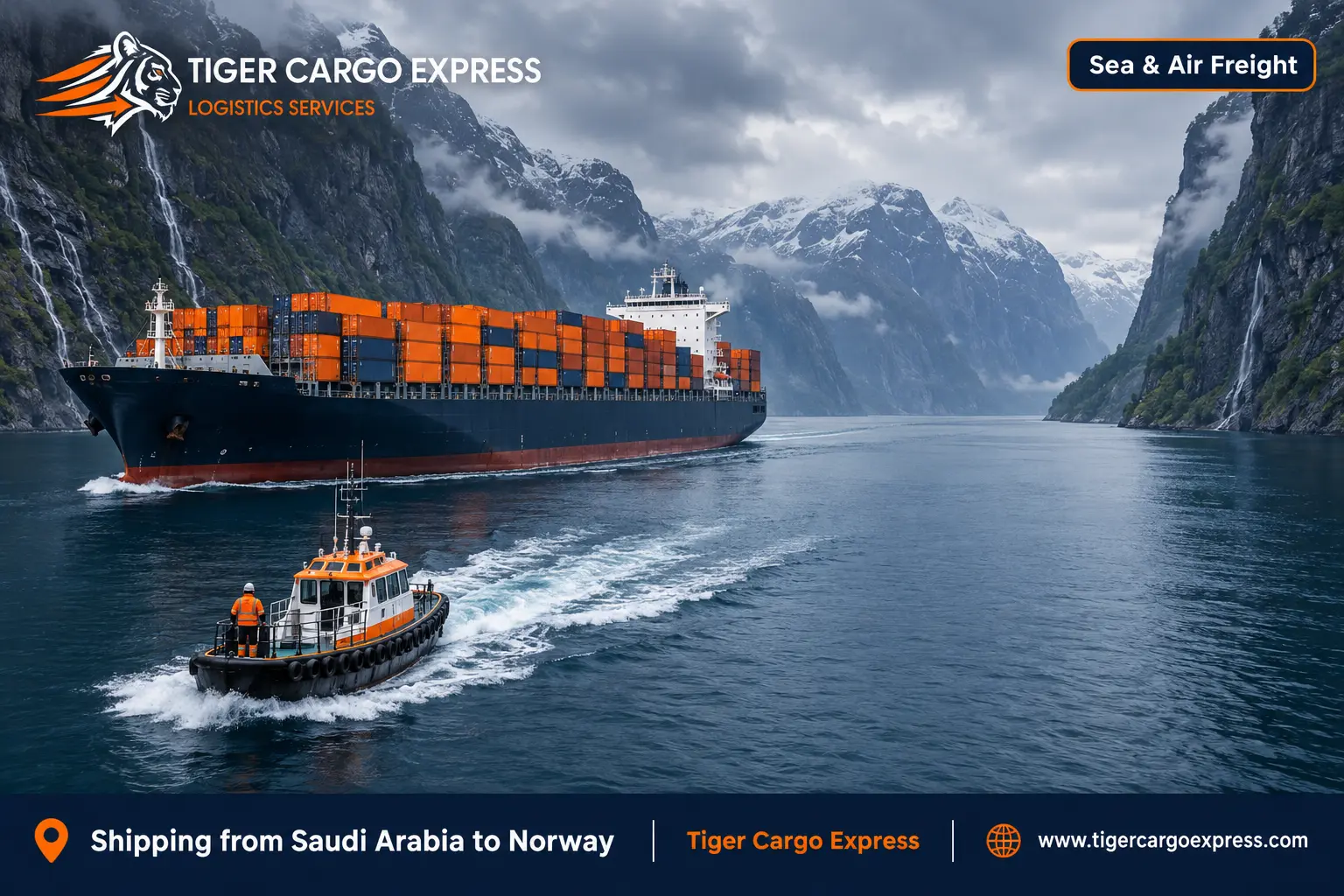
When your container calls at a port inside the European Union on its way to Oslo, it is passing through, not entering. Which means the paperwork must be prepared from the outset on the basis of a Norwegian destination rather than a European one. Confusing the two — an error we do see — creates a clearance route in the wrong place and drags your shipment into procedures that do not concern it. We fix the final destination in the documents from the moment the bill of lading is issued.
Full container or shared load?
| Aspect | Full container | Shared load |
|---|---|---|
| When it suits you | A whole home, a vehicle, or volume close to container capacity | A small flat, a researcher’s belongings, or part of a home |
| Clarity of the customs file | One file, one consignee — simpler on a non-EU route | One container, several files — and a delay in someone else’s may delay yours |
| Transit | Shorter — no waiting for a load to fill | Longer — consolidation before sailing and deconsolidation after |
| Cost | A fixed rate — better value the closer you get to filling it | Per cubic metre — better value for small volumes only |
A note specific to Norway: in a shared load, the customs files of several people sit in one container. On a non-EU route any shortfall in one person’s file is slower to resolve — and may hold up the unloading of the whole container. So if your schedule is tight, a full container buys you real independence rather than luxury.
Norwegian cities we cover
Door delivery from the south to the Arctic north.
Bergen
Stavanger
Trondheim
Drammen
Fredrikstad
Kristiansand
Sandnes
Tromsø
Sarpsborg
Skien
Bodø
Ålesund
Moss
Haugesund
Arendal
Shipping prices from Saudi Arabia to Norway
Indicative figures following sea-freight pricing logic — the final quote is built on the survey.
| Shipment type | Price range | Unit and notes |
|---|---|---|
| Shared load (LCL) | Request a quote — set by survey | Per cubic metre with a minimum |
| 20ft container | Request a quote — set by survey | Suits a mid-sized flat, or a vehicle with belongings |
| 40ft container | Request a quote — set by survey | Suits a full house, or two vehicles |
| Car shipping | Request a quote — set by survey | Freight cost only — excluding Norwegian taxes, inspection and registration |
| Non-EU clearance | Set in the quote, by your destination | A separate line — because the Norwegian route is not the EU route |
| Air freight | Request a quote — set by survey | By volumetric weight — for urgent cargo and the small first batch |
Note that we give clearance its own line in this table specifically. Because clearing in Norway is not an extension of a European clearance but a route in its own right with its own authority and forms — and anyone folding it into “general charges” is hiding a real item from you.
What actually sets your price?
Documents required for shipping to Norway
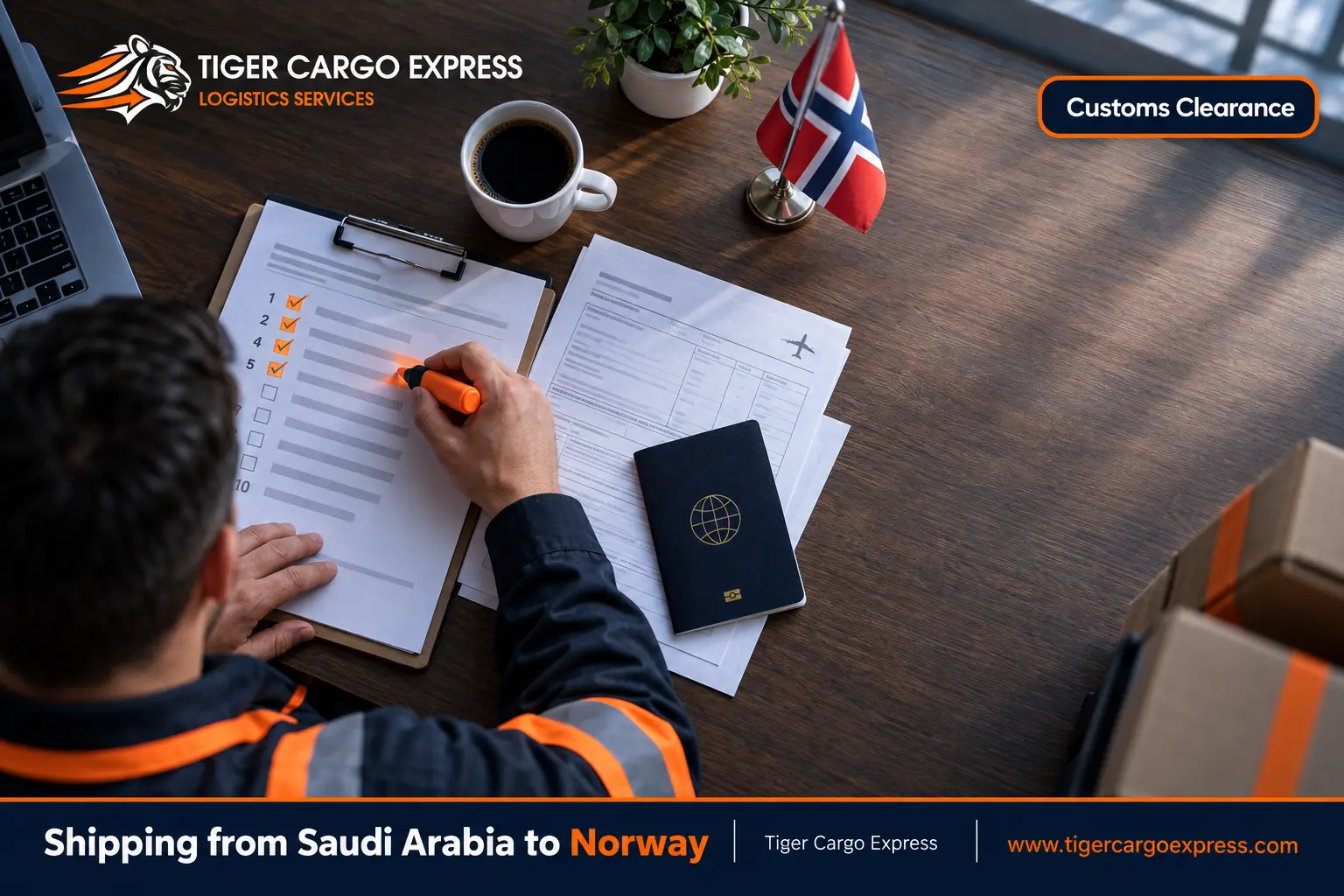
Do you hold a Norwegian identification number? We ask in the first minute. If the answer is no, there is a route to obtaining a number from Customs that lets a representative declare on your behalf — and it takes time, so it must start early. Anyone discovering this item when the container lands pays days of standing time for a piece of paper that could have been prepared while the ship was at sea.
Customs clearance and standing charges
We handle clearance at both ends. A container has a limited free period starting from discharge rather than from your notification, after which a daily charge applies for it remaining and another for late return to the shipping line.
For two recurring reasons: an incomplete removal goods declaration — and goods are not cleared until it is submitted correctly — or a missing identification number that would let a representative declare. Both are pieces of paper prepared during the sailing weeks at no cost, or prepared after arrival at a daily cost. We close both before the ship sails.
Prohibited and restricted items
- ▸ Professional equipment: not prohibited, but it does not enter relieved as removal goods — tell us at the survey.
- ▸ New items in original packaging: duty is payable — and an inventory that flags them saves you time and argument.
- ▸ Foodstuffs: duty is payable and import restrictions apply — they are not covered by the relief.
- ▸ Alcohol and tobacco: duty is payable even inside a household goods shipment.
- ▸ Flammables and pressurised goods: aerosols, paints, solvents, fuel and gas — excluded entirely.
- ▸ Plants, seeds and soil: heavily restricted — Norway guards its northern environment strictly.
- ▸ Weapons, ammunition and replicas: including souvenirs — with their own permit regime.
- ▸ Untreated timber: every crate and pallet needs approved treatment and marking.
Packing and insurance
The climatic gap between Riyadh and Oslo is among the sharpest in this entire series — and the challenge is not only the voyage but what follows delivery: timber houses, damp, and continuous indoor heating through winter.
Inland delivery after the port
- ▸ Timber houses with external steps: very common in Norway — delivery needs a larger crew and more time.
- ▸ Mountain roads and tunnels: height and weight limits on some routes — studied before the vehicle is chosen.
- ▸ Seasonal mountain passes: some close in winter — so the route changes and so does the transit.
- ▸ Domestic ferries: some western and northern destinations need one — on a fixed schedule booked in advance.
- ▸ Winter daylight hours: very short in the north — we build the delivery window on them, not on office hours alone.
The reverse direction — Norway to Saudi Arabia
We work both directions on the same services and ports. The dominant traffic out of Norway is marine and industrial equipment, spare parts and furniture, alongside the effects of people returning after work or study.
Note that exporting from Norway — being outside the Union — also has its own separate procedures, and what suffices for an export from a European state does not suffice here. We review your list before loading in both directions, because Saudi import restrictions follow their own logic, particularly for cosmetics and foodstuffs.
How to choose a shipping company to Norway
Our written guarantees
How to lower the cost of your shipment
- ▸ Settle the car decision first. It is the heaviest item here — and settle it on data rather than impression.
- ▸ Do not buy new furniture to ship along. New goods attract duty — buying before departure is a costly decision without your realising it.
- ▸ Tell us about your professional equipment early. Including it undeclared stops the file; declaring it settles the matter in minutes.
- ▸ Start the identification number early. A free piece of paper if prepared in time, an expensive one if prepared after arrival.
- ▸ Choose the port by the road, not the map. Bergen via Oslo means crossing mountains for nothing.
- ▸ Sort before you pack. Every cubic metre has a price on the longest route in this series.
- ▸ Allow full dismantling. It cuts volume appreciably, and volume is the invoice.
When do rates rise and transits lengthen?
| Period | What happens |
|---|---|
| July | The broad Norwegian holiday season — administrative and delivery slowdown, and those days count against your deadline. |
| August | Peak work relocations and the start of the academic year — pressure on containers and packing crews. |
| Deep winter | Mountain passes may close and daylight hours are short — inland delivery is slower and harder. |
| North Sea storms | Can delay short feeder vessels — and that delay falls after the transhipment call rather than before it. |
| Disruption on sea lanes | Rerouting lengthens transit and moves rates — we tell you as soon as we know. |
How we work: five steps
Five recurring mistakes — all avoidable
- ▸ Applying EU rules to Norway. The mistake most specific to this lane — the conditions, forms and deadlines differ entirely.
- ▸ Including professional equipment undeclared. It is not relieved — and discovery at the opening stops the whole file.
- ▸ Leaving the identification number until arrival. A costless piece of paper before sailing, a metered one after.
- ▸ Counting the vehicle inside the relief. It has its own tax regime, and assuming otherwise builds a budget that collapses.
- ▸ Passing the one-year deadline without applying for an extension. It can be extended for special reasons — but on application, not automatically.
Why Tiger Cargo Express?
Because the first thing we tell you on this lane is what does not apply to you. Most of what a client reads about shipping to Europe does not concern Norway, and most of our competitors reuse a ready-made European route on a destination that is not European in customs terms.
We give you the three differences in writing before you ship: an ID number started early, professional equipment that is not relieved, and a vehicle on a separate regime. And we point out what works in your favour too — such as the absence of a sale restriction — because candour runs both ways.
Frequently asked questions about shipping from Saudi Arabia to Norway
In summary
Shipping to Norway is not shipping to “another European country”. It is in Europe and outside its customs union, and its file is separate from the first document. Three things matter here: an identification number whose route starts early, an explicit declaration of professional equipment because it is not relieved, and a separate calculation for the vehicle because it has its own regime. Tiger Cargo Express gives you all three in writing before you ship — and tells you what works in your favour too.
Send your shipment details — approximate volume, origin city, your Norwegian city, when you moved or will move, whether you hold a Norwegian identification number, and whether professional equipment or a vehicle is included — and we reply with a detailed quote within 60 minutes. 0506688227
Where does Norway sit on our map?
Shipping to Norway is one lane within a wider region — and the full Europe guide explains the rules governing it and its neighbours together: the route, the customs framework, and the challenge that lane is priced around.
Related Shipping Guides
Continue with practical guidance connected to the same route or shipping decision.
Furniture and Car Shipping Company from Saudi Arabia to the Gulf 0506688227
⚠️ "How much does shipping to Kuwait cost?" is a question missing three things. Shipping from Riyadh is not shipping…
Shipping Company from Saudi Arabia to the Middle East 0506688227 — Overland Guide
The Middle East overturns all of it: it is the only destination whose journey starts at your front door rather…
Shipping Company from Saudi Arabia to Oceania 0506688227 — The Biosecurity Guide
On every preceding continent the question was: what is inside your shipment? Oceania asks an entirely different one: what is…
Send your shipment details and get a written quote
We reply within 60 minutes during working hours — with what the price includes and what it does not, stated before you commit.