
Car and Furniture Shipping Company from Saudi Arabia to France 0506688227 Your Obligation Begins After Clearance, It Does Not End There
Shipping cars and household goods from Saudi Arabia to France by sea—specifically to Marseille or Le Havre—involves a process that extends beyond mere customs clearance. Customs duty exemption is conditional upon retaining and using the items for a specified period after importation, without disposing of them during that time. There is also a practical requirement that causes many applications to be rejected: a detailed, signed, and stamped inventory in French, listing brands and serial numbers. This guide explains the entire documentation process and how to select the port based on calculations rather than habit.
Guide contents ShowHide
Looking for a shipping company from Saudi Arabia to France that knows the file does not close on delivery? Tiger Cargo Express ships furniture, vehicles and cargo to Paris, Lyon, Marseille, Toulouse, Nice and the rest of France — by sea and air, with dismantling, packing and reassembly, customs clearance at both ends, and insurance on the load. To book: 0506688227
This lane differs from others in a point most people planning a move overlook: in many destinations your relationship with customs ends the day you receive your shipment. Here, the obligation begins after clearance and does not end with it.
French relief from duty and VAT is conditional on what you do with your belongings after they arrive: keeping and using them for a set period, and not disposing of them within it. And a practical requirement sinks many files before they even start: a detailed inventory in French, signed and stamped, listing makes and serial numbers.
We build the file to that standard from day one — because preparing it after arrival is practically impossible.
What do we ship from Saudi Arabia to France?
Traffic dominated by people relocating for residence and study, property owners, and corporate cargo.
Your obligation begins after clearance, it does not end there
French rules grant a relocator full relief from customs duty and VAT on furniture, belongings and a vehicle. It is generous, clear and used every day.
But it is not a gift without conditions — it is an implicit undertaking whose terms extend beyond arrival. Anyone who reads it as a stamp on a form whose job ends at the port gate can find themselves in a difficult position months later.
Five conditions — three before arrival and two after
| Condition | When? | What it means in practice |
|---|---|---|
| Prior residence outside the Union | Before | Twelve continuous months outside the European Union before the move. |
| Prior ownership and use | Before | The goods must have been in your personal use for a sufficient period — and valuables require evidence. |
| Transfer of principal residence | Before | France must become your main home on a permanent basis — not a second home and not a seasonal property. |
| Arrival within the window | At | Goods must arrive within a defined period from the date your residence is established, and may come in several consignments. |
| ⭐ Keeping and using | After | The goods must remain in your possession and use for a set period after import — no sale, loan, pledge or hire without prior notification. |
A client arrives, and two months later decides the furniture does not suit the new home — so they sell it and buy something else. A perfectly ordinary thing to do, except that it touches a condition of the relief file. We say this before anyone ships, not to frighten them but so they can decide knowingly: do they actually ship the furniture, or sell here and buy there? A fair question — and plenty of people find the second answer works out better for them.
The French inventory — the document that sinks files
This is where we see most trouble on this lane. The French file does not accept a generic “list of belongings” — it needs a detailed inventory drawn up in French, signed by the owner and by the mover, at a level of detail beyond what you are used to elsewhere.
For high-value items — watches, jewellery, paintings, antiques, rugs and expensive electronics — evidence of prior ownership is usually required: an invoice, a bank statement or an insurance document dated sufficiently before shipping. Someone who has owned a piece for ten years with no invoice needs an alternative that establishes possession. We identify that at the survey, because hunting for an old invoice after you have travelled is a hard task.
What we set out is the framework as we work with it in practice; rules are updated from time to time and customs offices may differ on points of detail. So we review the current conditions with you before booking. We prepare the file and coordinate the timing — we do not provide legal or tax advice.
Shipping for embassies, consulates and their staff
Paris is among the largest diplomatic capitals in the world — and these shipments follow their own route.
Shipments for diplomatic and consular missions and their staff do not go through the transfer of residence route and are not bound by its conditions — including the post-import holding requirement explained above. The basis here is the status of the mission or of your accreditation with it, not your previous residence or how long you have owned your belongings.
Beyond Paris, France hosts consulates and representations in Marseille, Lyon and Strasbourg — and headquarters of international organisations with their own treatment. Each location has a best-suited port and a different inland route, settled at booking.
How we work with missions
- ▸ We start with the mission’s administrative department, not with the individual — the official correspondence is the foundation of the file.
- ▸ We match consignee name and title between the correspondence and the bill of lading word for word, before issuing it.
- ▸ We schedule sailing around the accreditation date rather than around when the furniture is ready — the order is reversed here.
- ▸ We document the inventory to a higher standard and hand it over endorsed by both sides, because it is examined closely.
- ▸ We allow for access and permit requirements at official buildings and their surroundings on delivery.
- ▸ We handle everything in confidence — information, contents and movement schedules alike.
And we are clear: what the diplomatic exemption covers and how far it extends is for the competent authorities in the receiving state to determine, and the mission has its own official channels. Our role is purely logistical: we ship, coordinate and prepare a clean, consistent file. We work in both directions: foreign missions in the Kingdom, and Saudi missions in France.
Car shipping from Saudi Arabia to France
A precise documentary file — and it starts before the vehicle is loaded.
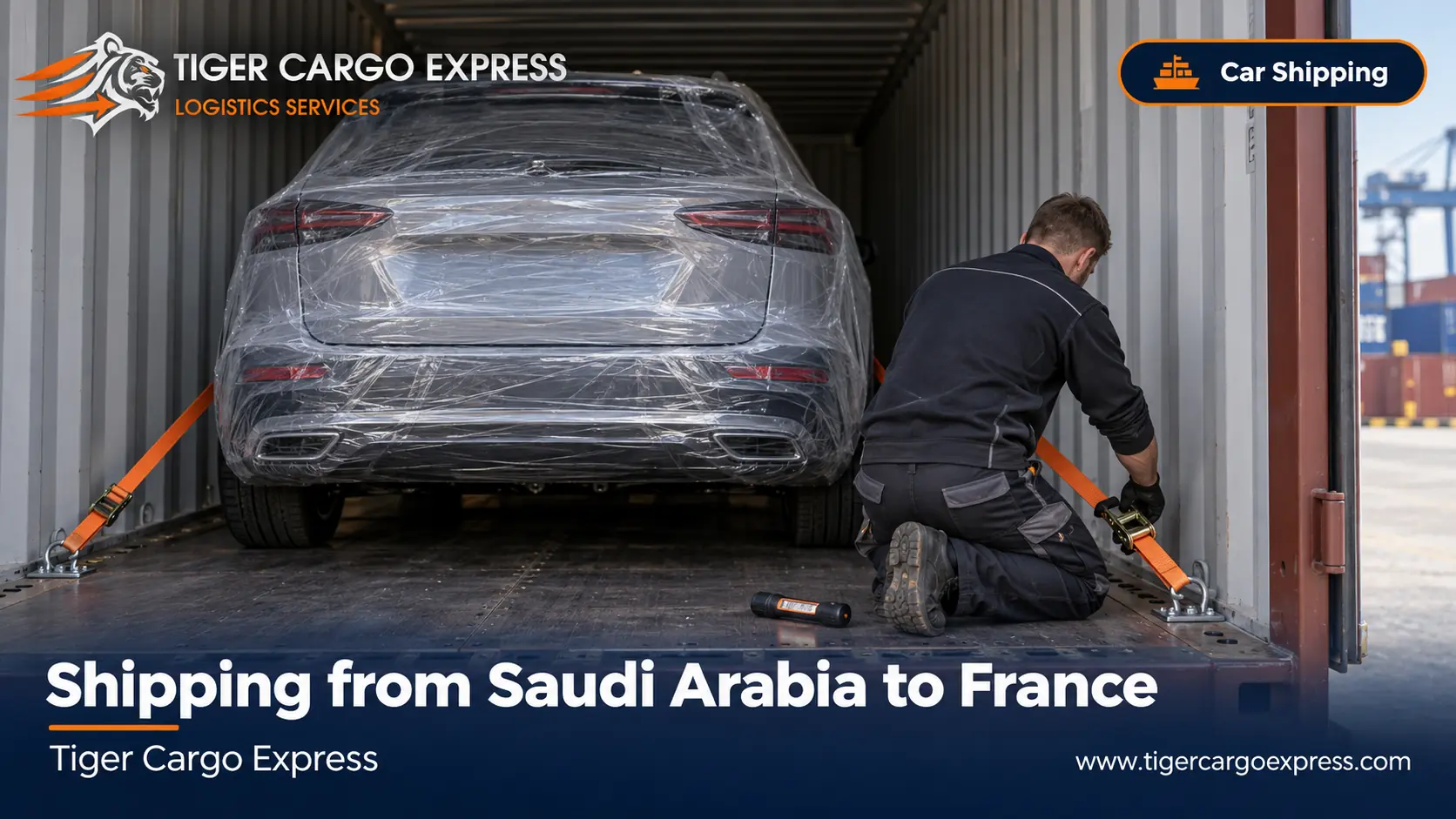
France drives on the right as Saudi Arabia does, so there is no conversion stage. But the French vehicle file is documentary above all — and it calls for papers that must be prepared before shipping rather than after.
What the vehicle file usually requires
- ▸ The original title and purchase invoice — not a copy and not an uncertified duplicate.
- ▸ The chassis number on the inventory rather than on a separate sheet — listed as its own line on the French list.
- ▸ A dated photograph of the odometer — a small detail that gets asked for and surprises many.
- ▸ Evidence of prior use: a valid insurance card and the Saudi registration documents.
- ▸ Evidence of technical conformity: a European certificate of conformity where one exists for the model, otherwise a longer approval route.
- ▸ Tax clearance for the vehicle — a document obtained in France that precedes registration and cannot be substituted.
This is what escapes anyone thinking of shipping their car and then selling it there because prices are higher. A vehicle admitted under transfer of residence relief is subject to the same holding and disposal restriction as the furniture. If that was the plan, better to know now — not after a buyer has been found.
Two ports on two different seas — and that changes the transit
The most significant logistical difference in this guide — with no equivalent in most European destinations.
France is one of the few countries facing both the Mediterranean and the Atlantic. That is not a geographical footnote but a real difference in how long your shipment takes.
A shipment bound for Marseille ends its voyage inside the Mediterranean. One bound for Le Havre continues west, exits through the Strait of Gibraltar and then heads north — extra sea stages that mean extra days.
| Port | Sea and route | Best suited to |
|---|---|---|
| Marseille-Fos | Mediterranean — the voyage ends after Suez with no exit to the Atlantic | The south and south-east — Marseille, Nice, Toulon, Montpellier, and usually Lyon |
| Le Havre | The Channel — after the Mediterranean, then Gibraltar, then north | Paris, the north and the west — Rouen, Lille, Rennes, Nantes |
If your destination is in the south or centre, Marseille is usually faster and cheaper. If it is Paris or the north, Le Havre is closer by road despite the longer sea leg. The case that needs real calculation is central France, where the two converge and details like sailing schedules and delivery distance decide it. We cost both routes in days and money and show you both figures — because the gap can be a full week.
Furniture moving from Saudi Arabia to France
From dismantling a piece in your home to reassembling it in your new one.
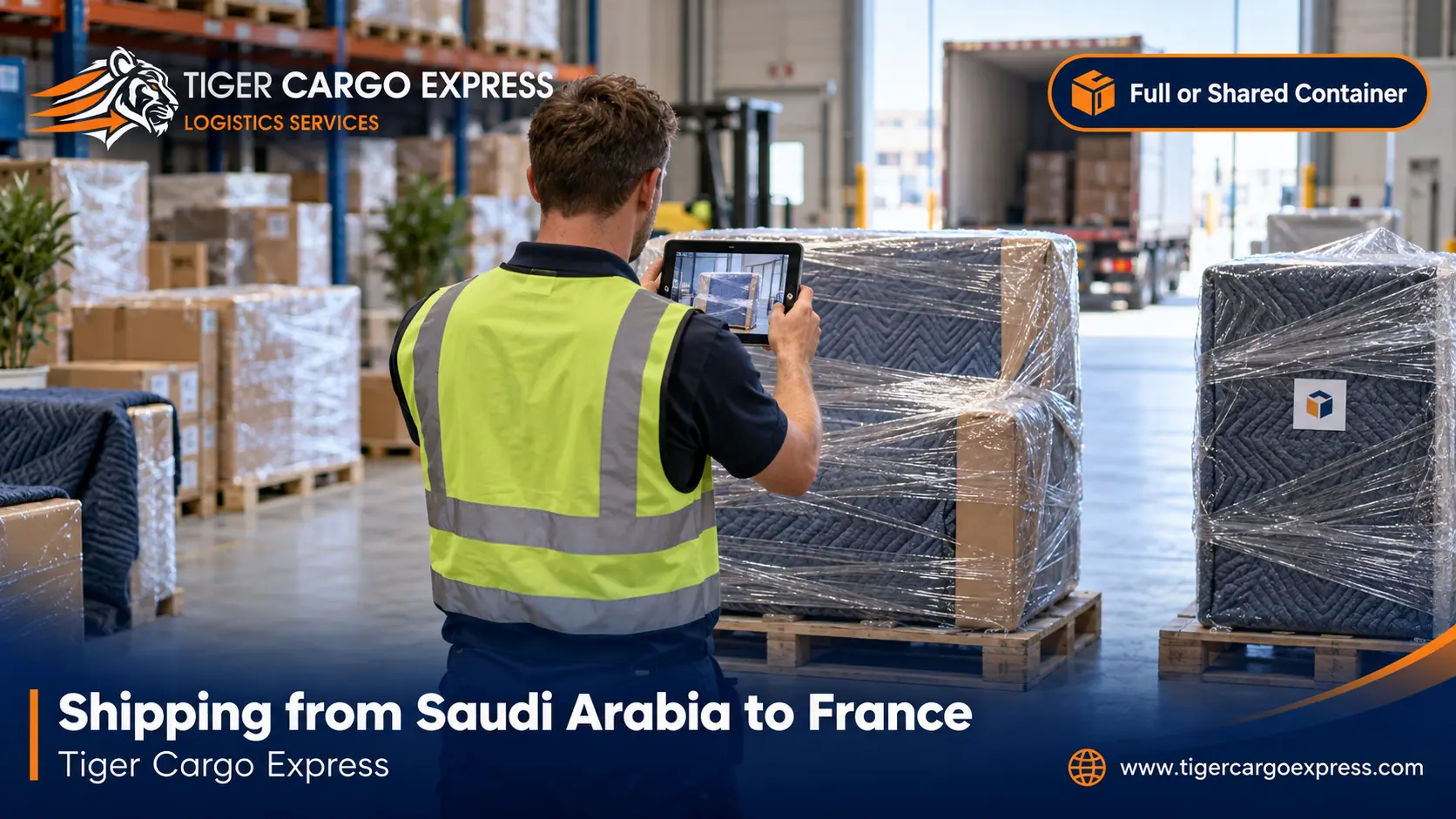
On this lane packing is not a process running alongside the inventory but a single operation with it. The technician wrapping the appliance is the one who reads its serial number, photographs it and records it. Separate the two and you end the day with a sealed container and an incomplete list — with no way to finish it but to open it.
- ▸ Survey and assessment: volume in cubic metres, and identifying which items will need ownership evidence.
- ▸ Professional dismantling: bedrooms, kitchens and shelving — full dismantling cuts volume, and volume is your invoice.
- ▸ Multi-layer packing: bubble, then blankets, then stretch film, with glass and mirrors in lined crates.
- ▸ Treated and stamped timber crates: a European condition of entry — applied to every crate we build.
- ▸ Reading and photographing serial numbers during packing and entering them on the French inventory immediately.
- ▸ A logged seal: photographed, its number handed to you, opened only in front of you or someone you authorise.
- ▸ Unpacking and reassembly: in your new home — not boxes left at the door.
Two shipping methods — and sea is the reality here

Full container or shared load?
| Aspect | Full container | Shared load |
|---|---|---|
| When it suits you | A whole home, a vehicle, or volume close to container capacity | A small flat, a student’s belongings, or part of a home |
| Transit | Shorter — no waiting for a load to fill | Longer — consolidation before sailing and deconsolidation after |
| Port flexibility | You choose Marseille or Le Havre to suit your destination | You follow the consolidated container — with narrower options |
| Cost | A fixed rate — better value the closer you get to filling it | Per cubic metre — better value for small volumes only |
French cities we cover
Door delivery across mainland France.
Marseille
Lyon
Toulouse
Nice
Nantes
Montpellier
Strasbourg
Bordeaux
Lille
Rennes
Toulon
Grenoble
Cannes
Annecy
Rouen
Shipping prices from Saudi Arabia to France
Indicative figures following sea-freight pricing logic — the final quote is built on the survey and on the arrival port.
| Shipment type | Price range | Unit and notes |
|---|---|---|
| Shared load (LCL) | Request a quote — set by survey | Per cubic metre with a minimum |
| 20ft container | Request a quote — set by survey | Suits a mid-sized flat, or a vehicle with belongings |
| 40ft container | Request a quote — set by survey | Suits a full house, or two vehicles |
| Car shipping | Request a quote — set by survey | Inside a closed container — excluding French registration costs |
| Air freight | Request a quote — set by survey | By volumetric weight — for urgent and sensitive cargo only |
And a France-specific note: preparing the detailed French inventory is real work that takes time — reading and photographing serial numbers, drafting the list in French and valuing it in euros. It is included in our quote rather than added to it, but we mention it so you know that a cheaper quote which excludes it is handing that work back to you.
What actually sets your price?
Documents required for shipping to France

A question we get constantly from people who have not yet settled. One of three is normally accepted: a tenancy agreement, a title deed, or an employer’s letter stating your address. What matters is having a documented address to build the file on. Waiting until you are fully settled eats into the time window — which runs from the date you transfer your residence, not from the date you feel ready.
Customs clearance and port standing charges
We handle clearance at both ends. A container landing at Marseille or Le Havre gets a limited free period starting from discharge rather than from your notification, after which a daily charge applies for it remaining and another for late return to the line.
In our experience the leading cause here is not a missing document but an inventory that does not match: an item in the container that is not on the list, a description too general to accept, or an unreadable serial number. Fixing that after arrival means opening the container, a fresh inventory and days of standing time. So we invest the time in the inventory before sealing — an extra hour in the warehouse saves a week at the port.
Prohibited and restricted items
- ▸ Flammables and pressurised goods: aerosols, paints, solvents, fuel and gas — excluded entirely.
- ▸ Alcohol and tobacco: outside the transfer of residence relief, with their own regime.
- ▸ Food and animal or plant products: tightly restricted under European sanitary and phytosanitary controls.
- ▸ Antiquities and antiques: may need additional documents establishing origin and lawful ownership — France is exacting on this.
- ▸ Products of protected species: ivory, certain hides, shells and rare woods — even as an old decorative piece.
- ▸ Weapons, ammunition and replicas: including souvenirs — treatment is strict.
- ▸ Counterfeits and IP infringements: seized and a case opened — French enforcement is very active.
- ▸ Untreated timber: every crate and pallet needs approved treatment and marking.
Packing and insurance
The shipment travels from a hot, dry climate into a temperate, damp one and spends weeks in salt-laden air. The swing — not the voyage — is what damages wooden furniture.
Inland delivery after the port
- ▸ Old Parisian buildings: narrow spiral staircases and small lifts — many deliveries need an external hoist through the window. A real line item costed in advance once we ask about the floor and stair width.
- ▸ A parking permit outside the building: routine in French cities, requested from the town hall well ahead of the slot.
- ▸ Narrow streets and historic centres: no access for a container lorry, so we tranship to a smaller vehicle from a nearby depot.
- ▸ Vehicle access restrictions in some cities: allowed for in the choice of vehicle and the timing.
- ▸ An agreed slot: we set a time window, keep to it, and tell you of any change as it happens.
The reverse direction — France to Saudi Arabia
We work both directions on the same services. The dominant traffic out of France is returnees’ effects, furniture and antique purchases, and corporate equipment and goods.
Note that Saudi import restrictions follow their own logic — particularly on cosmetics, foodstuffs, wireless devices and certain categories that leave without a question. We review your list before loading in both directions.
How to choose a shipping company to France
Our written guarantees
How to lower the cost of your shipment
- ▸ Settle “ship or buy there?” first. With the post-import holding restriction, selling here and buying there can be cheaper and simpler — and we will say so.
- ▸ Choose the port by calculation, not habit. Marseille can save you a full week if your destination is in the south.
- ▸ Sort before you pack. Every piece entering the container also enters the inventory — sorting saves volume and documentation time alike.
- ▸ Allow full dismantling. It cuts volume appreciably, and volume is the invoice.
- ▸ Gather ownership evidence before travelling. Easy to obtain from Saudi Arabia, hard from France.
- ▸ Describe your home accurately. Floor, stair width and whether there is a lift — discovering them on delivery day costs more than costing them in advance.
- ▸ Book early. Wider sailing options and calmer rates, especially ahead of summer.
When do rates rise and transits lengthen?
| Period | What happens |
|---|---|
| Summer | Peak relocation — and August in particular is a broad holiday season in France that slows procedures and delivery. |
| Start of the academic year | A wave of student shipments — book well ahead of it. |
| Channel winter | Affects the Le Havre route specifically and not Marseille — another difference between the two ports. |
| Disruption on sea lanes | Rerouting lengthens transit and moves rates — we tell you as soon as we know. |
| Strikes and public holidays | Port stoppages at either end add days — we build them into the schedule rather than ignore them. |
How we work: five steps
Five recurring mistakes — all avoidable
- ▸ Assuming the file closes on delivery. The mistake most particular to France — and the post-import obligation applies whether you noticed it or not.
- ▸ A generic inventory with no serial numbers. The commonest reason shipments stop here — and fixing it after sealing means opening the container.
- ▸ Shipping valuables with no ownership evidence. Discovered on arrival, when hunting for an old invoice is far too late.
- ▸ Choosing the port without calculating. A shipment to Nice via Le Havre means an extra week and hundreds of needless kilometres.
- ▸ Overlooking delivery difficulty. “Fifth floor, no lift” in an old Parisian building is not a detail — it is a cost line of its own.
Why Tiger Cargo Express?
Because the hard part of shipping to France is not the sea but the paperwork — and that is precisely what we take on. We prepare the French inventory ourselves with makes, serial numbers and euro valuations, and we identify which items need ownership evidence before you travel rather than after.
And we explain your post-arrival obligations plainly, even where doing so leads you to decide against shipping your furniture at all. Because a client who decided knowingly is better for us than one who shipped and then regretted it.
Frequently asked questions about shipping from Saudi Arabia to France
In summary
Shipping from Saudi Arabia to France is a file before it is a shipment. Three things matter here: a detailed, signed French inventory with serial numbers, a port chosen by calculation rather than habit, and a clear understanding of your obligations after arrival. Tiger Cargo Express gives you all three in writing before you ship.
Send your shipment details — approximate volume, origin city, your French city, your floor and whether there is a lift, and whether a vehicle is included — and we reply with a detailed quote within 60 minutes. 0506688227
Where does France sit on our map?
Shipping to France is one lane within a wider region — and the full Europe guide explains the rules governing it and its neighbours together: the route, the customs framework, and the challenge that lane is priced around.
Related Shipping Guides
Continue with practical guidance connected to the same route or shipping decision.
Furniture and Car Shipping Company from Saudi Arabia to the Gulf 0506688227
⚠️ "How much does shipping to Kuwait cost?" is a question missing three things. Shipping from Riyadh is not shipping…
Shipping Company from Saudi Arabia to the Middle East 0506688227 — Overland Guide
The Middle East overturns all of it: it is the only destination whose journey starts at your front door rather…
Shipping Company from Saudi Arabia to Oceania 0506688227 — The Biosecurity Guide
On every preceding continent the question was: what is inside your shipment? Oceania asks an entirely different one: what is…
Send your shipment details and get a written quote
We reply within 60 minutes during working hours — with what the price includes and what it does not, stated before you commit.