
Car and Furniture Shipping Company from Saudi Arabia to the Netherlands 0506688227 Arrived at Port Does Not Mean Released From Port
Shipping cars and household goods from Saudi Arabia to the Netherlands involves sea transport to Rotterdam—Europe’s largest port. This is where customers often face a financial surprise: the container’s arrival does not mean it has cleared the port. Between the ship docking and your shipment leaving the port, there are customs clearance procedures and handling schedules to navigate. Furthermore, the container is allotted a limited number of "free days," after which fees begin to accrue—in fact, two separate "clocks" start ticking, not just one. This guide explains how these timeframes work and why having complete documentation ready before arrival saves more money than any price negotiation.
Guide contents ShowHide
Looking for a shipping company from Saudi Arabia to the Netherlands that knows your bill can grow after your shipment lands? Tiger Cargo Express ships furniture, vehicles and cargo to Amsterdam, Rotterdam, The Hague, Utrecht and the rest of the Netherlands — by sea and air, with dismantling, packing and reassembly, customs clearance at both ends, and insurance on the load. To book: 0506688227
This lane ends at Europe’s largest port — which gives you wide sailing options and services you will not find elsewhere. But it also carries the single biggest financial surprise on any European lane.
The surprise is not in the freight rate but in what follows it: “the container has arrived” does not mean “the container has left the port”. Between those two moments a daily meter runs quietly — and in fact there are two meters, not one.
Anyone who understands how those meters work pays the freight rate and nothing more. Anyone who does not may pay a second invoice with nothing to show for it.
What do we ship from Saudi Arabia to the Netherlands?
Traffic combining relocations for work and study, corporate cargo, and transit into Europe.
“Arrived at port” does not mean “released from port”
When the arrival notice reaches you, most people feel the job is done. That is precisely the moment when the cost can begin.
Between the vessel berthing and your container leaving the gate sits a chain of steps: discharge from the ship, placement in the yard, filing the customs declaration and obtaining release, booking a collection slot, and the road haulage itself. Each takes time — and the port gives you a limited number of free days to complete all of them.
That the free period begins when you are notified of arrival. In reality it begins at discharge of the container from the vessel — and a day or two may pass before any information reaches you. In other words, you have started spending your allowance before you knew the allowance was running.
Two meters, not one
This detail escapes even some people working in the trade: once the free period ends, it is not one charge that starts but two independent charges, each with its own cause, its own recipient and its own calculation. One can be running while the other has stopped.
| Aspect | Charge for the container staying at the port | Charge for late return of the container |
|---|---|---|
| Cause | The container remaining inside the terminal beyond the free period | Late return of the empty container to the shipping line after unloading |
| When it starts | After the port’s free days expire | After the shipping line’s free days expire — a separate allowance |
| When it stops | When the container passes the terminal gate | When the empty container is returned to the designated depot |
| Who charges it | The container terminal | The shipping line that owns the container |
| The trap in it | It escalates the longer the container stands | It keeps running after your goods are already in your home, if the box is not back |
The shipment reaches their home, the furniture is unpacked and reassembled — and days later a charge arrives. The reason is that the empty container stayed with them or in transit and was not returned to the depot in time. This is a meter that stops on return, not on delivery — and we manage that step ourselves rather than leave it to you.
How we manage the meter for you
Six actions carried out before the vessel arrives, not after.
That any standing charges arising from a delay on our side are ours to bear. We write that into the quote rather than say it verbally. Anything arising from a missing document on your side or a change of delivery address we set out for you in advance and warn you about before it happens — because our job is to prevent the charge, not to argue about it once issued.
Rotterdam is a gateway, not a destination
An option that may serve you even if the Netherlands is not your destination at all.
Most people looking to ship to Germany, Belgium or eastern France assume the entry point is that country’s own port. Sometimes it is — but it is not the rule. Rotterdam is a gateway to a continent rather than a national port, and behind it lies an inland network of waterways and rail reaching into the heart of Europe.
We are not saying Rotterdam is always the answer — we cost it and compare. If your destination is Munich, Hamburg or even a Mediterranean port may work out better. But having the option put on the table at all beats booking out of habit.
Shipping for embassies, consulates and their staff
The Hague is a city of missions and international organisations — and these shipments follow their own route.
Shipments for diplomatic and consular missions and their staff do not go through the transfer of residence route and are not bound by its conditions. The basis here is the status of the mission or of your accreditation with it, not your previous residence. That changes the documents, the channel and the authority addressed, entirely.
The Netherlands is distinctive in that The Hague hosts — alongside bilateral missions — a number of international organisations and courts, whose staff may be treated differently from an ordinary diplomatic agent depending on each body’s headquarters agreement. We ask about this on the first call, because it determines the whole route of the file.
- ▸ We start with the mission’s administrative department, not with the individual — the official correspondence is the foundation of the file.
- ▸ We match consignee name and title between the correspondence and the bill of lading word for word before issuing it.
- ▸ We schedule sailing around the accreditation date rather than around when the furniture is ready.
- ▸ We document the inventory to a higher standard and hand it over endorsed by both sides.
- ▸ We allow for access and permit requirements at official buildings on delivery.
- ▸ We handle everything in confidence — information, contents and movement schedules alike.
And we are clear: what the exemption covers and how far it extends is for the competent authorities in the receiving state to determine, and the mission has its own official channels. Our role is purely logistical. We work in both directions: foreign missions in the Kingdom, and Saudi missions in the Netherlands.
Car shipping from Saudi Arabia to the Netherlands
A Dutch tax item worth asking about before you book.
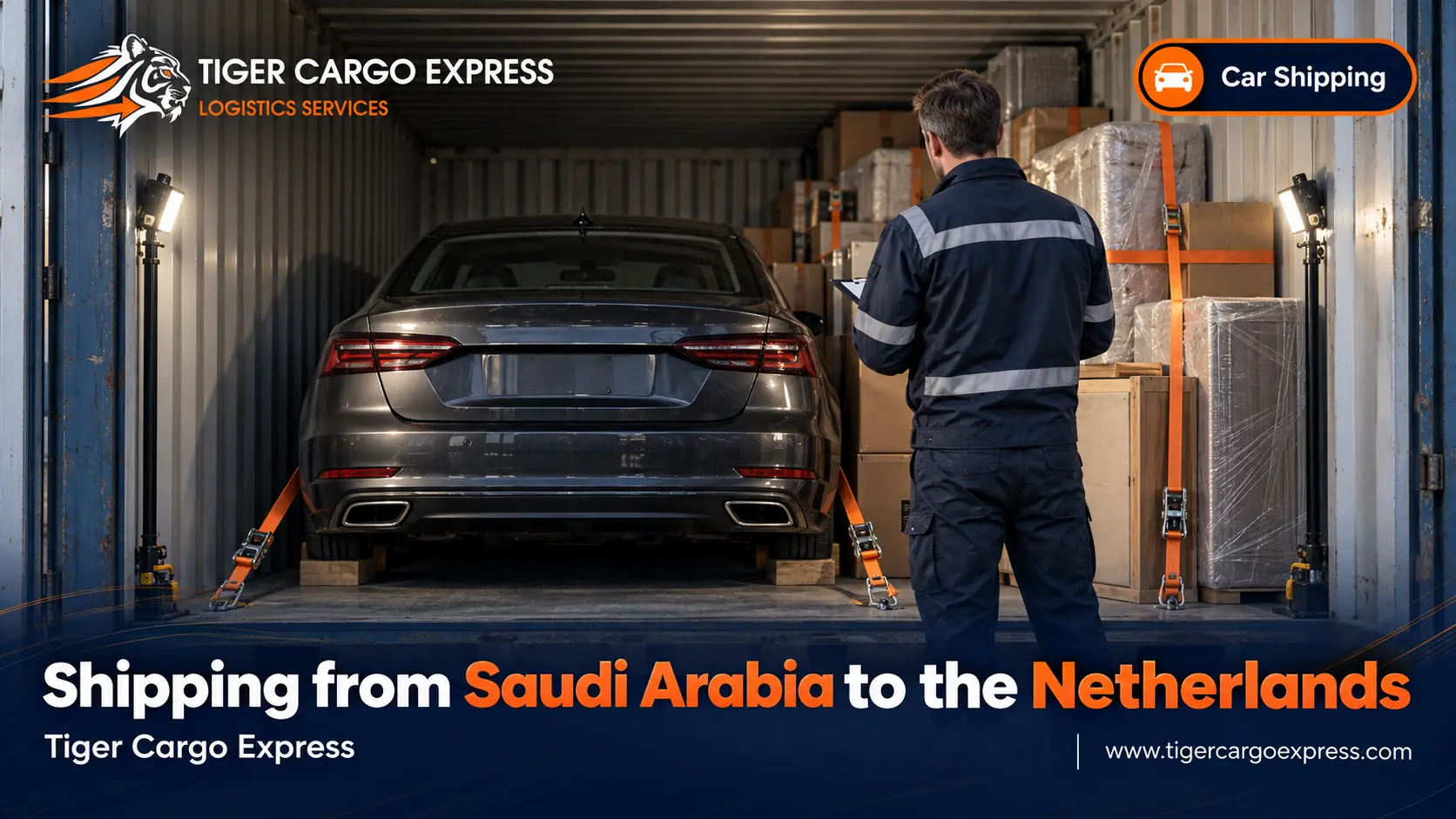
The Netherlands drives on the right as Saudi Arabia does, so there is no conversion stage. But registering a vehicle here passes through a separate financial item: vehicle registration tax, a Dutch tax due when the vehicle is registered and calculated on its characteristics.
And the important part: there is an exemption route from that tax tied to a transfer of residence, subject to conditions about how long you have owned and used the vehicle before moving, your previous residence outside the country, and a period during which you must keep the vehicle after registration. It is applied for — it is not granted automatically.
Because the gap between a vehicle that qualifies for the exemption and one that does not can be very large — large enough to turn your decision from shipping it to selling it. We ask for the model, the year, when you bought it and how long you have used it, and we review the route with you before booking. We do not promise the exemption — we tell you what the framework is and where you stand within it, and the decision rests with the competent authority.
The vehicle route in brief
The arrival port
Rotterdam is the arrival port for most shipments — Europe’s largest and busiest, which means wider sailing options and greater flexibility on dates. For certain specialised services, Amsterdam is used.
Distances within the Netherlands are short compared with other European countries, so road haulage from Rotterdam to any Dutch city is not a large line on the invoice. That makes the port choice a simpler decision here than in France or Germany — and puts the entire focus on managing time inside the port rather than outside it.
Furniture moving from Saudi Arabia to the Netherlands
From dismantling a piece in your home to reassembling it in your new one.
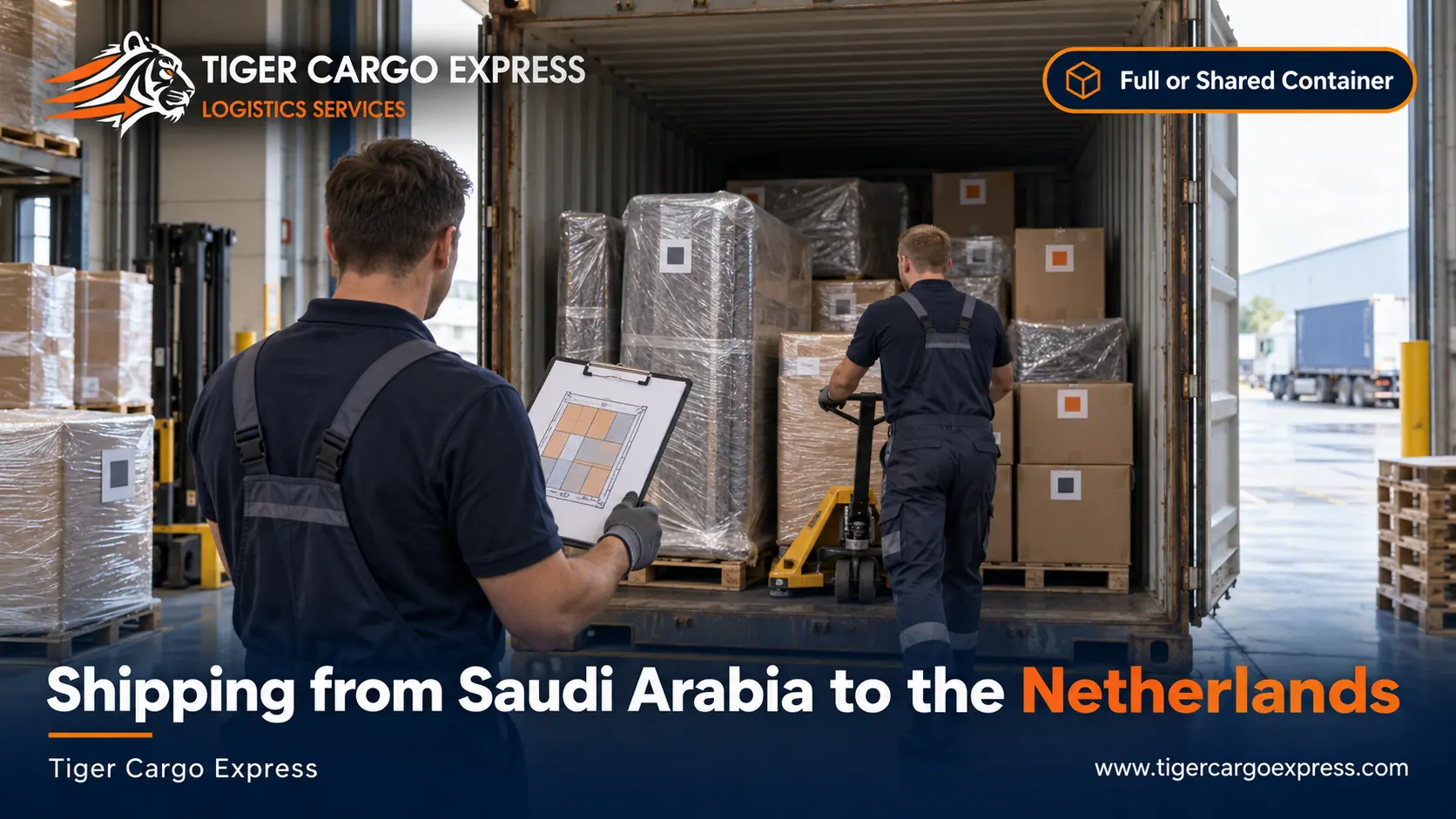
On this lane the loading order takes on financial rather than merely organisational importance. A container packed to a clear plan is stripped in hours; one loaded haphazardly costs an extra day — and an extra day here means a meter running.
- ▸ Survey and assessment: volume in cubic metres, and deciding what is dismantled and what needs a crate.
- ▸ Professional dismantling: bedrooms, kitchens and shelving — full dismantling cuts volume, and volume is your invoice.
- ▸ Multi-layer packing: bubble, then blankets, then stretch film, with glass and mirrors in lined crates.
- ▸ Treated and stamped timber crates: a European condition of entry — applied to every crate we build.
- ▸ A written loading plan: what comes off first goes on last — real time saved at delivery.
- ▸ Numbering and photographic inventory: a copy in your hands before sailing, serving insurance, customs and handover.
- ▸ Unpacking and reassembly: in your new home — not boxes left at the door.
Two shipping methods — and sea is the reality here
Full container or shared load?
| Aspect | Full container | Shared load |
|---|---|---|
| When it suits you | A whole home, a vehicle, or volume close to container capacity | A small flat, a student’s belongings, or part of a home |
| Standing charges | Yours alone — and fully under control if the file is well managed | Follow the consolidated container — another party’s delay can affect the schedule |
| Transit | Shorter — no waiting for a load to fill | Longer — consolidation before sailing and deconsolidation after |
| Cost | A fixed rate — better value the closer you get to filling it | Per cubic metre — better value for small volumes only |
On a shared load the container is stripped at a warehouse near the port and returned empty quickly, and your goods are then delivered from the warehouse. Which means the container-return meter is not yours at all. That is a genuine advantage for smaller consignments on this lane in particular — and we say so plainly when comparing.
Dutch cities we cover
Door delivery across the whole country — and distances here are short.
Rotterdam
The Hague
Utrecht
Eindhoven
Tilburg
Groningen
Almere
Breda
Nijmegen
Apeldoorn
Arnhem
Haarlem
Amersfoort
Maastricht
Leiden
Shipping prices from Saudi Arabia to the Netherlands
Indicative figures following sea-freight pricing logic — the final quote is built on the survey.
| Shipment type | Price range | Unit and notes |
|---|---|---|
| Shared load (LCL) | Request a quote — set by survey | Per cubic metre with a minimum — and no container-return meter |
| 20ft container | Request a quote — set by survey | Suits a mid-sized flat, or a vehicle with belongings |
| 40ft container | Request a quote — set by survey | Suits a full house, or two vehicles |
| Car shipping | Request a quote — set by survey | Inside a closed container — excluding Dutch registration tax and inspection |
| Air freight | Request a quote — set by survey | By volumetric weight — for urgent and sensitive cargo only |
And the point we press hardest here: standing charges are not part of any quote in this market — ours or anyone else’s — because they only arise on delay. The difference is that some companies never mention them, so the client is caught out; we mention them, explain how we prevent them, and commit to bearing any that arise through us.
What actually sets your price?
Documents and customs relief
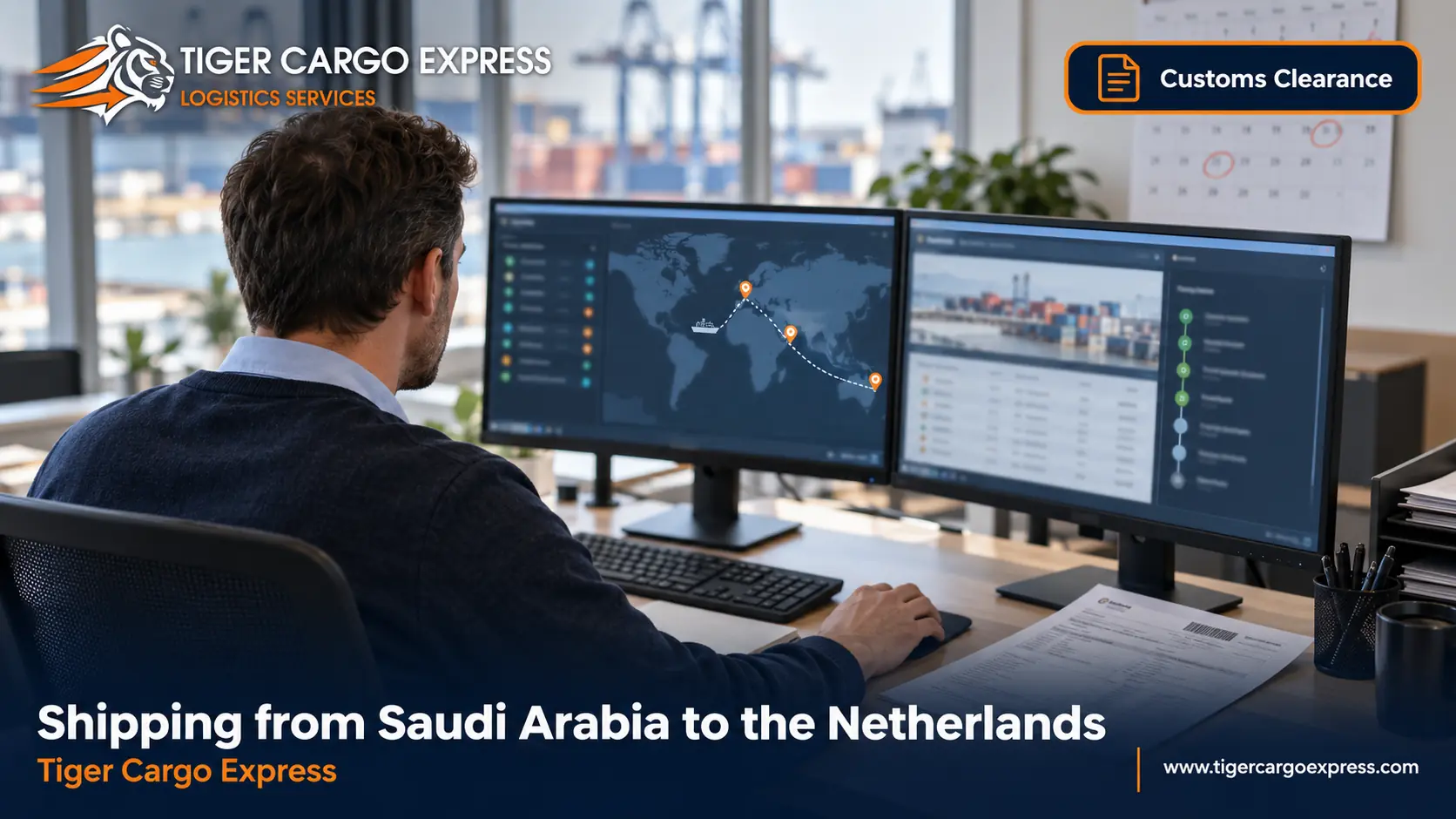
The Netherlands is part of the European Union, so the removal goods relief here follows the same European framework: twelve continuous months of normal residence outside the Union, an actual move of residence, prior ownership and use in household quantities, arrival within a defined window, and a restriction on disposal for a period after import.
Because every day lost on paperwork turns into a daily charge at the port. A missing document elsewhere means waiting at no cost; here it means a meter running. So we ask for your complete file before sailing rather than before arrival — and we would rather delay the sailing than sail on a short file.
What we set out is the framework as we work with it in practice, and rules are updated from time to time. So we review the current conditions with you before booking. We prepare the file and coordinate the timing — we do not provide legal or tax advice.
Prohibited and restricted items
- ▸ Flammables and pressurised goods: aerosols, paints, solvents, fuel and gas — excluded entirely.
- ▸ Alcohol and tobacco: outside the removal goods relief, with their own regime.
- ▸ Food and animal or plant products: tightly restricted under European sanitary and phytosanitary controls.
- ▸ Plants, seeds and soil: effectively prohibited, and soil residue on garden tools triggers inspection.
- ▸ Counterfeits and IP infringements: Rotterdam is among the most active European ports on this front.
- ▸ Weapons, ammunition and replicas: including souvenirs — treatment is strict.
- ▸ Untreated timber: every crate and pallet needs approved treatment and marking.
- ▸ Medicines in quantity: anything beyond reasonable personal use requires authorisation.
Packing and insurance
The shipment travels from a hot, dry climate into a cold, damp one and spends weeks in salt-laden air. The swing — not the voyage — is what damages wooden furniture.
And we say plainly that cover typically excludes anything not professionally packed and anything not on the inventory — the item you slipped in yourself at the last minute may fall outside it.
Inland delivery after the port
Distances in the Netherlands are short, but the delivery itself has its own character — and any delay in it feeds back into the container-return meter.
- ▸ Narrow canal houses: slim frontages and extremely steep stairs — which is why many of these houses were built with a hoisting beam on the gable, and delivery goes through the window rather than up the stairs.
- ▸ A parking permit outside the building: routine in Dutch cities and requested well ahead of the slot.
- ▸ Cycle lanes: a genuine consideration when planning where the truck stands — not to be underestimated here.
- ▸ Historic streets: no access for a container lorry, so we tranship to a smaller vehicle from a nearby depot.
- ▸ A precise, respected slot: we set a time window, keep to it, and tell you of any change as it happens.
The reverse direction — Netherlands to Saudi Arabia
A very active lane in both directions, because Rotterdam is a European consolidation hub. The dominant traffic is corporate goods and equipment alongside the effects of people returning after study or work.
And one advantage is specific to this direction: the ability to consolidate consignments from several European countries at Rotterdam and ship them in a single container — an arrangement that saves a great deal for companies buying from scattered suppliers. Note too that Saudi import restrictions follow their own logic; we review your list before loading.
How to choose a shipping company to the Netherlands
Our written guarantees
How to lower the cost of your shipment
- ▸ Have your file ready before sailing. The cheapest money on this lane is the standing charge you never incur.
- ▸ Arrange the delivery address before the shipment lands. An address that is not ready, or a home you have not taken possession of, means a container standing and a meter running.
- ▸ For small volumes, compare shared carefully. Here it does not just save on rate — it takes you out of the container-return meter entirely.
- ▸ Sort before you pack. What you will not use is not worth crossing the seas. Every cubic metre has a price.
- ▸ Allow full dismantling. It cuts volume appreciably, and volume is the invoice.
- ▸ Book early. Service frequency here makes early booking produce real rate differences.
- ▸ Ask about your vehicle’s exemption route early. The answer may turn your decision from shipping it to selling it.
When do rates rise and transits lengthen?
| Period | What happens |
|---|---|
| Summer | Peak family relocation — pressure on containers and packing crews alike. |
| Port congestion | Its effect is doubled here: it delays discharge and makes collection slots harder to book at the same time. |
| North Sea winter | Weather can delay berthing by days — we build it into the schedule. |
| Disruption on sea lanes | Rerouting lengthens transit and moves rates — we tell you as soon as we know. |
| Holidays | Closures at either end add days — and the meter does not observe holidays. |
How we work: five steps
Five recurring mistakes — all avoidable
- ▸ Assuming the meter starts when you are notified. The most expensive mistake here — it starts at discharge.
- ▸ Leaving the empty container’s return to nobody. It produces an invoice that lands after you have your furniture and think it is over.
- ▸ Shipping before the home is ready. A container arriving before you have your keys stands, and is paid for daily.
- ▸ Postponing a document to “sort out on arrival”. It passes elsewhere; here it turns into a figure on an invoice.
- ▸ Shipping a vehicle without reviewing its tax position. You may discover an obligation after arrival that was never in your plan.
Why Tiger Cargo Express?
Because we treat this lane as a race against a meter rather than simply a sea voyage. Everything we do — from refusing to sail on a short file, to booking the collection slot early, to returning the container ourselves — serves one aim: that you do not pay a single riyal you had not intended to.
And we put our commitment on standing charges in writing in the quote. Because a company that takes that obligation on itself in writing will organise its work so as not to be late — and that is exactly what serves you.
Frequently asked questions about shipping from Saudi Arabia to the Netherlands
In summary
Shipping from Saudi Arabia to the Netherlands ends at Europe’s largest port — an advantage and a responsibility at once. Three things matter here: a complete file before sailing, a clear understanding of the two meters after arrival, and someone who returns the container themselves. Tiger Cargo Express gives you all three in writing before you ship.
Send your shipment details — approximate volume, origin city, your Dutch city, whether you have your keys, and whether a vehicle is included — and we reply with a detailed quote within 60 minutes. 0506688227
Where does the Netherlands sit on our map?
Shipping to the Netherlands is one lane within a wider region — and the full Europe guide explains the rules governing it and its neighbours together: the route, the customs framework, and the challenge that lane is priced around.
Related Shipping Guides
Continue with practical guidance connected to the same route or shipping decision.
Furniture and Car Shipping Company from Saudi Arabia to the Gulf 0506688227
⚠️ "How much does shipping to Kuwait cost?" is a question missing three things. Shipping from Riyadh is not shipping…
Shipping Company from Saudi Arabia to the Middle East 0506688227 — Overland Guide
The Middle East overturns all of it: it is the only destination whose journey starts at your front door rather…
Shipping Company from Saudi Arabia to Oceania 0506688227 — The Biosecurity Guide
On every preceding continent the question was: what is inside your shipment? Oceania asks an entirely different one: what is…
Send your shipment details and get a written quote
We reply within 60 minutes during working hours — with what the price includes and what it does not, stated before you commit.