
Car and Furniture Shipping Company from Saudi Arabia to Germany 0506688227 Customs Relief Does Not Mean Relief From Everything
This guide covers shipping cars and household goods from Saudi Arabia to Germany by sea—specifically to the ports of Hamburg or Bremerhaven. It highlights a crucial distinction often overlooked by those planning a shipment: while the customs exemption for relocating one's residence waives duties and import taxes, it does not cover everything. For instance, a vehicle remains subject to vehicle tax after registration even if it entered duty-free, and certain categories of items are excluded from the exemption entirely. The guide details the scope of the exemption and outlines the technical steps required for your vehicle before it is shipped.
Guide contents ShowHide
Looking for a shipping company from Saudi Arabia to Germany that tells you what you will actually pay rather than what you will not? Tiger Cargo Express ships furniture, vehicles and cargo to Berlin, Munich, Frankfurt, Hamburg, Cologne and the rest of Germany — by sea and air, with dismantling, packing and reassembly, customs clearance at both ends, and insurance on the load. To book: 0506688227
This lane carries a misunderstanding that costs people dearly: someone hears that removal goods are exempt, builds a budget around that single word — and then discovers the relief has limits.
The German relief is real and routinely applied. It covers customs duty and import tax on your furniture, belongings and vehicle. But it does not cover everything you will pay after arrival. Some items remain due, and some categories fall outside it entirely.
We would rather tell you that before you book — not after an invoice you had not budgeted for.
What do we ship from Saudi Arabia to Germany?
Traffic combining people relocating for work and study with industrial corporate cargo.
Customs relief does not mean relief from everything
This is the sentence we open every Germany conversation with.
European rules provide for importing removal goods free of customs duty and import tax for anyone transferring their normal place of residence from outside the Union into it. Germany applies this through a clear written procedure: a dedicated customs declaration submitted at import, not a verbal mention at the counter.
But many people read “exempt” as “I will pay nothing”. That is not the case — so here are the limits, plainly.
| Item | Within the relief? |
|---|---|
| Customs duty on furniture and effects | ✔ Yes — where the conditions are met |
| Import turnover tax on removal goods | ✔ Yes — under the same procedure |
| Excise duties | ✘ No — they remain due on goods subject to them |
| German vehicle tax | ✘ No — due on the vehicle once registered, even if it entered duty-free |
| Alcohol and tobacco | ✘ No — excluded from the scope of the relief |
| Port, handling and clearance charges | ✘ No — operating costs with no connection to the relief |
| Standing charges on delay | ✘ No — and this is the item paid for nothing when the file runs late |
A car enters completely free of customs duty, exactly as its owner was told — and then, after registration, an assessment for annual vehicle tax arrives. That is a domestic tax with nothing to do with importation, calculated on the vehicle itself and continuing for as long as you own it. Budget on “the car is exempt” and you get a shock; know it in advance and you simply plan for it.
Eligibility conditions and the customs declaration
Five conditions, and a written procedure rather than a verbal one.
| Condition | What it means in practice |
|---|---|
| Normal residence outside the Union | A continuous period of at least twelve months before the move. Exceptions may be allowed where you can show you intended to live outside the EU for that period — by employment contract, for instance. |
| An actual move of residence to Germany | Your new normal residence must be established in Germany, even if temporarily. Not a seasonal home and not an investment property. |
| Prior possession and use | The goods must have been in your possession and used before shipping. Anything new in its original packaging raises the question and is usually assessed separately. |
| Personal use | In reasonable household quantities and for personal use — not for trade and not for a professional activity. |
| Post-import restriction | Goods admitted under relief may not be sold, lent, pledged or hired out for a set period after import without prior notification to the competent authority. |
In the UK an application is made in advance and a reference number is issued before arrival. In Germany the procedure rests on a written customs declaration submitted at import, with its supporting documents. That does not make timing unimportant — it means that having the documents complete before the vessel lands is what decides whether your file moves smoothly or stops. We prepare it fully before sailing either way.
What we set out is the framework as we work with it in practice; customs rules are updated from time to time and customs offices may differ on points of detail. So we review the current conditions with you before booking. We prepare the file and coordinate the timing — we do not provide legal or tax advice.
Shipping for embassies, consulates and their staff
Berlin is a crowded diplomatic capital — and these shipments have rules of their own.
Shipments for diplomatic and consular missions and their staff do not go through the removal goods procedure and are not bound by its conditions. The basis here is not your previous residence or how long you have owned your belongings, but the status of the mission or of your accreditation with it. That changes the documents, the channel and the authority addressed, entirely.
Beyond Berlin, Germany hosts consulates and representations in Frankfurt, Munich, Hamburg and Düsseldorf — each with its own best-suited port and inland route. That logistical detail is settled at booking, not on arrival.
How we work with missions
- ▸ We start with the mission’s administrative department, not with the individual — because the official correspondence is the foundation of the whole file.
- ▸ We build the bill of lading around the correspondence, not the reverse, matching consignee name and title letter for letter.
- ▸ We schedule sailing around the accreditation date rather than around when the furniture is ready — the order is reversed compared with ordinary shipments.
- ▸ We document the inventory to a higher standard and hand it over endorsed by both sides, because it is examined closely on these consignments.
- ▸ We deliver to the mission premises or the staff member’s residence, allowing for access and permit requirements at official buildings.
- ▸ We handle everything in confidence — information, contents and movement schedules alike.
It is neither customs nor shipping — it is a mismatch of name and title between the bill of lading and the official correspondence. A different honorific, or the mission’s name abbreviated on one document and written in full on another, is enough to hold the file until it is corrected. So we check the match word for word before issuing the bill of lading, not afterwards.
And we are clear about this: what the diplomatic exemption covers and how far it extends is for the competent authorities in the receiving state to determine, and the mission has its own official channels for it. Our role is purely logistical: we ship, we coordinate, and we prepare a clean and consistent file — we do not decide on anyone’s behalf. We work in both directions: foreign missions in the Kingdom, and Saudi missions in Germany.
Car shipping from Saudi Arabia to Germany
One advantage that shortens the road — and two items that lengthen it.
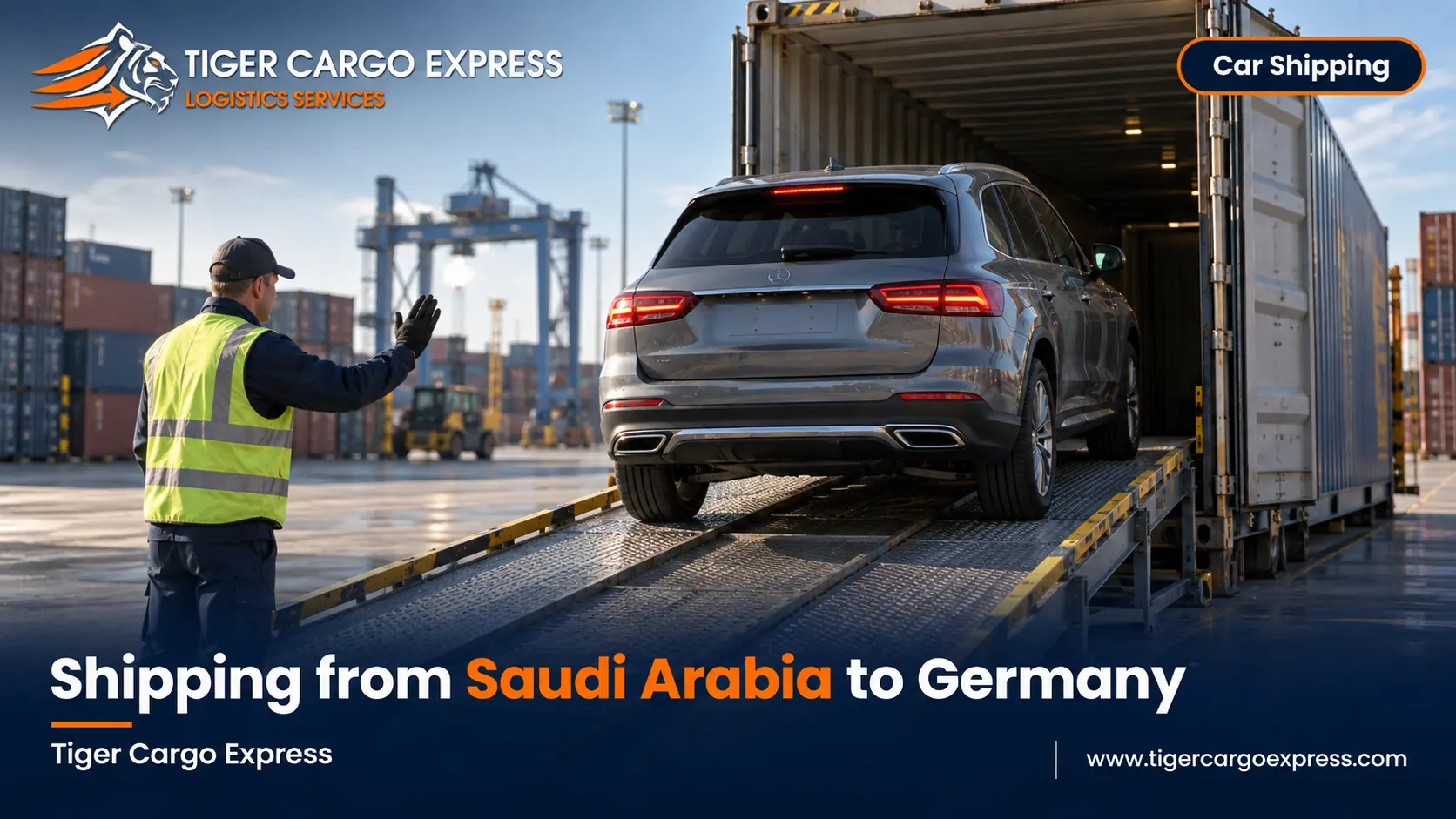
Start with the good news: Germany drives on the right, as Saudi Arabia does. That saves you an entire technical stage faced by anyone shipping a car to the UK. But the German route has two other items worth planning for.
First: proving technical conformity
A vehicle imported from outside the Union must be shown to meet the applicable standards. The easiest route is a European certificate of conformity from the manufacturer, where the model is sold in the European market. If the vehicle is built to a different market’s specification — common with Gulf-spec cars — the route becomes an individual approval assessing the vehicle on its own, and modifications may be required before acceptance.
We ask you for the model and year before booking, because the answer decides whether your path runs to weeks or to months.
Second: what comes after registration
Once registered, the vehicle enters the annual vehicle tax system, assessed on the vehicle’s own data. And there is a practical point many people miss: a great many German cities operate low-emission zones in their centres, entry to which requires an environmental sticker granted according to the vehicle’s emissions class. Ship an older vehicle and you may find yourself unable to drive it into the centre of the very city you moved to.
Which arrival port for your city?
Two main ports, and the difference lies in the road leg rather than the sea time.
| Port | Character | Best suited to |
|---|---|---|
| Hamburg | Germany’s largest container port, with the widest range of services | The north, east and centre — Berlin, Hamburg, Hanover, Leipzig; the default for most shipments |
| Bremerhaven | North Sea port and a major vehicle hub | The north-west and Bremen area — and a sound choice where the shipment includes a vehicle |
Southern cities — Munich, Stuttgart, Freiburg — work out differently: the road distance from the north is long, and arrival through another European port followed by road haulage can in some cases be faster and cheaper. We cost both routes and show you the figures rather than assume.
Furniture moving from Saudi Arabia to Germany
From dismantling a piece in your home to reassembling it in your new one.
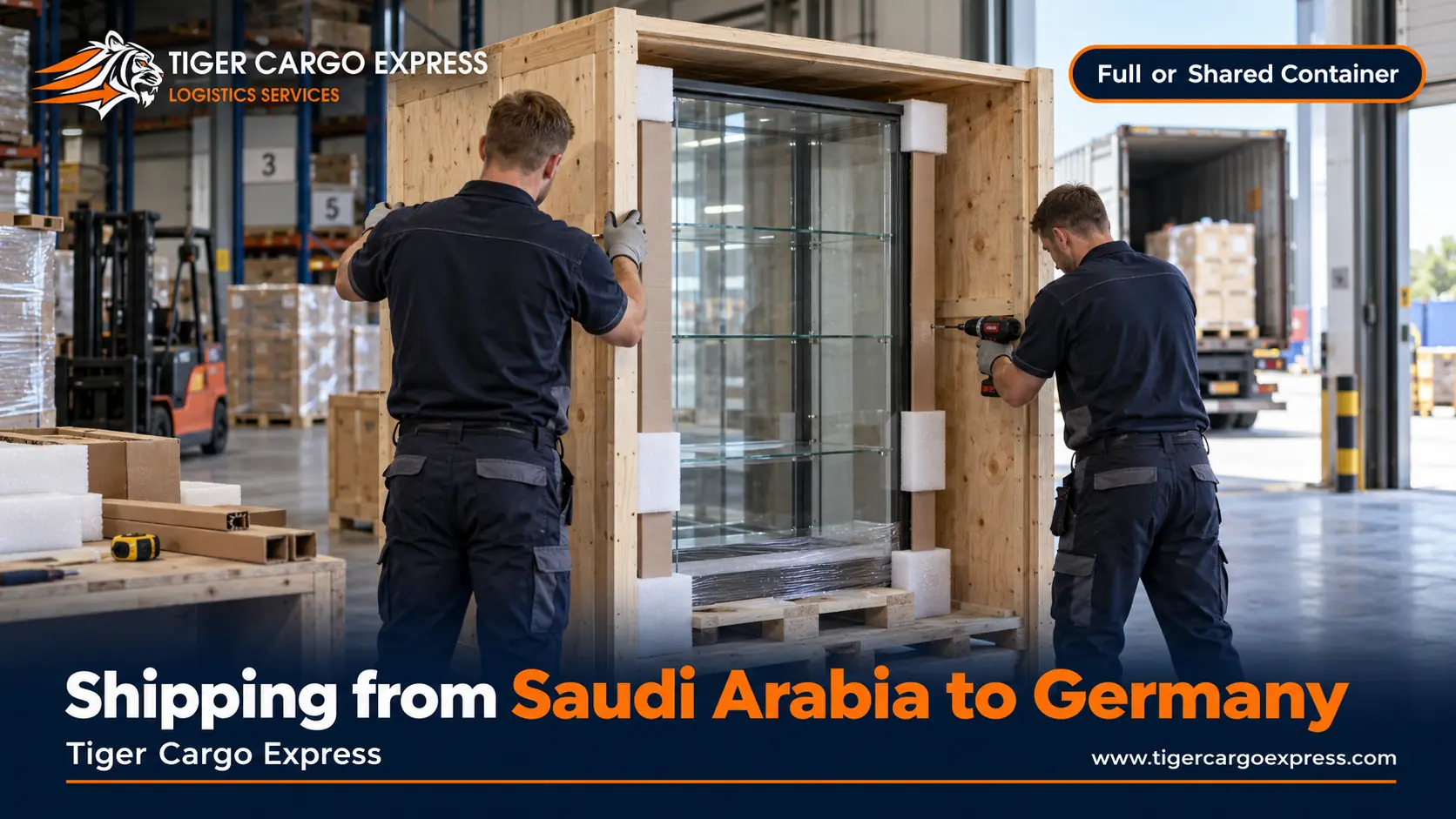
What marks the German file out is that the inventory is examined closely. The customs declaration is built on it, and the customs office may want more detail than you are used to elsewhere. So we prepare it to a standard that works as an official document: clear groupings, serial numbers for appliances, and photographs of what deserves them — before sealing, not after.
- ▸ Survey and assessment: volume in cubic metres, and deciding what is dismantled and what needs a crate.
- ▸ Professional dismantling: bedrooms, kitchens and shelving — full dismantling cuts volume, and volume is your invoice.
- ▸ Multi-layer packing: bubble, then blankets, then stretch film, with glass and mirrors in lined crates.
- ▸ Treated and stamped timber crates: a basic condition of entry — untreated timber is refused on the quay.
- ▸ Numbering and photographic inventory: serving your insurance and your customs declaration at once.
- ▸ A logged seal: photographed, its number handed to you, opened only in front of you or someone you authorise.
- ▸ Unpacking and reassembly: in your new home — not boxes left at the door.
Two shipping methods — and sea is the reality here
Air is available, and its logic is entirely different from sea.
Full container or shared load?
| Aspect | Full container | Shared load |
|---|---|---|
| When it suits you | A whole home, a vehicle, or equipment of real volume | A small flat, a student’s belongings, or part of a home |
| Transit | Shorter — no waiting for a load to fill | Longer — consolidation before sailing and deconsolidation after |
| The customs file | Yours alone — faster to process and clearer on the inventory | A container holding several files — and one late file can hold the container |
| Cost | A fixed rate — better value the closer you get to filling it | Per cubic metre — better value for small volumes only |
Because the German file is examined closely, a shared container carries an extra risk: another party’s late file can affect when the container is stripped. We tell you that plainly so you can compare — we reduce the exposure by preparing in advance, but we do not promise what we do not fully control.
German cities we cover
Door delivery across every German state.
Munich
Frankfurt
Hamburg
Cologne
Stuttgart
Düsseldorf
Dortmund
Essen
Leipzig
Bremen
Hanover
Nuremberg
Dresden
Bonn
Mannheim
Shipping prices from Saudi Arabia to Germany
Indicative figures following sea-freight pricing logic — the final quote is built on the survey.
| Shipment type | Price range | Unit and notes |
|---|---|---|
| Shared load (LCL) | Request a quote — set by survey | Per cubic metre with a minimum |
| 20ft container | Request a quote — set by survey | Suits a mid-sized flat, or a vehicle with belongings |
| 40ft container | Request a quote — set by survey | Suits a full house, or two vehicles |
| Car shipping | Request a quote — set by survey | Inside a closed container — excluding German technical approval and registration |
| Air freight | Request a quote — set by survey | By volumetric weight — for urgent and sensitive equipment |
And to repeat the point above: the relief lifts duty and import tax from you, it does not lift port, handling, clearance or inland delivery charges. We give you a price to your door and state plainly what sits outside it — including vehicle tax and technical approval where your shipment includes a car.
What actually sets your price?
Documents required for shipping to Germany
The shipment file, and the removal goods file.

Proof of your previous residence outside the Union. People prepare everything about Germany and forget to evidence where they were before it. An employer letter, a tenancy agreement or utility bills covering the required period are generally accepted — but obtaining them after you have left is far harder than before. That is why we ask for it on the first call.
Customs clearance and port standing charges
We handle clearance at both ends. And our real job here is not completing the procedure — it is preventing the delay before it starts.
A container landing at Hamburg or Bremerhaven gets a limited free period, after which a daily charge begins for it remaining in the terminal, and another for late return to the line. In ports of that scale, both accumulate quickly.
Procedures here are organised, clear and unforgiving of improvisation — an advantage to anyone whose file is ready and a problem for anyone whose file is not. A complete file moves with striking ease; an incomplete one waits until it is complete, with no allowances made. Which is why we would rather delay sailing by two days than sail with a file that is short — two days in the warehouse costs less than a week in the terminal.
Prohibited and restricted items
- ▸ Flammables and pressurised goods: aerosols, paints, solvents, fuel and gas — excluded entirely.
- ▸ Alcohol and tobacco: outside the removal goods relief, with their own excise regime.
- ▸ Food and animal or plant products: tightly restricted under European sanitary and phytosanitary controls.
- ▸ Plants, seeds and soil: effectively prohibited, and soil residue on garden tools triggers inspection.
- ▸ Weapons, ammunition and replicas: including souvenir pieces — treatment is extremely strict.
- ▸ Counterfeits and IP infringements: seized and a case opened — European enforcement is active.
- ▸ Untreated timber: every crate and pallet needs approved treatment and marking — no latitude on this point.
- ▸ Unapproved radio equipment: some devices require conformity with European standards.
Packing for a climate unlike your own
The shipment travels from a hot, dry climate into a cold, damp one, and spends weeks in salt-laden air. That swing — not the voyage itself — is what damages wooden furniture in particular.
Insuring the shipment
On a voyage of over a month with transhipment along the way, we do not regard insurance as optional. We provide declared-value cover built on your own inventory — which is exactly why we insist on a detailed, photographed one: it makes any claim provable rather than debatable.
And we say plainly that cover typically excludes anything not professionally packed and anything not listed. The item you slipped into a box yourself at the last minute may fall outside cover — and may hold up the customs file too, because it is not on the list.
Inland delivery after the port
- ▸ Low-emission zones: many city centres restrict vehicle entry by emissions class — arranged in advance, not on delivery day.
- ▸ Narrow streets and old quarters: no access for a container lorry, so we tranship to a smaller vehicle from a nearby depot.
- ▸ A parking permit outside the building: routine in German cities and applied for well ahead of the slot.
- ▸ Upper floors with no lift: common in older buildings and may call for an external hoist — costed in advance once we ask about the floor.
- ▸ Precise timing: keeping to the appointed hour is a working norm here rather than a courtesy — we keep to it and flag any change immediately.
The reverse direction — Germany to Saudi Arabia
A very active lane in both directions. The dominant traffic out of Germany is industrial equipment, machinery and spare parts, alongside the effects of people returning after study or work.
Industrial equipment brings its own considerations: certificates of origin and conformity, industrial packing, and sometimes out-of-gauge consignments needing special containers. It is an area we work in regularly on this lane specifically.
How to choose a shipping company to Germany
Our written guarantees
How to lower the cost of your shipment
- ▸ Settle your eligibility first. No discount matches what correct relief saves on a shipment the size of a house and a vehicle.
- ▸ Ask about your car’s route before shipping it. You may find the approval and modification costs exceed the vehicle’s own value — and selling it here is the better answer.
- ▸ Sort before you pack. What you will not use is not worth crossing the seas. Every cubic metre has a price.
- ▸ Allow full dismantling. It cuts volume appreciably, and volume is the invoice.
- ▸ Work out the break-even. A full container may beat a large shared load — ask for both figures.
- ▸ Book early. German lanes are busy, and early booking buys wider sailing options and calmer rates.
- ▸ Get the file ready early. In Germany specifically, a complete file saves more than any negotiation on rate.
When do rates rise and transits lengthen?
| Period | What happens |
|---|---|
| Summer | Peak family relocation — pressure on containers and packing crews alike. |
| Start of the university term | A wave of student and researcher shipments — book well ahead. |
| North Sea winter | Weather can delay arrival by days — we build it into the schedule. |
| Disruption on sea lanes | Rerouting lengthens transit and moves rates — we tell you as soon as we know. |
| Holidays | Port and customs closures at either end add days to the schedule. |
How we work: five steps
Five recurring mistakes — all avoidable
- ▸ Reading “exempt” as “free”. The commonest mistake here — and the one that leaves a client budgeting short from day one.
- ▸ Shipping a differently specified car without asking. It can turn into individual approval and modifications costing more than the vehicle.
- ▸ Untreated timber in the packing. There is no latitude on this, and it means the shipment stops on the quay.
- ▸ A generic inventory with no detail. It passes elsewhere and stops here. And stopping has a daily meter.
- ▸ Forgetting proof of previous residence outside the Union. Easy to obtain before you leave, and very hard afterwards.
Why Tiger Cargo Express?
Because we do not sell you the word “exempt” and then leave you with the invoices. We give you a full map of what you will pay: what the relief lifts, what remains due, and what is an operating charge with no connection to relief at all.
In a market competing over who promises most, we compete over who explains most. Because a client who knew their real number before booking does not come back with a complaint after arrival.
Frequently asked questions about shipping from Saudi Arabia to Germany
In summary
Shipping from Saudi Arabia to Germany runs through a system that is orderly and clear — it rewards anyone whose file is ready and makes no allowances for anyone whose file is not. Three things matter here: a precise understanding of the limits of the relief, an inventory and packing the customs office will accept, and a clear route for your vehicle before you ship it. Tiger Cargo Express gives you all three in writing before you ship.
Send your shipment details — approximate volume, origin city, your German city, and whether a vehicle is included and which model — and we reply with a detailed quote within 60 minutes. 0506688227
Where does Germany sit on our map?
Shipping to Germany is one lane within a wider region — and the full Europe guide explains the rules governing it and its neighbours together: the route, the customs framework, and the challenge that lane is priced around.
Related Shipping Guides
Continue with practical guidance connected to the same route or shipping decision.
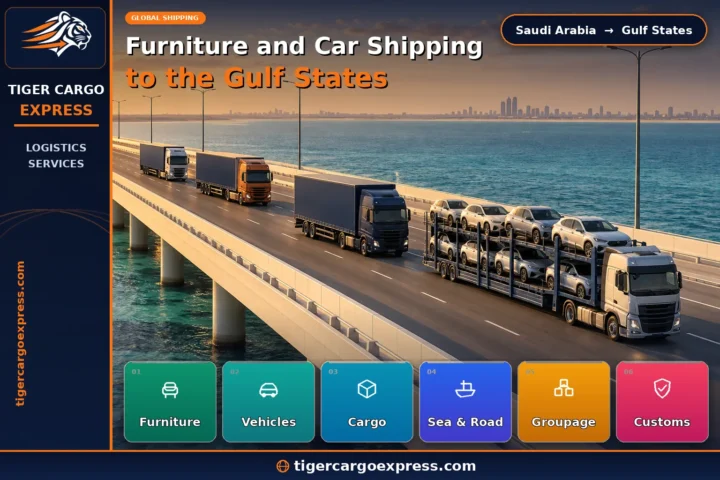
Furniture and Car Shipping Company from Saudi Arabia to the Gulf 0506688227
⚠️ "How much does shipping to Kuwait cost?" is a question missing three things. Shipping from Riyadh is not shipping…
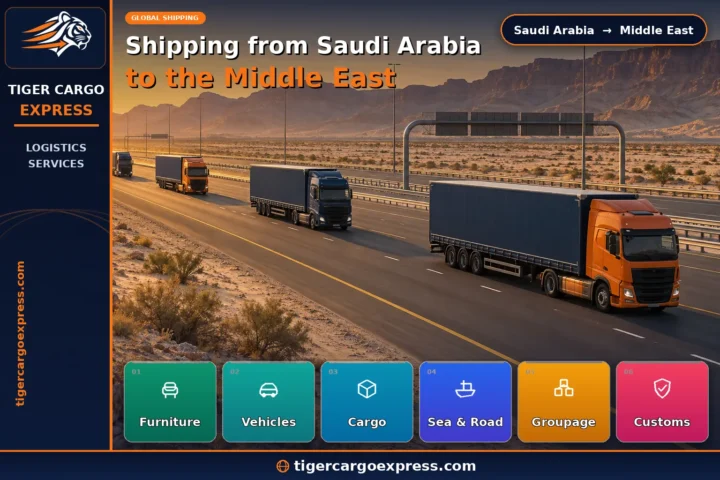
Shipping Company from Saudi Arabia to the Middle East 0506688227 — Overland Guide
The Middle East overturns all of it: it is the only destination whose journey starts at your front door rather…
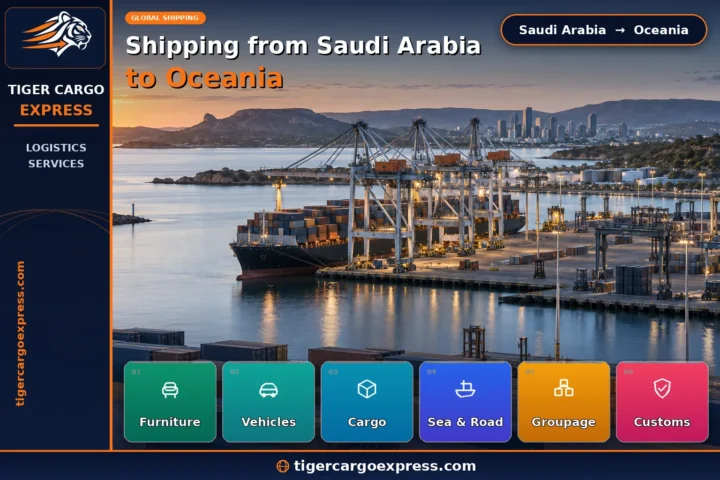
Shipping Company from Saudi Arabia to Oceania 0506688227 — The Biosecurity Guide
On every preceding continent the question was: what is inside your shipment? Oceania asks an entirely different one: what is…
Send your shipment details and get a written quote
We reply within 60 minutes during working hours — with what the price includes and what it does not, stated before you commit.