
Shipping Company from Saudi Arabia to the Maldives 0506688227 — Your Name, Not Your Company’s
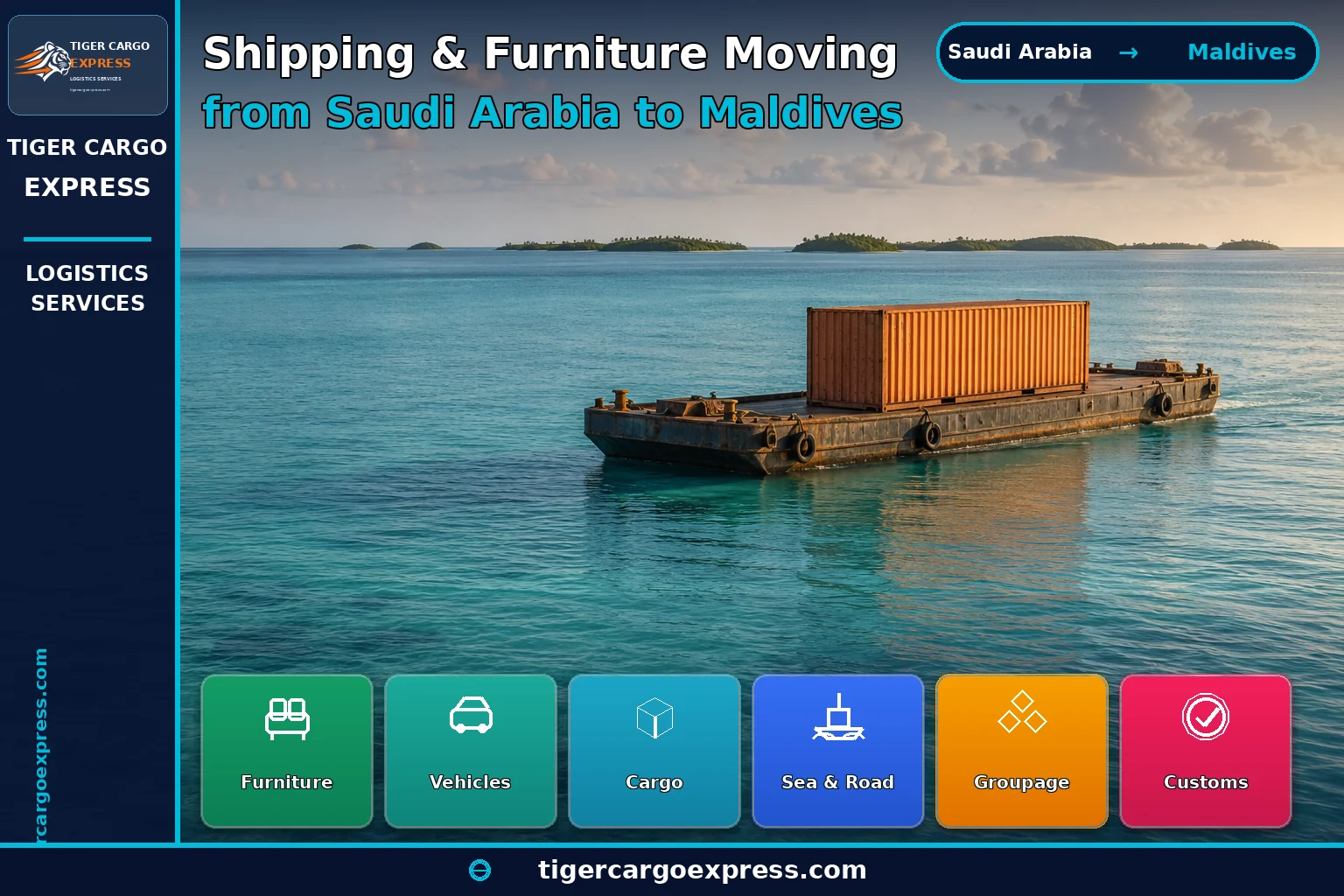
Across sixty-two destinations entitlement turned on how long you lived abroad or how old your goods were. In the Maldives it turns on one line: goods for personal use must be consigned in the individual's name, and a company name makes them a commercial import. The residence period is six months, not twelve, and the ceiling is 6,000 MVR on FOB — excluding freight and insurance. But the vessel berths in Malé — and your island is not Malé, so the final leg is a second sea voyage with its own schedule and cost.
Guide contents ShowHide
Looking for a shipping company from Saudi Arabia to the Maldives that knows a single name on the bill of lading can turn your personal shipment into a commercial import? Tiger Cargo Express moves household goods, furniture, cargo and vehicles to Malé, Hulhumalé and the rest of the archipelago — by sea and by air — with packing, clearance and the final sea leg to your island arranged for you. To book: 0506688227
Across sixty-two destinations we have written about, entitlement was decided by how long you lived abroad, how old your goods were, or what standing your residence carried.
Here it is decided by something simpler than all of that — and far easier to get wrong:
Your name on the bill of lading — not your company’s.
Goods imported for personal use must be consigned under the name of the individual importing them. If they are consigned under a company’s name, they are considered to be imported for a commercial purpose — and the normal import declaration process must be followed instead of the personal-effects route.
⚠️ Nothing about your shipment changes — not its contents, not its value, not its owner. One line on one document changes.
And to that is added a geographic fact there is no way around:
Your goods land in Malé… and your island is not Malé.
What we ship from Saudi Arabia to the Maldives
Traffic on this lane is mostly professional, and partly family: people relocating on work contracts in hospitality, health and education, Maldivians returning from the Gulf, families sending supplies, and importers.
⭐⭐ The consignee name — one line that decides your whole route
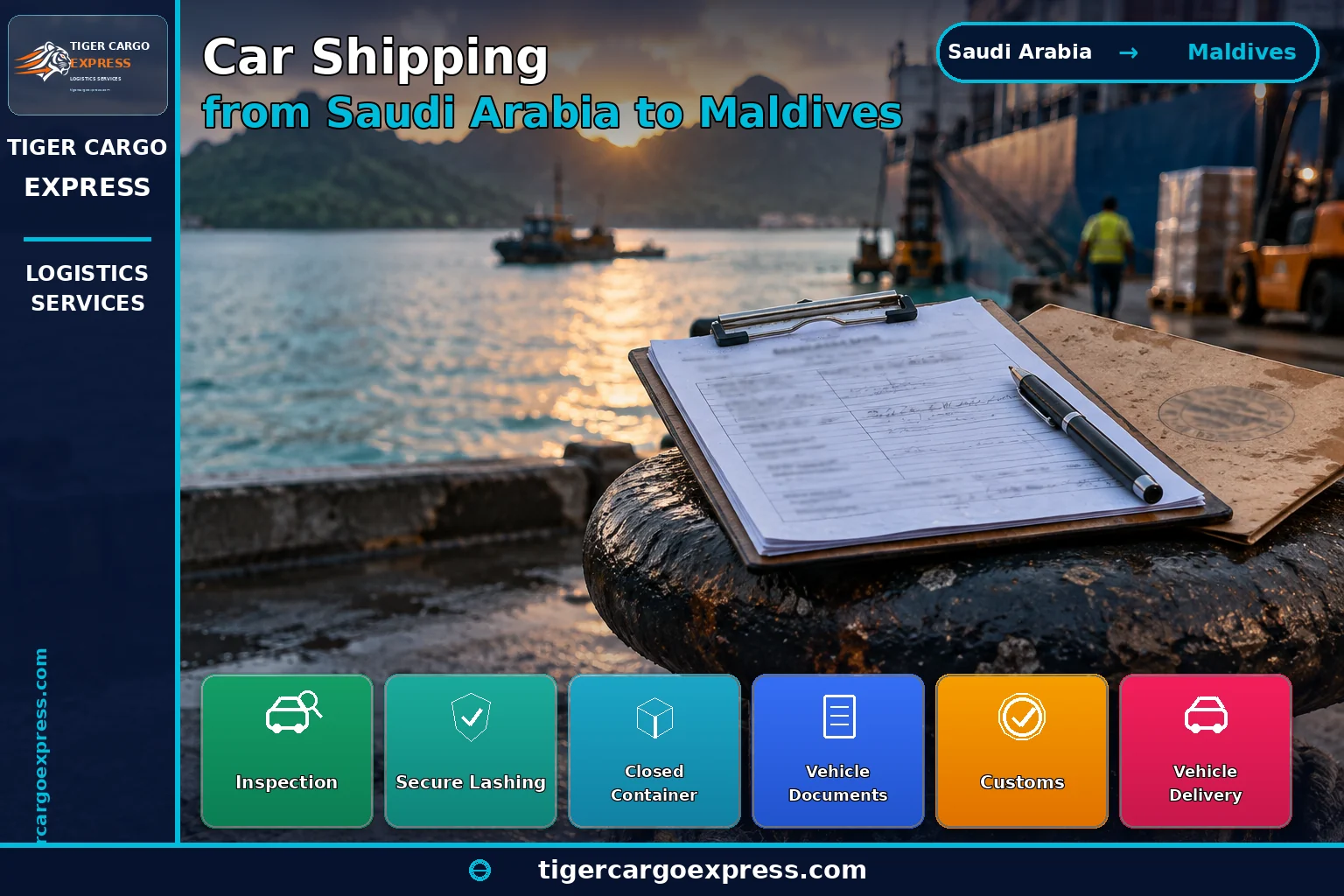
Goods imported for personal use must be consigned under the name of the individual importing them.
If they are consigned under a company’s name, they are considered to be imported for a commercial purpose — and the normal import declaration process must then be followed.
Stop and consider what that means.
⭐ The reclassification is not caused by what is in your shipment, nor its value, nor your intention.
It is caused by the name written in the consignee field.
⚠️ And it is a mistake made in complete good faith: the employer offers to ship the furniture under the company’s name “to make clearance easier”, or the husband uses his business because its registration is close at hand, or the agent writes the company because that is what his files usually carry.
Then a shipment of used family furniture arrives — and is read as a commercial import.
We ask who the consignee will be before we ask how big your shipment is, because that one line decides which road it travels.
⭐ The two routes, side by side
| Aspect | In your own name | In a company’s name |
|---|---|---|
| ⭐ Classification | Personal use | Commercial purpose |
| Route | The personal-effects route | The normal import declaration process |
| ⭐ The concession | Open, on its conditions | Not in question at all |
| The decisive document | Your passport and the release letter | The company’s commercial file |
| ⚠️ When the error surfaces | — | On arrival — with the bill already issued |
And what do we do about it?
- ▸ ⭐ We fix the consignee name before the bill of lading is issued — not after, because amending an issued bill is a procedure there is no need to create.
- ▸ ⭐ We decline to put a company name on a personal shipment even when the employer asks for it — and we explain why in writing.
- ▸ We match the name letter for letter across the passport, the bill of lading, the invoice and the packing list.
- ▸ ⭐ We split a mixed shipment: your personal effects in your name, work equipment in the company’s — on two bills of lading, not one.
- ▸ We check the form of the name exactly as it appears in the passport — no abbreviation, no addition, no reordering.
⭐ Six months, not twelve — and that works in your favour
Once the consignee name is settled, the question of entitlement follows. And here there is welcome news: the period required on this lane is shorter than anything else we have covered.
| Who are you? | The condition | The decisive document |
|---|---|---|
| ⭐ Returning Maldivian | Pre-used goods, after living abroad six months or more | Passport with its stamps + release letter |
| ⭐ Foreign professional | Pre-used items, coming to work for more than six months in the professional category | The original work permit |
| Resident importing for own use | Goods for personal use — and in their own name | Passport and bill of lading in that name |
| ⭐ Goods carried on entry | Items brought in at the time of entering the country | A route separate from the unaccompanied shipment |
Because most of the residence periods we have explained in this series were twelve months, some twenty-one, and one twelve months without interruption.
⭐ Here it is six months only — and that opens the door to a group excluded elsewhere:
▸ Anyone who finished a short contract in the Gulf and went home.
▸ Anyone relocating on a seasonal or fixed-term project.
▸ And anyone who postponed shipping because they assumed the period had not been met.
⚠️ But note the flip side: a professional must be coming to work for more than six months — so a short contract in the other direction does not help you.
A short period in your past is useful; a short period in your future is not.
We read your contract and your passport together before telling you which route is yours.
⭐ The concession ceiling — and why it is calculated on FOB
Under the Maldivian Import Export Act, Law No. 31/79, an import duty concession is granted for goods imported for personal use valued below six thousand rufiyaa — on an FOB basis, meaning excluding freight and insurance.
⭐ Stop at “excluding freight and insurance” — it works in your favour.
In many systems the value is assessed on a basis that includes freight and insurance, so your shipment’s value rises simply because you shipped it from far away.
Here neither freight nor insurance enters the value — only the goods themselves.
⚠️ But the ceiling is low, which gives three practical rules:
▸ Precise item-by-item description works for you — not grouped phrases.
▸ Separate used from new — new goods are assessed on a different logic.
▸ And depending on quantity, a goods declaration form may be required even for what falls within the ceiling.
We prepare the descriptions and values on that basis before sailing — not after arrival.
⭐ The port is not your destination — the final leg is by sea
A truck leaves the port and arrives at your door.
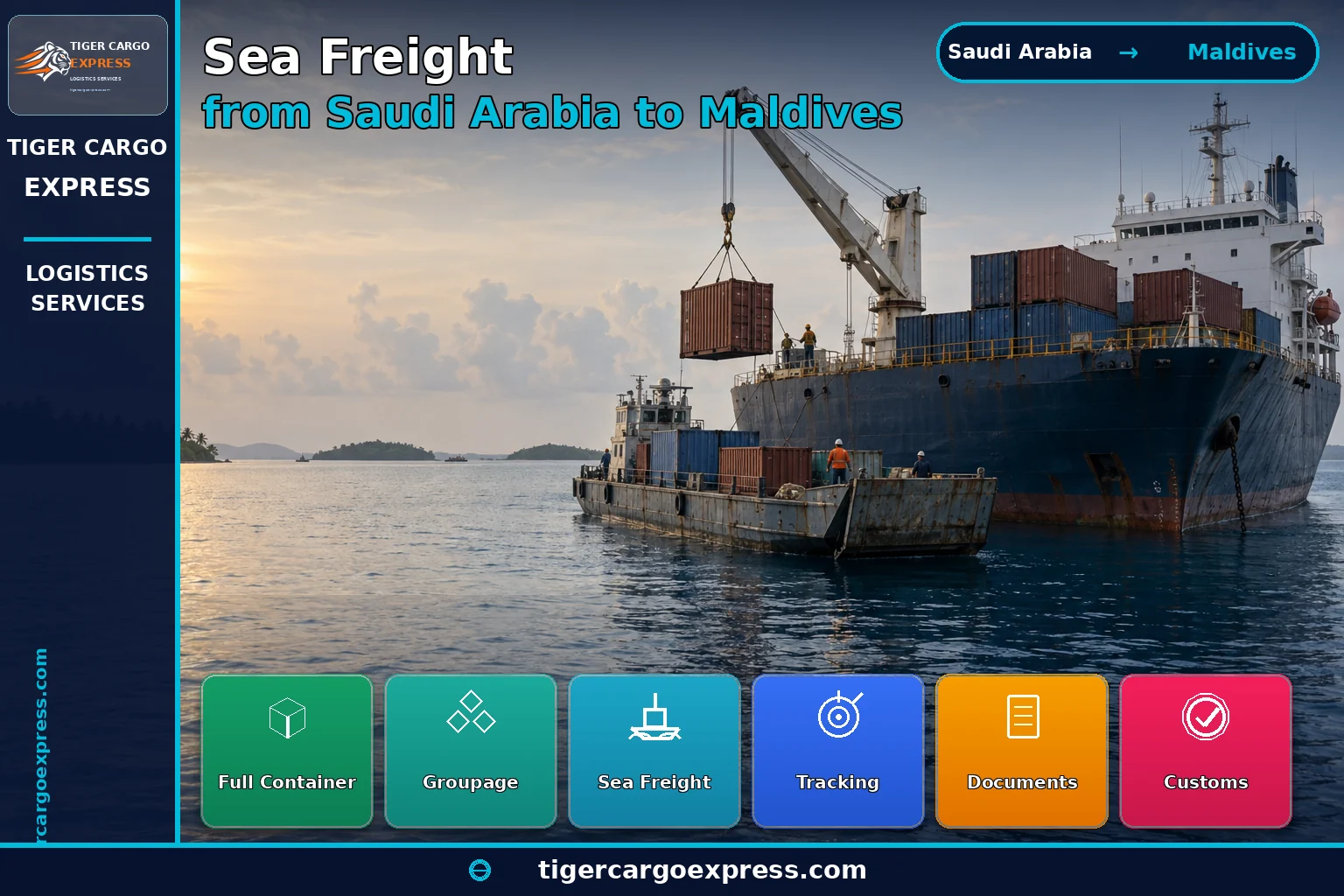
Here the final leg is by sea — because your destination is an island.
⭐ The Maldives is an archipelago of hundreds of scattered islands, the international vessel berths at the main commercial harbour — and your goods are then carried by boat or landing craft to your own island.
That changes four things in how your shipment is planned:
▸ Two sea legs, not one — each with its own schedule, handling and cost.
▸ The boat governs size and weight, not the truck — what a crane loads may not load onto a launch.
▸ Extra manual handling going down, going across and coming ashore.
▸ And the schedule answers to the sea, not to the road.
⚠️ Anyone packing for “container to the door” finds their packages carried by hand across a narrow jetty and then onto an open boat.
This is why we ask: which island? — before we price anything.
Car shipping to the Maldives
We do ship vehicles on this lane, but we start with the question of whether it is worthwhile — not the question of price.
- ▸ ⭐ To which island? A vehicle needs a road and a network, and many islands have limited roads — we ask before we book.
- ▸ ⭐ How does it get from the port to your island? A vehicle needs a ferry or a landing craft — an independent, declared stage in the quote.
- ▸ Documents in the owner’s name: title, invoice and bill of lading — under the same individual-name rule.
- ▸ Draining fuel and disconnecting the battery: a standard step with no exceptions — it is a vessel safety requirement.
- ▸ Four-point lashing inside the container: with straps and chocks — not an improvised timber wedge.
- ▸ ⭐ Emptying the vehicle completely: no personal items inside — it is an independent line, not a suitcase.
- ▸ Photographic documentation before sealing: exterior, interior and odometer — handed to you as a file.
⭐ And we say it plainly: shipping a vehicle to an archipelago is less worthwhile than shipping one to a mainland destination — because it crosses two sea legs and then needs a road network that may not exist on your island. Anyone who promises you the vehicle before asking which island you live on is selling you a shipment, not a solution.
⭐ Prohibited and restricted items
Prohibited from being imported, produced, handled, distributed or given:
▸ Religious materials offensive to Islam
▸ Idols intended for worship
▸ Pornographic material
▸ Narcotics and psychotropic substances
▸ Live pigs
Restricted: arms and ammunition · alcohol and spirits · pork and its by-products · dogs · dangerous animals.
⭐ Note something: this list is understood without ambiguity by any shipper from Saudi Arabia — because it rests on the same reference.
We review your list on that basis before loading, not after arrival.
⚠️ And the idols clause deserves attention specifically: a decorative figure may be packed in good faith with the household ornaments, and the classification turns on whether it is intended for worship — so we set aside anything ambiguous rather than let it hold up your shipment.
- ▸ Flammable and pressurised materials: aerosols, paints, solvents, fuel and gas — excluded entirely from any shipment.
- ▸ Untreated timber: every crate and pallet needs certified treatment and a visible mark.
- ▸ Whatever Saudi Arabia restricts on export: reviewed from our side before loading — a restriction can come from the departure side.
- ▸ ⭐ Currency declaration: sums of thirty thousand US dollars or more must be declared to Customs — this concerns the traveller rather than the shipment, and we flag it because overlooking it stops a person.
⭐ What needs a permit or a certificate
⭐ The radio and wireless clause deserves a pause: it does not mean professional communications gear alone — it can extend to things considered ordinary in a home. We review your list item by item on that basis, and place whatever needs it on a separate declaration so it can be declared on arrival without holding up the rest of the shipment.
Shipping for missions and international organisations
Shipments for diplomatic and consular missions, international organisations and their staff do not travel the personal-effects route and are not subject to its conditions — neither the six-month requirement nor the value ceiling. The basis is the standing of the mission or organisation, or your accreditation to it, the reference framework for missions is the Vienna Convention on Diplomatic Relations of 1961, and treatment is confirmed through the competent official channels.
First: the final leg stays a sea leg.
The vessel berths at the same harbour and the goods travel by boat to the same island — whether the consignee is a relocating family or an international organisation.
⭐ Standing changes the path of the paperwork; it does not change the geography of an archipelago.
Second: the precision of the consignee name and standing.
In a mission file the consignee is the mission itself in its own standing — and matching the name letter for letter between the official correspondence and the bill of lading is a practical requirement, not a formality.
⚠️ Anyone who planned on “the diplomatic documents being enough” prepared the paperwork and forgot the boat.
We prepare both.
- ▸ We establish standing first and build the file on it — not the other way round.
- ▸ ⭐ And we plan the second sea leg in every case — the sea does not distinguish between one shipment and another.
- ▸ We start with the competent department, not the individual — formal correspondence is the foundation of the file.
- ▸ We match the consignee name and standing across the correspondence and the bill of lading before issuing.
- ▸ We document the inventory to a higher standard and deliver it certified by both parties.
- ▸ We maintain full confidentiality over information, contents and movement schedules.
And we say it plainly: determining what the treatment covers and how far it extends rests with the competent authorities, and the mission or organisation has its own official channels. Our role is purely logistical. We work in both directions.
Household goods moving from Saudi Arabia to the Maldives
The work here begins with a line on a document and ends on an island jetty.
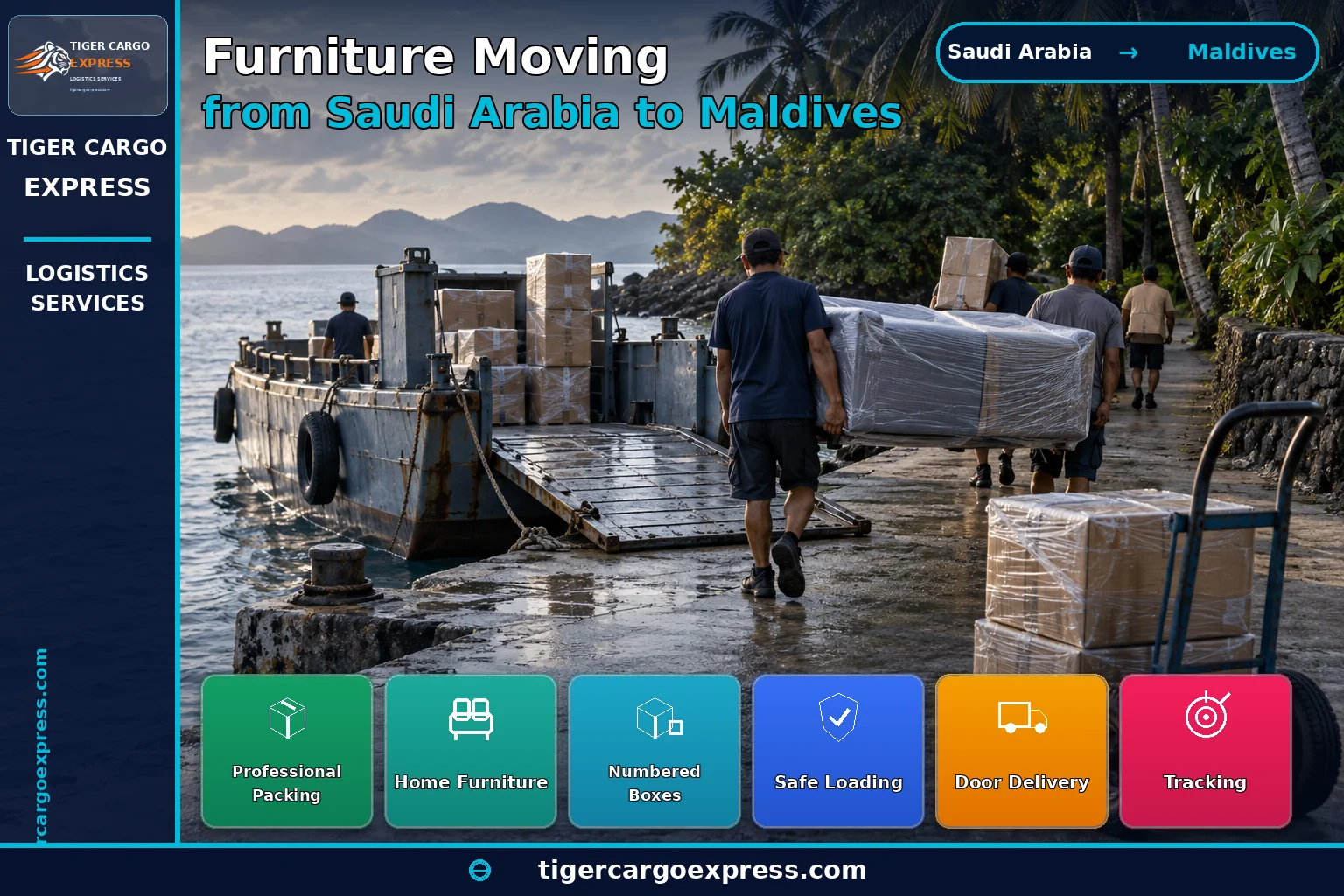
- ▸ ⭐ Fixing the consignee name first: in your own name as it appears in your passport — before anything else, because it decides the whole route.
- ▸ ⭐ Naming the island, not the city: because the second leg is by sea, and the boat governs size and weight.
- ▸ ⭐ Splitting the shipment into carriable packages: because manual handling repeats on two jetties, not one.
- ▸ ⭐ Double sealing against humidity and salt: because the second leg is sometimes on an open boat, and spray reaches what rain does not.
- ▸ Precise item-by-item description with values: on an FOB basis — because the ceiling is low and grouped descriptions hurt you.
- ▸ Numbering and a piece-by-piece tally: handed to the consignee before arrival so they count during the unloading.
- ▸ Full dismantling where possible: it reduces volume, protects edges and eases the lift onto the boat at once.
Full container, shared consignment or boxes?
| Aspect | Full container | Shared (LCL) | Boxes or air |
|---|---|---|---|
| When it suits you | A full home or project equipment | One or two rooms — the most common here | Selected items and urgent cargo |
| ⭐ With the second sea leg | Stripped, then moved piece by piece — the container does not board the boat | Practically the best fit — packages are already ready for the internal sea move | The simplest — and may reach a nearer airport directly |
| ⭐ With the consignee-name rule | One bill of lading in your name | ⚠️ Check your house bill is in your name, not the consolidator’s | In your name on the air waybill |
| Pricing | Fixed rate + stripping + internal sea move | Per cubic metre with a minimum | Per box or by volumetric weight |
Look at the third row. In a shared consignment a master bill is issued in the consolidator’s name and a house bill in yours — and it is the latter that is read at clearance. ⚠️ Anyone who does not check it may find their personal shipment listed under a commercial entity without anybody intending it. We request a copy and review it before sailing.
Islands and areas we cover
Hulhumalé
Hulhulé
Villingili
Addu — Hithadhoo
Fuvahmulah
Kulhudhuffushi
Thinadhoo
Eydhafushi
Naifaru
Dhuvaafaru
Resort islands
⭐ One caution: access to a resort island is subject to the resort’s own arrangements — it is not enough for us to bring the goods to its water. We ask for a contact inside the resort before booking, not after arrival.
Shipping rates from Saudi Arabia to the Maldives
The final quote is built on your island, not your city — with every line item declared.
| Shipment type or line item | Price | Unit and notes |
|---|---|---|
| Boxes and small consignments | Request a quote — set by survey | Per box or by weight |
| Shared consignment (LCL) | Request a quote — set by survey | Per cubic metre — with a house bill in your name |
| 20 / 40 ft container | Request a quote — set by survey | Stripped before the internal sea move |
| Air freight | Request a quote — set by survey | By volumetric weight — for urgent and small cargo |
| ⭐ Internal sea move to your island | Set in the quote, by your destination | A line item with no equivalent elsewhere — because the final leg is by sea |
| ⭐ Item-by-item description with FOB values | Set in the quote, by your destination | Because the ceiling is low and grouping hurts you |
| Vehicle shipping | Set after your file is reviewed | We start with whether it is worthwhile, not with price |
| ⚠️ Delivery inside a resort island | Set after your file is reviewed | Subject to the resort’s arrangements — confirmed before booking |
Note the green row. This is a line item we did not include in sixty-two destinations before this one — because in those the final leg was a road leg and an ordinary part of the job. Here it is a second sea voyage with its own schedule, handling and cost. We declare it openly, because whoever does not price it for you today will bill you for it at the quay.
Documents required
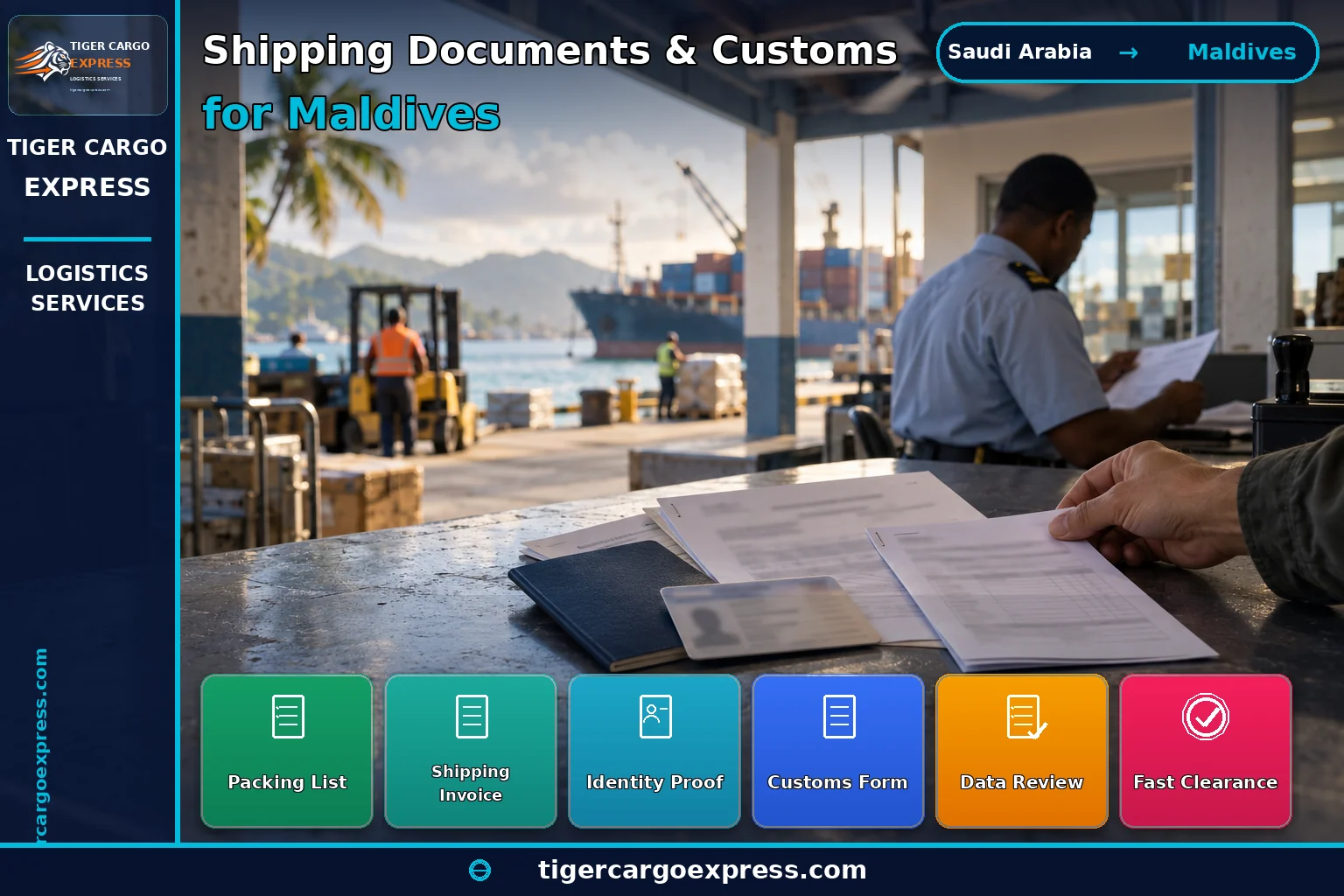
In many destinations, cargo arriving before you was a real problem.
Here there is a declared way through: if the owner of the goods is abroad at the time they arrive in the Maldives and cannot present the original passport, the goods are released when a copy of the passport is enclosed with a letter from the owner stating the situation.
⭐ That clause works in your favour, and we build on it:
▸ We prepare the letter signed by you before you travel — not after the shipment arrives.
▸ And we enclose a clear passport copy in the file from the start.
▸ And we name the receiving party on the island with contact details.
A document written before the flight gets things done; one requested after arrival holds things up.
Clearance and release
- ▸ ⭐ It starts with the consignee name: your name is what places your file on the personal-effects route instead of the commercial import one.
- ▸ ⭐ The release letter with its dates: your departure, your arrival and your visa details — written ready, not drafted by you at the quay.
- ▸ ⭐ The original work permit for professionals: their goods are released when it is presented — and we confirm it has been issued before sailing, not after.
- ▸ Documents to the documentation section first, then a request to the cargo examination section for inspection — in sequence, not in parallel.
- ▸ The invoice in English: and in an approved foreign currency — anything else goes back to the start.
- ▸ Then our second job begins: arranging the internal sea move — your file does not end at release.
Packing and insurance
The challenge here is compound: high tropical humidity year round, salt spray on the second leg, and repeated manual handling on two jetties.
⚠️ And insurance is no detail here: a port-to-port policy ends in Malé — and your island comes after it. We present the cover options by their clauses, not by their headings, because a policy’s name does not tell you where its responsibility ends.
Delivery to the island
- ▸ ⭐ Malé and Hulhumalé are the simplest: both sit close to the harbour — and delivery there is the easiest stage on this lane.
- ▸ ⭐ Distant islands are a voyage with their own schedule: and we give you a written estimate, not an open promise.
- ▸ The jetty governs: some islands take only small craft — and we survey that in advance through our agent.
- ▸ ⭐ Resort islands follow the resort’s arrangements: and we ask for a contact inside before booking.
- ▸ Piece-by-piece receipt against a pre-sent list: so the consignee counts during the unloading, not after it.
- ▸ The monsoon winds: they affect boat schedules in parts of the year — and we build a written margin for them.
The reverse direction — Maldives to Saudi Arabia
We work both directions on the same port and route. The dominant flow out of the Maldives is marine products and processed fish, alongside the effects of people finishing contracts and returning families’ household goods.
⭐ And the same rule applies in reverse: collection begins on your island by boat before it ever reaches the port — and packing at origin needs the same standard. We review your list before loading against Saudi import restrictions and the health requirements for marine products in particular. And we confirm the boat schedule before fixing the vessel date — not the other way round.
How to choose a shipping company from Saudi Arabia to the Maldives
What we commit to in writing
How to reduce your shipping cost
- ▸ ⭐ Fix your name on the bill of lading before anything else. A shipment diverted onto the commercial route costs more than any price difference between two companies.
- ▸ ⭐ Cut volume before the second leg, not after. The internal sea move is charged on what arrived — every cubic metre you save counts twice.
- ▸ ⭐ Standardise your package sizes. Uniform packages stow better on a boat — and better stowage means fewer trips.
- ▸ ⭐ Review your FOB values before sailing. Item-by-item description may keep you inside the ceiling where grouping puts you outside it.
- ▸ ⭐ Do not ship a vehicle before asking about your island’s roads. A vehicle arriving on an island with no road network is a total loss.
- ▸ Consolidate into one consignment. Two batches mean two sea legs doubled, not one.
- ▸ Allow full dismantling. It reduces volume and eases the manual lift on both jetties at once.
When do prices rise and transit times stretch?
| Period or situation | What happens |
|---|---|
| ⭐ A shipment consigned to a company | The most expensive situation on this lane — a full commercial route instead of the personal-effects one, discovered after the bill is issued. |
| ⭐ An island far from the harbour | A factor specific to this lane — the second leg lengthens, is priced separately, and may need more than one trip. |
| The monsoon winds | They affect boat schedules in parts of the year — and we build a written margin for them. |
| ⭐ Peak tourism season | A factor specific to an archipelago — resort supply traffic rises, and with it pressure on boats and handling. |
| ⚠️ Cargo arriving ahead of a work permit | Professionals’ goods are released when the original permit is presented — so we confirm its issue before sailing. |
How we work: five steps
Five recurring mistakes — all of them avoidable
- ▸ Accepting that the goods be shipped under a company name. The most expensive mistake here — goods consigned to a company are considered a commercial import, and the offer comes in good faith from someone who thinks they are helping.
- ▸ Pricing “the Maldives” instead of pricing the island. The port is not the destination — the second leg is a sea voyage with its own schedule and cost.
- ▸ Grouped descriptions on the invoice. The ceiling is assessed on FOB — item-by-item description may keep you inside it where grouping puts you outside.
- ▸ Packing to truck dimensions. The boat governs, not the truck — and an oversized package may not load at all.
- ▸ Flying before the release letter is prepared. The way through exists and is declared — but it is a document written before the flight, not after it.
Why Tiger Cargo Express?
Because we ask who the consignee will be before we ask how big your shipment is. The Maldives does not move your shipment onto the commercial route because of its contents or its value — but because of one line on one document. Your employer’s offer to ship your furniture under the company name looks like a favour, and is in fact a diversion of your entire route. We decline it and explain why in writing before the bill of lading is issued.
And because we price your island, not your port. The vessel berths in Malé, and your home is a second sea voyage beyond it, with its own schedule, handling and cost declared in our quote. And we prepare the release letter signed by you before you fly — because a document written before the flight gets things done, while one requested after arrival holds things up.
Frequently asked questions about shipping from Saudi Arabia to the Maldives
In summary
The Maldives is a destination whose conditions are easier than you expect and whose doors are narrower than you think. The residence period is six months, not twelve, the ceiling is assessed on FOB with no freight and no insurance, and anyone travelling after their shipment arrives has a declared way through. But in return: a company name on the bill of lading turns your personal shipment into a commercial import, and the port is not your destination because the final leg is by sea. What you need here is three things: a bill of lading in your own name, a quote that prices your island rather than your port, and a release letter written before you fly. Tiger Cargo Express gives you all three before you ship.
Send us your shipment details — your name as it appears in your passport, the island you live on, your shipment’s volume and departure city, and whether you are returning or relocating on a contract — and we will come back with a detailed, itemised quote within 60 minutes. 0506688227
See also our other South Asian lanes: shipping to India · shipping to Sri Lanka · shipping to Pakistan · and our international shipping service.
Where does the Maldives sit on our map?
Shipping to the Maldives is one lane within a wider region — and the full Asia guide explains the rules governing it and its neighbours together: the route, the customs framework, and the challenge that lane is priced around.
Related Shipping Guides
Continue with practical guidance connected to the same route or shipping decision.
Furniture and Car Shipping Company from Saudi Arabia to the Gulf 0506688227
⚠️ "How much does shipping to Kuwait cost?" is a question missing three things. Shipping from Riyadh is not shipping…
Shipping Company from Saudi Arabia to the Middle East 0506688227 — Overland Guide
The Middle East overturns all of it: it is the only destination whose journey starts at your front door rather…
Shipping Company from Saudi Arabia to Oceania 0506688227 — The Biosecurity Guide
On every preceding continent the question was: what is inside your shipment? Oceania asks an entirely different one: what is…
Send your shipment details and get a written quote
We reply within 60 minutes during working hours — with what the price includes and what it does not, stated before you commit.