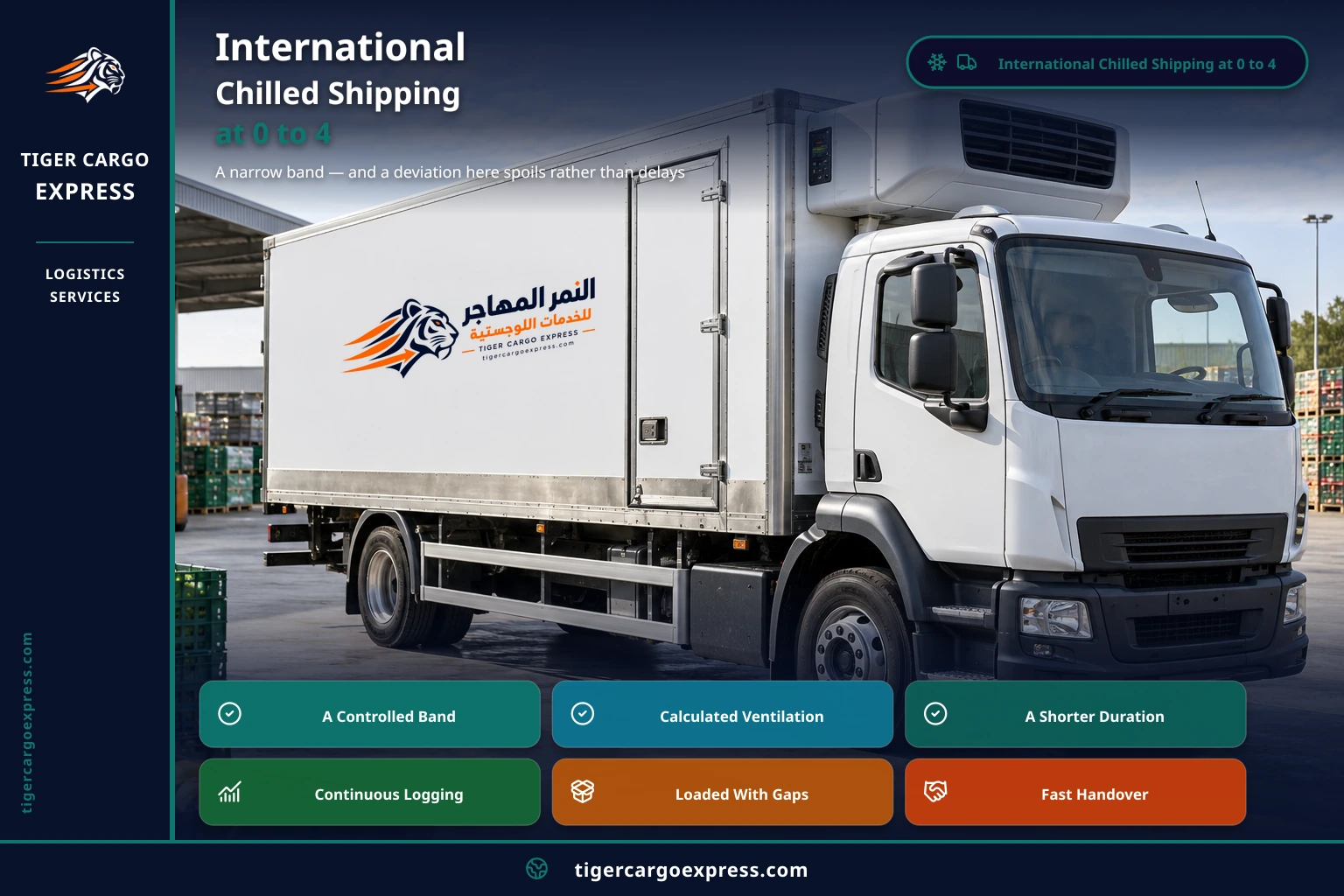
International Chilled Shipping at 0 to 4 0506688227 You Are Shipping Shelf Life, Not Goods
Guide summary
International chilled shipping from Riyadh, Jeddah and Dammam to the Gulf, Jordan, Syria and Lebanon — with frozen goods you ship a product; with chilled goods you ship shelf life. Frozen keeps for as long as it stays below the limit, while chilled spends its life every hour even at exactly the right temperature. So we count door to door rather than border to border, and tell you in days what remains for your consignee before you pay. And gaps are part of the load rather than a shortfall: vertical aligned stacking, a gap from the walls, and floor channels never blocked.
Guide contentsShowHide
Looking for international chilled shipping from Saudi Arabia at 0 to 4 from a company that knows the duration is more dangerous than the degree? Tiger Cargo Express ships your chilled products from Riyadh, Jeddah and Dammam to the Gulf, Jordan, Syria and Lebanon. To book: 0506688227
With frozen goods you ship a product. With chilled goods you ship shelf life. A frozen product keeps for as long as it stays below the limit. A chilled product spends its life every hour — even at exactly the right temperature.
Which turns the question around: not “did you hold the temperature?” but “how much shelf life remained when it arrived?” — two entirely different questions.
0–4a narrow band, not a figure
1day in transit taken, not added
3ventilation conditions
20+years in the field
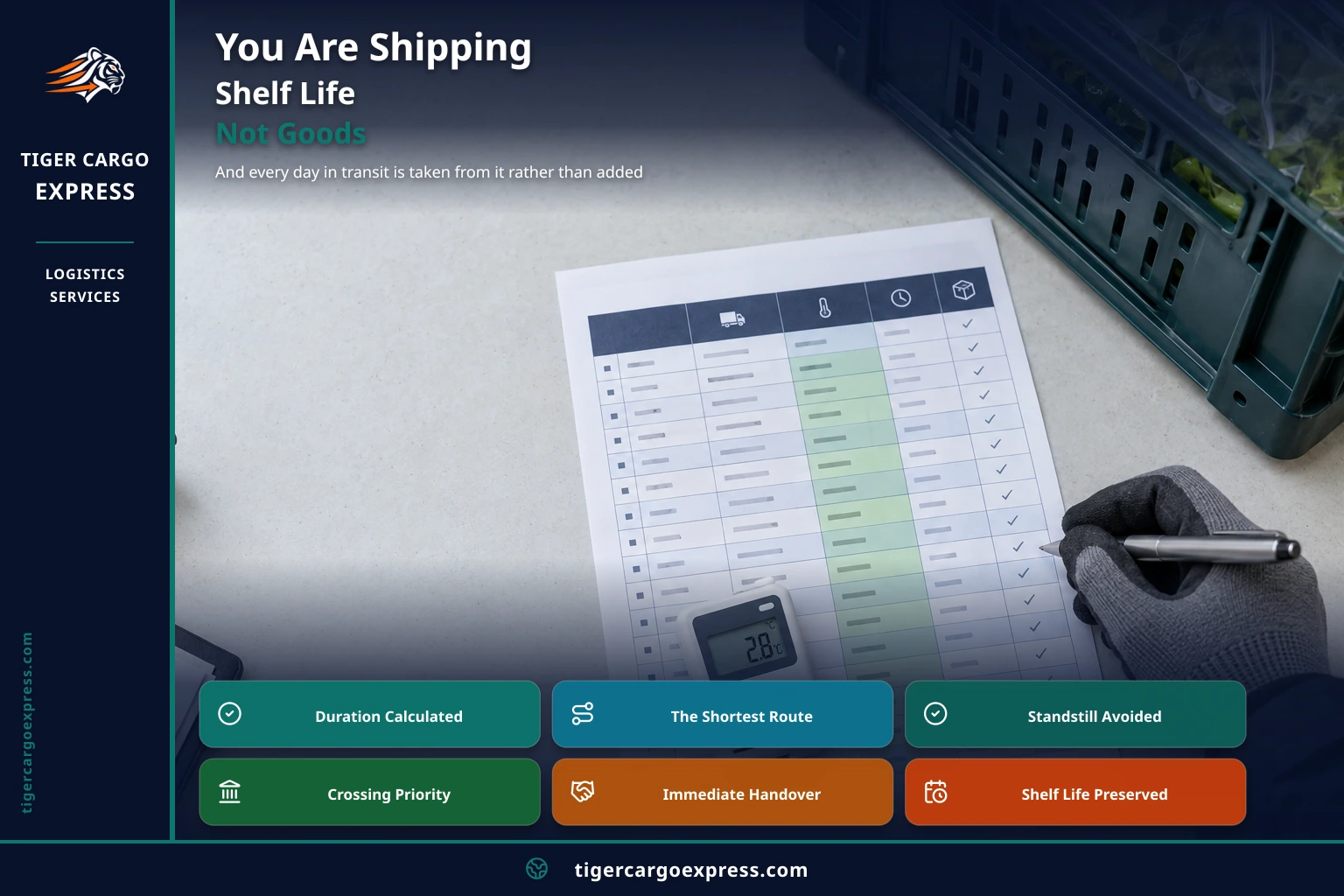
You are shipping shelf life, not goods
And every day in transit is taken from it rather than added.
And every day in transit is taken from it.
Work it out with me: a product with fourteen days’ shelf life, three days out of production, and a five-day journey to your destination. What reaches your consignee?
The stage
Days
Remaining of fourteen
Production and storage at yours
3
11
Waiting to load
1
10
The journey and the crossing
5
5
Clearance and handover
1
4
What remains for your consignee
—
4 days to sell
What they need to sell it
7 – 10
Short
Which is why we ask about remaining shelf life before the priceA question many find odd: ‘what business is it of yours?’ Our business is that a consignment arriving with four days left will be returned, sold at a loss or destroyed — and it will be said that the shipping spoiled it, when it did not. We tell you before we ship: this duration is not enough — so we either find a faster route, or the consignment is brought forward, or we do not ship.
And three ways we shorten the duration
Crossing priority for refrigerated freightRequested where available — an hour at a border is an hour of your shelf life.
Avoiding peak daysMoving on a congested day can add a whole day.
A dawn loading and an immediate departureA day that starts at dawn ends a day before one that starts at noon.
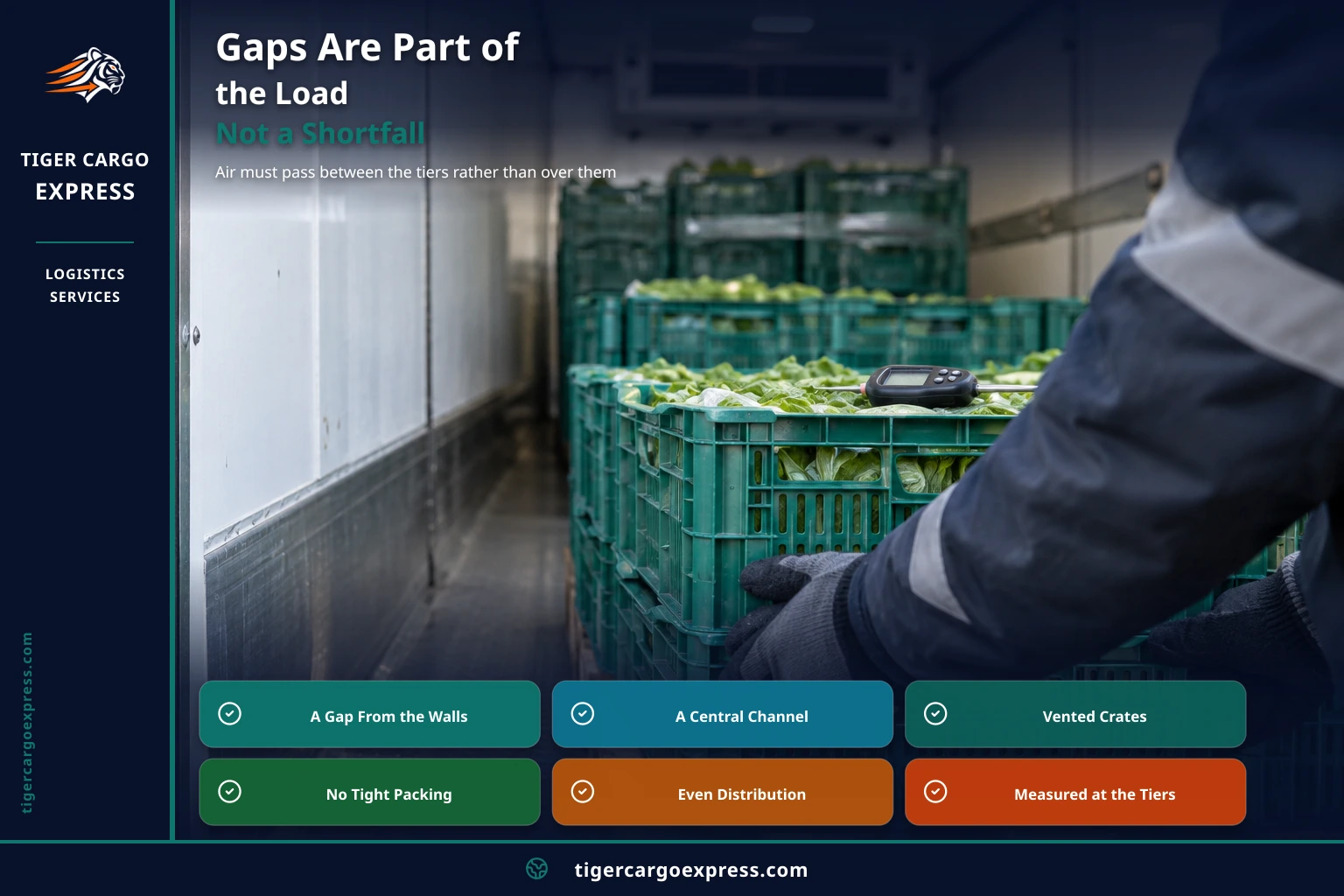
Gaps are part of the load, not a shortfall
Air must pass between the tiers rather than over them.
Frozen goods can be packed tight. Chilled goods cannot. A chilled product is alive, it respires and it gives off heat — and air must pass between it rather than over it.
The stacking
What happens
The result
Tight with no gaps
Air passes over the load rather than through it
A cold surface and a warm core
Flush against the walls
The wall exchanges heat with outside
Warmer edges
Up to the ceiling
It blocks the overhead air chute
No distribution at all
With a wall gap and a central channel
Air circulates through the load
An even temperature
Solid cartons with no vents
Air passes around them rather than through
A warmer carton core
Vented cartons aligned
The vents meet and air passes
Correct
And the last row is often got wrongA vented carton is no use if its vents do not meet those of the carton above it. When cartons are stacked offset — as bricks are laid, for stability — each carton’s vent is blocked by the body of the one above. Correct chilled stacking is vertical and aligned rather than offset, and it is secured with straps or boards rather than by the offset.
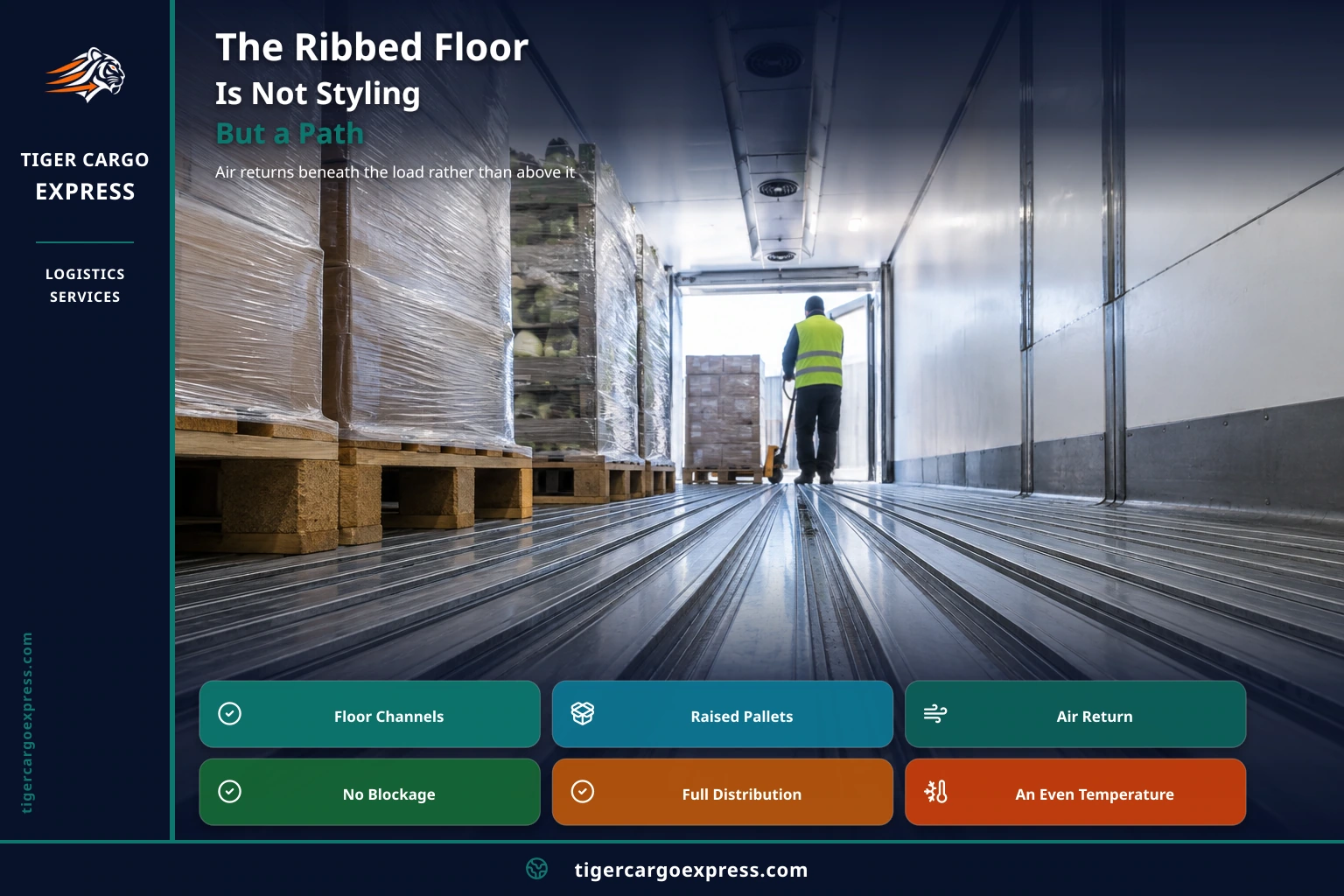
The ribbed floor is not styling but a path
Air returns beneath the load rather than above it.
The channels in a refrigerated floor are not for drainage but for the air’s return. The unit pushes air from above through the ceiling chute, and it must return to it from beneath the load. Blocking the channels stops the whole circuit.
The case
The air path
The result
Pallets directly on the channels
Pushed from above, returning from below
A complete circuit
A carton placed on the floor
It blocks the channels beneath it
No return from that point
A flat board covering the floor
It blocks every channel
The circuit stops
Broken pallets touching the floor
Partial blockage
Uneven distribution
A load reaching the ceiling
It blocks the delivery chute
The air cannot leave at all
A 10 cm gap below the ceiling
The delivery works
Correct
And the commonest error: a carton on the floor to fill a gapA crew finds a gap between two pallets and puts cartons in it directly on the floor. It looks like good use of space, and it is in fact a blockage of the return channels at that point — so whatever sits above it becomes warmer than the rest. Gaps are filled with pallets rather than cartons, or left empty with the load secured by boards.
What we ship chilled
Fresh fruit and vegetablesWith calculated ventilation and separation of what ripens what.
Dairy and cheeseWhere the duration matters more than the degree itself.
Chilled meat and poultryArranged to prevent contact and let air pass.
EggsProtected from vibration more than from temperature.
Fresh baked goodsThe shortest-lived — and needing the fastest route.
Chilled datesWith their agricultural certificates before loading.
And the produce line needs detailSome items give off a gas that ripens others in an enclosed space. Bananas, apples and tomatoes, for instance, hasten the ripening of what sits beside them, while leafy greens and cucumbers suffer from it quickly. We ask about every item rather than the largest, and may recommend separating them into two consignments — which costs more and arrives with less loss.
What we require for chilled specifically
The condition
Why for chilled alone
Vertical aligned stacking rather than offset
So each carton’s vent meets the one above
A gap from all four walls
The wall exchanges heat with outside
A central channel through the load
So air circulates through it rather than over it
Not one floor channel blocked
The return stops at that point
A gap below the ceiling
So the delivery chute is not blocked
The shortest route available
Because the duration is taken from the shelf life
And the first condition goes against shippers’ habitOffset stacking is more stable on the road — as bricks are laid. Which is why everyone who has ever loaded dry freight does it. And in chilled freight it is the very error that blocks the ventilation — we secure with straps and boards instead of the offset, and that takes longer at loading.
How to compare two chilled quotes
Six questions — and the first is about duration rather than degree.
1How many days door to door?Not how many on the road — clearance and waiting come out of my shelf life.
2How do you stack the load?‘Tightly’ is the wrong answer for chilled — gaps are part of the load.
3Do you block the floor channels?Anyone who does not know they have a function will block them with a carton.
4Do you separate items that ripen one another?Or load them together in one enclosed space?
5Do you request crossing priority for reefers?Where it is available — an hour at a border is an hour of my shelf life.
6When do you say a consignment is not worth it?Anyone who never says it will ship you what arrives with no life left.
An example of the wrong comparisonTwo quotes at the same duration with two hundred riyals between them. But ask about the stacking: if it is tight with no gaps your load’s surface is cold and its core warmer. You receive a sound chart from a device in the air path and goods that spoiled from within. And two hundred riyals do not replace a load of produce arriving with half its life gone.
What we guarantee and what we do not
Calculating the duration before the priceAnd telling you the remaining shelf life is not enough — before we ship.
Stacking that lets air passVertical, aligned, with gaps and a central channel — not tight.
Floor channels left openThe return stops wherever they are blocked — even by one carton.
Separating incompatible itemsEven at the cost of two consignments rather than one.
And what we do not promise: we will not say the duration will be shorter than it is. Crossings and clearance are partly beyond us, and we give you a realistic estimate rather than an optimistic one — because an optimistic estimate makes you ship what does not arrive saleable. And we will not pack your load tight to save space — the gap here is part of the service.
Five mistakes in chilled shipping
Counting the duration on the road aloneWaiting, clearance and handover all come out of the shelf life. The count is door to door rather than border to border.
Tight stacking to save spaceAir passes over the load rather than through it, so the surface is cold and the core warmer. Gaps are part of the load.
Offset stacking as bricks are laidEach carton’s vent is blocked by the body of the one above. Correct chilled stacking is vertical and aligned, secured with straps rather than the offset.
Putting cartons on the floor to fill a gapIt blocks the air-return channels at that point so whatever sits above becomes warmer. Gaps are filled with pallets rather than cartons.
Mixing items that ripen one anotherSome items give off a gas that hastens the ripening of what sits beside them in an enclosed space. Separation costs more and arrives with less loss.
Why Tiger Cargo Express?
We count your shelf life, not only your temperatureAnd say ‘not worth it’ before shipping rather than after arrival.
We stack for ventilation rather than for spaceVertical, aligned, with gaps and a central channel — and it takes longer.
We block not one floor channelThe return stops wherever it is blocked, even by a carton.
We separate incompatible itemsEven at the cost of two consignments — the loss exceeds the difference.
We request crossing priority for reefersWhere available — an hour at a border is an hour of your goods’ life.
Verify that we are properly registeredRegistration 5800108005 and a documented national address — sent whenever you ask.
Send the item, the remaining shelf life and the destinationAnd the estimate reaches you with a count of what remains for your consignee — within an hour.Call 0506688227Message on WhatsApp
Frequently asked questions about international chilled shipping
What is the difference between chilled and frozen?With frozen you ship a product; with chilled you ship shelf life. Frozen keeps for as long as it stays below the limit; chilled spends its life every hour, even at exactly the right temperature. So the question here is not ‘did you hold the temperature?’ but ‘how much shelf life remained on arrival?’
Why do you ask about remaining shelf life?Because a consignment arriving with four days left will be returned, sold at a loss or destroyed — and it will be said that the shipping spoiled it, when it did not. We tell you before we ship: this duration is not enough — so we find a faster route, or bring it forward, or do not ship.
And how is the duration counted?Door to door rather than border to border. Waiting to load is a day, the journey and crossing are days, and clearance and handover are a day. All of it is taken from your shelf life — and we give you a full count of what remains for your consignee.
Why is the load not packed tight?Because a chilled product is alive, respires and gives off heat — air must pass between it rather than over it. Tight packing makes the air pass over the load so the surface is cold and the core warmer. Gaps from the walls and a central channel are part of the load rather than a shortfall.
And what is wrong with offset stacking?That each carton’s vent is blocked by the body of the one above it. Offset stacking — as bricks are laid — is more stable on the road, which is why everyone who has loaded dry freight does it. Correct chilled stacking is vertical and aligned, secured with straps and boards rather than the offset.
What are the floor channels for?The air’s return rather than drainage. The unit pushes air from above through the ceiling chute and it must return from beneath the load. Blocking the channels stops the whole circuit at that point.
And the commonest error with them?Putting cartons directly on the floor to fill a gap between two pallets. It looks like good use of space and it is a blockage of the return channels, so whatever sits above becomes warmer. Gaps are filled with pallets rather than cartons, or left with the load secured by boards.
Do you separate produce from produce?Yes when two items conflict. Some give off a gas that hastens the ripening of what sits beside them in an enclosed space — bananas, apples and tomatoes among them — while leafy greens and cucumbers suffer from it quickly. We may recommend two consignments rather than one.
How do you shorten the duration?In three ways: requesting crossing priority for refrigerated freight where available, avoiding peak days that can add a whole day, and a dawn loading with an immediate departure — a day starting at dawn ends a full day before one starting at noon.
Does the degree matter more or the duration?The duration — and this is what marks chilled from frozen. A consignment whose temperature was held perfectly and that arrived after seven days may be in worse condition than one that fluctuated a degree and arrived in three. Both matter — but the duration is always taken and never given back.
Which items are the shortest-lived?Fresh baked goods and leafy greens. They need the fastest route available and the shortest waiting time, and we may decline distant destinations for them because the duration alone consumes their life before they arrive.
And what suffers more from vibration than temperature?Eggs. Their required temperature band is relatively wide, but vibration and knocks crack them or weaken the shell so they spoil before their date. We place them where there is less vibration and secure them with greater care.
Do you ship chilled dates?Yes — with the agricultural certificates prepared before loading rather than after. Dates are among the most common things we ship from Qassim and Al Ahsa, and their certificates always precede the container.
What if the crossing is delayed and shelf life is lost?We notify you the moment the delay occurs rather than on arrival — so you decide: hand over as is, divert to a nearer consignee, or otherwise. The decision is taken while the consignment moves rather than after it stands at their door.
In summary
With frozen goods you ship a product. With chilled goods you ship shelf life. Frozen keeps for as long as it stays below the limit; chilled spends its life every hour — even at exactly the right temperature.
Which is why we count door to door rather than border to border: waiting to load, the journey, the crossing, the clearance and the handover — all of it taken from your shelf life. And we tell you in days what remains for your consignee before you pay.
And gaps are part of the load rather than a shortfall: vertical aligned stacking so each carton’s vent meets the one above, a gap from the walls, a central channel, and floor channels never blocked, not even by a single carton — the return stops wherever it is blocked.
Send the item, the remaining shelf life and the destination — the estimate reaches you with a count of what remains for your consignee. 0506688227
Your chilled goods are in safe handsCounted door to door · Stacked for ventilation · Channels open · Incompatibles separatedCall 0506688227Message on WhatsApp
Related cold-chain services
Chilled 0–4°C is a distinct lane with its own temperature band, its own cost structure and its own responsibilities — and the right one depends on what you are moving.