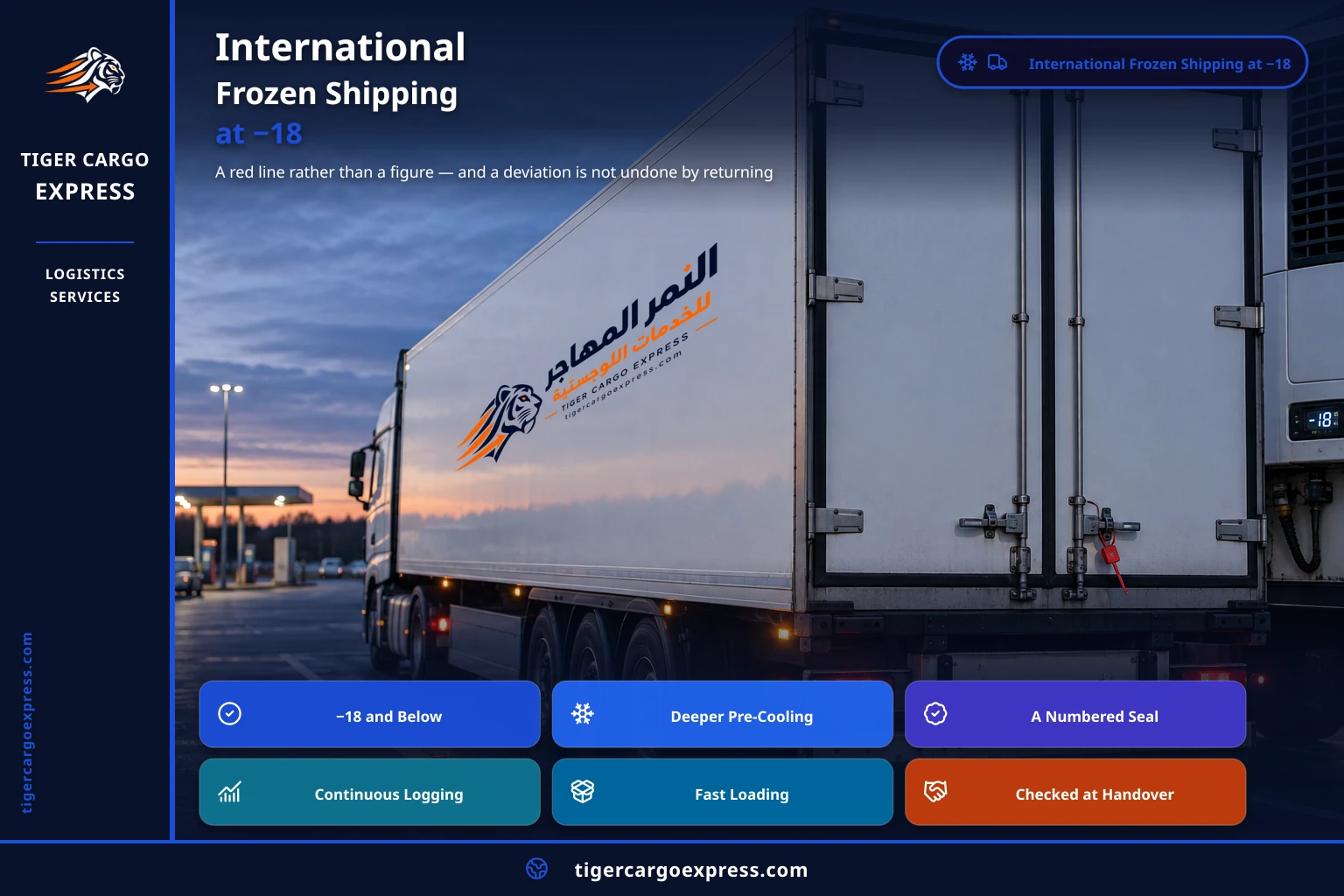
International Frozen Shipping at −18 0506688227 A Deviation Is Not Undone by Returning
Guide summary
International frozen shipping from Riyadh, Jeddah and Dammam to the Gulf, Jordan, Syria and Lebanon — the difference between chilled and frozen is not the figure but the nature of the failure. Chilled goods that rise two degrees and return may survive; frozen goods that rise two degrees and return do not, however sound they look: what thawed partly is refrozen with larger crystals that tear the structure, and that shows not on a thermometer but at cooking or at sale. So we require a unit reaching −25 rather than −18, load at −20 or lower, and log by the minute rather than the hour.
Guide contentsShowHide
Looking for international frozen shipping from Saudi Arabia at −18 from a company that knows the figure is a red line rather than a target? Tiger Cargo Express ships your frozen products from Riyadh, Jeddah and Dammam to the Gulf, Jordan, Syria and Lebanon. To book: 0506688227
The difference between chilled and frozen is not the figure but the nature of the failure. Chilled goods that rise two degrees and return may survive. Frozen goods that rise two degrees and return do not — however sound they look.
And that sentence is the whole article: what partly thawed does not return by refreezing. The crystals that form again are larger and coarser, and they have torn the product’s structure from within.
−18a red line, not a target
0acceptable deviation
1continuous log, by the minute
20+years in the field
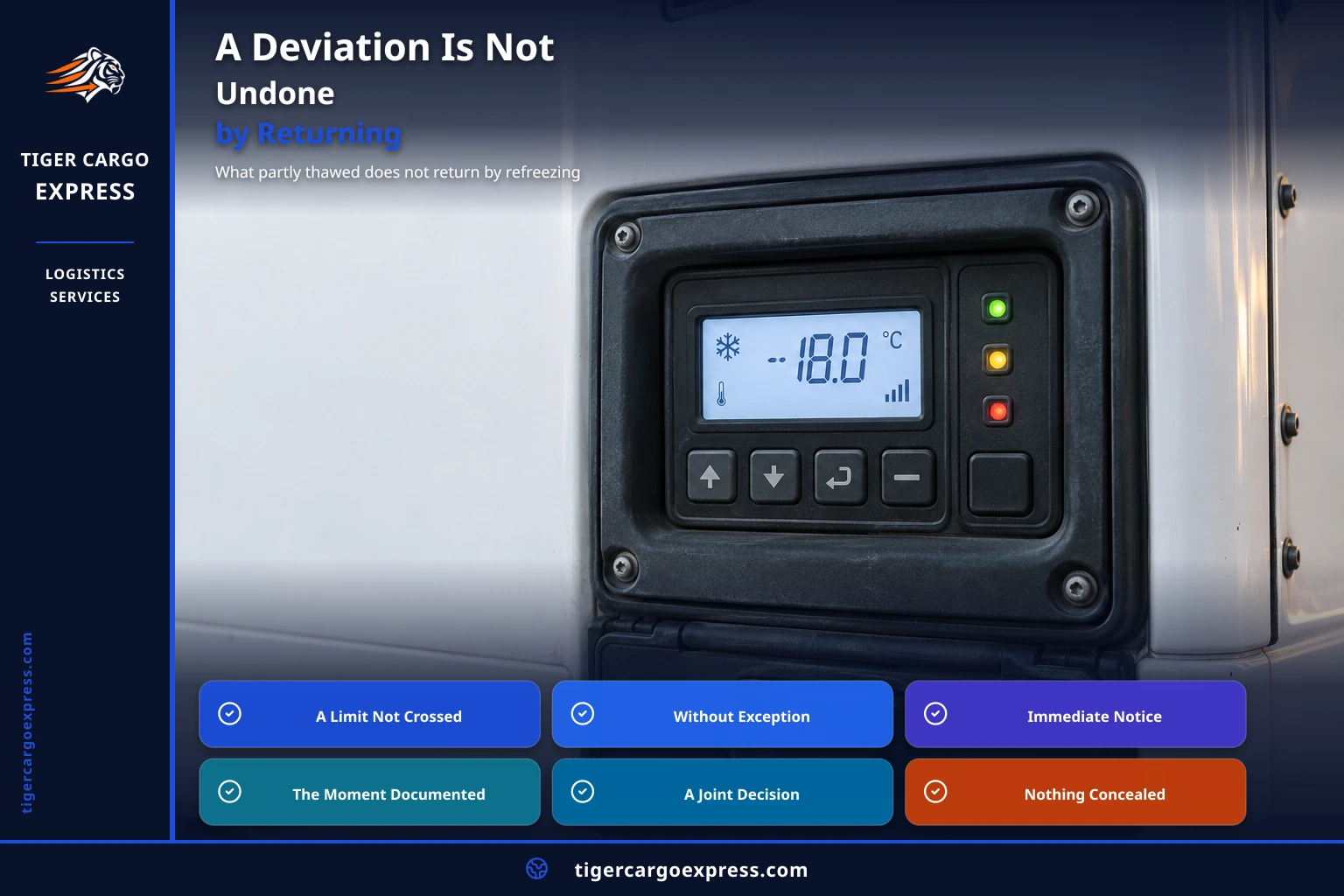
A deviation is not undone by returning
And this is what separates frozen from everything else.
What partly thawed does not return by refreezing.
Picture a consignment that rose to minus fourteen for three hours and then returned to minus eighteen. It arrives at exactly the right figure. And the thermometer at handover says: sound.
What happened
What the thermometer says
What actually happened
A rise to −14
Nothing now
Partial thawing at the edges
Three hours held
Nothing
Water migrating within the structure
A return to −18
Sound
Refrozen with larger crystals
Arrival at −18
Sound
A structure torn from within
Opened at the consignee’s
Sound
Discovered at cooking or at sale
Days later
—
A complaint with no visible cause
And why do the crystals grow on refreezing?Because rapid freezing at the plant makes fine crystals that do not tear the cells. When a product thaws partly and then freezes slowly in a trailer, the water gathers and freezes as larger crystals that pierce the structure. So it cooks watery, its texture is altered and its taste is not what it was. And none of that shows on a thermometer or to the eye.
Which is why we do not negotiate on the figure
−18 is a limit, not a targetWe do not ship at ‘about −16’ — approximation here means failure.
Loading at −20 or lowerA margin that absorbs the open door, the loading and the standing.
Logging by the minute rather than the hourA two-hour rise does not appear in a six-hourly record.
Immediate notice on any breachNot on arrival — the decision is taken while the consignment moves.
And the second line surprises some clientsWhy load at minus twenty when we want minus eighteen? Because the loading itself raises the temperature: the door opens, outside air enters and pallets are pushed in. Anyone starting at exactly minus eighteen leaves the limit before the lorry moves. The margin is not excess — it is what keeps you inside the limit for the whole road.
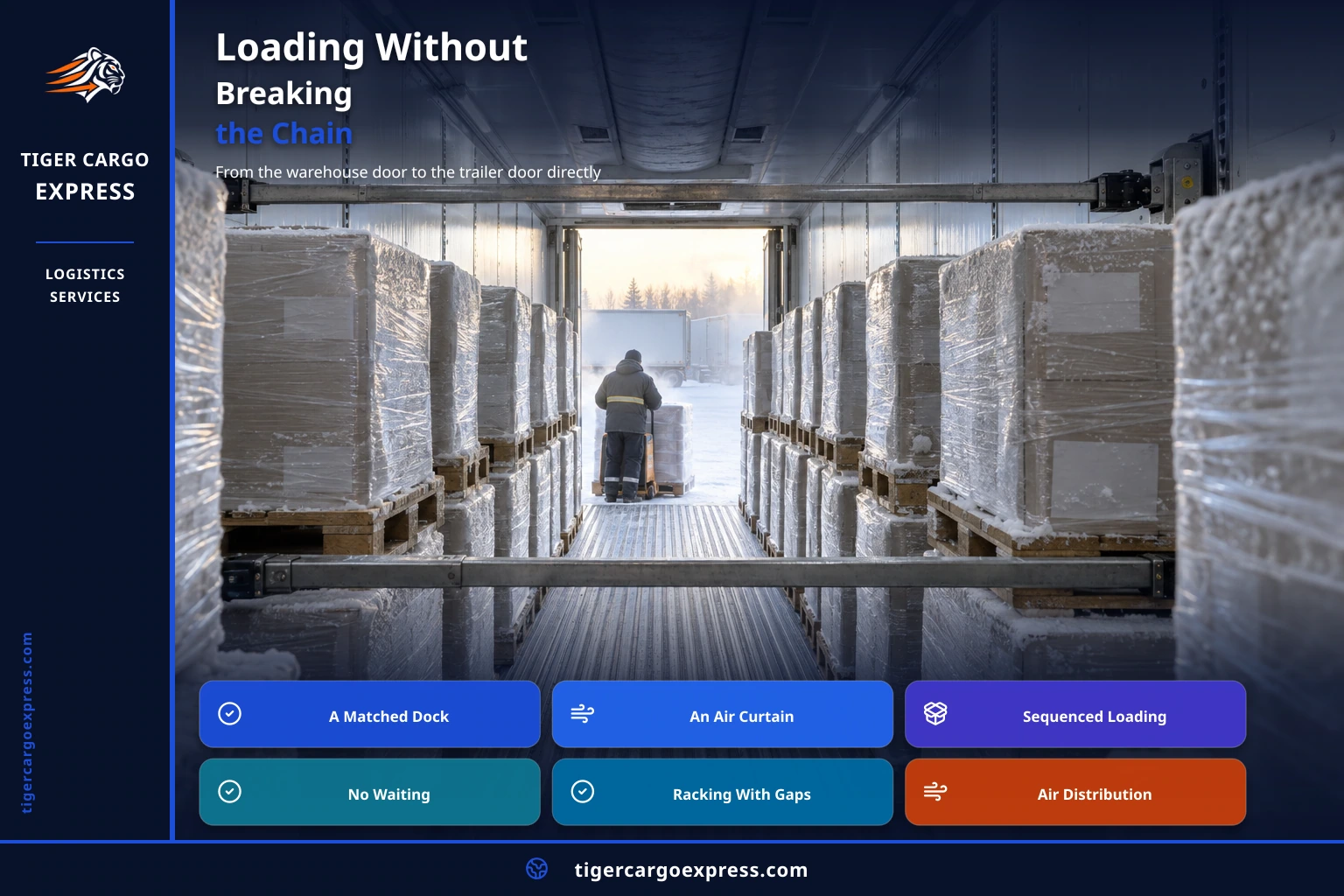
Loading without breaking the chain
From the warehouse door to the trailer door directly.
The most dangerous moment in frozen shipping is not on the road but at the dock. Between the warehouse door and the trailer door a pallet may pass through outside air — minutes that cost hours of correction.
The case
What happens to the surface
Time needed to recover
A matched dock with seals
No exposure
None
A short covered passage
Limited exposure
Minutes
Crossing an open yard
Immediate surface thawing
Hours
A pallet waiting on the dock
Cumulative exposure
By the duration
Both doors opened together
A full through-draught
The whole space emptied
Loading paused for a break
The worst — an open door with no movement
A full re-cooling
And the last row happens more than you would thinkA crew opens the door, loads half the consignment and then stops for a break with the door open. Twenty minutes with an open door is enough to raise the whole space several degrees and to thaw the surfaces of what is already loaded. We require continuous loading: the door opens when loading begins and closes when it ends — and the break comes before the opening or after the closing, never between them.
And six conditions at the loading point
A matched dock with rubber seals — or at the very least a short covered passage
The trailer cooled to minus twenty before its door is opened
Pallets ready and stacked before the opening rather than during it
One door opened rather than two — a draught empties the space
Continuous loading with no pause — the break before or after
Measuring the product surface rather than the space’s air before closing
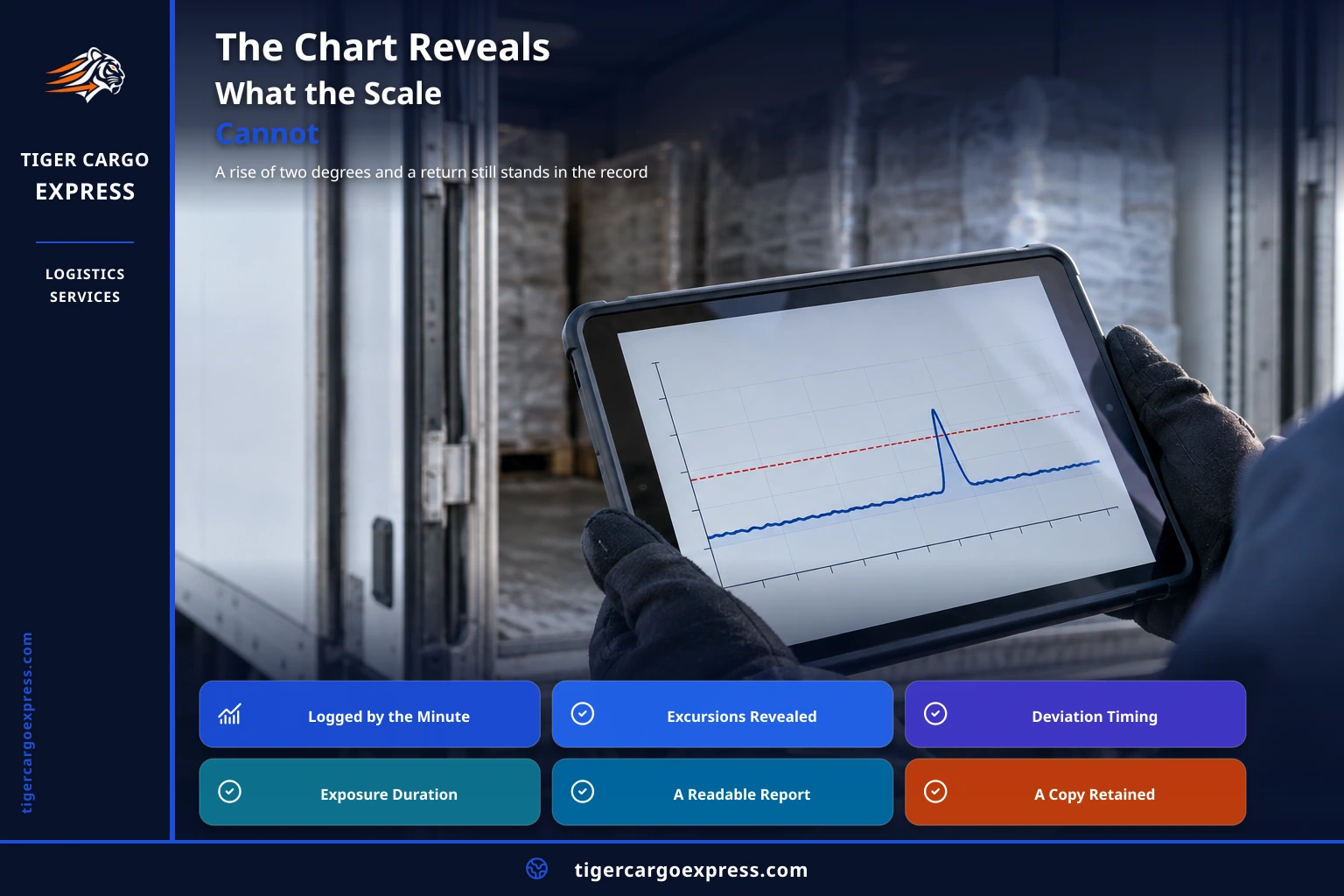
The chart reveals what the scale cannot
A rise of two degrees and a return still stands in the record.
A thermometer tells you the temperature now. A chart tells you its history. And in frozen goods the history is everything — because the present may be sound while the damage is already done.
What appears on the chart
What it means
Why it matters
A flat line below the limit
An unbroken chain
The goods as they were shipped
A short sharp rise
A door opening or a momentary fault
May be tolerable by its duration
A long rise above the limit
Partial thawing
Damage that cannot be undone
A slow gradual rise
A weakening unit or an overload
An early warning
A gap in the record
The device was switched off or removed
More dangerous than the rise itself
Repeated fluctuation
A unit cycling on and off
Margin being consumed
And a gap in the record is more dangerous than a riseBecause a rise is measured and its effect estimated, while a gap conceals whatever happened in it. Two hours unlogged may have been sound or may have been a disaster — and there is no way to know which. We require a device that is neither switched off nor removed until handover, and any gap is treated as a deviation rather than as an absence.
What we ship frozen
Frozen meat and poultryArranged to prevent contact and let air pass between the tiers.
Fish and seafoodThe most sensitive to fluctuation — with a narrower margin than the rest.
Frozen fruit and vegetablesProtected from the clumping that partial thawing causes.
Baked goods and doughsWhere thawing ruins the texture before it ruins the taste.
Prepared mealsOn a chain unbroken from production to handover.
Ice cream and its productsThe most sensitive of all — we may require a deeper margin.
And ice cream deserves a wordIt is what reveals partial thawing without a laboratory. Coarse ice crystals appear on its surface — visible proof that it thawed and was refrozen. Which is why we require a deeper margin and a lower set point for it, and refuse it if the loading point has no matched dock.
What we require of the carrier for frozen specifically
The general conditions apply — with five added that concern frozen alone.
The condition
Why for frozen specifically
A unit reaching −25 rather than −18
The margin absorbs the open door, the standing and the load
Logging by the minute rather than the hour
A two-hour rise does not appear in a six-hourly record
Acceptance of continuous loading with no pause
With the break before the opening or after the closing
Not switching the unit off while standing
Even if standing at a border runs to hours
Immediate notice on any breach
Not on arrival — the decision is taken while the consignment moves
And the fourth condition is the most often brokenA refrigeration unit burns fuel, and a long wait tempts a driver to switch it off. A driver waiting four hours at a border in summer may switch it off to save fuel — believing the insulation is enough. Insulation slows rather than prevents. And four hours with the unit off in summer is enough to cross the limit — the log reveals it, which is why the log prevents more than it proves.
When we refuse a frozen consignment
When the goods reach the dock above the limit — we do not cool them in the trailer
When the loading point has neither a matched dock nor a covered passage — for sensitive items
When the carrier refuses an independent logger — and we look for another
When the pallets are not stacked at the time of opening — we postpone until they are
When a client asks to ship at −16 ‘to save fuel’ — we do not accept
When we find no carrier with a unit reaching −25 on that line at that time
And the last line sometimes means a postponementAnd we say it plainly: we may decline your date and offer you another. An available carrier is not a qualified carrier, and shipping frozen goods on a unit without the margin is a gamble — one that loses your consignment and your trust together. Two days’ delay is better than handing over goods that look sound and are not.
How to compare two frozen quotes
Six questions — and not one about the price.
1What temperature does your unit reach?−18 is not an answer — I want the margin, not the limit.
2At what temperature do you load?Anyone starting exactly at the limit leaves it before the lorry moves.
3How often does the device log?A six-hourly record hides a two-hour rise.
4Do you switch the unit off during long waits?The honest answer here reveals everything about the carrier.
5What if the record has a two-hour gap?Anyone treating it as an absence rather than a deviation has missed the point.
6Do you require a matched dock?Or do you load from an open yard and call it loading?
An example of the wrong comparisonA quote fifteen per cent lower for a frozen meat consignment. But ask what the unit reaches: if it barely reaches −18 you are shipping without a margin. And the first long wait at a summer border takes you out of the limit — your goods arrive at exactly the right figure, having thawed and been refrozen. And fifteen per cent does not replace a load of meat that lost its texture.
What we guarantee and what we do not
A unit reaching −25 rather than −18The margin is what keeps you inside the limit rather than the limit itself.
Loading at −20 or lowerBecause the loading itself raises the temperature before the lorry moves.
Logging by the minute, handed to youA two-hour rise does not appear in a six-hourly record.
Refusing what we cannot deliverEven at the cost of your date — postponement beats a handover that looks sound.
And what we do not promise: we will not say the chain will never break. Failures and long waits happen, and what we guarantee is that they are recorded and that you learn of them at once so we decide with you while the consignment moves rather than after it arrives. And we will not ship at −16 however it is asked — approximation in frozen goods means failure.
Five mistakes in frozen shipping
Loading at exactly the limitThe loading itself raises the temperature: the door opens, air enters, pallets are pushed in. Anyone starting at −18 leaves it before the lorry moves.
Pausing for a break with the door openTwenty minutes is enough to raise the space several degrees and thaw the surfaces of what is loaded. The break comes before the opening or after the closing.
Accepting a six-hourly recordA two-hour rise does not appear in it at all. Logging by the minute is what reveals what actually happened.
Treating a gap in the record as an absence rather than a deviationA rise is measured and its effect estimated; a gap conceals whatever happened in it. It is more dangerous, not less.
Being reassured because the temperature is right at handoverA thermometer tells you the temperature now; a chart tells you its history. And in frozen goods the history is everything.
Why Tiger Cargo Express?
We require −25 rather than −18The margin is the protection; the limit itself is a red line rather than a target.
We load at −20 or lowerBecause the open door and the loading consume degrees before departure.
Logging by the minute, handed to youAnd we treat a gap as a deviation rather than an absence.
We require continuous loadingWith the break before the opening or after the closing, never between.
We refuse and postponeIf we find no qualified carrier — we do not ship on a unit without a margin.
Verify that we are properly registeredRegistration 5800108005 and a documented national address — sent whenever you ask.
Send the item, the set point and the destinationAnd the estimate reaches you with the required unit rating and the logging interval — within an hour.Call 0506688227Message on WhatsApp
Frequently asked questions about international frozen shipping
Why is −18 a red line rather than a target?Because failure in frozen goods is not undone by returning. Chilled goods that rise two degrees and return may survive; frozen goods that rise two degrees and return do not, however sound they look — because what thawed partly is refrozen with larger crystals that tear the structure.
But the consignment arrives at −18 — is it not sound?A thermometer tells you the temperature now; a chart tells you its history. A consignment that rose to −14 for three hours and returned arrives at exactly the right figure, with its surface thawed and refrozen — discovered at cooking or at sale rather than at handover.
And why do the crystals grow on refreezing?Because rapid freezing at the plant makes fine crystals that do not tear the cells. When a product thaws partly and then freezes slowly in a trailer, the water gathers and freezes as larger crystals that pierce the structure. So it cooks watery and its texture is altered — and none of that shows on a thermometer or to the eye.
At what temperature do you load?At −20 or lower — not at exactly −18. The loading itself raises the temperature: the door opens, air enters and pallets are pushed in. Anyone starting at the limit leaves it before the lorry moves.
And what unit rating do you require?A unit reaching −25 rather than −18. The margin is what absorbs the open door, the long standing, the extra load and the summer heat. A unit that barely reaches the limit leaves it at the first condition that is not ideal.
How often does the device log?By the minute rather than the hour.A two-hour rise does not appear at all in a six-hourly record — you may receive a chart that looks flat while whatever happened, happened between two points.
And what if the record has a gap?We treat it as a deviation rather than an absence — and it is more dangerous than a rise. A rise is measured and its effect estimated; a gap conceals whatever happened in it. Two hours unlogged may have been sound or a disaster, with no way to know which.
What is the most dangerous moment in frozen shipping?At the dock rather than on the road. Between the warehouse door and the trailer door a pallet may pass through outside air. And the worst of it: loading paused for a break with the door open — twenty minutes raises the whole space several degrees and thaws the surfaces of what is loaded.
Do you require a matched dock?For sensitive items yes — or at the very least a short covered passage. We refuse loading from an open yard for ice cream and seafood, because a pallet crossing outside air means immediate surface thawing that needs hours to correct.
Does the driver switch the unit off while waiting?We require that he does not, however long the wait. The unit burns fuel and a long wait tempts switching it off, and anyone doing so believes the insulation is enough. Insulation slows rather than prevents — and four hours off in summer is enough to cross the limit.
Will you ship at −16 to save fuel?No — and we will not accept it however it is asked. Approximation in frozen goods means failure, and −18 is a limit rather than a target. Anyone offering you that is offering a saving on fuel against your whole load.
When do you refuse a frozen consignment?In six cases: goods reaching the dock above the limit; a loading point with no matched dock for sensitive items; a carrier refusing an independent logger; pallets not stacked at the time of opening; a request to ship at −16; or no carrier with a unit reaching −25 on that line at that time.
And what do you do in the last case?We decline your date and offer you another. An available carrier is not a qualified carrier, and shipping frozen goods on a unit without a margin is a gamble — and two days’ delay is better than handing over goods that look sound and are not.
Which items are the most sensitive?Ice cream and seafood. Ice cream is what reveals partial thawing without a laboratory — coarse crystals appear on its surface, visible proof that it thawed and was refrozen. We require a deeper margin for it.
In summary
The difference between chilled and frozen is not the figure but the nature of the failure. Chilled goods that rise two degrees and return may survive. Frozen goods that rise two degrees and return do not — however sound they look.
What thawed partly does not return by refreezing. The crystals that form again are larger and coarser and have torn the structure from within — and that shows neither on a thermometer nor to the eye, but at cooking or at sale.
Which is why we do not negotiate on the figure: a unit reaching −25 rather than −18, loading at −20 or lower, logging by the minute rather than the hour, and continuous loading with no break at an open door.
And we refuse and postpone when we find no qualified carrier — an available carrier is not a qualified one, and two days’ delay is better than a handover that looks sound and is not.
Send the item, the set point and the destination — the estimate reaches you with the required unit rating and the logging interval. 0506688227
Your frozen goods are in safe hands−25 rather than −18 · Loading at −20 · Logging by the minute · Refusing what we cannot doCall 0506688227Message on WhatsApp
Related cold-chain services
Frozen −18°C is a distinct lane with its own temperature band, its own cost structure and its own responsibilities — and the right one depends on what you are moving.