International Refrigerated and Frozen Shipping from Saudi Arabia 0506688227 Who Sets the Carrier’s Conditions?
Guide summary
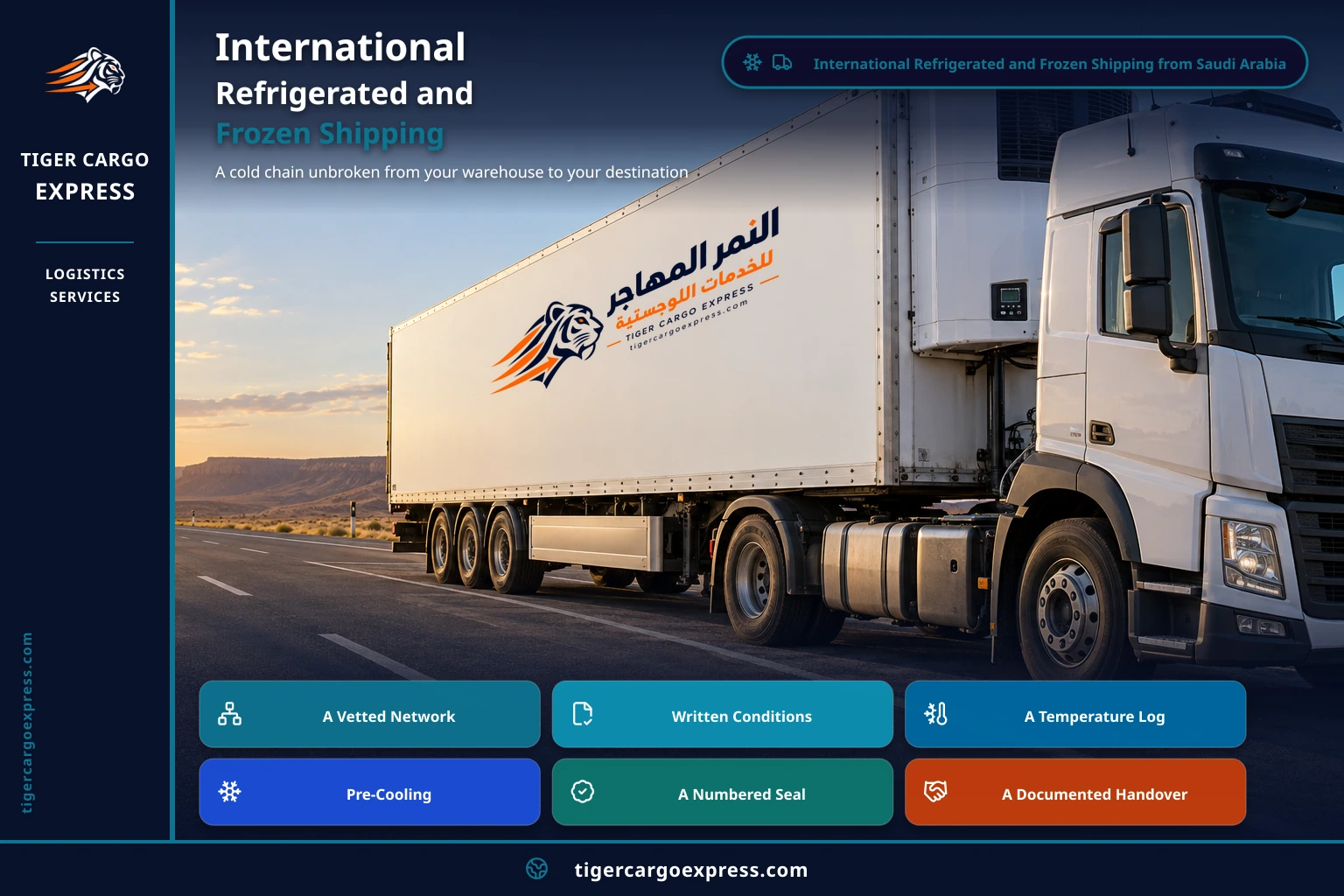
International refrigerated and frozen shipping from Riyadh, Jeddah and Dammam to the Gulf, Jordan, Syria and Lebanon — and we begin with what few pages say: we own no fleet of refrigerated vehicles, but carry through a network of carriers we select, set conditions for and monitor. Whoever owns a lorry sells you its space; whoever selects the carrier sells you that they refused the unfit. Two conditions separate more than the rest: capacity beyond the requirement, because a unit that barely suffices fails at the first condition that is not ideal; and an independent temperature log inside the load, because the unit's reading measures its own air rather than your goods.
Guide contentsShowHide
Looking for international refrigerated and frozen shipping from Saudi Arabia that tells you who bears the temperature at every stage? Tiger Cargo Express ships your chilled and frozen goods from Riyadh, Jeddah and Dammam to the Gulf, Jordan, Syria and Lebanon. To book: 0506688227
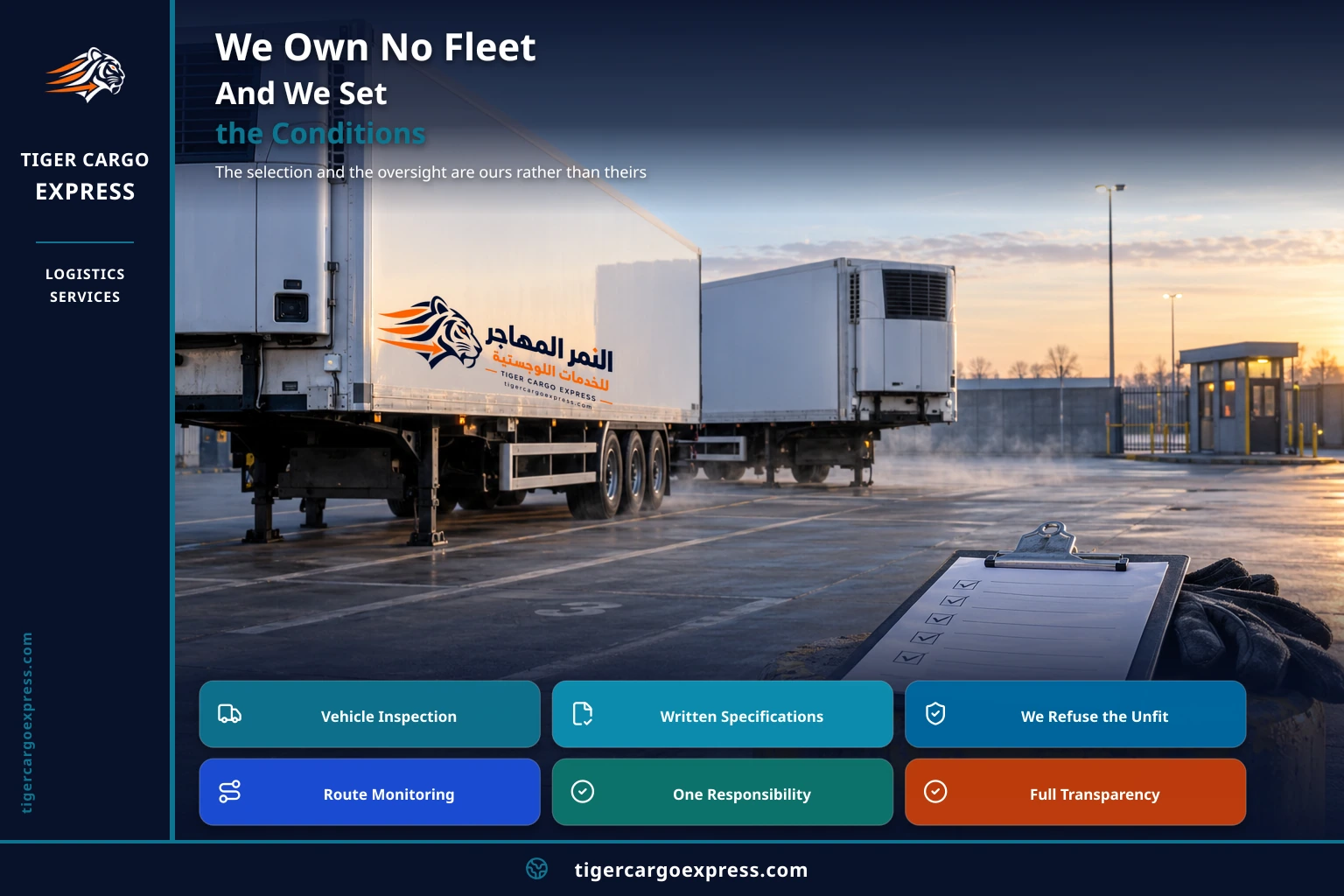
We begin with what few refrigerated shipping pages say: we do not own a fleet of refrigerated vehicles. We carry your consignments through a network of carriers we select, set conditions for and monitor.
And why say it in the third line rather than at the foot of the page? Because whoever owns a lorry sells you its space. And whoever selects the carrier sells you that they refused the unfit — and that is what we actually sell.
0fleet of our own
1single responsibility to you
1temperature log handed to you
20+years in the field
Who sets the conditions for the carrier? — this is the question
Not ‘do you have refrigerated lorries?’
The selection and the oversight are ours.
In refrigerated shipping the lorry is not the service. Refrigerated lorries are plentiful and available to anyone who pays. What is rare is whoever sets conditions for them, verifies them and bears the outcome.
The question
A single lorry owner
A broker with no conditions
Us
Who inspects the vehicle?
Himself
Nobody
We do, before loading
What if his unit is weak?
He ships with it
He ships with it
We refuse it
Who provides the temperature log?
He might
Usually nobody
We require it and hand it to you
If the temperature deviates?
You negotiate with him alone
He refers you to him
We are the party before you
If his unit fails?
You wait for his repair
You wait
A replacement from the network
How many carriers are available?
One
Whoever answers
A network we select from
And the fourth column is what you are actually buyingOne responsibility before you is better than three parties each referring you to the other. We are the party you contracted with, and we do not tell you ‘the carrier says’ when something goes wrong — we settle it with you and then settle it with him. A difference that shows not when things go well but when they do not.
And what we require of any carrier before we load with them
A refrigeration unit with capacity beyond the requirement — not one that barely meets it; the margin is what protects you
Doors with sound gaskets, inspected visually before loading
Acceptance of pre-cooling the vehicle before its door is opened for loading
Acceptance of an independent temperature logger rather than the unit’s own reading
Acceptance of a numbered seal broken only at handover
An undertaking to notify us at once of any deviation or failure — not on arrival
A maintenance record for the refrigeration unit rather than the vehicle alone
And the first condition is where most carriers are refusedBecause a unit that barely suffices works in ideal conditions and fails in others. An extra load, a door opened twice, or an hour standing at a border in summer — each consumes a margin the man who chose a unit to measure does not have. We require capacity beyond the requirement, which reduces the number we can work with and raises our cost — and we accept that.
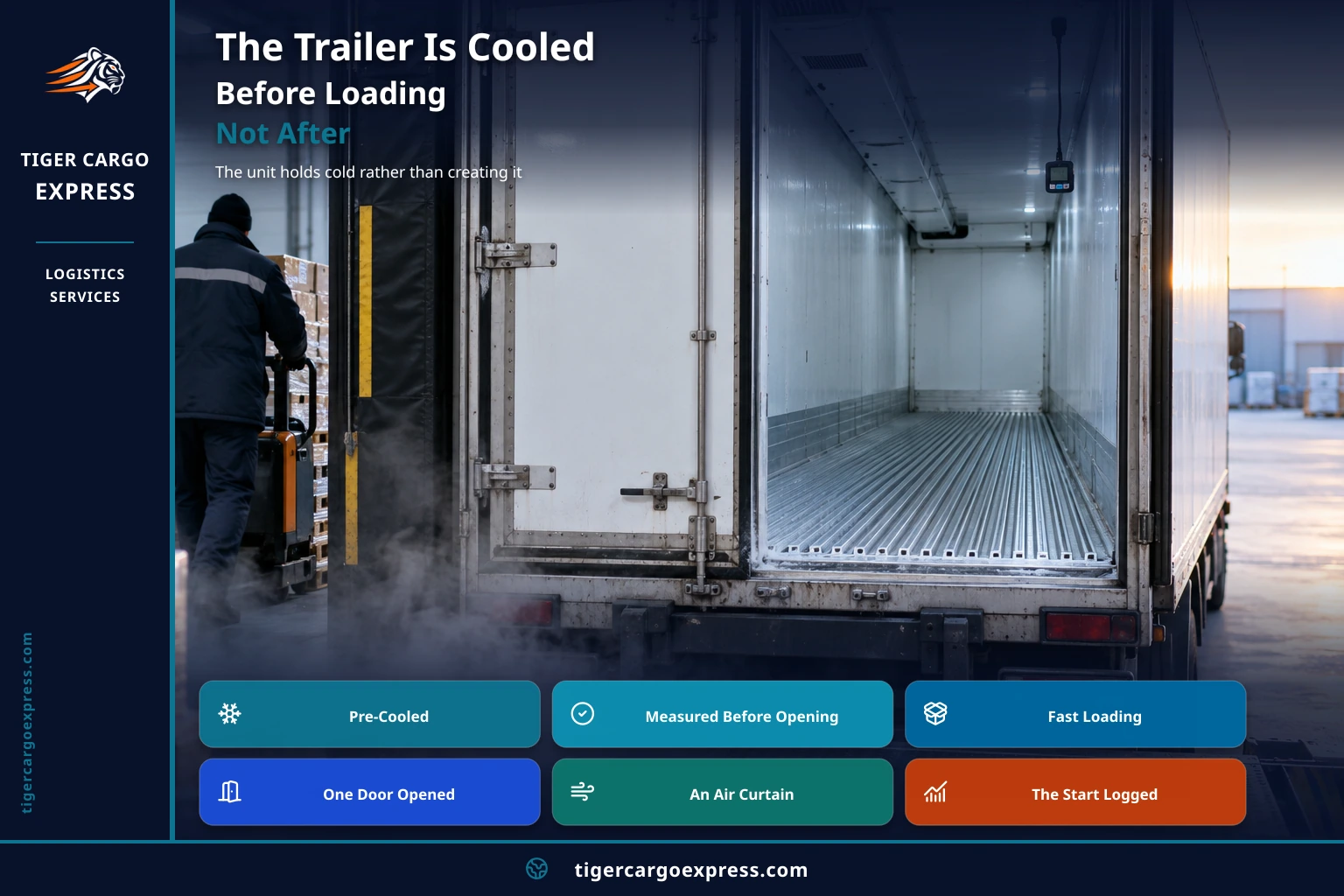
The trailer is cooled before loading, not after
The unit holds cold rather than creating it.
A refrigeration unit holds cold rather than creating it. That is the single most important sentence in refrigerated shipping, and the most often broken in practice.
The case
What happens
The result
Loading into a warm trailer
The unit cools the air, the walls and the goods together
Hours before it reaches the set point
Pre-cooled, then slow loading
Cold escapes through the open door
Partial exposure
Pre-cooled and loaded fast
The unit only holds
Correct
Both doors opened together
A full through-draught
The fastest possible loss
Warm goods into a cold trailer
The goods themselves warm the space
Not shipped at all
And the last row is sometimes refused to the clientGoods arriving warm at the loading dock are not cooled in the trailer. A refrigeration unit is designed to remove heat that leaks in, not the heat of a whole load. Anyone loading warm goods believes they will cool on the road — what happens is that they reach the right temperature after hours, having already spoiled in the first ones. We tell you so and postpone the loading rather than shipping and staying silent.
The temperature log — without a recorded chart you have no claim
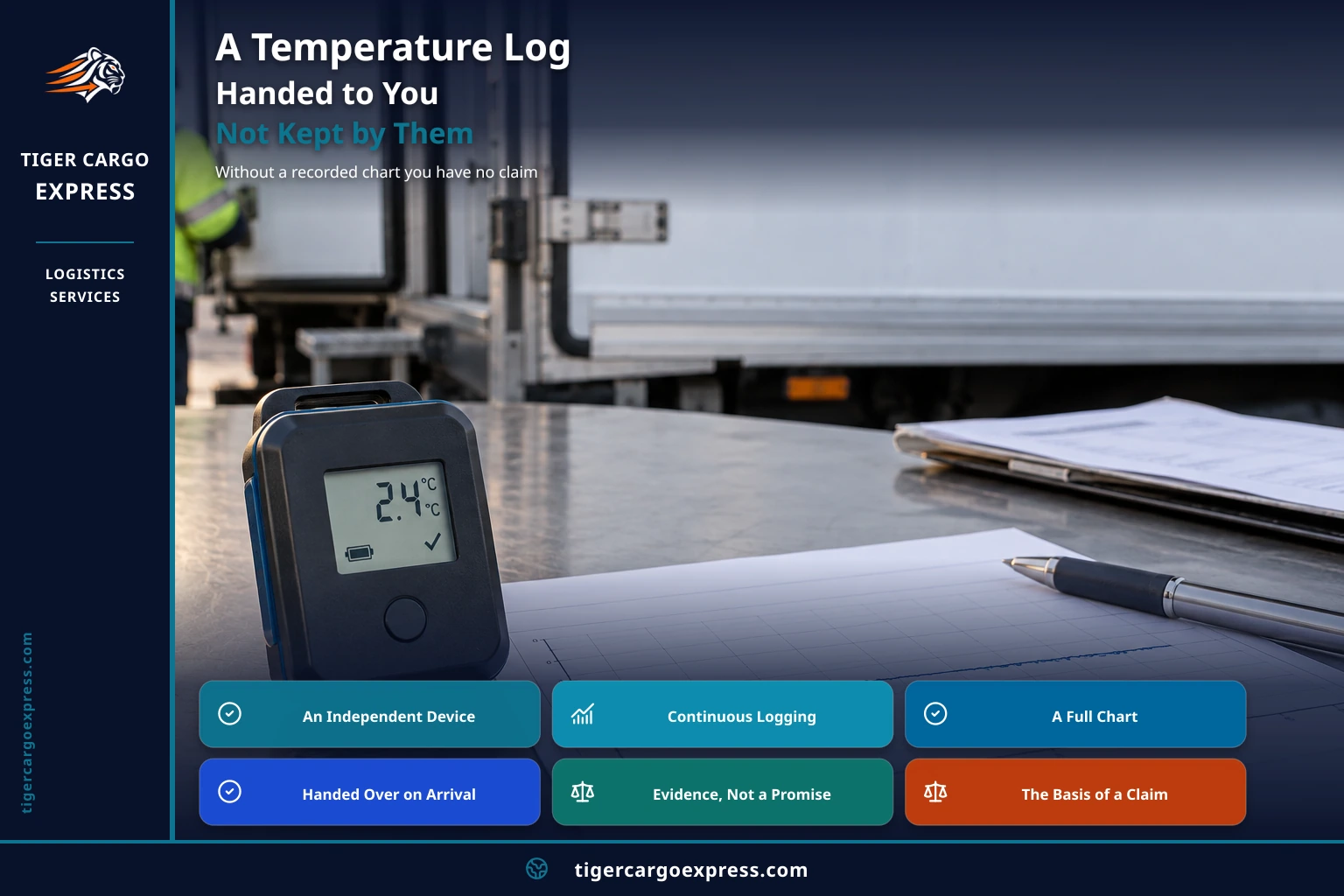
Without a recorded chart you have no claim.
This is the most important clause in any refrigerated contract, and the most often omitted. Goods that arrive spoiled do not by themselves prove when they spoiled or in whose hands.
Without a log
With a recorded log
The goods arrive spoiled
The goods arrive spoiled
Everyone says they were sound with them
The chart says when it rose and how long it held
No evidence of the stage
The timing identifies the stage and the party
Negotiation with nothing behind it
A claim with evidence behind it
The weaker party loses
Whoever it happened with bears it
And it repeats, because nobody was held to it
And it does not, because the carrier knows
And the preventive effect matters more than the remedial oneA carrier who knows an independent device is recording on him drives differently. He does not switch the unit off to save fuel while standing, does not open the door for a personal errand, and does not linger at a stop. The log prevents more than it proves — which is why we require it of every carrier, even on short consignments that appear not to need it.
And four conditions on the log itself
An independent device, not the unit’sThe unit’s reading measures its own air rather than your goods.
Continuous logging rather than a spot readingA reading on arrival says nothing about the road.
Handed to you with the consignmentNot kept by the carrier and not sent ‘later’.
A readable chart rather than raw figuresYou see the line and see any rise in it with your own eyes.
And the first condition separates a working log from a token oneA refrigeration unit measures the temperature of the air returning to it — not the temperature of your goods. The air may sit at the right point while the heart of the load is degrees warmer because the air never reached it through poor distribution. We place the device inside the load rather than in the air path — so it measures what you are shipping rather than what the unit is breathing.
What we ship chilled and frozen
Your frozen foodsAt −18 and below — with stricter conditions and continuous logging.
Your chilled productsIn a narrow band from zero to four.
Fruit and vegetablesWith calculated ventilation and gaps rather than tight packing.
Dairy and cheeseWhere the duration matters more than the temperature itself.
Meat and poultryArranged to prevent contact and let air pass.
Dates and agricultural produceWith the certificates that precede the container.
And what we do not shipWe do not ship medicines, vaccines or biological preparations. Their regime is entirely different: continuous monitoring, qualified vehicles and documented procedures under a competent authority’s oversight. Anyone offering to carry them within a general food service is offering you what you should not accept — and we say so and decline rather than taking a consignment we are not qualified for.
Where we collect from in Saudi Arabia
RiyadhIndustrial warehouses, logistics cities and cold storage areas.
JeddahThe industrial area and cold stores near the port.
Dammam and KhobarEastern warehouses and chilled distribution centres.
QassimAgricultural production centres and dates.
Madinah and YanbuBy prior arrangement according to consignment size.
Al AhsaDate and agricultural produce centres.
How a refrigerated consignment runs
1You tell us the item, the set point and the durationNot the weight alone — the temperature point determines everything that follows.
2We select the carrier and inspect themThe unit and its capacity, the doors and their gaskets, and the maintenance record.
3We pre-cool the vehicle before the loading slotAnd measure inside it before the door is opened.
4We fit the temperature logger inside the loadNot in the air path — so it measures your goods.
5Fast loading through one doorWith photographic documentation and then a numbered seal.
6Monitoring on the roadAnd notifying you of any deviation at once rather than on arrival.
7At the crossingStanding hours are logged, with the unit running throughout.
8Handover and the seal broken before your consigneeWith the full chart handed over alongside.
The destinations we cover
The destination
Approximate distance
What marks its line
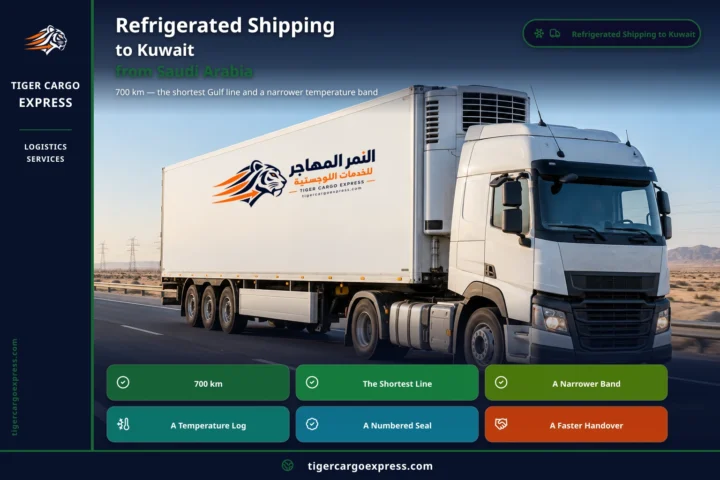
Kuwait
Around 700 km
The shortest — permitting a narrower band
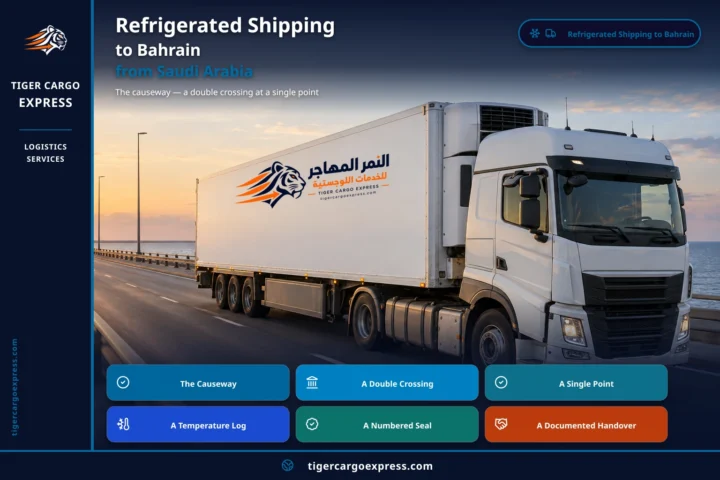
Bahrain
Around 450 km to the causeway
One point for two crossings
Qatar
Around 700 km
A single crossing with no alternative
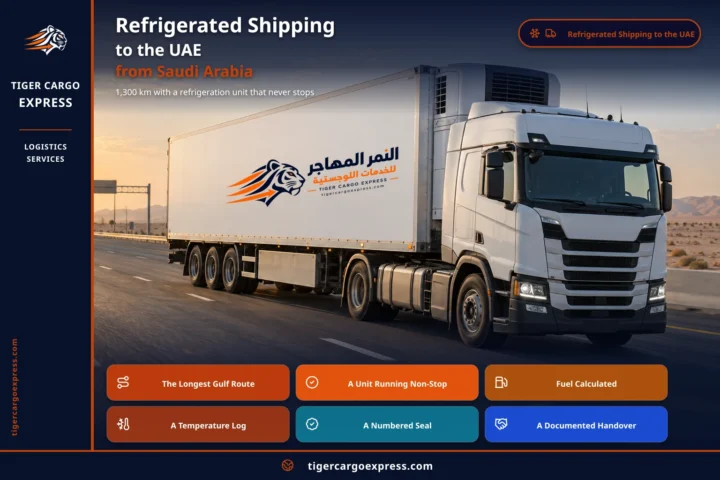
The UAE
Around 1,300 km
The longest Gulf line, the unit running two days
Oman
Around 1,600 km
The furthest — on a route without services
Jordan
Around 1,300 km
The summer tests the unit rather than the road
Syria
Via Jordan
Two borders rather than one, and doubled time
Lebanon
Via Jordan and Syria
Three borders and three logs
And every destination has its own pageBecause what concerns the Kuwait line does not concern the Oman line. The first is seven hundred kilometres with one border; the second is sixteen hundred on a route without services. It will not do to put them in one table and call it coverage — the details that protect your consignment differ between them entirely.
What we need from you before pricing
The information
Why it is needed
If it is not given
The required set point
It determines the unit type and the carrier
We cannot price
The item specifically
Each has its ventilation and arrangement
An imprecise estimate
The volume or pallet count
Vehicle capacity and distribution
An approximate price only
The loading point and its facilities
Does it have a matched dock?
A risk of breaking the chain
The destination precisely
The route, the borders and the duration
A distance estimate rather than a price
The remaining shelf life
It determines whether shipping is worth it at all
We may ship what will not arrive saleable
And the last line is a question we ask that surprises manyHow much shelf life remains on your goods? Anyone shipping a product with ten days left to a destination taking six hands their consignee four days to sell it — that is moving a problem rather than shipping. We tell them: it is not worth it. We lose the consignment and gain that they believed us the next time.
How to compare two refrigerated quotes
Six questions — and not one of them about the price.
1Will you hand me a temperature log?From an independent device or from the unit’s reading? The difference between them is everything.
2Do you pre-cool the vehicle before loading?‘The unit is running’ is not an answer — pre-cooling is a procedure with a duration.
3Where is the logger placed?Inside the load or in the air path? The second measures the unit’s air rather than my goods.
4What happens if the unit fails on the road?‘It won’t’ is not a plan — and a plan is stated before rather than after.
5Whom do I deal with if there is a dispute?You or the carrier? And who refers me to whom?
6Do you require capacity beyond the requirement?A unit that barely suffices fails at the first condition that is not ideal.
An example of the wrong comparisonA quote ten per cent lower looks better for a frozen consignment. But ask about the log: if there is no independent device you are shipping without evidence. And one consignment arriving spoiled without a log costs you many times the difference across twenty consignments — because you will be able to prove nothing against anyone.
What we guarantee and what we do not
Written conditions on the carrierCapacity beyond the requirement, sound gaskets, and acceptance of the log and the seal.
An independent log handed to youFrom inside the load rather than from the air path.
One responsibility before youWe do not refer you to the carrier — we settle with you and then with him.
Candour about fleet ownershipWe do not own one, and we say so in the third line rather than at the foot of the page.
And what we do not promise: we will not say the temperature will never deviate. Failures, congestion and border hours happen, and what we guarantee is that you learn of them at once and that they are recorded rather than discovered when the door opens. And we will not ship medicines or vaccines — their regime is different and we hold no qualification for it.
Five mistakes that ruin refrigerated consignments
Loading warm goods into a cold trailerThe unit is designed to remove heat that leaks in, not the heat of a whole load. The goods reach the set point after hours, having spoiled in the first ones.
Relying on the refrigeration unit’s own readingThe unit measures its returning air rather than your goods. The air may be right while the heart of the load is degrees warmer.
Choosing a unit that barely sufficesIt works in ideal conditions and fails in others. An extra load or an hour standing in summer consumes a margin it does not have.
Shipping with no temperature logSpoiled goods do not by themselves prove when they spoiled or in whose hands. Without a chart there is no claim.
Shipping goods whose remaining shelf life is near the transit timeYou hand your consignee goods on the verge of expiring. That is moving a problem rather than shipping.
Why Tiger Cargo Express?
We say we own no fleetIn the third line rather than at the foot of the page — and the selection and oversight are ours.
We require capacity beyond the requirementWhich reduces those we can work with and raises our cost — and we accept it.
An independent log inside the loadNot a unit reading measuring its own air — so it measures what you ship.
One responsibility before youNot ‘the carrier says’ — we settle with you and then settle with him.
We decline what we are not qualified forNo medicines and no vaccines — and we say so before taking your money.
Verify that we are properly registeredRegistration 5800108005 and a documented national address — sent whenever you ask.
Send the item, the set point and the destinationAnd the estimate reaches you with our conditions on the carrier in writing — within an hour.Call 0506688227Message on WhatsApp
Frequently asked questions about international refrigerated and frozen shipping
Do you own refrigerated lorries?No — and we say so in the third line rather than at the foot of the page. We carry through a network of carriers we select, set conditions for and monitor. Whoever owns a lorry sells you its space; whoever selects the carrier sells you that they refused the unfit — and that is what we sell.
And how do you differ from an ordinary broker?In the conditions, the oversight and the responsibility. A broker with no conditions passes your request to whoever answers first, and refers you to the carrier when something goes wrong. We inspect the vehicle, refuse the unfit, and remain the only party before you — settling with you and then with him.
What do you require of the carrier?Seven conditions, chief among them: a unit with capacity beyond the requirement rather than one barely meeting it; sound door gaskets inspected visually; acceptance of pre-cooling the vehicle; acceptance of an independent logger; a numbered seal; and an undertaking to notify us at once of any deviation rather than on arrival.
Why capacity beyond the requirement?Because a unit that barely suffices works in ideal conditions and fails in others. An extra load, a door opened twice, or an hour standing at a border in summer — each consumes a margin. The condition reduces those we can work with and raises our cost — and we accept that.
What does pre-cooling mean?That the vehicle is cooled before its door is opened for loading. A refrigeration unit holds cold rather than creating it. Loading into a warm trailer makes the unit cool the air, the walls and the goods together — so hours pass before it reaches the set point.
And what if my goods are warm?We do not ship them and we postpone the loading. The unit is designed to remove heat that leaks in, not the heat of a whole load. Anyone loading warm goods believes they will cool on the road — what happens is that they reach the set point after hours, having spoiled in the first ones.
Will you hand me the temperature log?Yes — from an independent device placed inside the load, handed over with the consignment rather than ‘later’.And without a recorded chart you have no claim: spoiled goods do not by themselves prove when they spoiled or in whose hands.
And why an independent device rather than the unit’s reading?Because the unit measures the temperature of the air returning to it rather than your goods. The air may sit at the right point while the heart of the load is degrees warmer because the air never reached it. We place the device inside the load rather than in the air path.
And is the log of any use before a problem occurs?Its preventive use matters more than its remedial one. A carrier who knows an independent device is recording on him does not switch the unit off to save fuel while standing, does not open the door for a personal errand and does not linger at a stop. The log prevents more than it proves.
What do you need from me before pricing?Six things: the set point, the item specifically, the volume, the loading point’s facilities, the destination precisely, and the remaining shelf life.The last is the one we ask that surprises many — because it may end with us saying: it is not worth shipping.
When do you say a consignment is not worth it?When the remaining shelf life is close to the transit time. Anyone shipping a product with ten days left to a destination taking six hands their consignee four days to sell it — that is moving a problem rather than shipping. We lose the consignment and gain that they believed us next time.
Do you ship medicines and vaccines?No — and we decline them plainly. Their regime is entirely different: continuous monitoring, qualified vehicles and documented procedures under a competent authority’s oversight. Anyone offering to carry them within a general food service is offering you what you should not accept.
What happens if the refrigeration unit fails on the road?We are notified at once and we notify you at once — not on arrival. Then we arrange a replacement from the network or a transfer of the load, according to the position and the case. And this is what you buy from a network rather than from a single lorry owner: that an alternative exists at all.
Which destinations do you ship to?Kuwait, Bahrain, Qatar, the UAE, Oman, Jordan, Syria and Lebanon. We collect from Riyadh, Jeddah, Dammam, Qassim and Al Ahsa, and elsewhere by prior arrangement. And every destination has its own page, because what concerns the Kuwait line does not concern the Oman line.
In summary
We began with what few refrigerated shipping pages say: we own no fleet. We carry through a network of carriers we select, set conditions for and monitor.
And the right question is not “do you have refrigerated lorries?” — they are plentiful and available to anyone who pays. It is: who sets conditions for them, verifies them and bears the outcome? And one responsibility before you is better than three parties each referring you to the other.
Two conditions separate more than the rest: a unit with capacity beyond the requirement — because one that barely suffices fails at the first condition that is not ideal; and a temperature log from an independent device inside the load — because the unit’s reading measures its own air rather than your goods, and without a recorded chart you have no claim.
And we tell you what we cannot do: no medicines and no vaccines, and no consignment whose remaining shelf life is close to its transit time. We decline before taking your money rather than after.
Send the item, the set point, the destination and the remaining shelf life — the estimate reaches you within an hour. 0506688227
Your goods are in safe handsWritten conditions · An independent log handed to you · One responsibility · Candour about what we are not qualified forCall 0506688227Message on WhatsApp
Related cold-chain services
Refrigerated & Frozen is a distinct lane with its own temperature band, its own cost structure and its own responsibilities — and the right one depends on what you are moving.