
Furniture and Box Shipping Company from Saudi Arabia to the Philippines 0506688227 Your Privilege Has Two Locks
Looking for a shipping company from Saudi Arabia to the Philippines that knows which tier you qualify for, and when? Tiger Cargo Express ships furniture, boxes and cargo to Manila, Cebu, Davao and the rest of the Philippines — by sea and air, with dismantling, packing and reassembly, customs clearance at both ends, and insurance […]
Guide contents ShowHide
Looking for a shipping company from Saudi Arabia to the Philippines that knows which tier you qualify for, and when? Tiger Cargo Express ships furniture, boxes and cargo to Manila, Cebu, Davao and the rest of the Philippines — by sea and air, with dismantling, packing and reassembly, customs clearance at both ends, and insurance on the load. To book: 0506688227
First: Filipinos are among the largest expatriate communities in the Kingdom, and this is one of our busiest lanes — in boxes far more than in containers.
What sets the Philippines apart from every destination before it in our series is this:
Your relief has two locks, not one.
Your years abroad set your tier — that much is familiar. But every tier is tied to a waiting period of comparable length: the higher the tier, the longer you must not have used the privilege.
So the question is not only “how many years were you away?” but “and when did you last use your privilege?” — a double lock with no parallel at any destination before it.
What do we ship from Saudi Arabia to the Philippines?
And the traffic on this lane runs the opposite way to our European lanes: mostly a journey home rather than away.
The double lock — your tier and its waiting period
Section 800 of the Customs Modernization and Tariff Act grants a returning Filipino resident relief on personal and household effects. A returning resident is a national who has stayed abroad for at least six months.
But the ceiling is not one figure — it is three tiers, each with its own time lock:
| Your time abroad | Relief ceiling | ⭐ The second lock — the waiting period |
|---|---|---|
| Ten years or more | PHP 350,000 | You must not have used the privilege within the ten years before your arrival |
| Five to ten years | PHP 250,000 | Not used within the preceding five years |
| Under five years | PHP 150,000 | Not used within the preceding six months |
| Under six months | Does not apply | You are not a “returning resident” at all |
Look at the third column: the length of the waiting period roughly matches the length of the tier itself.
The top tier requires that you have not used the privilege for ten years. The middle one, five. The lowest, six months.
Which means the privilege is a credit you spend, not an annual right. Someone who used it three years ago and returns today after twelve years abroad may not reach the top tier despite qualifying on duration.
So our first question to you is not the size of your load, but: “how many years were you away — and when did you last use the privilege?”
The sixty-day window
Qualifying for the tier is not enough — your goods must arrive at the right time.
They must either accompany you on your return or arrive within sixty days of it.
That window is tighter than Sri Lanka’s (ninety days after arrival) and tighter than Bangladesh’s (six months). It needs precise scheduling, not a rough estimate.
So we build the sailing around your own return date and write the window’s closing date as a figure in the quote — because a shipment landing on day sixty-one falls outside the relief even if you qualified for its tier.
- ▸ Not in commercial quantities — quantity moves a shipment from “baggage” to “goods”.
- ▸ Not for sale, barter or hire — the purpose is strictly personal and household.
- ▸ Anything above your tier ceiling is dutiable — the excess alone, not the whole shipment.
- ▸ An overseas Filipino worker is defined by a valid passport duly certified for overseas employment — and has an extra privilege.
- ▸ Professional instruments and tools of trade are admitted for those returning to resettle, provided they come from the former place of residence.
What we set out is the framework as we work with it in practice; the ceilings are subject to periodic adjustment under the statute itself, and some details are decided case by case by the competent authority. So we review the position in force with you before booking. We prepare the file and coordinate the timing — we do not provide legal or tax advice, and we do not promise a relief that is not ours to give.
Boxes sent home — an entirely separate system
And here is the single most important correction in this guide: the route for boxes sent to family is a system in its own right, entirely separate from the returning-resident tiers set out above. Neither consumes the other, and their conditions do not mix.
| Aspect | The returning-resident route | ⭐ The box route |
|---|---|---|
| When it is used | On your own return, with your belongings | While you are still in the Kingdom — you send, your family receives |
| The ceiling | One tier, set by your years | PHP 150,000 — and note the detail below |
| Frequency | Once, then a long waiting period | Three times per calendar year |
| The recipient | You, personally | Family or relatives in the Philippines |
| The time window | Sixty days from your return | Not tied to your travel at all |
Many people assume the 150,000 ceiling applies to each box. That is an expensive mistake.
It is in fact an annual aggregate ceiling covering all three shipments together. Send one high-value box in January and you have consumed part of your credit for the entire year — the two remaining boxes build on what is left.
Exceeding the aggregate does not mean confiscation, but the excess becomes subject to duties and taxes.
So we ask: “have you sent boxes this year, and roughly at what value?” — before we schedule your next one.
The conditions on the box itself are simple: personal and household effects only, not in commercial quantities, not for sale, barter or hire, and the recipient must be family or a relative.
Very small shipments falling below the de minimis value — PHP 10,000 — do not count against the three-shipment limit.
In practice: a small parcel with medicine, a gift or a spare part does not consume one of your three precious slots.
So in planning with you we distinguish between “the small parcel” and “the full box” — the first is almost free in credit terms, the second deserves to be filled properly.
An extra privilege for the returning worker
A returning overseas Filipino worker has a third privilege added to the above, not replacing it:
Shipping for embassies, consulates and their staff
The only category here with no tiers and no waiting periods.
Shipments for diplomatic and consular missions and their staff do not go through the returning-resident route and are not bound by its conditions — not the six-month rule, not the three tiers, not the waiting periods, not the sixty-day window. The basis here is the status of the mission or of your accreditation with it, and the reference framework is the Vienna Convention on Diplomatic Relations of 1961.
On the returning-resident route our first question is “how many years, and how long since?”. In a mission file neither question means anything.
The first question becomes: “what is the consignee’s status, and who corresponds with us officially?”
So we begin these files with the competent department rather than the individual, and schedule the sailing around when the correspondence is complete rather than when the furniture is ready.
- ▸ We settle the status first and build the file on it — not the other way round.
- ▸ We do not put mission cargo through the tier route nor apply a lock that does not concern it.
- ▸ We start with the competent department, not the individual — the official correspondence is the foundation of the file.
- ▸ We match consignee name and title between the correspondence and the bill of lading word for word before issuing it.
- ▸ We document the inventory to a higher standard and hand it over endorsed by both sides.
- ▸ We handle everything in confidence — information, contents and movement schedules alike.
And we are clear: what the exemption covers and how far it extends is for the competent authorities in the receiving state to determine, and the mission has its own official channels. Our role is purely logistical. We work in both directions: foreign missions in the Kingdom, and Saudi missions in Manila.
Car shipping from Saudi Arabia to the Philippines
We start with the fact you need before any figure: vehicles fall outside all three relief tiers. The tiers cover personal and household effects and professional instruments — they do not cover motor vehicles.
Three reasons together:
▸ Outside the relief — no tier protects it, however long you were away.
▸ High duties and taxes, assessed in layers on imported vehicles.
▸ Import and registration requirements that may need separate permits and procedures, reviewed before shipping rather than after.
The result is that the freight itself may be the smallest line on the bill.
Our advice: add the freight to the duties and set it against the price of an equivalent car there. In most cases selling here and buying there works out cheaper — and we say so even when it costs us the whole line.
If your case genuinely justifies shipping, we review the model, year of manufacture and engine capacity before booking, and prepare its file separately from the household file — because mixing the two stalls both.
Furniture moving from Saudi Arabia to the Philippines
From dismantling a piece in your accommodation here to reassembling it in your home there.
- ▸ Survey and assessment: volume in cubic metres — even for three boxes, because that is this lane’s real market.
- ▸ Settling the route first: the tier route or the box route? — the conditions differ fundamentally and must not be mixed.
- ▸ A detailed valued inventory: written during packing and handed over before sailing — and it measures how close you are to your tier ceiling.
- ▸ Professional dismantling: bedrooms, kitchens and wardrobes — full dismantling cuts volume, and volume is your invoice.
- ▸ Multi-layer packing: bubble, then blankets, then stretch film, with glass and mirrors in lined crates.
- ▸ Protection against tropical humidity: the archipelago is humid year-round — with moisture absorbers in every box.
- ▸ Unpacking and reassembly: in your new home, with an inventory check piece by piece.
The port of entry — an archipelago, not a coastline
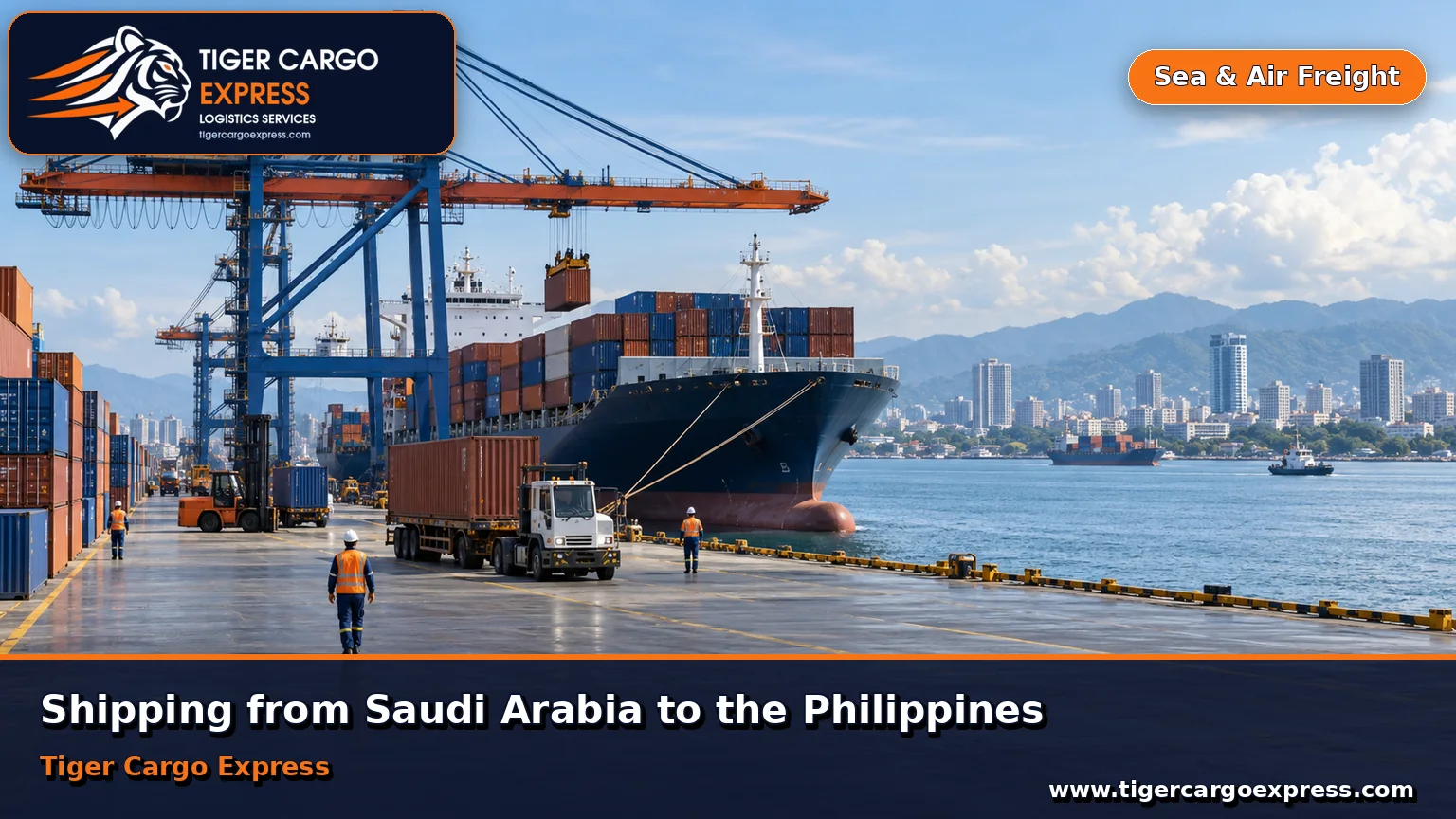
This is a real geographic distinction: the Philippines is thousands of islands, not one coastline. Choosing the port here is not a detail — it can save you an entire domestic sea leg.
| Port | Location | Best for |
|---|---|---|
| ⭐ Manila | Luzon — the capital | The main port with the most frequent schedules — serving all of Luzon |
| Cebu | The Visayas — central | Saves an entire domestic leg for residents of the central islands |
| Davao | Mindanao — the south | The logical choice for the south — instead of routing through Manila |
| Subic Bay | Northern Luzon | An alternative to Manila when its schedule is congested |
| Air — Manila | The international airport | Urgent and small — and it times the sixty-day window precisely |
Note the second and third rows. Anyone living in Cebu or Davao whose shipment routes through Manila pays for an extra domestic sea leg between islands. We weigh the port by your city, not by what is convenient for us.
Ways to ship — sea and air
Boxes, shared load or full container?
| Aspect | Boxes ⭐ | Shared load | Full container |
|---|---|---|---|
| When it suits you | Sending home while you are still here — by far the most requested | A room or two plus appliances on your return | A whole home |
| ⭐ And which customs route | The box route — three times, annual aggregate ceiling | The tier route — with its two locks and its window | The tier route — and closest to consuming the ceiling in full |
| Pricing | Per box or by weight | Per cubic metre with a minimum | A fixed container rate |
| Transit | Depends on the mode and the schedule | Longer — consolidation then deconsolidation | Shortest — no waiting for a load to fill |
Note the second row — you will not find it in the equivalent table in any other article of ours. The question here is not “how big is your load?” but “which customs route are you using?”. That decision precedes the size decision and governs it.
Philippine cities we cover
Door delivery across the three main island groups and in between.
Quezon City
Cebu
Davao
Caloocan
Zamboanga
Baguio
Iloilo
Bacolod
Cagayan de Oro
General Santos
Batangas
Angeles
Naga
Tacloban
Laoag
Shipping prices from Saudi Arabia to the Philippines
Indicative figures — the final quote is built on the survey and your delivery city.
| Shipment type | Price range | Unit and notes |
|---|---|---|
| ⭐ The full box | Request a quote — set by survey | Per box — by far the most requested service on this lane |
| ⭐ The small parcel | Request a quote — set by survey | By weight — and it does not consume one of your three slots |
| Shared load (LCL) | Request a quote — set by survey | Per cubic metre with a minimum |
| 20ft / 40ft container | Request a quote — set by survey · Request a quote — set by survey | A mid-sized flat or a full house |
| ⭐ Air freight | Request a quote — set by survey | By volumetric weight — and it times the sixty-day window precisely |
| Clearance at the arrival port | Set in the quote, by your destination | And it differs by route: the tier route or the box route |
| ⭐ Inter-island domestic leg | Set in the quote, by your destination | A line with no parallel — it appears only when the entry port is on another island |
Note the last row. The Philippines is an archipelago, and anyone shipping to Cebu or Davao via Manila pays for a complete domestic sea leg between islands. We declare that line openly — because choosing the right port from the start may remove it altogether.
What actually sets your price?
Documents required
First: how many years were you outside the Philippines? — this sets your tier.
Second: and when did you last use the privilege? — this sets whether you actually qualify for that tier or drop below it.
Third: have you sent boxes this year? — this sets what remains of your annual aggregate credit.
All three are asked before any discussion of price. Anyone starting with the price and reaching them late may discover — after booking — that their tier is not what they assumed.
Clearance and standing charges
We handle clearance at both ends. A container has a limited free period at the arrival port starting from discharge rather than from your notification, after which a daily charge applies for it remaining and another for late return to the shipping line.
A common and expensive confusion. The sixty days are a limit for your shipment to be accepted within the relief — not a free period at the port.
A shipment berthing on day ten and sitting uncleared until day fifty is inside the relief range and standing for forty days at the same time — and the meter waits for nobody.
So we do not use the window as waiting space but as a safety margin: we time the berthing close to your return, and prepare the file before arrival rather than after.
One day of organisation saves more than any discount on the freight rate.
Prohibited and restricted items
- ▸ Flammables and pressurised goods: aerosols, paints, solvents, fuel and gas — excluded entirely.
- ▸ Weapons, ammunition and replicas: including souvenirs — under a strict permit regime.
- ▸ Counterfeit goods: seizure and penalties — and enforcement on this is active, in boxes especially.
- ▸ ⭐ Loose batteries and power banks: a line that surprises many — most carriers decline them in boxes, by air especially. A device with a built-in battery is treated differently, and we review that with you.
- ▸ New goods in quantity: treated commercially rather than as baggage — and that takes your shipment out of the route entirely.
- ▸ Food and agricultural products: restricted under health controls, and some need clearance from the competent agency.
- ▸ Medicines in large quantities: keep evidence of the prescription and personal use.
- ▸ Untreated timber: every crate and pallet needs approved treatment.
Do not under-declare the value. Boxes are inspected, and declaring below the real value saves you nothing — it may hold up the box and consume one of your three slots for no benefit.
The better course is the opposite: write the real value and plan around it. The ceiling is an annual aggregate, and knowing what you have used makes the next box a calculation rather than a surprise.
Packing and insurance
The challenge on this lane is twofold: tropical humidity year-round, and extra handling if your shipment takes a domestic sea leg between islands.
Inland delivery after clearance
- ▸ ⭐ The move between islands: a whole stage unique to an archipelago — and we declare its cost as a separate line.
- ▸ Metro Manila congestion: among the heaviest we deal with — and we allow a clear time margin for it.
- ▸ Narrow streets and alleys: which may require a smaller vehicle for the final leg.
- ▸ Buildings without lifts: costed in advance by the number of floors, not discovered on delivery day.
- ▸ Typhoon season: it affects both the sea schedule and the domestic legs — we allow a written margin.
The reverse direction — the Philippines to Saudi Arabia
We work both directions on the same ports and routes. The dominant traffic out of the Philippines is electronics and components, wooden and rattan furniture, handicrafts and coconut products, alongside the effects of those arriving for work in the Kingdom.
And we review your list before loading because Saudi import restrictions follow their own logic, particularly for foodstuffs and plant products.
How to choose a shipping company to the Philippines
Our written guarantees
How to lower the cost of your shipment
- ▸ Do not use the privilege too early. The biggest saving on this lane may be in waiting — using it today can cost you a whole tier tomorrow.
- ▸ Fill your three boxes intelligently. The ceiling is aggregate — three planned boxes beat three random ones.
- ▸ Use small parcels for urgent items. Below the de minimis value they do not consume one of your three slots.
- ▸ Choose the port by your island, not by habit. A shipment to Davao via Manila adds a complete sea leg.
- ▸ Settle the vehicle decision with arithmetic. It sits outside the tiers — compare the full calculation against the local price.
- ▸ Allow full dismantling. It cuts volume appreciably, and volume is the invoice.
- ▸ Sort before you pack. What you do not need here you will not need there — and every cubic metre is paid for.
When do rates rise and transits lengthen?
| Period | What happens |
|---|---|
| ⭐ September – November | The absolute peak on this lane — the year-end wave of boxes. Book well ahead. |
| Typhoon season | It affects the ocean schedule and the inter-island legs together — a double exposure. |
| The end of the calendar year | A factor specific to the Philippines — many rush to use their three slots before the year closes, lifting demand. |
| Congestion at the Port of Manila | The main port carries a large share of imports — and its congestion lengthens clearance. |
| Disruption on sea lanes | Moves rates generally — though its effect is smaller here because we do not pass through the Suez Canal. |
How we work: five steps
Five recurring mistakes — all avoidable
- ▸ Assuming the years alone are enough. The mistake most specific to the Philippines — the second lock is the waiting period.
- ▸ Thinking the box ceiling is per box. It is an annual aggregate covering all three.
- ▸ Overrunning the sixty-day window. The tier falls away even if you qualified — and the window runs from your return.
- ▸ Shipping to Manila while you live on another island. A complete domestic sea leg that could have been avoided.
- ▸ Under-declaring the value in a box. It saves nothing — and may hold up the box and burn a slot.
Why Tiger Cargo Express?
Because we ask both locks, not one: how many years you were away, and when you last used the privilege. Anyone asking only the first may promise you a tier you do not qualify for today.
And we distinguish for you between the box route and the tier route — two independent systems where neither consumes the other, and confusing them wastes your credit. We tell you plainly that the box ceiling is an annual aggregate, not per box, and that a small parcel does not burn a slot. And we declare the inter-island line openly rather than burying it — because choosing the right port may remove it from your bill entirely.
Frequently asked questions about shipping from Saudi Arabia to the Philippines
In summary
The Philippines is the destination where your relief is closed by two locks: your years abroad set your tier, and the waiting period decides whether you qualify for it today. The privilege is a credit you spend, not an annual right. A third, temporal lock is added: sixty days from your return — tighter than Sri Lanka’s and Bangladesh’s. Alongside it runs an entirely separate route for boxes: three times a year under a ceiling that is aggregate, not per box, with small parcels not consuming a slot. Three things matter here: both locks asked before pricing, the route stated in writing, and a port chosen by your island. Tiger Cargo Express gives you all three before you ship.
Send your shipment details — approximate volume, origin city and your city and island in the Philippines, how many years you were away, when you last used the privilege, and whether you have sent boxes this year — and we reply with a detailed quote and your route settled within 60 minutes. 0506688227
Where does the Philippines sit on our map?
Shipping to the Philippines is one lane within a wider region — and the full Asia guide explains the rules governing it and its neighbours together: the route, the customs framework, and the challenge that lane is priced around.
Related Shipping Guides
Continue with practical guidance connected to the same route or shipping decision.
Furniture and Car Shipping Company from Saudi Arabia to the Gulf 0506688227
⚠️ "How much does shipping to Kuwait cost?" is a question missing three things. Shipping from Riyadh is not shipping…
Shipping Company from Saudi Arabia to the Middle East 0506688227 — Overland Guide
The Middle East overturns all of it: it is the only destination whose journey starts at your front door rather…
Shipping Company from Saudi Arabia to Oceania 0506688227 — The Biosecurity Guide
On every preceding continent the question was: what is inside your shipment? Oceania asks an entirely different one: what is…
Send your shipment details and get a written quote
We reply within 60 minutes during working hours — with what the price includes and what it does not, stated before you commit.