
Furniture Shipping Company from Saudi Arabia to Vietnam 0506688227 Your Shipment Passes Two Reviews, Not One
Furniture shipping from Saudi Arabia to Vietnam — the destination where your shipment passes two reviews rather than one: the usual customs review, and an independent cultural review of printed matter, recorded media and artworks. And the most important paper in your file is obtained at the airport, not at the port: the arrival declaration that must be requested rather than handed over, stamped before you leave the point of entry.
Guide contents ShowHide
Looking for a shipping company from Saudi Arabia to Vietnam that knows the most important paper in your file is obtained at the airport, not at the port? Tiger Cargo Express ships furniture, cargo and boxes to Ho Chi Minh City, Hanoi, Da Nang and the rest of Vietnam — by sea and air, with dismantling, packing and reassembly, customs clearance at both ends, and insurance on the load. To book: 0506688227
The route heads east through the Strait of Malacca, then north into the South China Sea — and does not pass through the Suez Canal.
What sets Vietnam apart from every destination before it in our series is this:
Your shipment passes two reviews, not one — and the paper that opens the first is not handed to you.
In Thailand the question was about your visa. In Malaysia, about the age of the item. In Indonesia, about the nature of the item. Here the question is procedural: “did you request the form, and was it stamped before you left the point of entry?”
Alongside the usual customs review, an independent cultural review applies to printed matter, recorded media and artworks. And one does not stand in for the other.
What do we ship from Saudi Arabia to Vietnam?
The traffic on this lane is mixed: returning Vietnamese, and people relocating into an active industrial sector.
The form that must be requested
At every destination before this one, your papers were gathered before travelling or filed after berthing. Here there is one paper obtained neither before departure nor after arrival — but in the moment of entry itself.
▸ It is requested, not handed over automatically. Nobody will call you over to give it to you — you have to ask for it on arrival.
▸ It is stamped before you leave the point of entry. Once you walk out of the airport, putting it right becomes difficult.
▸ And your whole shipment file is built on it — it is what links you to the belongings arriving later.
And here lies the costliest mistake on this lane: arriving, clearing immigration, and walking out into the street — without knowing there was a form you should have asked for.
Then your container berths weeks later and you discover its file is missing its foundation. And the meter is running.
So we send our clients a written reminder before their travel date: “on arrival — request the form before you leave the hall.”
| Destination | When the decisive papers are prepared |
|---|---|
| Malaysia | Before packing — purchase receipts gathered in Saudi Arabia |
| Indonesia | Before berthing — electronic filing into the system |
| Thailand | Before pricing — settling the visa status |
| ⭐ Vietnam | In the moment of your own entry — a form requested and stamped before leaving the hall |
And the use requirement: twelve months
Alongside the form, effects must have been owned and used long enough — twelve months as a rule — to be treated as household goods rather than new merchandise.
Malaysia’s rule is six months; Vietnam’s is twelve — twice as long.
Which makes our advice here firmer: do not buy new appliances in the final year before you travel thinking it cheaper than buying them there. They may fail the test, take on their duty, and carry the freight on top.
The practical rule: the old is shipped, the new is bought there.
The second review — the cultural one
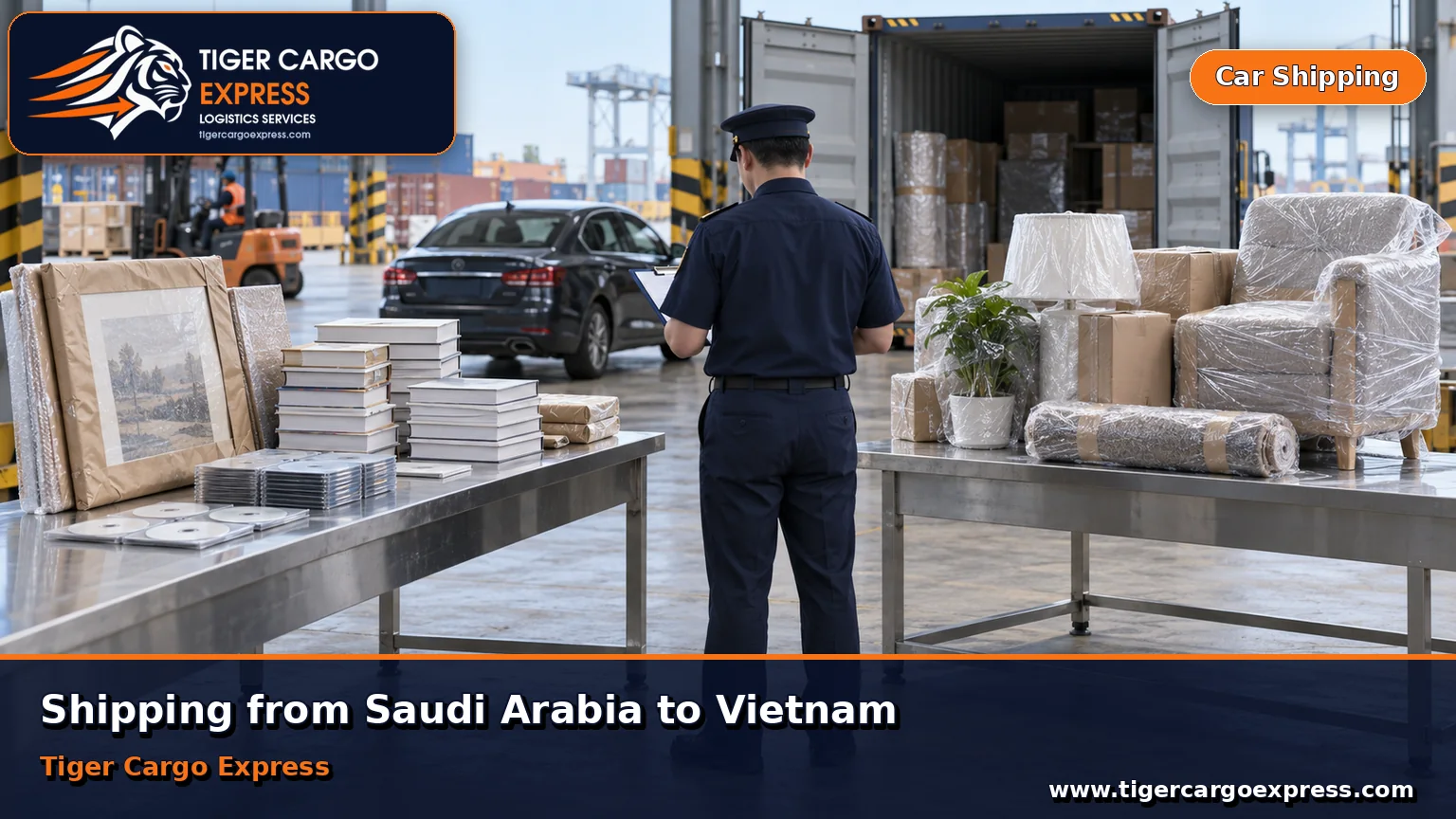
And here is the layer most people shipping to Vietnam do not know about: alongside customs, certain categories are subject to an independent cultural review.
Because clearing one says nothing about the other, and each runs at its own pace.
Your customs file can be complete — form stamped, inventory precise, use evidenced — while your boxes of books and artworks remain under review.
The result is that your entire container waits on two boxes, and the meter runs against the whole shipment, not the two boxes.
So we do something simple and effective: we separate these categories into their own list before packing, and decide with you whether they travel with the household goods or in a separate file — so two boxes do not hold up the whole container.
What we set out is the framework as we work with it in practice, and some details are decided case by case by the competent authority. Requirements are subject to updating. So we review the position in force with you before booking. We prepare the file and coordinate the timing — we do not provide legal or tax advice, and we do not promise an approval that is not ours to give.
Shipping for embassies, consulates and their staff
The only category here that does not need to request that form.
Shipments for diplomatic and consular missions and their staff do not pass through the personal-effects route and are not bound by its conditions — not the arrival declaration form, not the twelve-month requirement. The basis here is the status of the mission or of your accreditation with it, and the reference framework is the Vienna Convention on Diplomatic Relations of 1961.
We explained above that our ordinary client here carries a procedural burden in the moment of their own personal entry — they must request a form and see it stamped before leaving the hall.
An accredited officer does not enter by that route at all. The official correspondence precedes their arrival and stands in place of the individual step, and status is evidenced through the channel rather than through a form.
The cultural review is likewise not read against mission cargo on personal-effects logic — treatment is settled through the official channel.
And the first question here is: “what is the consignee’s status, and who corresponds with us officially?” — not “was your form stamped?”
- ▸ We settle the status first and build the file on it — not the other way round.
- ▸ We do not put mission cargo through the personal-effects route nor request a form that does not concern it.
- ▸ We start with the competent department, not the individual — the official correspondence is the foundation of the file.
- ▸ We match consignee name and title between the correspondence and the bill of lading word for word before issuing it.
- ▸ We document the inventory to a higher standard and hand it over endorsed by both sides.
- ▸ We handle everything in confidence — information, contents and movement schedules alike.
And we are clear: what the exemption covers and how far it extends is for the competent authorities in the receiving state to determine, and the mission has its own official channels. Our role is purely logistical. We work in both directions: foreign missions in the Kingdom, and Saudi missions in Hanoi.
Car shipping from Saudi Arabia to Vietnam
We start with the fact before any figure: a vehicle sits outside the personal-effects relief, on an independent import route with its own requirements.
Three reasons together:
▸ Outside the relief — no status protects it however complete your file.
▸ High duties and taxes, assessed in layers on imported vehicles.
▸ Import, registration and specification requirements, reviewed before shipping rather than after.
The result is that the freight itself may be the smallest line on the bill.
And a consideration specific to Vietnam is added: port congestion. A vehicle waiting in a congested yard accumulates standing charges on top of its duties.
Our advice: add the freight to the duties and set it against the price of an equivalent car there. In most cases selling here and buying there works out cheaper — and we say so even when it costs us the whole line.
If your case genuinely justifies it, we review the model, year of manufacture and engine capacity with you before booking, and prepare its file separately from the household file — because mixing them stalls both, in a port that is congested to begin with.
Furniture moving from Saudi Arabia to Vietnam
And the inventory here is written as two lists, not one.
- ▸ ⭐ Two lists, not one: the household inventory, and a separate list for books, artworks and recorded media — because the two reviews are separate.
- ▸ ⭐ The form reminder before you travel: sent to you in writing — “request the form before you leave the hall”.
- ▸ Survey and assessment: volume in cubic metres — even for a few boxes, because we serve small shipments, not containers only.
- ▸ Screening what was bought recently: the use requirement here is twelve months — twice what Malaysia asks.
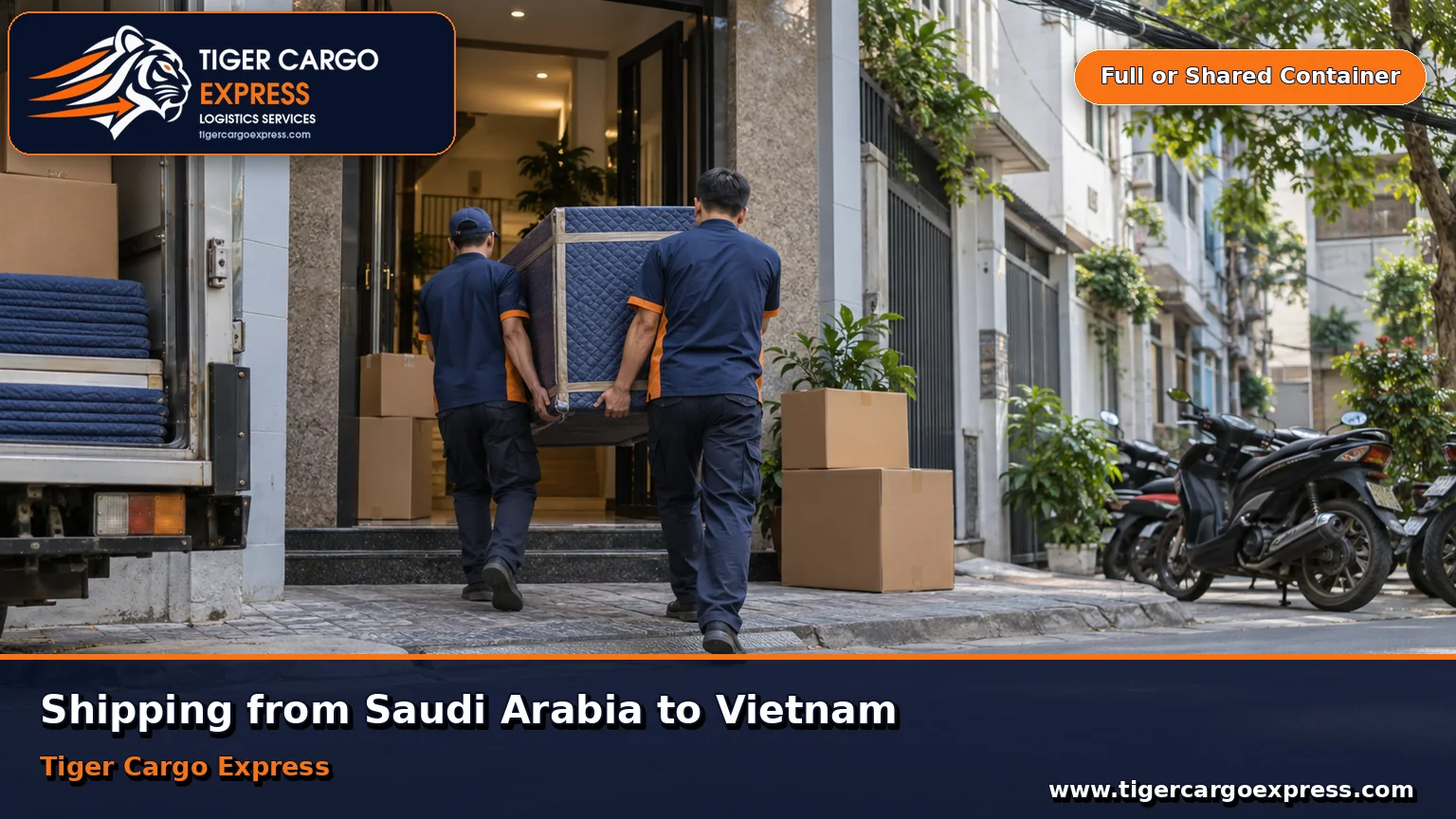
- ▸ Professional dismantling and multi-layer packing: full dismantling cuts volume and eases the climb in narrow tall houses.
- ▸ Protection against tropical humidity: Vietnam is humid year-round — with moisture absorbers in every box.
- ▸ Unpacking and reassembly: in your new home, with an inventory check piece by piece.
Ports of entry — and congestion is a real factor
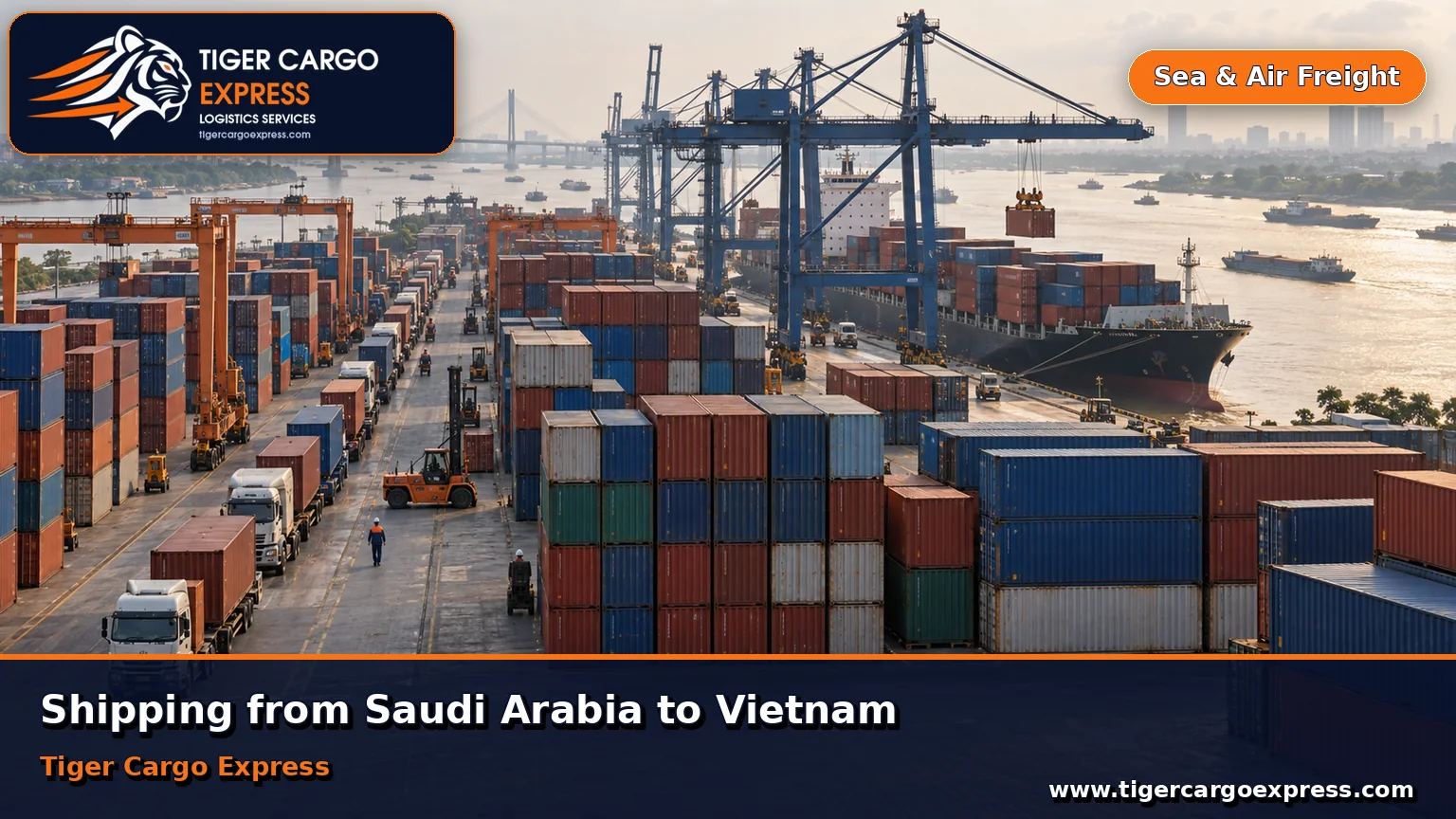
| Port | Location | Best for |
|---|---|---|
| ⭐ Cat Lai | Ho Chi Minh City — on the river | The largest and most frequent — but among the most congested, and we build a margin for it |
| ⭐ Cai Mep | Ba Ria — deep water | A practical alternative to Cat Lai when congestion is heavy — and we sometimes prefer it |
| Hai Phong | The north — near Hanoi | The natural choice for Hanoi and the north — saving a very long overland leg |
| Da Nang | The centre — on the coast | The central provinces and Hue — and Vietnam is very long, so do not overlook it |
| Air — Hanoi and Ho Chi Minh City | The two international airports | Urgent and small — and usually the points where the form is stamped |
Vietnam is a very long country from north to south. Anyone living in Hanoi whose shipment routes through Ho Chi Minh City pays for an overland journey the length of the country. We weigh the port by your city, not by what is convenient for us.
Ways to ship — sea and air
Full container, shared load or boxes?
| Aspect | Full container | Shared load | Boxes |
|---|---|---|---|
| When it suits you | A whole home | A room or two plus appliances | Limited personal effects |
| ⭐ Exposure to the cultural review | One box of books stops the whole container — which is why we separate it | The risk is greater here — someone else’s box can hold you up | Least exposed — and suitable for shipping printed matter separately |
| Effect of port congestion | A daily standing charge on a full container | Deconsolidation adds time on top of the congestion | The lightest exposure |
| Pricing | A fixed container rate | Per cubic metre with a minimum | Per box or by weight |
Note the second row: a simple solution to a real problem. Rather than let your box of books hold up a whole container, we ship it in a small separate file — so it is reviewed on its own while your household goods move on.
Vietnamese cities we cover
Door delivery from the north to the southern delta.
Hanoi
Da Nang
Hai Phong
Can Tho
Bien Hoa
Nha Trang
Hue
Vung Tau
Binh Duong
Bac Ninh
Vinh
Quy Nhon
Da Lat
Buon Ma Thuot
Ha Long
Shipping prices from Saudi Arabia to Vietnam
Indicative figures — the final quote is built on the survey and your delivery city.
| Shipment type or line | Price range | Unit and notes |
|---|---|---|
| Boxes and small shipments | Request a quote — set by survey | Per box or by weight |
| Shared load (LCL) | Request a quote — set by survey | Per cubic metre with a minimum |
| 20ft / 40ft container | Request a quote — set by survey · Request a quote — set by survey | A mid-sized flat or a full house |
| Air freight | Request a quote — set by survey | By volumetric weight — and it skips the port queues |
| ⭐ The printed matter and artworks file | Set after your file is reviewed | A line with no parallel — a separate file that protects your container from stopping |
| Clearance at the arrival port | Set in the quote, by your destination | Preparing the file and following it to release |
| ⭐ The congestion margin | Written into the schedule in days | We declare it as an explicit line rather than promise a schedule the port cannot hold |
Note the two distinctive lines. The printed matter file is a small cost that buys large protection — it stops one box from stopping a container. And the congestion margin we declare openly because promising a tight schedule in a congested port is not generosity but misdirection.
What actually sets your price?
Documents required
First: when do you arrive, and through which airport? — not only to set the timing, but to send you the form reminder well before you travel.
Second: how many books, artworks and discs are in your shipment? — this settles whether we separate them into their own file or keep them with the household goods.
And the second question is one nobody else generally asks — so the client arrives and discovers their whole container is held up over a box of books.
These two questions save more time than any discount on the rate.
Clearance and standing charges
We handle clearance at both ends, through the electronic customs system. A container has a limited free period at the arrival port starting from discharge rather than from your notification, after which a daily charge applies for it remaining and another for late return to the shipping line.
For three reasons that stack on one another:
▸ The congestion of the port itself — and Cat Lai is among the most congested river ports.
▸ The second review — a box of books under review holds up the whole container.
▸ A missing form — the worst of the three, because putting it right after you have left the airport is difficult.
Together they make standing a more dangerous line here than at any other destination in this group.
So we work backwards: we secure the form before you travel, we separate the printed matter before packing, and we declare the congestion margin in the schedule.
Three simple precautions against three stacking causes.
Prohibited and restricted items
- ▸ Flammables and pressurised goods: aerosols, paints, solvents, fuel and gas — excluded entirely.
- ▸ ⭐ Printed matter, recorded media and artworks: the core of the second review — listed separately before packing.
- ▸ Weapons, ammunition and replicas: including souvenirs — under a strict permit regime.
- ▸ Wireless communication devices: some need clearance from the regulator — we review them with you item by item.
- ▸ New goods in quantity: treated commercially — and the twelve-month requirement makes this more likely to arise here.
- ▸ Counterfeit goods: seizure and penalties — and enforcement is active.
- ▸ Food and plant products: under precise health and phytosanitary controls.
- ▸ Untreated timber: every crate and pallet needs approved treatment.
We do not tell you “don’t ship your books”. Your personal library is part of your home and it is yours to move with you.
We set out three explicit options:
▸ Separate them into a small independent file — reviewed on their own while your household goods move on. This is what we usually prefer.
▸ Ship them with the household goods on a detailed list — if they are few and clearly described.
▸ Reduce them — some books cost less to buy there than to ship and wait for.
The decision is yours — but made knowing.
Packing and insurance
The challenge on this lane is high tropical humidity, a typhoon season running from September to November, and extra handling because of congestion.
Inland delivery after clearance
- ▸ ⭐ Narrow tall houses: a Vietnamese architectural signature — a narrow frontage and several floors without a lift, costed in advance by the number of floors.
- ▸ ⭐ Motorbike alleys: many addresses no truck can reach at all — so we plan the final leg with a smaller vehicle.
- ▸ Distances between north and south: Vietnam is very long — and the port choice removes an entire journey.
- ▸ Ho Chi Minh City and Hanoi traffic: movement windows are chosen carefully, not at random.
- ▸ Typhoon season: September to November — affecting the north and centre especially, and we allow a written margin.
The reverse direction — Vietnam to Saudi Arabia
We work both directions on the same ports and routes. The dominant traffic out of Vietnam is electronics and components, wooden and rattan furniture, textiles and clothing, footwear, and agricultural products such as coffee, pepper and rice, alongside the effects of those arriving for work in the Kingdom.
And note that the two-review logic holds on the way out as well: artworks and heritage pieces have controls on export. We review your list before loading, as we review Saudi import restrictions, particularly for foodstuffs and plant products.
How to choose a shipping company to Vietnam
Our written guarantees
How to lower the cost of your shipment
- ▸ Request the form on arrival. The cheapest action with the largest consequence — one minute at the airport saves weeks of standing.
- ▸ Separate your books and artworks. A small cost that buys large protection — one box then cannot stop a container.
- ▸ Do not buy new in the final year. The use requirement here is twelve months — twice Malaysia’s.
- ▸ Choose the port by your city. A shipment to Hanoi via Ho Chi Minh City crosses the length of the country for nothing.
- ▸ Avoid berthing at peak. One day outside the peak can save days of standing.
- ▸ Allow full dismantling. It cuts volume and eases the climb in a narrow tall house — two benefits, not one.
- ▸ Sort before you pack. What you do not need here you will not need there — and every cubic metre is paid for.
When do rates rise and transits lengthen?
| Period or situation | What happens |
|---|---|
| ⭐ Tet — January and February | The largest pause of the year — a broad administrative and operational slowdown before and after it. We schedule around it, not into it. |
| ⭐ Typhoon season — September to November | Affects the north and the centre especially — and can halt handling for days. |
| Industrial export peaks | Vietnam is a major industrial exporter — and outbound congestion directly affects inbound. |
| Congestion in the Strait of Malacca | A narrow corridor we cross before heading north into the South China Sea. |
| Disruption on sea lanes | Moves rates generally — though its effect is smaller here because we do not pass through the Suez Canal. |
How we work: five steps
Five recurring mistakes — all avoidable
- ▸ Leaving the airport without a stamped form. The mistake most specific to Vietnam — and putting it right afterwards is difficult.
- ▸ Folding books and artworks into “personal effects”. One box holds up a whole container.
- ▸ Accepting a schedule with no congestion margin. Cat Lai is among the most congested ports — and a tight promise is not generosity.
- ▸ Shipping to Ho Chi Minh City while you live in Hanoi. An overland journey the length of the country that could have been avoided.
- ▸ Confusing Malaysia’s requirement with Vietnam’s. Here it is twelve months, not six.
Why Tiger Cargo Express?
Because we work with two reviews, not one. Anyone preparing you an excellent customs file while leaving your box of books inside the household inventory may stop your whole container over a single box.
So we write you two lists rather than one, send you the form reminder before you travel because the most important paper in your file is obtained at the airport rather than at the port, and declare the congestion margin in the schedule rather than promise you a date we know Cat Lai cannot hold.
Frequently asked questions about shipping from Saudi Arabia to Vietnam
In summary
Vietnam is the destination where your shipment passes two reviews rather than one: the usual customs review, and an independent cultural review of printed matter, recorded media and artworks — and clearing one says nothing about the other. And the most important paper in your file is obtained at the airport, not at the port: the arrival declaration that must be requested rather than handed over and stamped before you leave the point of entry. Add to that real port congestion and a twelve-month use requirement — twice what Malaysia asks. Three things matter here: the form reminder before you travel, two lists rather than one, and a declared congestion margin. Tiger Cargo Express gives you all three before you ship.
Send your shipment details — approximate volume, origin city and your city in Vietnam, your travel date and arrival airport, and how many books and artworks are in your shipment — and we reply with a detailed quote and a declared margin within 60 minutes. 0506688227
Where does Vietnam sit on our map?
Shipping to Vietnam is one lane within a wider region — and the full Asia guide explains the rules governing it and its neighbours together: the route, the customs framework, and the challenge that lane is priced around.
Related Shipping Guides
Continue with practical guidance connected to the same route or shipping decision.
Furniture and Car Shipping Company from Saudi Arabia to the Gulf 0506688227
⚠️ "How much does shipping to Kuwait cost?" is a question missing three things. Shipping from Riyadh is not shipping…
Shipping Company from Saudi Arabia to the Middle East 0506688227 — Overland Guide
The Middle East overturns all of it: it is the only destination whose journey starts at your front door rather…
Shipping Company from Saudi Arabia to Oceania 0506688227 — The Biosecurity Guide
On every preceding continent the question was: what is inside your shipment? Oceania asks an entirely different one: what is…
Send your shipment details and get a written quote
We reply within 60 minutes during working hours — with what the price includes and what it does not, stated before you commit.