
Furniture Shipping Company from Saudi Arabia to Thailand 0506688227 Your Visa Class Decides Your Bill
Furniture shipping from Saudi Arabia to Thailand — the destination where your bill is decided before you pack a single box. Relief is tied to a work visa with an annual permit, and retirement, tourism and study do not grant it however genuine your residence. Add to that an asymmetric window — one month before you and six after, your presence at arrival, and one sea and one air shipment through which the benefit is consumed.
Guide contents ShowHide
Looking for a shipping company from Saudi Arabia to Thailand that knows your customs bill is decided before you pack a single box? Tiger Cargo Express ships furniture, cargo and boxes to Bangkok, Chiang Mai, Phuket and the rest of Thailand — by sea and air, with dismantling, packing and reassembly, customs clearance at both ends, and insurance on the load. To book: 0506688227
The route heads east through the Strait of Malacca, then turns north into the Gulf of Thailand — and does not pass through the Suez Canal.
What sets Thailand apart from every destination before it in our series is this:
The paper that decides your bill here is not an invoice or an inventory — it is the visa page in your passport.
In the Philippines the question was about your years. In Indonesia, about the nature of the item. In Malaysia, about the age of the item. Here it is different altogether: “in what capacity do you reside in Thailand?”
Relief here is tied directly to your visa class. Two people can ship identical household goods from the same street on the same day — and one pays full duty while the other pays nothing. The only difference between them is what is stamped in their passports.
What do we ship from Saudi Arabia to Thailand?
The traffic on this lane is mixed: returning Thais, people relocating for work, and families settling long term.
Your residence status decides your relief
Thailand grants relief on used household effects for someone transferring residence there. But “transferring residence” here is not a description of your situation but an official classification proved by your papers.
Relief is in practice tied to a non-immigrant visa accompanied by a work permit valid for one year. Which means the basis is your employment, not your intention to settle.
And the consequence catches people out:
▸ A retirement visa — does not grant relief
▸ A tourist visa — does not grant relief
▸ A student visa — does not grant relief
So someone moving to spend their retirement years in Thailand — a genuine resident in every ordinary sense — may find themselves entirely outside the relief, while an employee who arrived a month earlier on a work contract receives it.
So we ask before we price: “which visa will you enter on, and does it come with a work permit?” — and we answer you plainly even when the answer is that the relief does not cover you, because knowing that before shipping is far kinder than learning it at the port.
| Your status | Relief position | What we do with you |
|---|---|---|
| ⭐ Work visa with an annual permit | The clearest route to relief | We build the file on it and schedule the arrival around it |
| A returning Thai | A separate route with its own conditions | We review your visit history with you, not just your absence |
| ⚠️ Retirement visa | Does not grant relief | We tell you before booking and calculate the full bill |
| ⚠️ Tourist or student | Does not grant relief | And we usually suggest reducing the shipment to a minimum |
And the returning Thai — absence alone is not enough
A returning Thai has a separate route requiring twelve continuous months outside the country. That much is familiar.
But the second condition has no parallel in the whole series: that every visit you made to Thailand during that period did not exceed three months.
So absence alone is not enough — the pattern of your returns is examined. Someone away three years who spent four continuous months on one visit may lose the “continuous” characterisation.
So we ask for your entry and exit record, not your total time away. And we review it with you before promising anything.
What we set out is the framework as we work with it in practice, and some details are decided case by case by the competent authority. Requirements are subject to updating. So we review the position in force with you before booking. We prepare the file and coordinate the timing — we do not provide legal, tax or immigration advice, and we do not promise a relief that is not ours to give.
The time window — and your presence is a condition
Once your status is settled, three time constraints follow that work together rather than separately:
This constraint appears at no other destination in our series, and its practical effect is large.
In the Philippines you send three boxes a year. In Indonesia you can split your shipment. Here the benefit is consumed by shipment, not by value.
Which means you cannot send half your household now and half later and expect both halves to be relieved. The second shipment falls outside the benefit and is treated as an ordinary import.
So planning here becomes a single decision rather than a series of decisions: we sit with you once and settle what travels by sea, what travels by air, and what is left behind — because there is no chance to correct it later.
Note the asymmetry: one month before your arrival and six months after it. That differs from Indonesia, which gives ninety days in both directions, and echoes India and Bangladesh in tightening the pre-arrival side. The message is clear: the system wants you present when your shipment lands.
Shipping for embassies, consulates and their staff
The only category here not asked about its visa.
Shipments for diplomatic and consular missions and their staff do not pass through the personal-effects route and are not bound by its conditions — not the work-permit requirement, not the one-shipment limit, not the one-month-and-six-months window. The basis here is the status of the mission or of your accreditation with it, and the reference framework is the Vienna Convention on Diplomatic Relations of 1961.
We explained above that our ordinary client here has their visa decide their bill — retirement grants no relief while employment does.
A mission file has no visa in that sense at all. An accredited officer is not classified as an “employee” or a “retiree” or a “tourist” — they are classified by their diplomatic status, a status that precedes the customs classification and does not pass through it.
The “one sea and one air shipment” limit is not read against it on that logic either — treatment is settled through the official channel.
And the first question here is: “what is the consignee’s status, and who corresponds with us officially?” — not “what visa class are you on?”
- ▸ We settle the status first and build the file on it — not the other way round.
- ▸ We do not put mission cargo through the personal-effects route nor apply a limit that does not concern it.
- ▸ We start with the competent department, not the individual — the official correspondence is the foundation of the file.
- ▸ We match consignee name and title between the correspondence and the bill of lading word for word before issuing it.
- ▸ We document the inventory to a higher standard and hand it over endorsed by both sides.
- ▸ We handle everything in confidence — information, contents and movement schedules alike.
And we are clear: what the exemption covers and how far it extends is for the competent authorities in the receiving state to determine, and the mission has its own official channels. Our role is purely logistical. We work in both directions: foreign missions in the Kingdom, and Saudi missions in Bangkok.
Car shipping from Saudi Arabia to Thailand
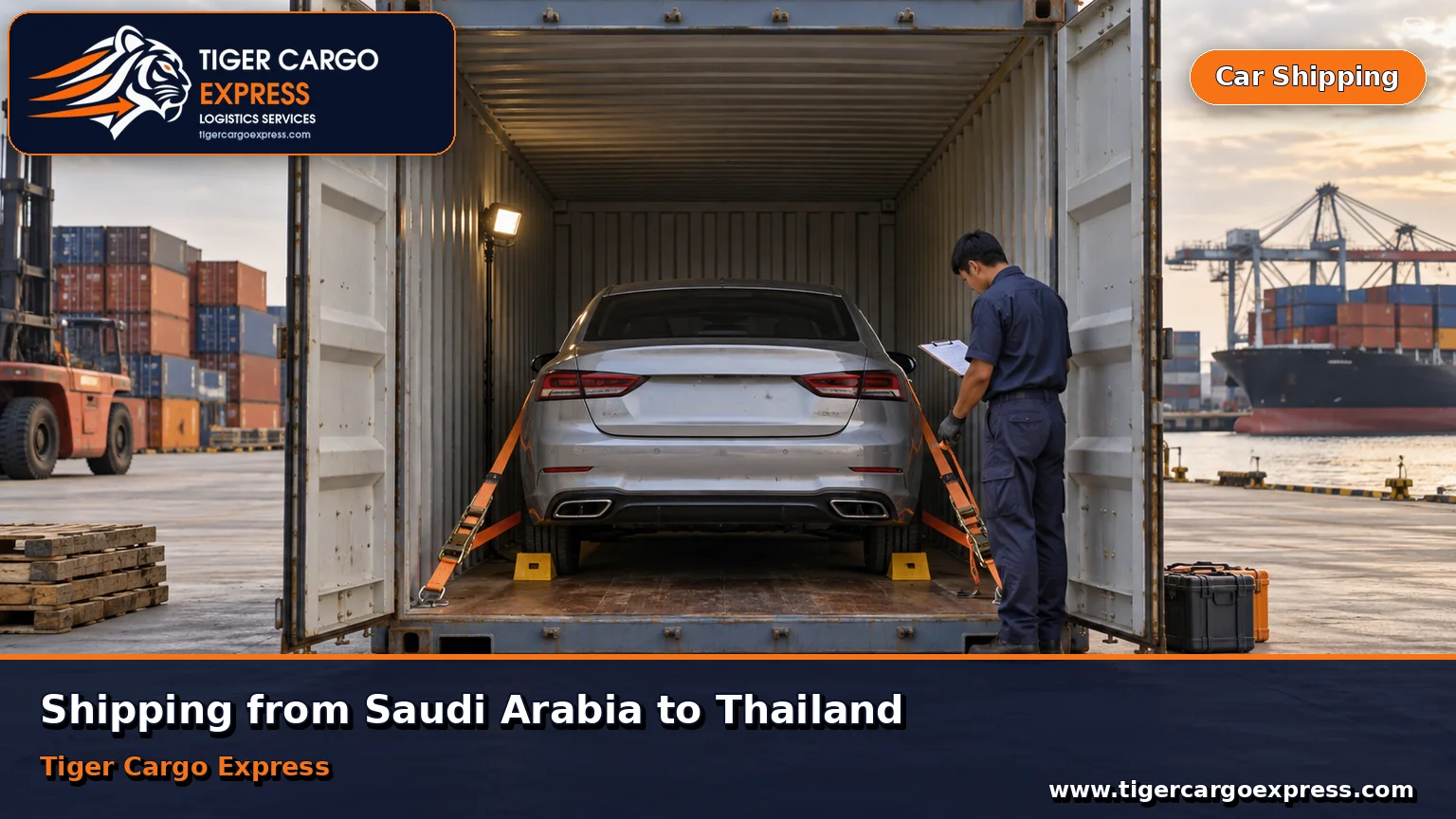
We start with the fact before any figure: a vehicle sits outside the personal-effects relief whatever your status and however complete your file.
Because Thailand is among the highest-duty destinations for imported vehicles in the whole region.
The reasons together:
▸ Outside the relief — no status protects it.
▸ A high layered duty structure assessed on imported vehicles.
▸ Import, registration and specification requirements, reviewed before shipping rather than after.
The result is that the freight itself may be the smallest line on the bill by a wide margin.
Our advice here is firmer than at any destination before it: add the freight to the duties and set it against the price of an equivalent car there — Thailand has a large car market and a well-established motor industry. In most cases selling here and buying there works out considerably cheaper, and we say so even when it costs us the whole line.
If your case genuinely justifies it, we review the model, year of manufacture and engine capacity with you before booking, and prepare its file separately from the household file — because mixing them stalls both, and may consume your “one sea shipment” for nothing.
Furniture moving from Saudi Arabia to Thailand
And the “what travels” decision here is taken once — there is no second relieved shipment.
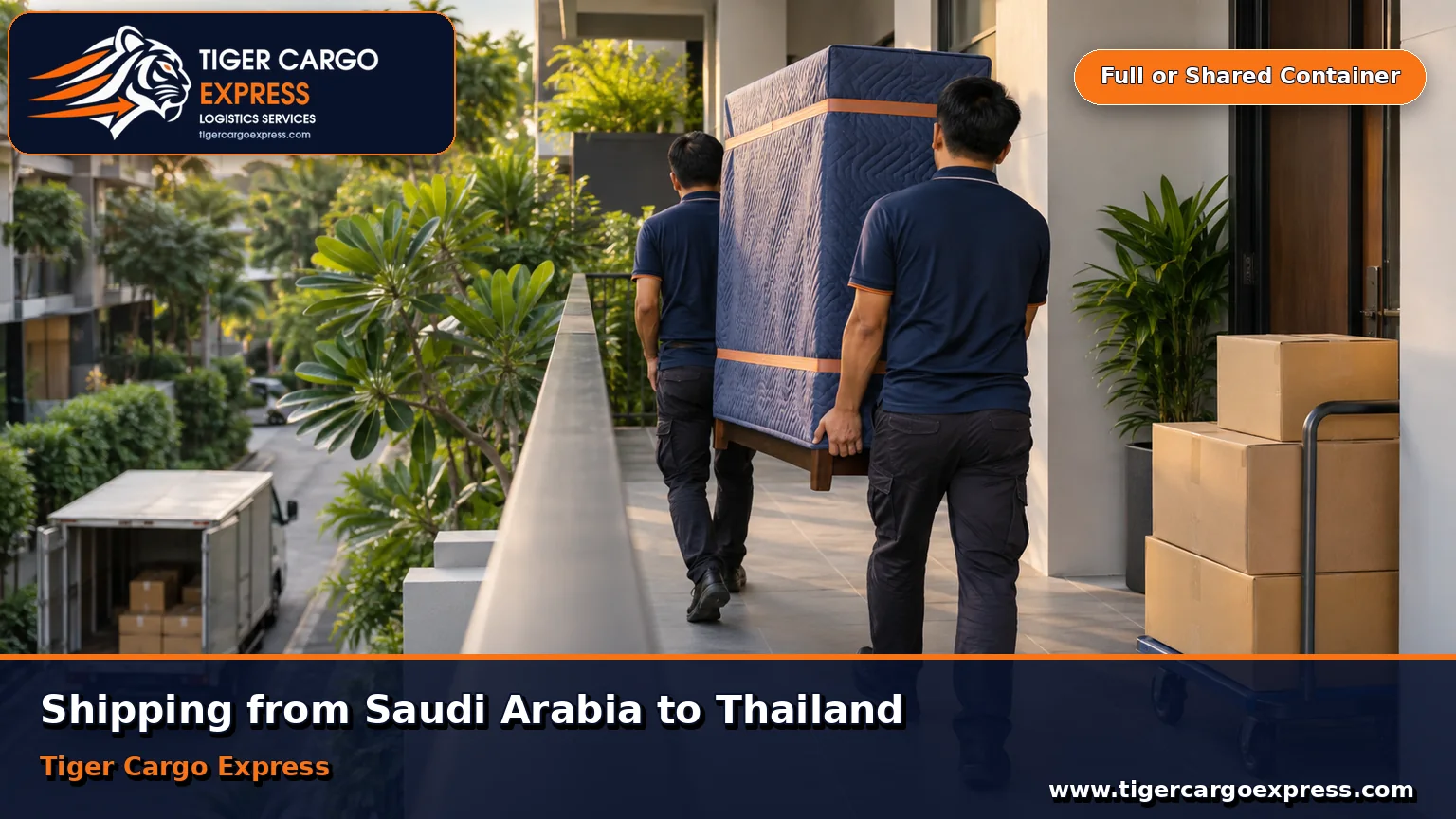
- ▸ ⭐ Settling status first: your visa class and work permit — before any discussion of volume or price.
- ▸ ⭐ One decision session: what travels by sea, what by air, and what is left — because there is no chance to correct it later.
- ▸ Survey and assessment: volume in cubic metres, calibrated to what counts as reasonable household effects for a family and no more.
- ▸ Screening restricted items: including artworks and statuary, which have a permit regime of their own, explained below.
- ▸ A detailed valued inventory: written during packing and handed over before sailing, with precise descriptions rather than general ones.
- ▸ Professional dismantling and multi-layer packing: full dismantling cuts volume, and volume is your invoice.
- ▸ Protection against tropical humidity: Thailand is humid year-round — with moisture absorbers in every box.
Ports of entry
| Port | Location | Best for |
|---|---|---|
| ⭐ Laem Chabang | Chonburi — east of Bangkok | The principal deep-water port with the most frequent schedules — serving Bangkok and around |
| Bangkok — Klong Toey | Inside the capital on the river | Closer to the city centre — but with limits on vessel size |
| Songkhla | The far south | The southern provinces — saving a very long overland leg for their residents |
| Air — Bangkok | The international airport | And this is your “one air shipment” — so choose its contents carefully |
Note the last row. The air shipment here is not an extra option but a benefit consumed once. So we usually reserve it for what you need immediately — work equipment, children’s essentials, and whatever cannot wait out the sea voyage.
Ways to ship — sea and air
Full container, shared load or boxes?
| Aspect | Full container | Shared load | Boxes |
|---|---|---|---|
| When it suits you | A whole home | A room or two plus appliances | Limited personal effects |
| ⭐ Effect of the one-shipment limit | The best fit for the limit — everything in one go | Acceptable — provided all your goods are in it | Beware of instalments — two batches means the second is outside the benefit |
| Timing flexibility | One date, set against your arrival | Less — it depends on the load filling | Highest — but use it once |
| Pricing | A fixed container rate | Per cubic metre with a minimum | Per box or by weight |
Note the second row — a consideration that appears at no other destination. In the Philippines and Indonesia, splitting was a reasonable option. Here splitting costs you the benefit itself: the first batch is relieved, the second is treated as an ordinary import.
Thai cities we cover
Door delivery in the capital, the north, the south and the main islands.
Chiang Mai
Phuket
Pattaya
Nonthaburi
Hat Yai
Udon Thani
Khon Kaen
Nakhon Ratchasima
Chonburi
Rayong
Surat Thani
Krabi
Chiang Rai
Ayutthaya
Hua Hin
Shipping prices from Saudi Arabia to Thailand
Indicative figures — the final quote is built on the survey, your status and your delivery city.
| Shipment type or line | Price range | Unit and notes |
|---|---|---|
| Boxes and small shipments | Request a quote — set by survey | Per box or by weight |
| Shared load (LCL) | Request a quote — set by survey | Per cubic metre with a minimum |
| 20ft / 40ft container | Request a quote — set by survey · Request a quote — set by survey | A mid-sized flat or a full house |
| ⭐ The single air shipment | Request a quote — set by survey | By volumetric weight — and it is a benefit consumed once |
| Clearance at the arrival port | Set in the quote, by your destination | And it differs by the route your status determines |
| ⭐ A second shipment outside the benefit | Set after your file is reviewed | A line with no parallel — treated as an ordinary import at full duty |
| ⭐ Artwork permits | Set after your file is reviewed | Appears only if your list holds statuary or antiquities |
Note the sixth line — a line we put in the quote as a warning, not a sale. We would rather you saw the cost of a “second shipment” in writing before you decide to split, than discover afterwards that your final batch fell outside the benefit.
What actually sets your price?
Documents required
First: which visa will you enter on, and does it come with a work permit? — this settles whether there is relief at all.
Second: exactly when do you arrive? — this settles the window: not more than a month before you, not more than six months after, and you present at arrival.
Third: will you ship everything in one go? — this settles whether you use your benefit fully or waste half of it.
And the first question is the one we refuse to price without. Anyone giving you a figure without knowing your visa is pricing a situation that may not be yours.
Clearance and standing charges
We handle clearance at both ends. A container has a limited free period at the arrival port starting from discharge rather than from your notification, after which a daily charge applies for it remaining and another for late return to the shipping line.
A common and costly confusion here in particular, because the far end of the window is so wide.
The six months are a limit for your shipment to be accepted within the benefit — not a free period at the port. A shipment berthing in the second month and sitting uncleared until the fourth is inside the window and standing for two months at the same time.
Worse, the width of the window tempts people to defer. We use it the other way: as a safety margin for a delay in your own arrival, not as waiting space for clearance.
And the more important constraint is not the window at all — it is being present at arrival. Whoever sets their berthing against their entry date wins both.
Prohibited and restricted items
- ▸ Flammables and pressurised goods: aerosols, paints, solvents, fuel and gas — excluded entirely.
- ▸ ⭐ Statuary, artworks and antiquities: a line specific to Thailand — with a permit regime of its own, explained below.
- ▸ Weapons, ammunition and replicas: including souvenirs — under a strict permit regime.
- ▸ Wireless communication devices: some need clearance from the regulator — we review them with you item by item.
- ▸ New goods in quantity: treated commercially rather than as household effects — and that takes your shipment out of the route.
- ▸ Counterfeit goods: seizure and penalties — and enforcement is active.
- ▸ Food and plant products: under precise health and phytosanitary controls.
- ▸ Untreated timber: every crate and pallet needs approved treatment.
Thailand takes particular care over its artistic and cultural heritage, and subjects the removal of certain pieces to a permit regime overseen by the Fine Arts Department.
That includes statuary and pieces of a religious or antique character — which surprises anyone who acquired a souvenir piece and never thought it might need approval.
The point arises most often in the outbound direction — taking a piece out of Thailand rather than bringing one in — but we review it in both directions before packing.
And our position is clear: we respect this regime fully and take it seriously, and we offer either to ship the piece with its permit or to leave it behind — we do not ship a piece whose position is in doubt.
Packing and insurance
The challenge on this lane is high tropical humidity with a long rainy season, and inland distances that can be very long towards the north or the south.
Inland delivery after clearance
- ▸ Bangkok traffic: among the heaviest we deal with anywhere — and movement windows are chosen carefully, not at random.
- ▸ Distances to the north and south: Chiang Mai and Hat Yai are genuinely far from Laem Chabang — costed as a clear line.
- ▸ Crossing to the islands: Phuket, Samui and others — an extra stage declared openly.
- ▸ Residential towers: service lifts on booked slots — arranged before delivery day, not on it.
- ▸ The rainy season: it slows handling and the roads together — we allow a written margin.
The reverse direction — Thailand to Saudi Arabia
We work both directions on the same ports and routes. The dominant traffic out of Thailand is wooden and artisan furniture, textiles, rubber goods, car parts and canned food products, alongside the effects of those arriving for work in the Kingdom.
And note here in particular the artworks and statuary line — it arises far more often on the way out of Thailand than on the way in. We review your list before loading, as we review Saudi import restrictions, particularly for foodstuffs and plant products.
How to choose a shipping company to Thailand
Our written guarantees
How to lower the cost of your shipment
- ▸ Ship everything in one go. The biggest saving on this lane — splitting takes the second batch outside the benefit.
- ▸ Settle your status before you plan. If the relief does not cover you, the honest advice may be to shrink the shipment rather than grow it.
- ▸ Allocate the air shipment carefully. It is a benefit consumed once — save it for what genuinely cannot wait.
- ▸ Set the berthing against your entry date. Your presence is a condition — and aligning both dates saves standing.
- ▸ Choose the port by your city. Songkhla removes a very long overland leg for southern residents.
- ▸ Settle the vehicle decision with arithmetic. Thailand is among the highest-duty destinations for them — the full calculation decides it.
- ▸ Allow full dismantling. It cuts volume appreciably, and volume is the invoice.
When do rates rise and transits lengthen?
| Period or situation | What happens |
|---|---|
| ⭐ The Thai new year holiday | A broad administrative pause in April — we schedule around it, not into it, because it can eat part of your window. |
| The rainy season | Slows handling at the ports and on the long inland roads together. |
| Thai export peaks | Thailand is a major exporter — and port congestion from outbound cargo affects inbound too. |
| Congestion in the Strait of Malacca | A narrow corridor we cross before turning north into the Gulf of Thailand. |
| Disruption on sea lanes | Moves rates generally — though its effect is smaller here because we do not pass through the Suez Canal. |
How we work: five steps
Five recurring mistakes — all avoidable
- ▸ Assuming residence means relief. The mistake most specific to Thailand — retirement is genuine residence with no relief.
- ▸ Splitting the shipment into two batches. The second batch falls outside the benefit and is treated as an ordinary import.
- ▸ Sending the shipment far ahead of your arrival. The limit is one month before you only — the two ends are not symmetric.
- ▸ Relying on total absence alone. For a returning Thai — a visit exceeding three months can break the continuity.
- ▸ Including a souvenir statue without review. Artworks have a permit regime of their own, which we respect fully.
Why Tiger Cargo Express?
Because we do not price before knowing your visa. Relief here is tied directly to your status, and anyone giving you a figure without asking is pricing a situation that may not be yours — and you may discover at the port that your retirement visa grants you nothing.
And we tell you plainly even when the answer is that the relief does not cover you — in which case our advice may be to shrink the shipment rather than grow it. We settle one decision session with you because the benefit covers only one sea and one air shipment, and we put the second-shipment cost in the quote as a warning, not a sale.
Frequently asked questions about shipping from Saudi Arabia to Thailand
In summary
Thailand is the destination where your bill is decided before you pack a single box: relief is tied to a work visa with an annual permit, and retirement, tourism and study do not grant it however genuine your residence. Three constraints work alongside it: an asymmetric window — one month before you and six after, your presence at arrival, and one sea and one air shipment through which the benefit is consumed. Three things matter here: not being priced before your status is settled, one decision session, and a berthing set against your entry date. Tiger Cargo Express gives you all three before you ship.
Send your shipment details — approximate volume, origin city and your city in Thailand, your visa class and whether it carries a work permit, and your own arrival date — and we reply with a detailed quote showing both ends of the window within 60 minutes. 0506688227
Where does Thailand sit on our map?
Shipping to Thailand is one lane within a wider region — and the full Asia guide explains the rules governing it and its neighbours together: the route, the customs framework, and the challenge that lane is priced around.
Related Shipping Guides
Continue with practical guidance connected to the same route or shipping decision.
Furniture and Car Shipping Company from Saudi Arabia to the Gulf 0506688227
⚠️ "How much does shipping to Kuwait cost?" is a question missing three things. Shipping from Riyadh is not shipping…
Shipping Company from Saudi Arabia to the Middle East 0506688227 — Overland Guide
The Middle East overturns all of it: it is the only destination whose journey starts at your front door rather…
Shipping Company from Saudi Arabia to Oceania 0506688227 — The Biosecurity Guide
On every preceding continent the question was: what is inside your shipment? Oceania asks an entirely different one: what is…
Send your shipment details and get a written quote
We reply within 60 minutes during working hours — with what the price includes and what it does not, stated before you commit.